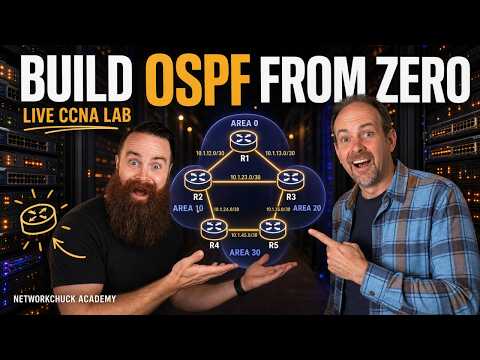
If you’ve ever wondered how data finds its way across the vast, tangled web of the internet, the answer often comes down to a single, elegant protocol: OSPF. In the latest installment of the Summer of CCNA series, NetworkChuck takes you on a 90-minute deep dive into Open Shortest Path First, breaking it down from absolute zero. This isn’t just another dry lecture—it’s a hands-on journey that builds a mini-internet in real time, and by the end, you’ll not only understand OSPF but also feel confident tackling it on the CCNA exam.
Why OSPF Matters: The Backbone of Modern Networking
Before we jump into the technical weeds, let’s talk about why OSPF deserves your attention. In a world dominated by massive networks—think cloud providers, enterprise campuses, and global ISPs—static routing simply doesn’t cut it. Networks change, links fail, and traffic patterns shift. OSPF, a link-state routing protocol, dynamically adapts by building a complete map of the network topology. Each router independently calculates the shortest path to every destination using Dijkstra’s algorithm, ensuring efficient and loop-free routing.
Building on this, OSPF is also an open standard, which means it works across devices from Cisco, Juniper, MikroTik, and beyond. That interoperability is a huge reason why it’s everywhere. For CCNA candidates, mastering OSPF is non-negotiable—it’s a core topic that appears in both the written exam and practical labs. But don’t worry, this Summer of CCNA session makes it approachable, even if you’re starting from scratch.
From Zero to Hero: What the Video Covers
In this 90-minute session, NetworkChuck doesn’t just explain OSPF—he builds it. The video kicks off with the basics: what OSPF is, how it compares to distance-vector protocols like RIP, and why link-state routing is superior in modern networks. From there, he dives into the nuts and bolts: areas, router IDs, neighbor adjacencies, and the all-important cost metric. Each concept is paired with live configuration on real Cisco equipment, so you see exactly how commands translate into network behavior.
One of the standout moments is when Chuck constructs a multi-area OSPF network that mirrors the internet’s structure—complete with backbone and transit areas. He walks through the configuration step-by-step, explaining why certain commands are used and what happens behind the scenes. As a result, you gain a mental model that sticks, not just a list of commands to memorize.
Key Takeaways: OSPF Concepts You Can’t Ignore
Let’s highlight some critical OSPF concepts that the video drives home:
– **Areas and the Backbone**: OSPF divides networks into areas to reduce routing overhead. Area 0 is the backbone, and all other areas must connect to it. The video explains this hierarchy with clear diagrams and real-world analogies.
– **Neighbor Relationships**: OSPF routers form adjacencies by exchanging Hello packets. The process—down, init, two-way, exstart, exchange, loading, full—is broken down in a way that’s easy to recall during exams.
– **Cost and Path Selection**: OSPF uses cost (calculated from bandwidth) to determine the best path. Chuck shows how to manipulate cost for traffic engineering, a skill that’s invaluable in production networks.
– **Troubleshooting**: No network is perfect. The session includes common OSPF issues—like mismatched areas or MTU mismatches—and how to diagnose them using show commands.
In addition, the video emphasizes practical lab practice. Chuck encourages you to follow along in Packet Tracer or GNS3, because OSPF is best learned by doing. The Summer of CCNA program is designed to give you that hands-on experience, with weekly sessions and a supportive community.
Why This Matters for Your CCNA Journey
The CCNA exam isn’t just about memorizing facts; it’s about understanding how networks operate. OSPF is a perfect vehicle for that understanding because it touches on so many core concepts: routing protocols, metrics, neighbor discovery, and hierarchical design. By mastering OSPF from zero, you’re not just checking a box—you’re building a foundation that will serve you in any networking role.
Moreover, the Summer of CCNA series is more than a set of videos. It’s a structured study plan that keeps you accountable. Each session builds on the last, and the community forums are filled with fellow learners and mentors ready to help. If you’re serious about passing the CCNA, this is a resource you don’t want to miss.
Ready to Build the Internet (Almost)?
OSPF might seem intimidating at first, but with the right guide, it becomes one of the most rewarding protocols to learn. This video breaks down complex ideas into digestible, hands-on lessons that you can immediately apply. Whether you’re a complete beginner or someone brushing up before the exam, you’ll walk away with a newfound confidence in OSPF.
So, grab your laptop, open up your favorite network simulator, and dive into this Summer of CCNA session. As NetworkChuck would say, let’s get to work—the internet (well, almost) is waiting for you.