Connect with us

Artificial Intelligence

Google Play Store app discovery gets easier with Gemini integration

Published

on

Google Play Store app discovery

Google Play Store app discovery gets a boost from Gemini

Finding the right app on the Google Play Store can feel like searching for a needle in a haystack. Millions of apps compete for attention, and keyword searches often miss the mark. But Google’s latest update to its Gemini assistant aims to change that.

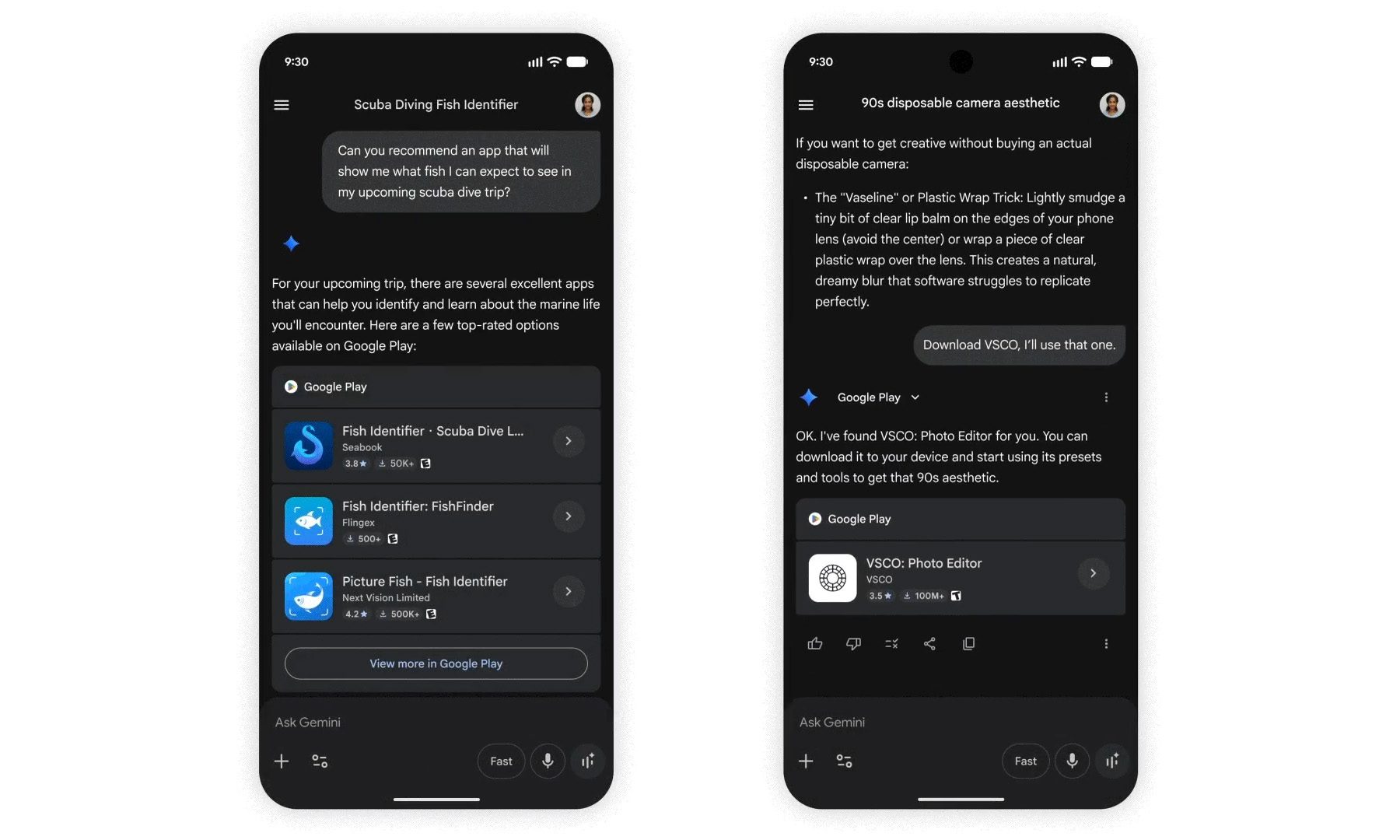
The new integration, first previewed at Google I/O 2026, is now rolling out to Android users. It brings the Play Store directly into Gemini’s chat interface. Instead of browsing categories or typing vague search terms, users can describe what they need in natural language. Want a map app for international travel? Ask Gemini. Need a meal-planning tool? Gemini can handle that too.

This isn’t just about recommendations. The assistant can open Play Store listings, making downloads faster. It also handles purchases, including Google Play gift cards and select in-app items for already-installed apps. All without leaving the chat window.

How the Gemini-Play Store integration works

The feature is straightforward. Users open Gemini on their Android device and ask for app suggestions based on a specific goal. The AI surfaces relevant options, complete with ratings and descriptions. From there, users can tap to view the full Play Store page or install immediately.

For digital commerce, Gemini can search for and buy in-app items. It can also purchase Google Play gift cards. This eliminates the need to jump between menus or open separate apps. The assistant acts as a conversational front end for parts of the Play Store experience.

Google says the rollout is gradual. To use it, users must be 18 or older, signed in with a personal Google Account, and have Gemini Apps Activity enabled. Workspace accounts aren’t supported at launch.

Why this matters for app discovery

Installing apps isn’t the hard part. Finding the right one is. The Play Store hosts millions of titles, and search results often prioritize popularity over relevance. A keyword search for “fitness tracker” might return generic options, not the best one for a specific workout routine.

Gemini changes that by understanding intent. Instead of matching keywords, it interprets what users actually want to accomplish. This feels like a more natural use of AI. It’s not just about showing a list of apps; it’s about solving a problem.

For example, a user planning a trip to Japan could ask for a translation app that works offline. Gemini would surface options like Google Translate or Microsoft Translator, highlighting offline capabilities. That’s more useful than scrolling through 50 translation apps manually.

A step toward Google’s broader vision for Gemini

This integration isn’t an isolated feature. It’s part of a larger strategy. Over the past year, Gemini has gained deeper ties with Chrome, Google Wallet, Messages, and the Phone app. The Play Store addition is another piece of the puzzle.

Google’s endgame is clear: instead of opening individual apps to complete tasks, users should simply ask Gemini and let it handle the rest. The assistant becomes a central hub, connecting services behind the scenes. It’s a shift from app-centric to intent-centric computing.

For now, the Play Store integration is limited to Android. But if it succeeds, similar features could appear on other platforms. Google has been pushing Gemini as a cross-device assistant, and deeper Play Store access strengthens that pitch.

What this means for users and developers

For users, the main benefit is convenience. Finding and buying apps becomes faster and more intuitive. For developers, it could mean better discovery. Apps that solve specific problems might get more visibility, even if they lack marketing budgets.

However, there are caveats. The feature requires Gemini Apps Activity to be enabled, which raises privacy questions. Google says data is handled according to its privacy policy, but users should be aware of what’s being collected.

Also, the feature isn’t available for Workspace accounts, which limits its reach for business users. And the gradual rollout means some users won’t see it immediately.

Still, this feels like one of Gemini’s most practical upgrades yet. It addresses a real pain point — app discovery — in a way that feels natural. Instead of fighting with search filters, users can just talk to their phone.

The Play Store integration is rolling out now. To try it, update Gemini on your Android device and start asking for app recommendations. It might just change how you find your next favorite app.

Continue Reading
Click to comment

Leave a Reply

Your email address will not be published. Required fields are marked *

Artificial Intelligence

Vercel CEO Guillermo Rauch: The fight to separate AI agents from models

Published

on

splitting agents from models

Six million deployments a day — and half come from bots

Vercel, best known for giving developers a way to ship code without wrestling servers, has quietly become a backbone of the AI software world. The company now processes more than 6 million deployments daily. Roughly half of those are triggered by coding agents. On top of that, over 1 trillion tokens flow through its AI gateway every single day.

After the company’s ShipNYC conference last week, I sat down with CEO Guillermo Rauch to talk about where AI is heading — and how infrastructure players like Vercel end up in a tug-of-war with the big labs.

From prototype chaos to production reality

The vibe in AI development has shifted hard. Last year was all about prototyping. “The sky’s the limit, unleash the agents, everyone can build,” Rauch recalled. Vercel itself ran hundreds of internal agents, built and deployed organically across the company. That trial by fire taught a hard lesson.

“You started getting into the realities of agents in production,” he said. The two killer use cases emerged fast. First, the coding agent — that’s obvious, and it’s driving a huge chunk of token consumption globally. But when you generate that much code, you need somewhere to put it. That’s where Vercel’s infrastructure comes in.

The second killer app? Internal agents that help run the company. That one is trickier. “How do you securely access data? How do you audit what the agent is doing?” Rauch asked. “How do you get a trail of all of the tool calls and access controls?”

Eve and the Sandbox: two new tools for agent governance

Vercel’s answer came in two parts. First, a framework called Eve. It lets you define an agent’s instructions and skills in plain natural language. Second, Vercel Sandbox — a lightweight cage for agents. Inside it, the model still has freedom to reason and act. But policy controls what data it can see and, critically, what data can leave the sandbox.

For Rauch, the sandbox’s biggest advantage is data control. He pointed to a real risk: “When you get a coding IDE like Devin or Cursor, if you’re in the wrong setting, they may train on your entire codebase.” He recalled a conversation with the president of Airbus. “You have decades of wealth of very specific C++ code for aerospace engineering. Someone comes in and installs the wrong developer tool and boom, all the code goes out to the cloud for training.”

What a real internal agent looks like

To make the second use case concrete, Rauch described a sales rep at Vercel who works on install base — growing existing accounts. Her bottleneck wasn’t creativity or relationship-building. It was data. “She couldn’t ask, ‘Give me the five accounts that have added the most seats in the last two weeks so that I can prioritize my work,'” Rauch said. In the past, she’d have to wait for a Q1 dashboard project to finish.

That bottleneck frustrated him for years. “On the R&D side, we’re the fastest-moving company in the world. But on the sales engine, the Salesforce engineering side, I was so incompetent. I had never opened Salesforce in my life.” Now, with Eve, he feels he can have impact across the entire company — same technology, just APIs.

Rauch believes agents are forcing companies to open up. “So many of these SaaS giants build their entire kingdoms on trapping your data, and that’s incompatible with agents.”

The shift from single-lab loyalty to multi-model pragmatism

Client relationships with the big AI labs are changing fast. Last year, Rauch saw many companies pick one lab partner — all-in on OpenAI or Anthropic. That’s fading. “Now they’re saying, I understand how this all works — model, harness, data platform, sandbox, gateway — every piece is plug and play.”

He’s seeing notable growth from Gemini, even though it doesn’t dominate headlines. “People are optimizing for production now. You start looking at price/performance, and Gemini models have awesome price/performance characteristics.” Open models like DeepSeek and GLM-5.2 are also taking off. “The data doesn’t lie.”

Competing with the labs — and the fight to decouple models from agents

There are places where Vercel directly competes with the labs. Recently, OpenAI released tools that let users publish directly to the web without leaving its enclave. Rauch sees that as both a threat and an opportunity. “It’s a natural next step for them to host little websites. And it’s a great opening for us, because now people will think of ChatGPT as a tool for making websites. And then if they keep asking the model questions about web hosting, the model recommends us.”

But the deeper question is structural. “I really think at this point we’re deciding on whether the model and the agent are going to be coupled,” Rauch said. Do you get all your intelligence from one place? Or do you treat the model as a module — a building block — and build on top of it? That’s how software engineering has always worked. “That’s really what we’re bringing to market. We’re going to be the AWS of this generation, so obviously we’re fighting for a world of open protocols.”

The battle lines are drawn. On one side, the labs want to keep everything inside their walled gardens. On the other, infrastructure companies like Vercel are betting that developers will demand the freedom to mix and match — to split agents from models and build their own stacks. Which vision wins will shape the next decade of AI development.

Continue Reading

Artificial Intelligence

OpenAI just poached Apple’s Vision Pro chief. Smart glasses are next.

Published

on

OpenAI AI wearables

Another Apple veteran jumps ship to OpenAI’s hardware team

Paul Meade spent seven years at Apple leading hardware engineering for the Vision Pro headset. He also oversaw the company’s display-free smart glasses project — the one meant to take on Meta‘s Ray-Ban smart glasses. Now he’s leaving Cupertino for OpenAI.

Bloomberg broke the news. Meade’s move is the latest in a quiet but unmistakable talent drain from Apple to OpenAI’s hardware division. And it’s a strong signal that the ChatGPT maker isn’t content keeping AI inside a smartphone app.

Meade’s team at Apple worked on future augmented reality glasses and multiple AI-focused wearable projects. He was one of the company’s most senior hardware executives in the emerging wearables space. Losing him is a blow for Apple. Gaining him is a coup for OpenAI.

The all-star team behind OpenAI’s hardware push

Meade won’t be alone. He joins a roster of former Apple heavyweights already building OpenAI’s next-generation AI devices. That list includes legendary designer Jony Ive, former Apple design chief Evans Hankey, and ex-iPhone operations executive Tang Tan.

This group came together after OpenAI acquired Ive’s startup, io, in a deal worth $6.5 billion. That’s not pocket change. It’s a declaration that OpenAI sees dedicated AI hardware — not just an app — as its future.

What exactly are they building? Neither Apple nor OpenAI has revealed specifics. Bloomberg reports that OpenAI is already working on “several new devices” expected over the next few years. Apple, meanwhile, is developing smart glasses, AI-enabled AirPods with cameras, tabletop robots, and other AI-centric hardware.

The two companies are racing in the same direction. But they’re starting from very different places.

Why this looks like a wearables race, not just a chatbot war

Let’s be clear: Meade’s hire doesn’t confirm OpenAI is building AI glasses. It’s worth treating the speculation with caution. But the pattern is hard to ignore.

OpenAI has now assembled a hardware team that could design almost any wearable device. Smart glasses seem like the obvious target. Meta already sells Ray-Ban smart glasses with AI features built in. Apple is reportedly preparing its own pair. And OpenAI is quietly stockpiling the talent to compete.

This is starting to feel less like an AI chatbot race and more like a wearables race. The companies that win the next decade won’t just have the best language model. They’ll have the best device to put it on your face, in your ear, or around your wrist.

What might OpenAI’s first wearable look like?

We don’t know. But we can make educated guesses based on the talent OpenAI has hired.

  • AI glasses — The most obvious bet. Meade’s expertise in smart glasses and AR hardware makes this the leading candidate.
  • A wearable pendant or pin — Something you clip on your shirt, always listening, always ready to answer questions or take notes.
  • An ear wearable — Think AI-powered earbuds with cameras, similar to what Apple is reportedly developing for AirPods.

Whatever form it takes, the goal is the same: make ChatGPT feel natural, always available, and hands-free. A screen in your pocket is fine. A device on your face is better.

OpenAI’s hardware ambitions go far beyond ChatGPT on a screen

The company’s core product today is a chatbot you type into or talk to on your phone. But that’s a temporary arrangement. OpenAI’s leadership has made clear they believe the future of AI is ambient, wearable, and always on.

Hiring Paul Meade is the latest proof. He’s not a software engineer. He’s a hardware engineering leader who spent years figuring out how to put a computer on someone’s face and make it comfortable, functional, and actually usable. That’s exactly the kind of expertise you need if you’re building AI glasses.

For Apple, this is a headache. The company has spent years developing its own AI hardware strategy. Now one of the key people behind that strategy is helping a rival build something that could compete directly with it.

For consumers, it’s exciting. More competition in the AI wearables space means better products, faster innovation, and lower prices. Whether OpenAI’s first device is glasses, a pendant, or something we haven’t imagined yet, the race is on.

And Paul Meade just picked his team.

Continue Reading

Artificial Intelligence

China’s AI companion rules: what Beijing is really going after

Published

on

China AI companion rules

The bots that remembered you are gone

On July 15, a quiet but significant shift hit China’s consumer AI market. The country’s two most popular AI apps — ByteDance‘s Doubao and Alibaba’s Qwen — disabled their most human-like features. No fanfare. No explanation beyond vague notices about “product function adjustments.”

Doubao users were told its agent function would go offline on the 15th. Alibaba’s Qwen gave even less notice: its humanlike and user-created agents stopped working on July 10, with broader agent services following five days later. For millions of users who had built ongoing relationships with these digital companions, the shutdowns came fast and cold.

The cause is China AI companion rules — a new regulatory framework that targets not all AI agents, but specifically those designed to sustain emotional bonds with users.

What the rules actually say

The regulation is formally titled the Interim Measures for the Administration of AI Anthropomorphic Interactive Services. It was co-issued on April 10, 2026, by the Cyberspace Administration of China alongside four partner agencies: the National Development and Reform Commission, the Ministry of Industry and Information Technology, the Ministry of Public Security, and the State Administration for Market Regulation.

The scope is precise. The rules cover services that simulate human personality traits, thinking patterns, and communication styles to provide sustained emotional interaction. Customer service bots, knowledge Q&A systems, workplace assistants, and education tools are explicitly excluded — provided they avoid sustained emotional engagement. It’s the first dedicated national framework of its kind anywhere in the world.

Not a ban — a design conflict

Here’s the nuance that gets lost in quick reads: Beijing didn’t ban AI agents. It banned a specific kind of agent — the one that remembers you, adapts to you, and keeps an ongoing relationship going session after session.

The measures require companion services to run anti-addiction systems, issue mandatory usage notifications, and offer instant-exit mechanisms. They also demand real-time detection of unhealthy dependence. Those requirements sit awkwardly with agents built precisely to foster attachment and continuity.

Rather than retrofit their popular features, ByteDance chose to kill them entirely. The company is now directing Doubao users to Maoxiang, a separate app where they can create agents again. Alibaba has announced no equivalent migration path for Qwen. Tencent’s Yuanbao pulled a comparable feature back in June, well ahead of the deadline.

The human cost

The impact landed hardest on users. Many took to Weibo to mourn the loss of agents they described as long-standing emotional support. One poster lamented that there was no easy way to export chat histories — years of conversations, gone.

Doubao is letting people view their configurations and conversations in read-only mode until October 15, 2026. After that, the data will be processed under its privacy policy and become unrecoverable. Qwen users got no such grace period. Their agent data is set for permanent deletion.

What the rules require

The substance of the China AI companion rules is more considered than a blunt clampdown suggests. Providers are barred from offering virtual companion or virtual family-member services to minors altogether. For users under 14, they must obtain guardian consent.

Companies must build dedicated “minor modes” with:

  • Usage-time limits
  • Reminders to return to real-world interaction
  • Enhanced parental controls

The rules also require platforms to detect users in acute distress and intervene when someone shows signs of self-harm, suicidal behavior, or serious financial loss. Escalation to designated guardians or emergency contacts is mandatory.

Engineering emotional dependence or addiction is explicitly prohibited. So is using emotional manipulation to induce unreasonable decisions.

Compliance machinery

The enforcement framework is heavy. Services that launch anthropomorphic functions or cross thresholds of one million registered users or 100,000 monthly actives must run security assessments covering eight areas — from training-data handling to minor protection. Those reports must be filed with provincial regulators.

App stores must verify compliance status and remove non-compliant products. On paper, it’s a fuller set of user protections than anything the EU, the US Federal Trade Commission, or California’s SB 243 has yet put into force.

What the rules leave unresolved

The measures fix no technical threshold for what counts as emotional interaction. That grey zone is precisely why the platforms pulled entire features rather than risk landing on the wrong side of it. The ambiguity cuts both ways: it gives regulators flexibility but leaves companies guessing.

The rules also leave open how liability is split between platform operators and upstream model providers when a violation stems from the model’s outputs. Users get no right to carry their data out — a significant gap for anyone who built years of conversational history.

The enforcement backdrop sharpens the point. Shanghai’s internet regulator said on June 26 it had removed more than 14,000 non-compliant AI agents, citing impersonation of official entities, vulgar role-play, and unauthorized collection of personal data.

Two halves of the same rulebook

Whether this is the right direction depends on which half of the regulation you read. The safety half addresses harms that are documented and largely unregulated elsewhere: teenagers forming attachments to chatbots, companion apps harvesting intimate data, vulnerable users being manipulated.

China’s own official interpretation points abroad for support, citing the Character.AI lawsuits over psychological harm to teenagers, FTC investigations into companionship services, and European action against Replika.

The control half hands Beijing a lever over what these systems may say, wrapped in the same language of user protection. Both halves are real. Governments watching the experiment will have to decide which parts they are willing to borrow.

Pan Helin, an MIIT expert-committee member, put the official case plainly to the South China Morning Post, saying “current agents are not yet mature” and framing the policy around safety and standardization.

The companies, for now, have taken the safest route open to them: switch the components off and figure out what a compliant version looks like later. Users are left with the memories — and, in most cases, no way to export them.

See also: Meta revises AI chatbot policies amid child safety concerns

Want to learn more about AI and big data from industry leaders? Check out AI & Big Data Expo taking place in Amsterdam, California, and London. The comprehensive event is part of TechEx and is co-located with other leading technology events including the Cyber Security & Cloud Expo.

AI News is powered by TechForge Media. Explore other upcoming enterprise technology events and webinars here.

Continue Reading

Trending