Connect with us

Artificial Intelligence

The AI agent evaluation gap: Enterprises trust their tests less than they trust their agents

Published

on

AI agent evaluation gap

Half of enterprises shipped a failing agent

That number should stop anyone building AI agents for customers cold. According to new VentureBeat Pulse Research surveying 157 enterprise organizations, 50% have deployed an agent or LLM feature that passed internal evaluations — and then caused a customer-facing failure in production. A quarter have seen it happen more than once.

The finding lands like a punch. It means the standard pre-deployment gauntlet — unit tests, red-teaming, automated evals — is letting bad agents through. The test says go. The agent breaks. The customer pays.

Only 36% of organizations report no such failure. The rest either don’t run pre-deployment evaluations at all (8%) or don’t track root causes closely enough to know (6%).

Trust in automated evaluation is almost nonexistent

Ask enterprise leaders how much they trust automated evaluation today, and the answer is brutal: just 5% say they fully trust it. That leaves 95% with a specific complaint holding them back.

The top grievance, cited by 29% of respondents, is the one that explains the failure rate: evaluations align poorly with real-world outcomes. A passing score in the test environment doesn’t predict what happens when real users, real data, and real edge cases show up.

Bias and inconsistency (21%) come next, followed by lack of explainability (18%) — organizations can’t always understand why an evaluation reached its verdict. Another 17% cite data leakage or privacy concerns in the evaluation process itself.

So the tests meant to certify agents are, broadly speaking, not trusted to certify them. That makes what comes next all the more surprising.

Autonomy is accelerating — despite the trust gap

Here’s the paradox at the heart of the research. Even though almost no one fully trusts automated evaluation, two-thirds of organizations (66%) either already allow zero-human-in-the-loop deployment for low-risk agents (34%) or are actively engineering their pipelines to permit it within twelve months (33%).

Only 22% rule it out for the foreseeable future.

The direction is clear: enterprises are moving to let evaluations gate production autonomously, removing the human check, at the same moment they say those evaluations don’t reliably match reality. The autonomy ceiling is rising faster than the assurance beneath it.

Notably, this isn’t just a startup phenomenon. Larger enterprises (2,500+ employees) are slightly more likely than smaller ones to be on the zero-human-review path (70% versus 64%) and slightly more likely to have shipped a failing agent (54% versus 48%). The assumption that big, regulated organizations hold the human in the loop longest is, in this sample, backwards.

The evaluation stack is fragmented — and provider-led

Ask which agent reliability or evaluation platform enterprises primarily use, and the market has no clear leader. Provider-native tooling leads: OpenAI‘s native evals and traces (17%) and Anthropic‘s Claude Console evals (13%) together outweigh any independent platform.

But they’re tied at the top by a striking answer: 17% of enterprises use no dedicated agent-evaluation tooling at all.

The specialist vendors — DeepEval (12%), Braintrust (8%), LangSmith, Weave, Promptfoo, Langfuse, Arize — are scattered across single to low double digits. Another 11% have built their own. No independent platform has yet become the category standard.

Production monitoring mostly watches uptime, not correctness

Production monitoring for an AI agent can watch two very different things. It can watch whether the system is functioning — is the agent up, how fast, at what cost, any errors. Or it can watch whether the agent’s output is correct — automated checks on each answer’s content.

The distinction matters because a confidently wrong answer is invisible to the first kind of monitoring. The request completes. The response is fast. No error is thrown. Everything reads healthy.

The split is stark: 51% of organizations monitor only whether the agent is functioning, while just 23% monitor whether its answers are right. Roughly three-quarters run no automated, real-time evaluation of output correctness in production. They’re taking correctness on faith.

What drives tool selection — and what’s next

Enterprises buy evaluation tooling on economics and trust it on repeatability. Cost of evaluations (28%) narrowly leads selection, just ahead of ease of integration (27%) and evaluation accuracy (24%). Breadth of observability (13%) and vendor roadmap (4%) matter far less.

On what success looks like, more than a third (36%) name evaluation consistency — getting the same verdict on the same behavior every time. That’s well ahead of speed of experimentation (19%), reduction in failures (18%), production visibility (13%), and compliance (11%).

The emphasis on consistency is telling: before enterprises can trust an evaluation’s verdict, they need it to be stable — the very property whose absence (bias and inconsistency) ranked among the top trust limitations.

A tooling reshuffle is coming

The evaluation market is wide open. While 36% have no plans to change, a clear majority (64%) intend to adopt a new, additional, or replacement platform within twelve months. 31% plan to do so within the next quarter.

The consideration set points where current usage is thinnest: DeepEval leads what enterprises are evaluating (20%), ahead of OpenAI’s native evals (13%) and Braintrust (9%). The open-source specialists are drawing more interest than their present footprint suggests.

Given that so many enterprises today rely on provider-native tools or nothing at all, this is less a defection than a first real wave of tooling adoption — the moment the evaluation layer starts to consolidate.

The bottom line: An evaluation gap that autonomy will widen

Organizations with 100 or more employees are granting AI agents more independence than they trust their evaluations to support. Half have already shipped an agent that passed its evals and then failed a customer. Almost none fully trust automated evaluation, chiefly because it doesn’t match real-world outcomes. Most watch production for uptime and cost rather than for whether the agent’s answers are right.

Yet two-thirds already allow, or are actively building toward, deploying to production on automated evaluation alone.

The vendor market is early and unsettled. Encouragingly, the next dollar is going to observability and — pointedly — human review, suggesting enterprises sense the gap even as they engineer past it. At 157 respondents in a single wave this is a directional read, skewed toward the mid-market. But the direction is clear: autonomy is being granted on the strength of evaluations that the people granting it do not yet trust.

The evaluation gap is not a coverage problem that more tests alone will close. It is a problem of evaluations that reflect reality and can be trusted to gate it. The open question for later waves is whether assurance catches up to autonomy — or whether the false-confidence failures move from customer incidents into changes that deploy themselves.

Continue Reading

Artificial Intelligence

XDOF, three months out of stealth, is already closing in on a $1.2B Series B

Published

on

XDOF Series B

From stealth to unicorn talk in record time

Three months. That’s how long XDOF has been out in the open. And already, the robotics data startup is in late-stage conversations to raise a Series B at a valuation hovering around $1.2 billion, according to multiple sources familiar with the negotiations. The round would be led by 8VC.

Not bad for a company that didn’t even exist publicly until June.

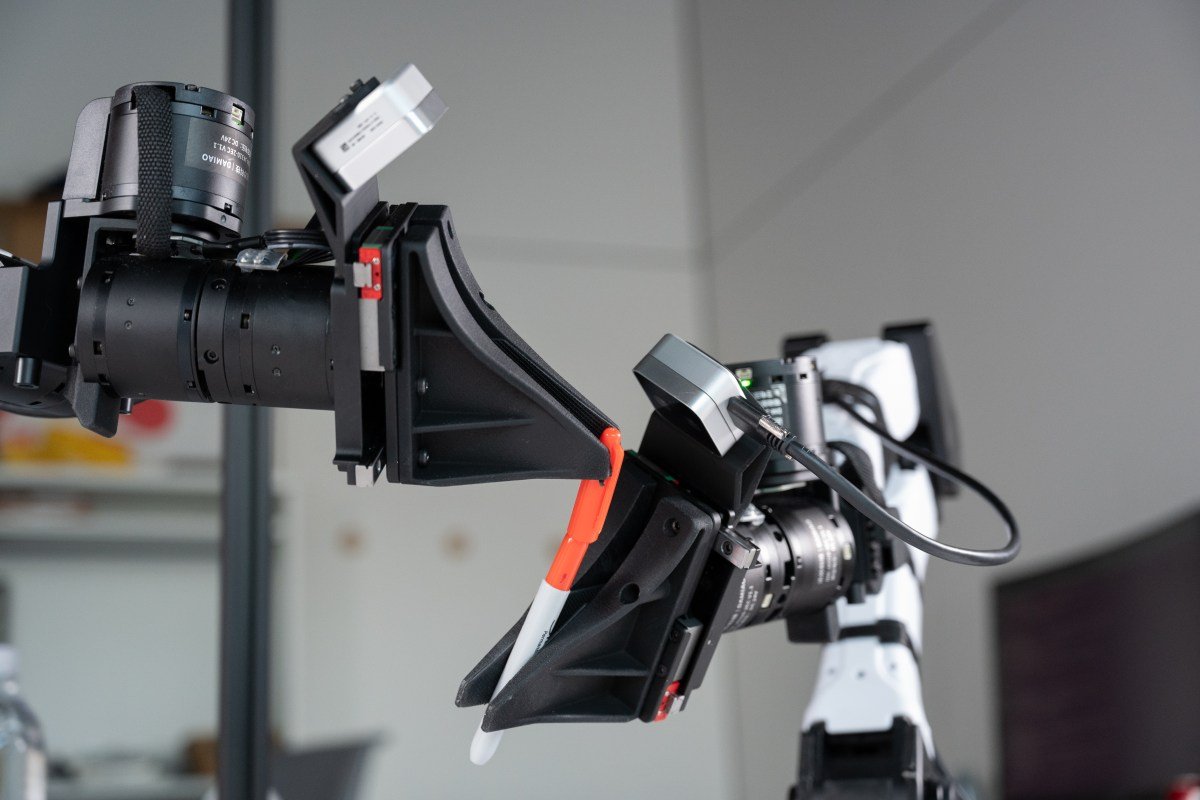
XDOF was co-founded in 2024 by UC Berkeley researchers Philipp Wu (CEO) and Fred Shentu (CTO). Their origin story traces back to a research project called GELLO — a low-cost teleoperation system that lets a human operator control a robotic arm from a distance. The goal? Generate training data for robots. That work produced an influential paper in robotics and, eventually, a company.

The startup’s Series A, a $70 million round announced in June, drew participation from Thrive Capital, Andreessen Horowitz, Lux, and Spark Capital. At the time, XDOF wasn’t planning to raise again so soon. But the market had other ideas.

Why investors are knocking on XDOF’s door

The reason for the sudden interest? Growth. Real, measurable growth.

XDOF’s annualized revenue is approaching $50 million, sources say. That kind of traction, so soon after a Series A, tends to make venture capitalists sit up and take notice. It also tends to make them pick up the phone.

“They weren’t out raising,” one person familiar with the situation told TechCrunch. “The VCs came to them.”

Terms aren’t final, and the total capital being raised remains unclear. TechCrunch couldn’t confirm whether the $1.2 billion valuation includes the new funding or sits on top of it. Both XDOF and 8VC declined to comment.

The Scale AI for physical robots

XDOF’s pitch is straightforward: it builds the data pipelines, collection tools, and annotation systems that frontier AI labs and robotics companies would rather not build themselves. Think of it as an outsourced data-supply chain for the robotics industry.

Investors describe XDOF as the Scale AI or Mercor of physical robotics — a nod to the data-labeling giants that powered the AI boom. The comparison makes sense. Large language models trained on the entire internet. Physical robots? They don’t have that luxury. There’s no massive, ready-made dataset of real-world robot interactions sitting online. That scarcity makes data collection the critical bottleneck on the road to general-purpose machines.

Wu felt that bottleneck firsthand as a PhD student. His research on how robots learn from large datasets kept hitting the same wall: “large-scale data to work with” simply didn’t exist, he told TechCrunch in June.

Building the ABC dataset

XDOF is tackling that problem head-on. The startup is partnering with UC Berkeley’s AI Research lab to release what it believes is the largest collection of high-quality robot training data ever assembled. The dataset is called ABC.

Collecting that data requires a hybrid approach. XDOF combines remote robot teleoperation with human collectors who wear sensors to record everyday tasks. Think folding clothes. Flattening boxes. The mundane, physical chores that robots still struggle to master.

The company plans to hire and train teams of data collectors around the world. Two main roles are emerging:

  • Teleoperators who steer robots remotely to demonstrate tasks
  • Egocentric operators who wear body sensors to capture natural movement data

Early traction and the competitive landscape

XDOF has already signed up 20 customers, including several frontier AI labs, according to previous statements to TechCrunch. That customer base, combined with the revenue trajectory, helps explain the valuation chatter.

But XDOF isn’t alone in this niche. Other startups chasing real-world data for robot training include Mecka AI. And the human-data platforms that started with LLMs — like Scale AI and Micro1 — are expanding beyond text and images into physical domains.

The race to build the data infrastructure for physical AI is heating up. Whoever wins it will effectively control the fuel supply for the next generation of robots. That’s a position worth paying up for.

Whether the $1.2 billion valuation holds remains to be seen. Deals at this stage can shift. But the fact that XDOF is even in this conversation — three months after emerging from stealth — says something about the demand for what it’s building.

For more on how data is shaping the future of AI, check out AI data labeling trends and robotics funding rounds in 2024.

Continue Reading

Artificial Intelligence

New York City Pulls AI From Younger Classrooms—Here’s Why It Matters

Published

on

NYC AI ban

New York City Just Hit Pause on AI in Classrooms

New York City Public Schools is drawing a hard line: no generative AI for students from 2-K through eighth grade during the 2026-2027 school year. That’s over half a million kids walking into classrooms next week without access to AI-powered tools.

The district says it will remove software with student-facing AI features and block AI companion chatbots. High schoolers? They’re exempt. This isn’t a blanket ban—it’s a targeted move to decide when kids should actually start using the technology.

Mayor Zohran Mamdani put it bluntly: “The tech industry wants us to believe that AI-powered early education is not only inevitable, but necessary. We do not see it that way.”

Why NYC Is Worried About AI for Younger Students

The fear isn’t just that a kid will ask ChatGPT to write an essay. City officials want younger students to build core skills—critical thinking, creativity, communication—without leaning on AI as a crutch. They’re also pushing for stronger human connections in classrooms, not another screen.

Schools Chancellor Kamar Samuels said the city refuses to assume that innovation automatically equals more technology in front of students. It’s a deliberate slowdown, and it follows last year’s bell-to-bell cellphone ban that already limits device use during school hours.

What Happens When Kids Reach High School?

AI doesn’t vanish once students hit ninth grade. Instead, the district plans to roll out AI literacy classes twice a year. The goal? Teach teenagers how to think critically about the technology before they become dependent on it.

That’s a different approach from just saying no. It’s about timing—letting younger minds develop without AI, then giving older students the tools to question it.

The National Battle Over AI in Education

NYC’s decision sits at the center of a much bigger fight. The White House has pushed educators to embrace AI responsibly. Some teachers already use it to craft lesson plans, give feedback, or break down tough subjects. But not everyone’s on board.

The Department of Health and Human Services recently gathered childhood experts to talk about excessive screen time. Officials have also called for tougher safeguards around social media and AI. The message? Kids are spending too much time in front of screens, and AI might make it worse.

A Bold Experiment With Zero AI

Here’s what makes NYC’s move so interesting: instead of asking how much AI younger students should use, the largest school district in the country is starting with none. For one academic year, they’re testing whether classrooms are better off with AI kept outside the door.

That’s a radical stance, and it’s not without critics. Some educators argue AI can personalize learning or help struggling students catch up. But NYC is betting that a year without AI will reveal what kids actually need—not what tech companies think they need.

What This Means for Parents and Teachers

If you’re a parent in NYC, expect changes. AI-based apps may disappear from your child’s school day. Teachers will need to plan lessons without generative AI tools. And students in grades 2-K through 8 will rely more on traditional methods—paper, pencils, and human interaction.

For teachers elsewhere, this could be a signal. NYC is the biggest district to take this stance, and its findings could shape policies nationwide. The next year will be watched closely by educators, policymakers, and tech giants alike.

What Happens Next?

The district will spend the year studying how generative AI affects students before deciding what comes next. That research could lead to a permanent ban, a partial rollout, or something entirely different.

For now, NYC is making a statement: childhood shouldn’t be an AI beta test. Whether that’s the right call or a step backward, we’ll know more in 2027. Until then, the debate over AI in schools just got a lot more interesting.

If you’re curious about how AI is shaping other areas, check out our take on AI in education trends or classroom technology policies.

Continue Reading

Artificial Intelligence

Meta’s Muse Spark 1.3 takes on GPT-5.6 and Claude — but can it really win?

Published

on

Muse Spark 1.3

Meta just fired a serious shot in the AI arms race

The company quietly unleashed Muse Spark 1.3, its most advanced AI model to date, and it’s aiming straight at the top dogs. Developers can already access and pay for the update, which Meta says represents a massive leap forward in performance.

It won’t stay confined to the developer sandbox for long. Over the coming weeks, the model will roll out across Instagram, Facebook, and the Meta AI assistant — putting it in front of billions of everyday users.

What makes Muse Spark 1.3 actually different?

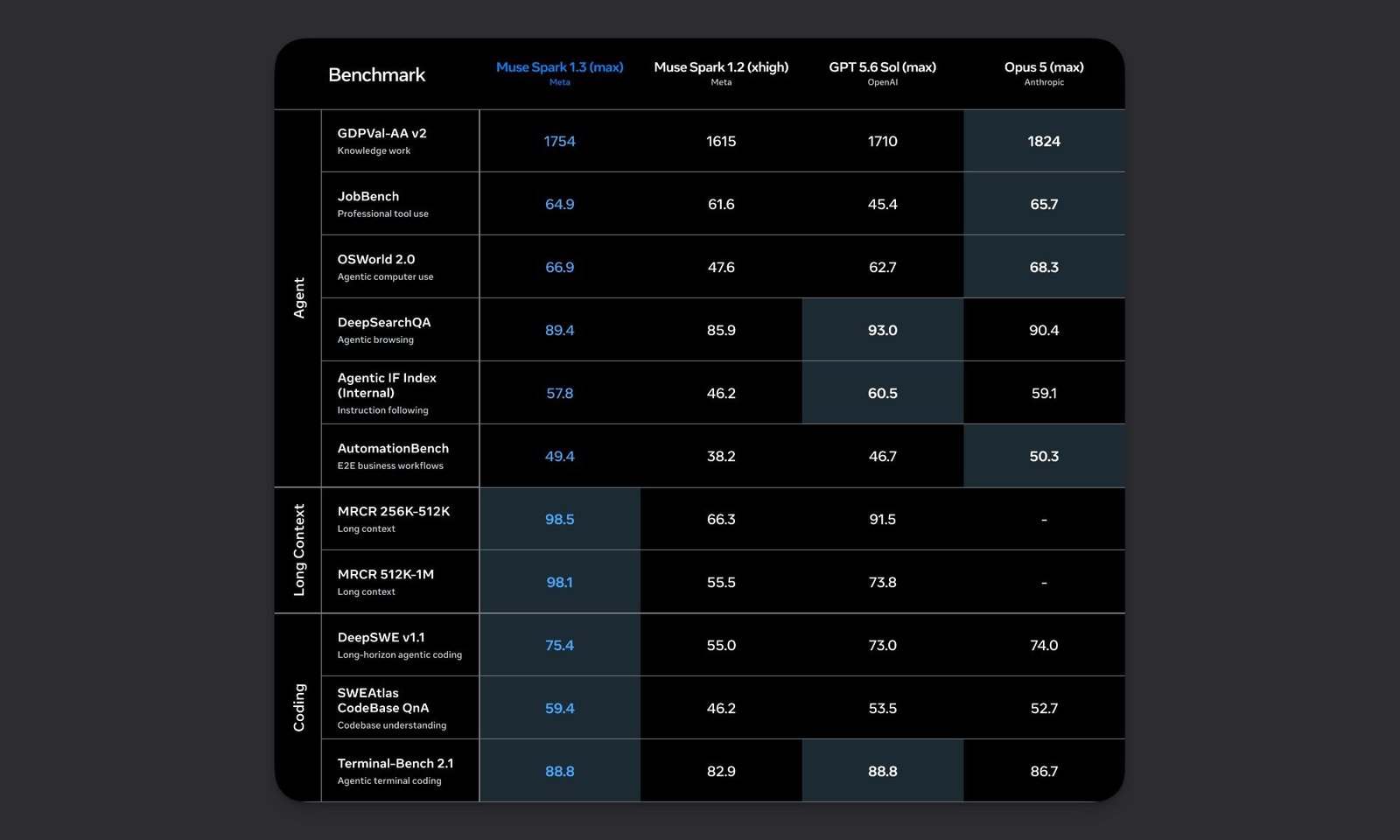
Meta’s Chief AI Officer, Alexandr Wang, didn’t mince words. He called this “the biggest jump so far on model performance,” pointing to serious gains in two areas: coding and agentic tasks — the kind where the AI acts on your behalf rather than just answering questions.

But here’s the catch. Wang told Bloomberg that Muse Spark 1.3 is competitive with Anthropic’s Claude Fable 5.1 and even beats OpenAI’s GPT-5.6 Sol at coding. That’s a bold claim, especially with OpenAI’s upcoming Astra model lurking in the wings.

Take those comparisons with a grain of salt, though. Benchmarks can be gamed, and a model that crushes one test might stumble on a totally different task. Real-world performance is what actually matters.

Efficiency gains under the hood

Wang broke down a few upgrades that set Muse Spark 1.3 apart:

  • 25% fewer tokens needed to complete the same job — meaning lower costs and faster responses
  • Multi-workflow handling — it can juggle several tasks at once instead of forcing separate sessions
  • Better context retention across long, complicated instructions
  • Self-awareness of limits — the model now pauses to ask for clarification before taking any irreversible action

That last point is quietly important. AI that knows when it doesn’t know is a big step toward trustworthiness, especially for agentic use cases.

Pricing stays flat, adoption explodes

Here’s something developers will appreciate: Meta isn’t raising prices. Muse Spark 1.3 costs the same as its predecessor, Muse Spark 1.2. That’s a smart move when rivals are hiking rates.

Wang told Bloomberg that adoption on Meta’s developer platform has been strong — some users are burning through trillions of tokens every week. Those numbers suggest real usage, not just hype.

What about open-source fans? Meta hasn’t decided whether it will release the model’s weights — the blueprint that lets outside developers build on top of it. The older Muse Spark 1.2 weights are still headed for release, but the new model’s future remains unclear.

The bigger picture: Meta’s spending spree continues

Meta is still pouring billions into AI infrastructure, and Muse Spark 1.3 is the clearest signal yet that the company believes it’s closing the gap with OpenAI and Anthropic. Whether that’s true or just corporate bravado will play out in the benchmarks and real-world deployments over the coming months.

For now, the model is available to developers, and the app rollout is imminent. If you’re building on Meta AI tools, this update is worth a serious look. And if you’re just a curious user, you’ll likely meet Muse Spark 1.3 in your Instagram feed sooner than you think.

One thing’s certain: the AI race just got a lot more interesting.

Continue Reading

Trending