Connect with us

Artificial Intelligence

Claude’s New Reflect Dashboard Is Quietly Making the Case for AI

Published

on

Claude Reflect

Claude Reflect Is Here, and It Knows Everything You’ve Asked

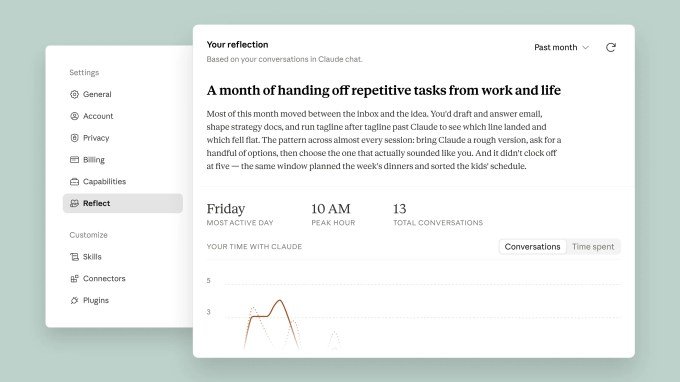
On Thursday, Anthropic flipped the switch on “Reflect,” a built-in dashboard that shows you exactly how you use Claude. Topics you’ve discussed. Patterns in your queries. The kinds of tasks you keep outsourcing to AI. It’s all there, laid out in charts and numbers.

On the surface, this looks like a simple analytics tool. Dig a little deeper, and you’ll see it’s something else entirely: a quiet, data-driven argument for why you should keep using Claude.

What Reflect Actually Does

Reflect is available in beta for Free, Pro, and Max users who have memory turned on. It tracks your usage across Claude, then presents it back to you in a clean, visual format. You can see what topics you’ve explored, how often you turn to AI, and what kind of work you’re delegating to the chatbot.

Later, Anthropic says Reflect will expand to include a view of how much time you’ve spent using Claude. That’s a metric that could go either way—motivating or mildly horrifying, depending on your screen time.

The Questions It Asks You

Reflect doesn’t just show you data. It occasionally pops up with questions designed to make you think. One example from Anthropic’s announcement: “What’s one thing you want to keep doing yourself, even if Claude could do it faster?”

That’s a thoughtful prompt. It’s also a clever way to position Claude as a tool you should use more—while simultaneously acknowledging the guilt you might feel about relying on AI for everything.

Why This Is a Sly Move by Anthropic

There’s a psychological trick at play here. When you see all the work Claude has helped you complete, laid out in one place, it’s hard not to feel like the tool has become essential. You start to see Claude not as a novelty, but as a core part of your workflow.

Anthropic also nudges you toward better AI habits. Reflect might suggest using Claude’s Projects feature instead of re-explaining context for every task. That’s genuinely useful advice. It also happens to integrate Claude more deeply into your daily routine, making it harder to switch to a competitor like OpenAI or Google.

This isn’t a new playbook. Back in 2012, Google pushed a tool called Gmail Meter, which crunched your inbox data and showed you traffic patterns and pie charts. It was fun for data nerds, but it also demonstrated, in vivid numbers, how central Gmail had become to your digital life.

Claude Reflect does the same thing—then takes it a step further by training you to use AI more effectively.

About Those Privacy Concerns

You might be wondering what happens to your sensitive conversations. Anthropic says Reflect only shows insights at a high level. Any conversation connected to a health integration tool is excluded entirely. The company also says none of the data in your insights is used for other purposes.

That’s reassuring, though it’s worth remembering that Anthropic’s business model depends on you trusting it with your data. The more you use Claude, the more value you get from Reflect—and the more data Anthropic has to improve its models.

Is This a Good Thing for Users?

Reflect is genuinely useful for people who want to understand their AI habits. If you’ve ever wondered whether you’re spending too much time chatting with chatbots, this dashboard gives you the answer. It also offers tools to set quiet hours or schedule nudges to take a break from AI.

That’s a nod to the addictive nature of these tools. Chatbots never get tired, never judge you, and always respond—which makes them dangerously easy to overuse. Reflect acknowledges that reality while simultaneously encouraging you to see Claude as an indispensable assistant.

The Verdict

Anthropic has built a feature that’s both self-reflective and self-promotional. It’s a smart product that helps you use AI more mindfully, and it’s also a retention tool disguised as a wellness feature.

Whether that’s a good thing depends on how you feel about AI companies shaping your habits. Either way, Reflect is worth trying if you’re a Claude user. Just be prepared to face the truth about how much you’re actually using it.

For more on AI tools and their impact, check out our articles on AI productivity apps and chatbot privacy concerns.

Continue Reading
Click to comment

Leave a Reply

Your email address will not be published. Required fields are marked *

Artificial Intelligence

X is teaching its AI something social networks used to know by heart

Published

on

X algorithm change

The short version: X wants your friends back in your feed

X has quietly started pushing a fix for one of the most complained-about feelings on social media: the sense that everyone in your replies is a stranger. The platform is now boosting posts from mutuals — accounts that follow you back — so they show up more often in feeds and conversations.

Nikita Bier, X’s product head, announced the change on the platform itself. He said the algorithm was missing relationship data, which made familiar accounts fade into the background whenever reply sections filled up with randoms.

It’s a small tweak, Bier said. But it could shift how the whole network feels.

What exactly is X changing?

In a post on July 13, 2026, Bier explained: “We’re rolling out a small tweak to boost visibility of your posts to your mutuals (people who you follow back). We noticed this data was missing from the algo and it made your friends appear less in your replies.”

The result, he said, was that reply sections felt more like a battleground than a conversation. With this adjustment, posts should reach mutual followers more reliably. And when those people jump into a thread, their replies should be easier for the original poster to spot among the noise.

Bier thinks this could help groups form around shared interests. That’s basically how social networks worked a decade ago — you followed people, and you saw them. But modern feeds are built on predicted behavior, not deliberate choices. An angry response from a stranger still counts as activity, even when it makes the whole experience feel hostile.

Giving existing connections more weight could redirect some of that attention. Whether you’ll notice the difference depends on how much influence this signal actually gets inside the ranking system.

Why did the AI need help finding friends?

Here’s the strange part. X’s published algorithm code already includes tools for understanding mutual relationships. A May 2026 release added mutual-follow graphs to user context, along with scores attached to posts being considered for recommendation.

So the data was there. The announcement implies it wasn’t reaching the ranking process that mattered, or it wasn’t affecting results the way it should. X hasn’t explained where the disconnect happened — whether it was an omission, a weighting problem, or something else entirely.

That gap matters because X’s recommendation engine leans heavily on Grok-based engagement predictions. The model estimates whether a post will earn replies or clicks. Those predictions can surface content that keeps people active, but activity doesn’t tell you whether a conversation is welcome. An algorithm can learn that arguments generate reactions without ever understanding why everyone involved is miserable.

The engagement trap

This is the core tension. Social platforms optimized for engagement will always find that outrage performs well. It’s not that the algorithm hates you — it’s that it doesn’t know the difference between a heated debate and a toxic dumpster fire.

By weighting mutuals more heavily, X is trying to reintroduce a signal that used to be foundational: the social graph. It’s a small acknowledgment that raw engagement numbers aren’t the same as meaningful interaction.

Will X actually feel friendlier?

Too early to say. X hasn’t disclosed how strong the boost is, whether it extends beyond replies and feeds, or how success will be measured. The company has described the desired outcome without demonstrating it.

Recognizable names in your replies could make conversations feel less random. But a ranking adjustment won’t remove outrage bait or hostile users. It just tilts the odds slightly in favor of people you already know.

Teaching an algorithm who your friends are is relatively easy. Teaching it that every argument isn’t valuable engagement — that’s the hard part, and no single tweak fixes that.

For now, the change is worth watching. If it works, other platforms might follow. If it doesn’t, X will quietly move on to the next experiment. Either way, the fact that a major social network is admitting its algorithm lost track of friendship is a telling moment.

Continue Reading

Artificial Intelligence

Samsung Health’s New AI Toggle: Say No, and Your Data Disappears

Published

on

Samsung Health AI data

A Toggle That Feels More Like a Threat

If you opened Samsung Health this week to log your morning run or check last night’s sleep score, you likely met a new pop-up. It asks for permission to use your personal health data for AI training and modeling. Nothing unusual there, right? Companies ask for consent all the time.

Here’s the twist. Decline the prompt, and Samsung warns it will stop syncing your health data to your Samsung account and permanently delete everything stored there. That’s not a choice. That’s a gun to the head of your fitness history.

The news broke via a report from Cybernews and quickly spread across social media. Users on X (formerly Twitter) shared screenshots of the warning, and the backlash was immediate.

What Exactly Does Samsung Want?

This isn’t just step counts and calories burned. The consent toggle covers a broad sweep of sensitive information:

  • Body measurements and nutrition logs
  • Sleep patterns and medication records, including prescriptions and dosages
  • Full health records, like diagnoses and test results
  • Menstrual cycle tracking data

If you pair the app with a Galaxy Watch or Galaxy Ring, the list gets even more intimate. Add biological aging indicators, body fat percentage, heart rate variability, skin temperature, and blood oxygen levels. That’s a detailed portrait of your body, handed over for machine learning.

Samsung says the data will be used to train and improve its AI models, and it may include human review. But the company hasn’t clarified whether the data is anonymized before training, who conducts the reviews, or how often they occur.

The Scale of the Problem

This isn’t a niche feature affecting a handful of early adopters. Samsung Health has over 1 billion downloads on the Google Play Store and roughly 65 million monthly active users worldwide. The policy also applies to iPhone users, since the app is available on iOS.

That’s tens of millions of people facing an ultimatum: hand over your most personal data, or lose access to years of health tracking.

What Users Are Saying

The backlash was swift and loud. One user on X wrote, “So now tech companies are threatening to make apps that you use in your daily life that you become reliant on fuel for their AI training and if you don’t comply then they just won’t work.”

Another critic pointed out the obvious: threatening to wipe your data if you don’t consent isn’t really consent. It’s coercion dressed up in a privacy settings menu.

What Happens If You Opt Out?

If you decline the toggle or later withdraw consent, Samsung Health will display a warning. Syncing to your Samsung account will be disabled, and all synced health data will be permanently deleted. The app itself may still function on your device, but the cloud backup and cross-device syncing are gone.

For users who rely on the app to track medications or monitor chronic conditions, that’s not just an inconvenience. It’s a potential health risk.

Is There a Way Around It?

Samsung says you can withdraw consent at any time through the app settings. But given the consequence — total data loss — that option feels less like a safety valve and more like a trap.

Some users are considering alternatives. If you’re worried about your data, you might export your health records before making any decision. Samsung does offer data download options, though the process isn’t always straightforward.

For those looking to switch, there are other health tracking apps that don’t tie your data to AI training. But migrating years of sleep, exercise, and medication history is a hassle. That’s exactly why Samsung can make this demand.

The Bigger Picture

This move fits a troubling pattern. Tech companies increasingly treat user data as fuel for AI development, and they’re willing to break core functionality to get it. Samsung Health isn’t the first app to do this, and it won’t be the last.

The question is whether regulators will step in. In the EU, GDPR rules require genuine consent, and threatening deletion could be seen as a violation. In the US, there’s no such federal protection for health app data outside of HIPAA-covered entities.

For now, the ball is in your court. Read the fine print, weigh your options, and decide whether your sleep data is worth the price of admission.

Continue Reading

Artificial Intelligence

OpenAI maps its safety stack to the EU AI Act’s GPAI Code — but gaps remain

Published

on

EU AI Act GPAI Code

OpenAI’s compliance playbook for the EU AI Act

OpenAI has published a detailed breakdown of how its safety, security, and transparency work maps onto the European Union’s General-Purpose AI (GPAI) Code of Practice — the rulebook that will govern how foundation models are built and deployed across the bloc. The timing is deliberate. Enforcement of the EU AI Act is creeping closer, and the company wants to show it’s not starting from zero.

The GPAI Code, alongside a separate Code of Practice on Transparency of AI-Generated Content, emerged from multi-stakeholder processes led by the European Commission. Both are meant to translate the AI Act’s broad obligations into concrete, actionable standards. OpenAI says it contributed to and endorsed both documents.

For companies building on OpenAI’s models in Europe, this is more than a regulatory update. It’s a signal about what due diligence will look like in practice.

What OpenAI already does — and what it’s adding

OpenAI’s argument is simple: much of what the GPAI Code demands, it already does. The company points to a stack of existing practices as evidence it operates near the bar set by the Code.

  • Pre-release testing of models before they reach the public.
  • Published system cards accompanying major launches, detailing capabilities and limitations.
  • External red-teaming through its Red Teaming Network, which brings in outside experts to probe for vulnerabilities.
  • A public Model Spec document that explains how the company shapes model behavior.

Underneath that work sit two internal governance frameworks. The Preparedness Framework, in place since 2023 and updated in 2025, sets out how OpenAI identifies, evaluates, and manages serious risks from advanced systems. A separate Frontier Governance Framework builds on it, explicitly mapping the company’s safety and security practices onto legal requirements — including the GPAI Code itself.

Together, these two documents govern risk assessment, safeguards, model reporting, security posture, incident response, and how external experts get pulled into the process. That’s a lot of paperwork, but it’s the kind of documentation regulators will expect to see.

The transparency problem: provenance gets harder

The Transparency Code tackles a different problem: helping people tell when content was made or altered by AI. OpenAI’s approach rests on two mechanisms that are meant to reinforce each other.

Content Credentials, built on the C2PA standard, attach context directly to a file — think of it as a digital signature that travels with the content. SynthID watermarking provides a fallback signal for cases where that metadata gets stripped out somewhere along the way. Coverage is expanding from images into audio outputs, and OpenAI says it’s working toward extending provenance measures across further modalities, including text, as the underlying standards mature.

None of this solves provenance outright. Metadata gets lost. Labels don’t always survive a transfer between platforms. No single signal — whether cryptographic or watermark-based — catches everything on its own. OpenAI’s response is a layered approach paired with continued work across the wider standards community, rather than a claim that any one mechanism closes the gap.

Cybersecurity as the test case for adaptive governance

Here’s the tension at the heart of AI regulation: capabilities that help defenders spot and patch vulnerabilities are the same capabilities that could help an attacker find them first. OpenAI believes the answer is its Trusted Access for Cyber programme, designed to give vetted defenders access to more advanced cyber capabilities while limiting exposure for misuse.

That programme now has a European deployment arm. OpenAI says it launched its EU Cyber Action Plan in early May 2026, working with EU and national cyber agencies, private sector partners, and infrastructure operators. The stated aim is to strengthen cyber resilience across the continent. Whether “most advanced” translates into measurable defensive gains inside these agencies is a claim from OpenAI itself; the source material offers no independent verification of outcomes.

The company positions this work as consistent with the European Commission’s Action Plan on Cybersecurity and Artificial Intelligence, which calls for coordinated handling of AI’s risks alongside its use in strengthening defensive capability — including secure access arrangements for cybersecurity purposes specifically.

What this means for developers and enterprises

The GPAI Code and the Transparency Code are still relatively new instruments, and OpenAI’s compliance documentation is a moving target rather than a finished product. Teams building on OpenAI’s models in regulated European markets should treat the current system cards and Frontier Governance Framework as a starting point for their own due diligence, not a substitute for it.

OpenAI says it will keep adjusting its compliance approach as EU AI Act implementation continues, and that it expects to keep learning from regulators and the wider community involved in shaping the rules. The company argues that rules need enough flexibility to adapt as the technology moves, so that businesses and organisations can keep benefiting from it.

For a deeper look at how these rules are shaping up, check out our coverage of AI regulation in Europe and the broader AI safety landscape.

Continue Reading

Trending