Connect with us

Artificial Intelligence

Google’s Gemini can now remember where you left your passport — no tracker tag needed

Published

on

Gemini location memory

Google’s new trick: Gemini remembers where you put things

Losing your passport is a special kind of panic. You tear through drawers, check the same coat pocket twice, and eventually swear you’ll never misplace it again. Google thinks its assistant can help with that — provided you’re willing to tell it where you stash your stuff.

The company announced a new Gemini location memory feature as part of the September Android Drop. It’s rolling out alongside four other updates, and it’s aimed squarely at people who forget where they keep important documents.

How does the new Gemini Find Hub feature work?

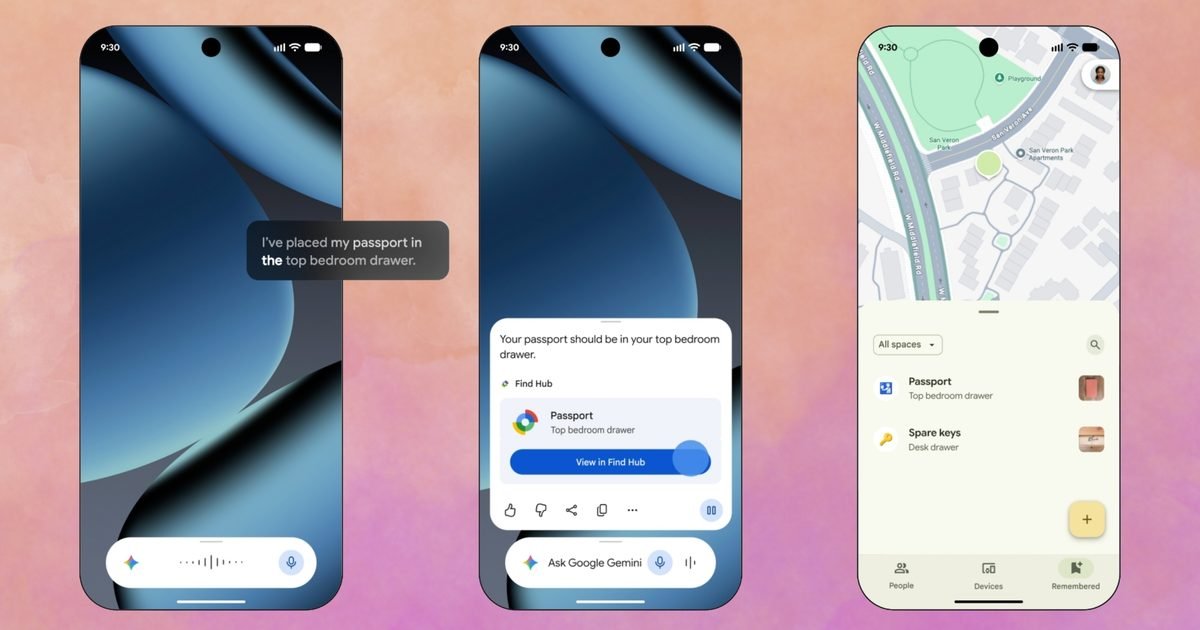
The idea is simple. You tell Gemini something like “I put my passport in the bedroom drawer,” optionally attach a photo, and the assistant saves that location in Find Hub. No tracker tag required. Nothing to pair, charge, or replace batteries in.

Later, when you’ve inevitably forgotten again — and Google seems to be counting on that — you can ask Gemini where you left the item, or open Find Hub and check the “remembered” items tab.

There are a few catches. The feature needs Android 16 or newer. It also only works in countries where both Gemini and Find Hub are available, so not everyone will see it right away.

This is not tracking — it’s just memory

Here’s the important distinction: Gemini isn’t actually tracking your belongings. It’s merely remembering what you told it. That’s it. No real-time location, no pinging, no map showing where your wallet currently sits.

Honestly, I’ve been doing this in the Notes app on my iPhone for years. Write down where I left something, check the note later. Works fine. But Google clearly thinks there’s value in having the assistant handle that recall for you — and tying it into Find Hub means it lives alongside your actual tracker-tagged items.

Motion Assist: fighting carsickness with moving bubbles

The other headline feature in this drop is Motion Assist. It targets the queasy feeling you get from staring at a stationary phone screen while the car moves around you.

The feature overlays small bubbles on your screen that drift along with the vehicle’s motion. The idea is that your eyes get a visual cue that matches what your inner ear is feeling, which can help reduce motion sickness. It’s aimed at passengers who want to read or text without feeling nauseous.

Whether it actually works well remains to be seen, but it’s a thoughtful approach to a very common problem.

Guided vision and other smaller updates

Three smaller additions round out the September Drop. Guided vision is designed for blind and low-vision users. During a Gemini Live session, it narrates whatever your camera sees — reading labels, menus, or other text aloud in real time.

That’s a genuinely useful accessibility feature, and it builds on Google’s existing work with Lookout and other vision tools.

Google Keep inside Messages

Google Keep is also getting deeper integration with Google Messages. You’ll soon be able to open Keep directly inside a conversation thread, letting a group build a shared list without leaving the chat. Planning a trip or a group dinner gets easier when the list and the discussion live in the same place.

Chat themes for customization

Finally, chat themes are arriving. These let you swap in custom backgrounds and colors per conversation, so you can tell at a glance which thread you’re in. It’s a purely cosmetic change, but it adds a layer of personalization that many users have wanted for a while.

When will these Android updates arrive?

Here’s the timing breakdown: Keep in Messages and chat themes are already live as of the announcement. The Gemini location memory feature, Motion Assist, and Guided vision will roll out later this month.

If you’re on a supported device with Android 16, keep an eye on your updates. The September Drop is shaping up to be a mix of practical tools and comfort features — some more useful than others, but all pointing in the same direction.

Google wants its assistant to be more than a search box. It wants Gemini to remember what you forget, help you avoid carsickness, and make your phone a little more accessible. Whether that’s enough to make you switch from your Notes app habit is another question entirely.

Continue Reading

Artificial Intelligence

Thinking Machines seeks $1B at $40B valuation as Accel reportedly leads the charge

Published

on

Thinking Machines $40B valuation

Murati’s AI lab is back in the fundraising spotlight

Thinking Machines, the AI startup that Mira Murati founded just over a year ago after leaving OpenAI, is reportedly in talks to raise $1 billion at a valuation of at least $40 billion. The Information broke the news Thursday, citing sources familiar with the matter.

Accel, an existing investor, is said to be in discussions to lead the round. Both Accel and Thinking Machines declined to comment when reached.

The number is striking — but not because it’s huge. It’s actually a step down. Late last year, the company was reportedly chasing a $50 billion valuation. Now it looks like investors are pricing in a more sober reality.

A $40 billion price tag on $100 million in revenue

Here’s where the math gets interesting. Thinking Machines’ annual revenue run rate has crossed $100 million, according to a person with knowledge of the company’s financials. That’s real revenue, not just promises.

But $40 billion on $100 million? That’s a 400x revenue multiple. Even in the frothiest corners of AI, that’s an extraordinary number. For context, most public software companies trade at 10–20x revenue. AI infrastructure names like Nvidia command far less on a trailing basis.

Investors aren’t paying for today’s numbers, though. They’re betting that Murati and her team can build something category-defining — the same bet that fueled the startup’s earlier rounds.

From a record seed round to a valuation reset

Thinking Machines’ previous raise was a $2 billion seed round — one of the largest in venture history — that valued the company at $12 billion. Andreessen Horowitz led that investment, with participation from Nvidia, GV, Lightspeed, and Conviction Partners.

That round was backed almost entirely on pedigree. Murati, who served as OpenAI’s CTO, brought a team of top-tier researchers with her. Investors were writing checks on the strength of the team’s résumés rather than on shipped products.

Since then, the company has launched its first offering, Inkling, an open-weight model. It generates revenue through usage-based compute fees — customers pay to adapt the model on proprietary data using the company’s Tinker platform.

But the team has also seen high-profile departures. Several co-founders, including Lilian Weng and Luke Metz, have returned to OpenAI. That kind of talent drain would worry most startups. At Thinking Machines, it’s a story investors are watching closely.

How the new round compares to the AI market’s giants

The reported $40 billion valuation would put Thinking Machines in rarefied air. For comparison:

  • OpenAI was valued at $300 billion in a recent tender offer
  • Anthropic has been valued around $180 billion
  • xAI, Elon Musk’s venture, has commanded a $50 billion valuation

Thinking Machines would sit below those giants but well above most AI startups. The question is whether the company can justify that gap with revenue growth alone — or whether it needs a breakout product first.

What’s next for Thinking Machines

The round isn’t closed yet. Terms could change, and talks could fall apart — that happens in venture capital all the time. But the signal is clear: Accel, a firm that backed Facebook and Spotify early, sees something here.

For Murati, the next few months will be telling. Can she keep the team intact? Can Inkling gain traction against open-weight rivals like Meta’s Llama and Mistral? And can she convince investors that the $50 billion ask was just a starting point, not a ceiling?

If the round closes at $40 billion, it will be a validation of the company’s progress — and a reminder that even the hottest AI labs aren’t immune to valuation resets. For those watching from the sidelines, the real story isn’t the number. It’s whether Thinking Machines can turn its pedigree into a durable business.

Related reading: how AI startup valuations are shifting in 2025 and the state of open-weight AI models.

Continue Reading

Artificial Intelligence

Scaling Secrets and Hard Truths: Inside the Builders Stage at TechCrunch Disrupt 2026

Published

on

Builders Stage Disrupt 2026

Back to San Francisco, Back to the Hard Questions

Building a startup is one thing. Turning it into a company that can actually scale? That’s a different beast entirely. And it’s the exact problem the Builders Stage at TechCrunch Disrupt 2026 is designed to tackle.

From October 13-15 at the Moscone Center in San Francisco, more than 10,000 founders, investors, and operators will gather for three days of unfiltered conversations. No vanity metrics. No hype. Just the operational playbooks that separate companies that fizzle from those that compound.

The Builders Stage is one of six industry-focused tracks at Disrupt, and this year’s agenda reads like a masterclass in the messy middle of growth. We’re talking fundraising in a brutal market, hiring when AI does half the work, and what happens when your roadmap collides with OpenAI’s.

AI Is the Elephant in Every Room

You can’t have a founder conversation in 2026 without AI looming overhead. But the Builders Stage isn’t just another AI cheerleading session. It’s grappling with the uncomfortable stuff.

What Happens When OpenAI Ships Your Roadmap?

Every AI founder has this nightmare. You build something great, and then a lab releases a feature that makes your product redundant. Michel Tricot (CEO of Airbyte), Rob Toews (Partner at Radical Ventures), and Linda Tong (CEO of Webflow) will get real about where defensibility actually lives when giants move fast.

Winning When You’re Not Building AI

Here’s a contrarian take: not every enduring company needs to sell AI models. Shan Shan from Baillie Gifford and Yuri Sagalov from General Catalyst will break down why efficient growth, retention, and disciplined execution still beat hype. Fundamentals, not buzzwords, build breakout businesses.

For a deeper dive on navigating these choices, check out our guide on AI startup strategy for founders.

The Money Talk: From Pre-Seed to Series A 2027

Raising capital has never been more unforgiving. The Builders Stage agenda reflects that reality with sessions that skip the platitudes.

  • Winning Pre-Seed Without a Product: Puneet Agarwal (True Ventures), Austin Clements (Slauson and Co.), and Sandhya Venkatachalam (Axiom Partners) discuss how to get investors to bet on your conviction before you have anything to show.
  • The Series A in 2027: Partners from Index Ventures, Peak XV, and Bessemer will define what “fundable” actually means in the next cycle. Spoiler: the old playbook is dead.
  • M&A Is Now an Early-Stage Strategy: Karl Alomar (M13) and Lindsey Mignano (Mignano Law Group) on building with an exit in mind from day one, not as an afterthought.

Want to prep before you go? Read our breakdown of how to prepare for a Series A pitch.

Growth Without the Budget: The Zero-to-1K Playbook

Grant Lee (CEO of Gamma), Leah Solivan (Founder of Precedent.vc), and Elia Wallen (CEO of Engine) are leading a session that sounds like a lifeline for bootstrapped founders: The Zero-to-1K Playbook.

Early customer acquisition isn’t about marketing spend. It’s about founder-led sales, community building, and relentless outbound. Most startups at this stage have zero budget and zero brand. They only have urgency and creativity. This session is about turning that scarcity into a distribution engine.

And if you manage to get those first customers, what then? Ryan Meadows (CRO at Lovable) and Tomasz Tunguz (Theory Ventures) will tackle the 90-Day GTM—why $0 to $10M ARR is the new baseline and how to hit it faster than you thought possible.

Hiring Humans (and Agents) in the AI Era

The team you build at seed stage won’t look like the team you need at Series B. And in 2026, that team might include AI agents.

Josh Reeves (CEO of Gusto) is leading a conversation called Hiring When AI Is a Co-Founder. It’s a wild title, but the question is real: as agents take on engineering and support roles, what should humans own? How do you build a hybrid team without losing speed, accountability, or culture?

Then there’s the brutal competition for talent. Matt Birnbaum (Wylder.co), Ioana Hreninciuc (Runware), and Atli Thorkelsson (Redpoint Ventures) will dig into compensation, equity, and retention in the most competitive hiring market we’ve ever seen.

Beyond the Hype: Honest Conversations and Viral Moments

Not every session is about growth hacking and term sheets. Some are about survival.

Yes, It’s Hard to Be a Founder is an honest conversation with Nell Daly (Revenge Capital), Dr. David H. Rosmarin (Harvard Medical School), and Jack Withinshaw (Airspeeder). They’ll unpack burnout, decision fatigue, and the identity strain of sustained pressure. It’s the kind of talk that doesn’t get enough stage time.

On the flip side, Zach Yadegari (Founder of Cal AI) will share how his company went viral and, more importantly, how they turned that overnight attention into durable retention. Because going viral is easy. Staying relevant is the real work.

If you’re ready to move beyond theory, explore actionable startup growth tactics that complement these sessions.

Your Pass to the Action

The Builders Stage is just one slice of the Disrupt 2026 pie. With the Startup Battlefield finals, the AI Disruptors 60 reveal, and networking that actually matters, this is where the tech ecosystem converges.

Secure your pass today and save up to $330 before rates increase. Your future competitors will be there. Will you?

Continue Reading

Artificial Intelligence

Forget the Cloud: HUMAIN and Qualcomm Just Built an AI PC That Thinks on Its Own

Published

on

Horizon Ultra AI PC

Riyadh just became the launchpad for a laptop that wants to end your dependence on the cloud

At LEAP 2026 in Riyadh, HUMAIN and Qualcomm pulled the wraps off a new machine called the Horizon Ultra AI PC. The pitch is refreshingly blunt: run more AI tasks directly on the device, not on some distant server farm.

That’s a meaningful shift. For years, the default assumption has been that serious AI work happens in the cloud. HUMAIN is betting a growing slice of users want that intelligence on their desk, not in a data center.

What’s actually inside the Horizon Ultra?

Under the hood sits Qualcomm’s Snapdragon X2 Elite chip. It’s a serious piece of silicon, packing an 18-core Oryon CPU, an Adreno GPU, and a Hexagon NPU. Each unit handles different workloads, so tasks get split intelligently rather than hammering a single core.

That architecture is what makes local AI possible. Models run on the device itself, which means your sensitive documents, client records, or proprietary code never have to leave the machine. When a task genuinely exceeds the laptop’s capabilities, it can still reach out to the cloud — but that’s now the exception, not the rule.

HUMAIN CEO Tareq Amin framed it as making intelligence native to the device. Not something you connect to. Something you own.

The real advantage: speed and privacy

Local processing isn’t just about keeping secrets. It’s also about responsiveness. No round trip to a server means faster answers, snappier AI-assisted workflows, and no awkward pauses while your request travels halfway around the world.

For sectors like healthcare, finance, or legal work — where data governance is non-negotiable — that’s a compelling argument. You get the benefits of AI without the compliance headache of shipping data off-site.

Windows first, HUMAIN OS later

The first iteration runs Microsoft Windows. That’s a smart move. It makes the Horizon Ultra instantly familiar to enterprise buyers who need software compatibility on day one.

But HUMAIN isn’t stopping there. The company confirmed its own operating system, HUMAIN OS, will arrive on this same hardware line in 2027. That gives the company time to build a software layer tailored to its vision of on-device intelligence.

Two operating systems on the same hardware is a bold strategy. It says: we want your business now, but we’re building toward something more integrated later.

When can you buy one?

If you’re an enterprise customer, the wait isn’t long. Sales for the Windows version of the Horizon Ultra open September 20, 2026, with AlFalak handling sales and delivery. That’s a tight turnaround from the LEAP debut.

Consumer availability hasn’t been announced yet. The focus is squarely on business buyers first.

A bigger AI puzzle

The Horizon Ultra isn’t a one-off gadget. It’s one piece of HUMAIN’s broader AI strategy, which already spans data centers, cloud infrastructure, models, and applications. This laptop is the company’s attempt to bring that stack down to the personal level.

Think of it this way: if HUMAIN can deliver a device that handles serious AI workloads locally, it changes the economics of enterprise computing. Less bandwidth. Lower latency. More control.

Whether that vision lands depends on execution — and on whether businesses actually prefer local AI over the convenience of the cloud. But with Qualcomm’s silicon and a clear roadmap, the Horizon Ultra is more than a concept. It’s a statement of intent.

For a deeper look at how on-device AI is reshaping hardware choices, check out our analysis of AI PC buying considerations and the broader Qualcomm Snapdragon X series roadmap.

Continue Reading

Trending