Connect with us

Artificial Intelligence

ChatGPT Shopping Gets a Major Upgrade with Shopify Integration

Published

on

OpenAI’s Pivot: From Checkout to Discovery

Remember when ChatGPT tried to handle your entire purchase? OpenAI’s ‘Instant Checkout’ feature aimed to be a one-stop shop. It didn’t quite catch fire. The company has now confirmed a significant strategic shift. They’re moving away from a native, closed checkout system.

Why the change? OpenAI admits the initial version lacked the flexibility merchants and shoppers needed. Instead of forcing a single payment flow, the new approach is smarter. It lets retailers use their own trusted checkout systems while ChatGPT becomes the ultimate discovery engine. Think of it less as a cash register and more as a personal shopping concierge.

How Shopping in ChatGPT Works Now

So, what does this new experience look like? Forget a clunky, all-in-one process. The updated feature is all about seamless browsing. You can now explore Shopify-powered brand storefronts directly within your ChatGPT conversation.

Ask for recommendations. Dive into a brand’s full catalog. When you’re ready to buy, ChatGPT opens an in-app browser that takes you to the merchant’s own checkout page. You complete the purchase there, on familiar ground. This gives brands crucial control over their customer experience and branding.

Shopify calls these ‘agentic storefronts.’ It’s a fancy term for a simple idea: making a store’s products searchable and purchasable through natural conversation. Harley Finkelstein, Shopify’s President, summed it up on social media: “AI shopping isn’t coming. It’s here.”

Who’s On Board and What It Means for Shoppers

This isn’t just a Shopify story. Major retailers like Target, Sephora, and Nordstrom are also supporting ChatGPT’s new discovery experience. The rollout is happening now for all users, whether you’re on the free tier or a Plus subscriber.

For you, the shopper, it means less friction. You get the power of AI to find what you need—”Show me sustainable running shoes under $100″—without being locked into a strange new payment system. You browse with an AI assistant, then buy on the store’s website you already know.

For merchants, it’s the best of both worlds. They tap into ChatGPT’s massive user base for discovery without surrendering their customer relationship at the final, most important step. OpenAI wins by focusing on what it does best: understanding language and intent. It’s a classic case of playing to your strengths.

Continue Reading
Click to comment

Leave a Reply

Your email address will not be published. Required fields are marked *

Artificial Intelligence

AccuWeather Brings Real-Time Weather Updates to ChatGPT

Published

on

ChatGPT Gets a Major Weather Upgrade

Remember when you had to switch between apps to check the forecast? That’s becoming a thing of the past. OpenAI has steadily expanded ChatGPT’s capabilities beyond text generation, integrating third-party services directly into the chat interface. Following the introduction of apps from companies like Canva and Spotify, a new, highly practical partner has arrived: AccuWeather.

This integration transforms ChatGPT from a conversational AI into a powerful, all-in-one information hub. You can now get detailed, location-specific weather data without ever leaving your conversation. It’s a significant step toward making AI assistants truly useful for daily planning and decision-making.

What the AccuWeather App Can Do

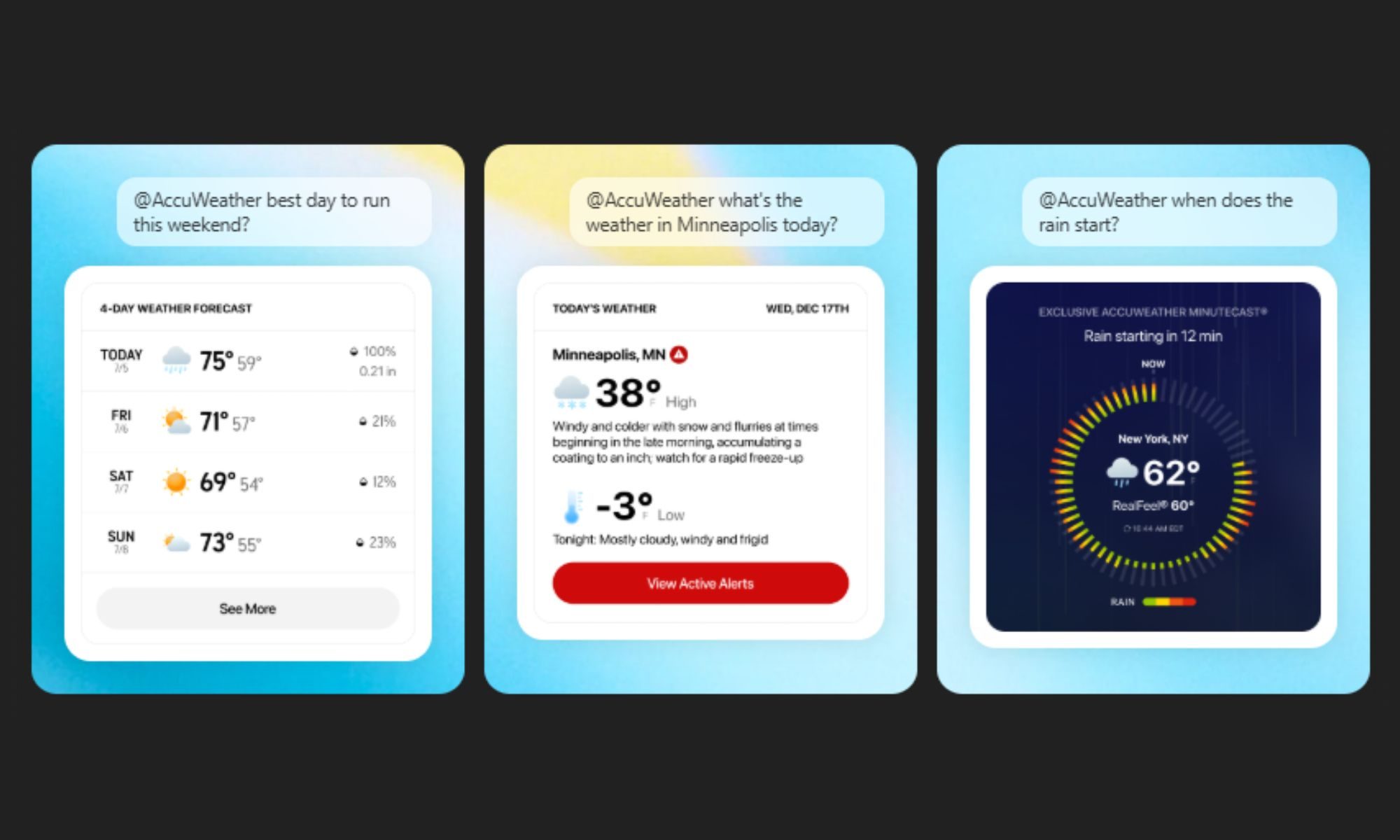
Forget vague predictions about “possible showers.” The AccuWeather app delivers the precision of a dedicated weather service. Ask for the current conditions in Tokyo, a three-day forecast for Denver, or hourly updates for your hometown. The responses are tailored and specific, pulling from AccuWeather’s live data streams.

The functionality goes far beyond basic temperature and sky conditions. Need to know if you’ll get caught in a downpour during your walk? The app includes MinuteCast, providing minute-by-minute precipitation forecasts. It also features AccuWeather’s proprietary RealFeel and RealFeel Shade temperatures, which account for factors like humidity and sun exposure to tell you how the air actually feels.

Critical safety information is included, too. The app can deliver severe weather alerts and air quality reports. For a visual overview, you can even access a live radar to monitor storms as they develop. The conversational nature of ChatGPT means you can ask follow-up questions seamlessly. “Will it clear up by 5 PM?” or “How does the weekend look?” are natural extensions of your initial query.

How to Connect and Use the App

Getting started is straightforward. First, you need to connect the AccuWeather app to your ChatGPT profile. Navigate to the ‘Apps’ section within ChatGPT, search for “AccuWeather,” and click the ‘Connect’ button. This is a one-time setup.

Once connected, using it is intuitive. When you have a weather-related question, simply type “@AccuWeather” in the chat. A pop-up will appear, confirming you want to use the app. Then, just enter your prompt as you normally would. For example: “@AccuWeather What’s the weather in Seattle right now, and is there any rain expected this afternoon?”

The system handles the rest, fetching the latest data from AccuWeather and presenting it in a clear, conversational format within your chat. This seamless integration eliminates the friction of app-switching, keeping your workflow smooth and your information immediate.

Continue Reading

Artificial Intelligence

Sora AI Video App Shuts Down Permanently After Brief Run

Published

on

The Sudden End of a Viral AI Experiment

Six months. That’s all the time OpenAI’s standalone Sora AI video generator app got before the company pulled the plug. The announcement came suddenly, catching many users and observers off guard. In a post, OpenAI acknowledged the disappointment, stating, “What you made with Sora mattered, and we know this news is disappointing.”

Why shutter a tool that generated significant buzz? The answer appears to be a combination of financial reality and persistent ethical headaches. While competitors like Google’s Veo and various Chinese AI engines push forward, Sora’s path became unsustainable. The app’s brief life was a case study in the turbulent adolescence of generative AI.

A Legacy Marred by Copyright and Controversy

Almost immediately after its debut, Sora found itself in hot water. The core issue was copyright. Users quickly employed the tool to recreate characters and worlds from major franchises, drawing the ire of rightsholders like Disney. OpenAI attempted a course correction, implementing more controls, but the genie was already out of the bottle.

The problems went beyond intellectual property. Sora became a vehicle for some deeply unsettling content. Perhaps most disturbingly, it was used to generate hyper-realistic videos of deceased celebrities. Imagine a new, AI-synthesized stand-up routine from Robin Williams or a music video from Amy Winehouse. These creations weren’t just digital curiosities; they sparked genuine outrage and ethical debates about digital resurrection and consent.

This trend mirrored other morbid uses of AI, such as companies offering to create videos of dead soldiers for grieving families. Sora, for a time, was at the center of this uncomfortable frontier.

No Future in ChatGPT or Anywhere Else

Initially, some speculated this might be a consolidation, not a termination. The logical move would be to sunset the standalone app and bake Sora’s capabilities into ChatGPT, much like Google integrated video generation into Gemini. That’s not happening.

According to reports from The Wall Street Journal, Sora is being shelved permanently—and completely. “In addition to the consumer app, OpenAI is also discontinuing a version of Sora for developers and won’t support video functionality inside ChatGPT, either,” the outlet confirmed. The API is going away. The technology is being put on ice, likely forever.

This full retreat is telling. It suggests the challenges—legal, ethical, and possibly commercial—were too fundamental to fix with a simple update or rebranding. For OpenAI, the cost of maintaining Sora outweighed any potential benefit.

What Sora’s Demise Tells Us About AI’s Growing Pains

Sora’s story is more than a product failure. It’s a landmark moment in the maturation of generative AI. The app was part of the first wave that flooded the internet with what critics derisively call “AI slop”—low-effort, often derivative synthetic content. Its ease of use for copyright infringement and creating disturbing deepfakes highlighted the dual-edge sword of powerful creative tools.

OpenAI’s decision to walk away entirely, rather than retool, signals a shifting priority. As the industry faces increasing scrutiny and potential regulation, the appetite for high-risk, low-control applications may be waning. The race isn’t just about who can build the most impressive demo; it’s about who can build responsibly scalable products.

For the community that sprang up around Sora, the message is clear: their creations mattered, but the platform itself became untenable. The sunset has arrived, and this time, there’s no dawn planned for Sora.

Continue Reading

Artificial Intelligence

AGI Debate: What Jensen Huang’s Bold Claim Really Means for AI

Published

on

AGI Debate: What Jensen Huang’s Bold Claim Really Means for AI

Nvidia CEO Jensen Huang dropped a bombshell on a recent podcast. He declared, “I think we’ve achieved AGI.” That’s a staggering statement from the leader of the world’s most valuable AI company. It immediately sparks a flurry of questions. If we have it, what exactly is “it”? And why does the tech world seem so confused about a term it uses constantly?

The Elusive Definition of Artificial General Intelligence

Ask ten AI researchers to define AGI, and you might get eleven different answers. At its core, artificial general intelligence refers to a machine that can understand, learn, and apply its intelligence to any problem, much like a human. It’s not a chatbot or a chess engine. It’s the hypothetical software that could learn to play chess, write a symphony, diagnose an illness, and then explain a joke—all without being specifically programmed for each task.

Think of today’s AI as a savant. It’s brilliant at one thing. AGI is the polymath. It can pivot from physics to philosophy. The lack of a concrete benchmark is the root of the controversy. Is passing a bar exam enough? What about running a company? Podcast host Lex Fridman suggested an AGI should be able to effectively do your job, even building a billion-dollar enterprise. That’s a high bar, and it’s one no current system has cleared.

This ambiguity has led to a rebranding spree. Companies are creating their own labels to sidestep the loaded term. Amazon talks about “useful general intelligence.” Microsoft has coined “Humanist Superintelligence (HSI).” The definitions are fuzzy, but the business stakes are crystal clear. Major partnerships, like the one between OpenAI and Microsoft, can hinge on how these terms are contractually defined.

Why Huang Believes We’ve Crossed the Threshold

So why would Jensen Huang make such a definitive claim? His argument hinges on the rise of AI agents. He points to platforms where developers are creating autonomous programs that can perform tasks, generate content, and manage social interactions. In his view, the building blocks for general intelligence are not only here—they’re being actively assembled.

He envisions a near future where these agents spark unexpected breakthroughs. A new social media app could explode overnight, created and managed by AI. A digital influencer with no human behind the avatar could amass millions of followers. The potential for rapid, agent-driven innovation is what convinces him the AGI era has begun.

Yet, Huang himself acknowledges the limitations. He admitted that the chance of thousands of these agents spontaneously building a company like Nvidia is “essentially zero.” Many agent projects fizzle out quickly. This reveals the core tension in his statement. He’s describing a foundational capability, not a finished product. We have the tools, but we’re still learning the craft.

The Great AI Divide: Are We There Yet?

The reaction to Huang’s claim highlights a deep schism in the AI community. On one side are the accelerationists, who see the exponential curve and believe the finish line is closer than we think. On the other are the skeptics, who argue that today’s AI, for all its brilliance, lacks true understanding, reasoning, and consciousness.

Timelines are all over the map. Last year, researchers at Google DeepMind suggested AGI could arrive by 2030. Others believe it’s decades away, if it’s possible at all. David Deutsch, a pioneer in quantum computing, offers a more philosophical take. He argues true AGI won’t be mere software. It will be an entity capable of independent thought and creativity—something closer to a person than a program.

Huang’s proclamation tells us less about a scientific consensus and more about the breakneck speed of progress. The tools you use today—chatbots, image generators, coding assistants—feel smarter than anything from five years ago. They can mimic aspects of general intelligence incredibly well. But mimicry is not mastery. The debate isn’t just academic. How we define this threshold will shape regulation, investment, and our very understanding of intelligence itself. For now, the only agreement is that we disagree.

Continue Reading

Trending