Connect with us

Artificial Intelligence

Microsoft Copilot Cowork: The New AI Agent That Wants to Finish Your Projects for You

Published

on

Microsoft Copilot Cowork: The New AI Agent That Wants to Finish Your Projects for You

Microsoft is taking workplace AI to the next level with the general availability of Copilot Cowork, an AI agent designed to handle complete projects from start to finish. Instead of just offering suggestions or generating text, this system executes multi-step workflows on its own. This launch signals a major shift in how enterprises can use artificial intelligence, moving from simple assistance to full task automation.

After a three-month preview in Microsoft’s Frontier program, the company reports that more than half of the Fortune 500 have already adopted Copilot Cowork. Early adopters include Accenture, Zurich Insurance, and Capital Group. According to Microsoft, this is one of the fastest-growing launches in the history of the Frontier program.

What Makes Copilot Cowork Different from Other AI Assistants?

Traditional AI tools like chatbots or content generators answer questions or produce drafts. However, Copilot Cowork is built to take over entire tasks. It can compare thousands of files across product versions, automate spreadsheet-heavy workflows, generate dependency charts, and identify stalled sales opportunities. All of this happens without constant human oversight.

How does it achieve this? Microsoft combines cloud-based processing, enterprise-grade security controls, and what it calls “Work IQ.” This context engine pulls information from the tools and systems businesses already use. As a result, the AI agent understands the full scope of a project before acting.

The Technology Behind Copilot Cowork

Microsoft emphasizes flexibility in model selection. Copilot Cowork can tap into different AI models depending on the task. At launch, it runs on Anthropic’s Opus 4.8 and Sonnet 4.6 models. Frontier customers can also access GPT-5.5. Additionally, Microsoft plans to release its own in-house model, Cowork 1, in the coming weeks.

This multi-model approach means businesses are not locked into a single AI provider. Instead, they can match the best model to each specific workflow. This is a critical advantage for enterprises that need reliability and performance across diverse tasks.

Copilot Cowork Pricing: A Consumption-Based Model

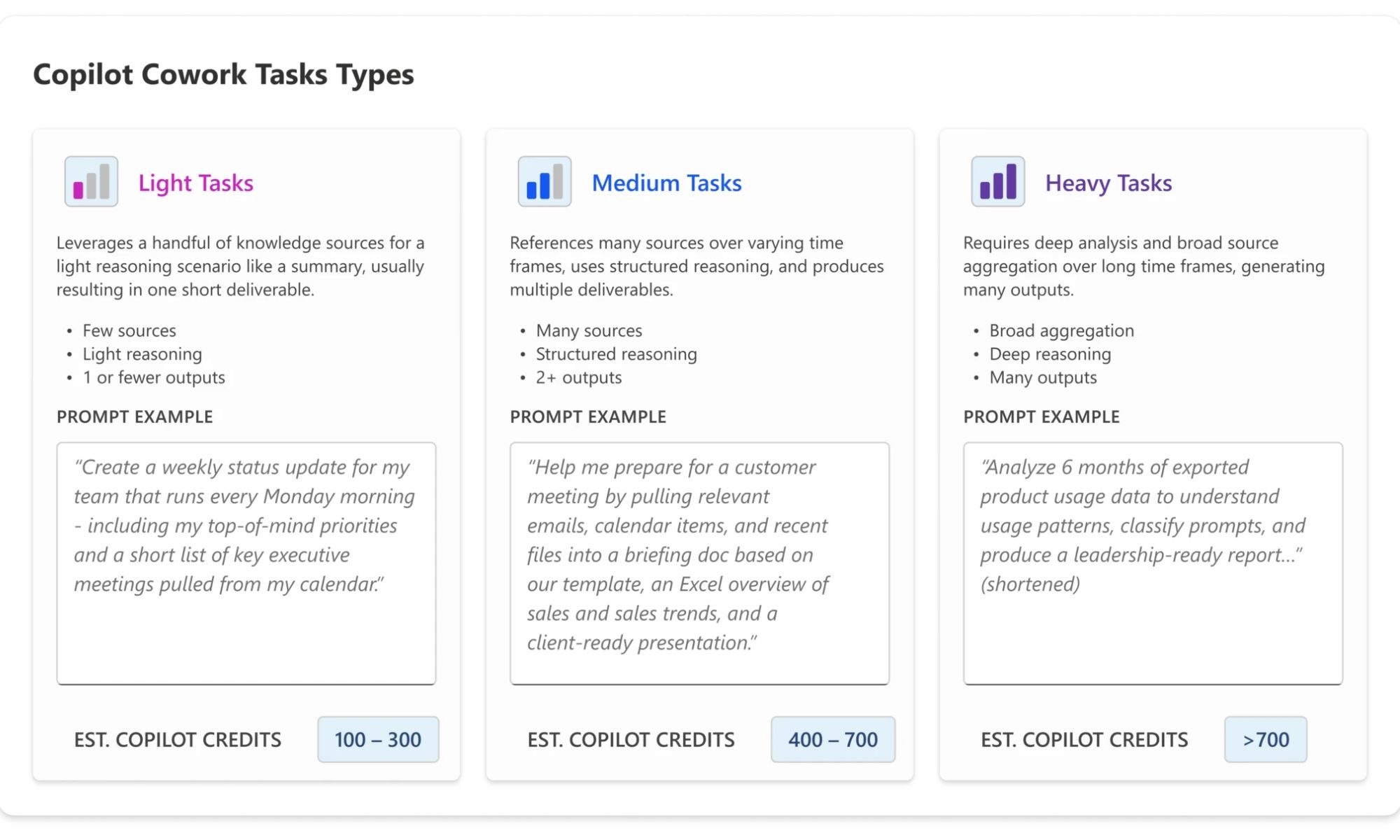
One of the most notable aspects of Copilot Cowork pricing is its departure from flat subscription fees. While the agent requires a Microsoft 365 Copilot subscription, usage is billed separately through a consumption-based model. Organizations pay according to the resources each task consumes, including model usage, context retrieval, tool calls, and runtime.

To help businesses estimate costs, Microsoft has identified three common categories of work: light, medium, and heavy tasks. Light tasks involve limited reasoning, while heavy tasks pull data from multiple sources and require deeper analysis. This approach allows companies to scale usage based on actual need rather than paying for unused capacity.

Microsoft claims internal testing showed Copilot Cowork to be roughly 30% to 40% cheaper per prompt than competing enterprise AI offerings that use Microsoft 365 connectors. For CFOs and IT leaders, this pricing model could make AI adoption more predictable and cost-effective.

Real-World Use Cases for the AI Agent

Early adopters have already found practical applications for Copilot Cowork. For example, financial analysts use it to automate reconciliation tasks across thousands of rows of data. Project managers rely on it to generate dependency charts and identify bottlenecks. Sales teams use the agent to detect stalled opportunities and suggest follow-up actions.

This is not about generating content faster; it is about handing entire projects to an AI agent and letting it bring back finished work. As a result, employees can focus on higher-value strategic decisions instead of repetitive manual tasks.

What This Means for the Future of Work

Microsoft is betting that the next phase of workplace AI is about full automation, not just assistance. With Copilot Cowork now available worldwide, enterprises have a powerful tool to offload complex workflows. This could dramatically change how teams operate, especially in data-heavy industries like finance, insurance, and consulting.

However, businesses must also consider the implications. While the AI agent is designed for enterprise security, companies still need to govern its access to sensitive data. Additionally, the consumption-based pricing model requires careful monitoring to avoid unexpected costs.

For more insights on AI agents in the workplace, check out our guide on AI agent workflow automation. You can also explore Microsoft 365 Copilot tips to maximize your productivity.

Final Thoughts on Copilot Cowork

Microsoft’s Copilot Cowork represents a significant leap forward for enterprise AI. By combining multi-model flexibility, consumption-based pricing, and deep integration with Microsoft 365, it offers a compelling solution for organizations looking to automate complex projects. As more companies adopt this technology, the line between human work and AI-driven execution will continue to blur.

Are you ready to let an AI agent take projects off your plate? The future of work is here, and it is powered by Copilot Cowork.

Continue Reading
Click to comment

Leave a Reply

Your email address will not be published. Required fields are marked *

Artificial Intelligence

Are ChatGPT and Claude Making You a Worse Writer? The ‘Fluency Trap’ Explained

Published

on

Are ChatGPT and Claude Making You a Worse Writer? The ‘Fluency Trap’ Explained

Have you ever used ChatGPT or Claude to polish a paragraph, only to realize later that the content was hollow? A new study suggests you might be falling into what researchers call the fluency trap. This phenomenon occurs when AI-generated text feels so smooth and confident that it tricks writers into thinking the work is complete—even when the ideas are shallow or inaccurate.

Published in the journal Computers and Composition, the research followed 38 undergraduate students over two semesters in an experimental “AI and Writing” course. The findings are a wake-up call for anyone relying on AI for writing tasks.

What Is the Fluency Trap in AI Writing?

The fluency trap describes a dangerous dynamic: AI writing tools produce text that reads as polished, authoritative, and error-free. But this surface-level perfection often masks a lack of depth. According to Abram Anders, associate professor of English at Iowa State University and co-author of the study, “AI writes in confident sentences, uses the right tone and sounds smart. But that polish can trick students into trusting it, even when it’s wrong, shallow, or missing the point entirely.”

Many students initially approached AI like a search engine—typing in a vague prompt and accepting whatever output appeared. They assumed that because the text flowed well, it was accurate and complete. In reality, the AI was generating plausible-sounding but hollow content.

Why Polished Output Isn’t Enough

This trap is particularly insidious because it exploits our cognitive biases. When text looks clean and reads smoothly, we naturally assume it’s correct. However, as the study highlights, fluency does not equal accuracy. Writers end up with a false sense of accomplishment, skipping the critical thinking required to evaluate and refine ideas.

As Anders and co-author Emily Dux Speltz (assistant professor at Embry-Riddle Aeronautical University) note, students who fell into the trap often spent less time revising or fact-checking. They mistook AI’s confident tone for reliable substance.

How to Avoid the Fluency Trap

The good news is that the fluency trap is avoidable. The researchers identified three key thresholds that writers must cross to use AI effectively:

1. Embrace Trial and Error

Effective AI writing isn’t about a single prompt and accept. It requires genuine trial and error. Writers need to experiment with different prompts, refine their queries, and compare multiple outputs before settling on a version. This process mirrors the drafting and revision cycle that strong writers already practice.

2. Apply Human Judgment

AI output still needs human oversight. Writers must check claims, refine logic, and ensure the text matches the expectations of their audience or context. As the study emphasizes, “AI can generate text, but it cannot generate purpose.” Only the writer can decide what the piece is arguing and why it matters.

3. Move from Outsourcing to Orchestrating

Students who mastered these thresholds stopped treating AI as a shortcut. Instead, they used it to test ideas, evaluate options, and sharpen their arguments. Anders and Dux Speltz describe this shift as moving from outsourcing your writing to orchestrating it. This approach transforms AI from a crutch into a creative partner.

For more on improving your writing process, check out our guide on best practices for AI-assisted writing.

What Good AI-Assisted Writing Looks Like

So, what does effective AI-assisted writing actually look like? It starts with a clear purpose. Instead of asking AI to “write an essay on climate change,” a skilled user might prompt: “Generate three contrasting arguments about carbon pricing, each supported by one potential counterpoint.” This approach forces the writer to think critically about structure and evidence.

The researchers observed that students who succeeded treated AI as a brainstorming tool rather than a final editor. They used it to explore angles, identify gaps in their reasoning, and test the strength of their thesis. In the end, they produced work that was both fluent and substantive.

If you’re looking to refine your AI writing skills, consider exploring our resource on effective prompt engineering techniques.

The Bottom Line: Writing Is Still Thinking

As Anders puts it, “AI changes the workflow, but it doesn’t change the fact that writing is thinking.” This distinction matters more than ever as AI-generated text becomes harder to distinguish from human writing. The fluency trap is real, but it’s not inevitable. By staying aware of its dangers and adopting a more deliberate approach, writers can harness AI’s power without sacrificing depth or originality.

Ultimately, the best AI-assisted writing combines machine fluency with human insight. Don’t let the polish fool you—keep questioning, keep refining, and keep thinking.

Continue Reading

Artificial Intelligence

AI as a dating wingman is a hot trend, but study says it’s just sabotaging your love life

Published

on

AI as a dating wingman is a hot trend, but study says it’s just sabotaging your love life

Using artificial intelligence to craft your dating app messages might seem like a clever shortcut, but a new study suggests it could be undermining your romantic prospects. More than one in four singles in the US have already turned to AI for help with their love lives, a figure that skyrocketed 333% in just one year. Dating apps like Hinge, Bumble, and Facebook Dating are actively encouraging this trend by integrating AI features. However, research from Constructor University indicates that relying on an AI dating wingman often backfires, leaving users feeling betrayed and frustrated.

The Cyrano Effect: When AI Writes Your Love Letters

Named after the French play where a man composes love letters for another, the Cyrano Effect describes what happens when AI becomes the true author of your romantic messages. Dr. Lennart Ante interviewed 45 dating app users, splitting them into those who used AI to write messages and those who received them. Interestingly, AI users rarely viewed themselves as dishonest. Many described ChatGPT as a form of social anxiety medication in text form, while others treated online dating as a numbers game to optimize before real-life meetings.

On the other hand, recipients had a starkly different experience. Words like ‘betrayed,’ ‘violated,’ and ‘catfished’ came up repeatedly. Some became so suspicious of well-written messages that they described every conversation as an exhausting Turing test. This disconnect highlights how an AI dating wingman can create false expectations and erode trust.

The Persona-to-Person Leap: When AI Charm Falls Flat

One participant described spending the day before a date rereading AI-generated chats, trying to memorize how to act. They called it ‘cramming for an exam, but the subject is this fake version of yourself.’ Dr. Ante terms this the Persona-to-Person Leap—the anxiety-ridden moment when an AI-polished online persona must show up in real life without any algorithmic backup. Recipients often met someone who seemed charming online but turned up quiet and awkward in person. The AI had set a bar that the real person could not clear.

This phenomenon is a core reason why the AI dating wingman trend can sabotage your love life. When the words that spark a connection aren’t yours, the connection tends not to survive beyond the first coffee. For more insights on authentic dating, check out our guide on building genuine connections on dating apps.

Why AI Dating Tools Often Fail

The study doesn’t call for an outright ban on AI dating tools, noting they can help people with social anxiety or language barriers. However, it argues that over-reliance on AI creates a persona that doesn’t match reality. Recipients feel deceived, and users become dependent on a crutch that prevents authentic interaction. Building on this, researchers suggest that users should use AI sparingly—perhaps for icebreakers or translation—but never for entire conversations.

In addition, the study emphasizes that dating is about human connection, not algorithmic optimization. If you’re using AI to write every message, you’re essentially outsourcing your personality. This can lead to awkward dates and dashed hopes. For more on using AI responsibly in relationships, see our article on AI tools for dating: pros and cons.

How to Use AI Without Sabotaging Your Love Life

So, how can you leverage AI without falling into the Cyrano Effect trap? First, use AI for inspiration, not for full message generation. Let it suggest topics or phrasing, but always personalize the message. Second, be transparent if you use AI for language help—honesty builds trust. Third, focus on real-life interactions. The goal of dating apps is to meet people, not to create perfect digital personas.

Ultimately, the best AI dating wingman is your own voice. Authenticity, even with its flaws, is far more attractive than a polished algorithm. As the study concludes, the moment AI-assisted charm meets real life and falls completely flat, you’re left with nothing but a fake version of yourself. Don’t let that be your story.

Continue Reading

Artificial Intelligence

ChatGPT Models Explained: How to Pick the Best One for Your Needs

Published

on

ChatGPT Models Explained: How to Pick the Best One for Your Needs

Artificial intelligence is advancing at an incredible pace. Every week seems to bring a new AI tool or feature, and ChatGPT models explained is a topic many users are eager to understand. OpenAI’s chatbot has become a daily assistant for millions, but selecting the right model now requires a bit of know-how. Instead of one option, you can choose from several models tailored to different tasks—writing, coding, research, or complex problem-solving.

But here’s the catch: the differences aren’t always obvious. Some models prioritize speed, others focus on deep reasoning, and a few strike a balance. Choosing the wrong one won’t ruin your results, but it might mean slower responses or less detailed answers. This guide breaks down the current lineup, explains each model’s strengths, and helps you decide which one fits your workflow.

Understanding the ChatGPT Model Lineup

Before diving in, it’s helpful to know what’s available. OpenAI has simplified its naming over the past year, replacing older versions with a focused collection of models. For most users, GPT-5 is the default—and it’s the one OpenAI recommends for everyday tasks. Alongside it, you’ll find specialized options for reasoning, speed, or specific workflows. The models you can access also depend on your subscription: Free, Go, Plus, or Pro.

Here’s a quick overview of the current models and what they do best.

Model Best For Should You Use It?
GPT-5 Everyday conversations, writing, research, productivity, image generation Yes. This is the default and best for most users.
GPT-5 Thinking Complex reasoning, coding, analysis, multi-step problems Use when you need deeper reasoning and detailed answers.
GPT-5 Thinking Pro Advanced research and expert-level problem solving Best for professionals and power users.
GPT-5 Instant Quick answers and everyday tasks where speed matters Use when you want the fastest response possible.
o3 Complex reasoning, coding, mathematics, science Still powerful, but GPT-5 Thinking may be a better choice now.
o4-mini Fast reasoning with lower resource needs Good for everyday reasoning tasks when speed is key.
o4-mini-high Stronger reasoning than o4-mini Useful for better reasoning without moving to larger models.
GPT-4.1 Coding and instruction-following tasks Particularly useful for developers.
GPT-4.1 mini Lightweight version for simple tasks Best for quick interactions.

For most people, the decision comes down to GPT-5, GPT-5 Thinking, or GPT-5 Instant. The rest are for specialized needs.

GPT-5: The All-Purpose Workhorse

GPT-5 is OpenAI’s flagship model and the default option. If you’re unsure, start here. It’s designed as an all-purpose assistant, balancing speed, intelligence, and versatility. It handles writing emails, summarizing documents, brainstorming ideas, generating images, conducting research, and coding projects. For most everyday tasks, GPT-5 delivers the best mix of performance and convenience.

When to Use GPT-5

Choose GPT-5 for reliable performance across a wide range of tasks. It’s ideal for writing, content creation, productivity, learning, and general problem-solving. You won’t need to overthink model selection.

When to Switch to Another Model

If you’re tackling a complex coding challenge or an advanced research project, GPT-5 Thinking may provide more detailed responses. For quick answers, GPT-5 Instant is faster.

GPT-5 Thinking: For Deeper Reasoning

While GPT-5 handles a bit of everything, GPT-5 Thinking is built for tasks that require deeper reasoning. It takes more time to work through complex prompts, evaluate approaches, and deliver detailed answers. This makes it excellent for advanced coding, research-heavy tasks, data analysis, mathematics, and multi-step problems where accuracy matters more than speed.

As a result, you’ll get more thorough explanations and stronger problem-solving capabilities, even if responses take longer.

When to Use GPT-5 Thinking

Use GPT-5 Thinking when tackling challenging problems, conducting in-depth research, or working on tasks that benefit from step-by-step reasoning. It’s especially useful for developers, students, researchers, and professionals with complex workflows.

When to Stick with GPT-5

For everyday conversations, writing, brainstorming, and general productivity, GPT-5 is often better—it provides excellent results more quickly.

GPT-5 Thinking Pro: Expert-Level Analysis

GPT-5 Thinking Pro takes reasoning a step further. It’s designed for situations where you need the highest analytical depth and are willing to trade speed for comprehensive answers. It excels at expert-level problem solving, advanced research, and complex coding challenges that require evaluating large amounts of information.

For most everyday tasks, the difference may not be obvious, but for highly technical or specialized work, the extra reasoning can be valuable.

When to Use GPT-5 Thinking Pro

Choose this model for complex professional projects, detailed research, or difficult technical problems where the most thorough analysis is critical.

When to Skip It

Most users will be better served by GPT-5 or GPT-5 Thinking. Unless your work genuinely benefits from deeper reasoning, the additional processing time may not be worth it.

GPT-5 Instant: Speed First

GPT-5 Instant prioritizes speed. Instead of spending extra time reasoning, it delivers answers as quickly as possible while maintaining core capabilities. It’s well suited for everyday questions, quick research, brainstorming, summarizing information, and routine productivity tasks where fast responses matter more than exhaustive analysis.

For rapid back-and-forth conversations, GPT-5 Instant feels more responsive.

When to Use GPT-5 Instant

Choose GPT-5 Instant when you need answers quickly, are working through many prompts, or want a faster ChatGPT experience for everyday tasks.

When to Use Another Model

If your prompt requires detailed reasoning, advanced coding, or complex analysis, GPT-5 or GPT-5 Thinking will produce stronger results, even if they take longer.

What Happened to Older Models Like GPT-4.1 and o3?

If you’ve been using ChatGPT for a while, you might notice that some models are no longer in the picker. OpenAI regularly retires older versions as newer ones arrive. GPT-4.5, GPT-4.1, GPT-4.1 mini, and o4-mini have been phased out of the standard experience. Access to models like o3 now depends on your subscription tier.

In most cases, OpenAI has replaced these with newer GPT-5 variants that offer stronger reasoning and better performance. That doesn’t mean the old models were bad—many had loyal followings for coding or conversational style. But for today’s users, the GPT-5 family is where development is focused.

For example, o3 was excellent for complex, multi-step tasks like strategic planning, detailed analyses, and extensive coding. OpenAI suggests using it for risk analysis or data-driven business strategies. o4-mini, a smaller model, is quick and cheap but has less world knowledge—best for fast technical tasks like extracting data from a CSV or generating quick summaries. o4-mini-high is a step up, thinking longer for higher accuracy in coding and math.

Which Models Are Available on Free, Go, Plus, and Pro?

The models you can use depend on your subscription. OpenAI has simplified the picker, but paid users get more advanced reasoning models and higher limits.

  • Free: GPT-5 (default) with limited reasoning features and lower usage limits.
  • Go ($8/month): GPT-5 with higher limits than Free, plus access to Thinking mode (lower limits than Plus).
  • Plus ($20/month): GPT-5, GPT-5 Instant, and GPT-5 Thinking with significantly higher limits.
  • Pro ($100/month): Same core models as Plus, plus GPT-5 Thinking Pro with substantially higher limits.
  • Pro ($200/month): Everything in Plus, plus GPT-5 Thinking Pro, the most capable reasoning model, with the highest limits.

OpenAI has also simplified the interface: most users now see options like Instant, Thinking, and Pro, with ChatGPT handling model selection behind the scenes. Keep in mind that model availability changes frequently.

Beyond consumer plans, OpenAI offers subscriptions for students, educators, businesses, and enterprise customers with higher limits and additional controls.

Why So Many Models?

Large language models are unpredictable—users never know exactly what responses they’ll get, and developers don’t either. It might be more convenient to have all capabilities in one model, but that’s not easy. As OpenAI tweaks models, some things improve while others get worse, and unexpected side effects occur. Releasing new versions focused on specific areas makes more sense than trying to balance everything perfectly.

Frequently Asked Questions

Which ChatGPT model should most people use?

For most users, GPT-5 is the easiest recommendation. It handles everyday tasks like web searches, writing assistance, brainstorming, and summarizing documents without much thought. Unless you’re working on advanced coding or research, GPT-5 is likely all you need.

What’s the difference between GPT-5 and GPT-5 Thinking?

GPT-5 balances speed and capability, while GPT-5 Thinking spends more time reasoning. GPT-5 Thinking is better for complex coding, research, and multi-step problems, while GPT-5 is ideal for everyday tasks where speed and versatility matter.

Is GPT-5 Instant less accurate than GPT-5?

Not necessarily. GPT-5 Instant prioritizes speed, making it great for quick questions. For many tasks, the output quality difference is minimal. However, GPT-5 generally delivers more detailed responses and stronger reasoning for complex prompts.

Do free ChatGPT users get access to GPT-5?

Yes. GPT-5 is available to free users, though usage limits and access to advanced reasoning features differ from paid plans. Go, Plus, and Pro subscribers get higher limits and additional model options.

For more tips, check out our guide on how to use ChatGPT effectively or explore best AI writing tools for comparison. Also, see our ChatGPT vs. Bard comparison for alternative options.

Continue Reading

Trending