Connect with us

Artificial Intelligence

Google Chrome’s New Skills Feature Turns Gemini Prompts Into One-Click Tools

Published

on

Google Chrome’s New Skills Feature Turns Gemini Prompts Into One-Click Tools

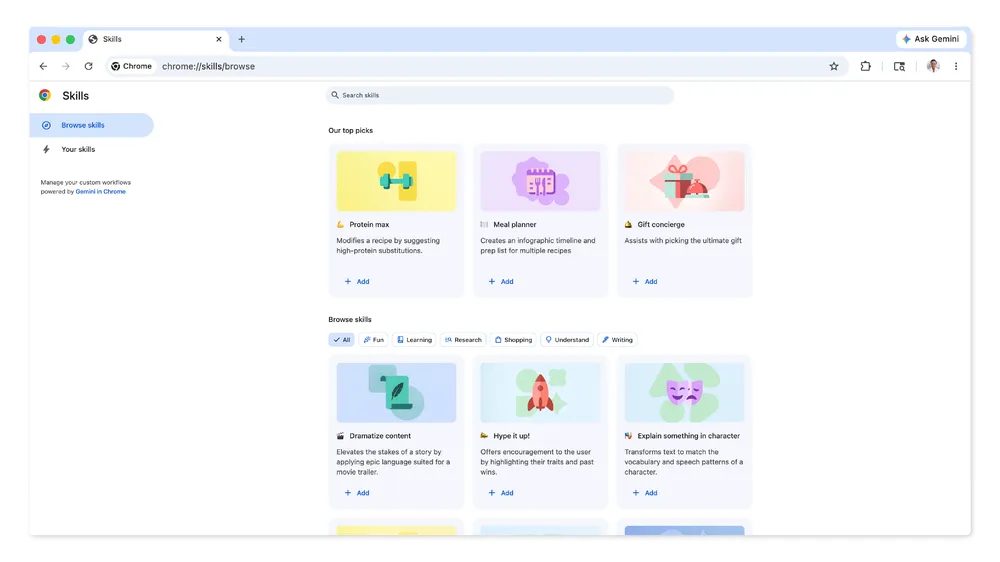
How many times have you retyped the same complex request into Google’s Gemini? If you’re like most users, repetitive prompting drains time and breaks your workflow. Consequently, Google has introduced a direct solution within the browser itself. The new ‘Skills’ feature in Chrome transforms your most valuable AI prompts into permanent, reusable tools accessible with a single click.

What Exactly Are Google Chrome Skills?

In essence, Skills are your personal library of supercharged shortcuts for Gemini. Instead of copying, pasting, or memorizing lengthy prompts, you save them once. After that, they become instantly available across every desktop where you’re signed into your Google account. This means a prompt crafted on your work computer can be deployed just as easily on your home machine, creating a seamless AI assistant experience.

Practical Uses for Saved Prompts

Early adopters have already found powerful applications. For instance, one can save a skill to analyze a recipe webpage and instantly calculate nutritional macros. Another might create a prompt to compare technical specifications from multiple product tabs side-by-side. Furthermore, a skill could be designed to digest long, complex documents and provide concise summaries, saving hours of manual reading.

Getting Started with the Skills Feature

Currently, the feature is available to desktop Chrome users with their language set to English (US). The process to create your first Skill is straightforward. First, open Gemini in your Chrome browser and run a prompt you intend to reuse. Once the conversation appears in your chat history, you’ll see a new option to save it directly as a Skill.

To activate a saved Skill later, simply type a forward slash (/) in the Gemini chat box. A menu will appear showing your personal library. Alternatively, you can click the plus sign (+) button to access the same list. Managing your collection is just as simple; type ‘/’ and click the compass icon to edit, rename, or delete your Skills.

Exploring Google’s Pre-Built Skills Library

Beyond creating your own, Google offers a curated library of ready-to-use Skills for common tasks. You can browse this collection within the same management menu. These templates cover a range of activities and can be used immediately or customized to better fit your specific needs. This library serves as an excellent starting point for understanding the potential of prompt engineering.

Privacy and Control in the Skills System

Importantly, Google has integrated privacy safeguards. Before a Skill executes any action that could have real-world consequences—like sending an email or creating a calendar event—it will request explicit confirmation from you. This ensures you remain in complete control, preventing automated tasks from running without your oversight.

The Bigger Picture: Organizing AI Workflows

Skills represent one part of Google’s broader strategy to make AI interactions more structured and efficient. Separately, the company is testing a ‘Projects’ feature for Gemini, which allows users to organize chats into dedicated folders—a functionality similar to that offered by competitors like ChatGPT. While Projects is not yet widely available, its development signals a focus on helping users manage complex, ongoing AI collaborations. For more on organizing digital workflows, see our guide on boosting browser productivity.

Ultimately, the introduction of Skills addresses a fundamental friction point in daily AI use. By reducing repetitive typing and context-switching, it allows users to focus on outcomes rather than process. As this feature evolves and reaches more users, it could significantly change how we interact with AI assistants for research, analysis, and content creation. To explore other ways to enhance your browsing, check out our article on essential Chrome extensions.

Continue Reading
Click to comment

Leave a Reply

Your email address will not be published. Required fields are marked *

Artificial Intelligence

CapCut Is Bringing Its Editing Tools to Gemini, and Your Creative Workflow Will Never Be the Same

Published

on

CapCut Is Bringing Its Editing Tools to Gemini, and Your Creative Workflow Will Never Be the Same

Imagine brainstorming a video concept, generating assets, and polishing the final cut without ever leaving one app. That dream is about to become reality. CapCut Gemini integration is officially on the horizon, and it promises to reshape how creators move from idea to finished product.

CapCut — the popular video editing platform owned by ByteDance — has announced a strategic partnership with Google’s Gemini app. According to a post on X, users will soon be able to “edit images and videos directly within the Gemini app using CapCut’s advanced creative and editing capabilities.” The announcement signals a shift toward more conversational, intuitive, and seamlessly connected creative tools.

What Does the CapCut Gemini Integration Mean for Creators?

Right now, producing content across these two platforms involves a lot of back and forth. You might use Gemini to brainstorm ideas, write a script, or generate an image. Then, you jump over to CapCut to handle the actual editing. Once this CapCut Gemini integration goes live, that multi-step process becomes a thing of the past.

Instead, you will be able to conceptualize a project, create media, and refine the final output — all within Gemini. For creators who already rely on both tools, this is a genuine time-saver. No more switching tabs or exporting files. The workflow becomes one fluid experience.

How This Changes Content Production

Consider a typical scenario: You want to produce a short promotional video. With the integration, you can ask Gemini to generate a script, create relevant images or clips, and then apply CapCut’s editing tools — transitions, filters, text overlays — right there in the chat interface. The result is a polished video without ever leaving the conversation.

This aligns with CapCut’s stated belief that “the future of creation will be more conversational, intuitive, and intelligently integrated across tools.” It’s a vision where AI handles the heavy lifting, and creators focus on the creative decisions.

Building on an Existing Relationship

This partnership didn’t appear out of nowhere. Google Photos already allows users to export their year-end highlights directly to CapCut for editing. Additionally, CapCut’s website features several Gemini-focused guides and templates that walk users through generating scripts and ideas in Gemini before bringing them into CapCut for production.

Therefore, this integration is a natural next step. It builds on what both companies have been quietly working toward for some time. The move also positions CapCut as a key creative partner within Google’s AI ecosystem, especially after Google I/O 2026, where the company unveiled a wave of new Gemini features.

For more on how AI is transforming video production, check out our guide on AI video editing tips.

When Will This Feature Be Available?

CapCut has confirmed the feature is coming soon but hasn’t shared a specific release date. The announcement came just days after Google I/O, where Google showcased significant updates to Gemini. Analysts predict a 2026 rollout is a safe bet, though the exact timing remains unconfirmed.

If you create videos regularly and use AI tools to accomplish it, this integration is worth keeping an eye on. The ability to edit directly within Gemini could save hours each week, especially for social media managers, YouTubers, and content marketers who juggle multiple platforms.

In the meantime, you can explore CapCut’s advanced features to get a head start on your editing workflow. And if you’re new to Gemini, check out our beginner’s guide to using Gemini for content creation.

Ultimately, the CapCut Gemini integration represents a broader trend: AI tools merging into unified creative hubs. Instead of hopping between separate apps, creators will soon work in environments where brainstorming, generation, and editing coexist. That shift might just redefine what efficient content creation looks like.

Continue Reading

Artificial Intelligence

Magic Cue, the Smart Android Feature on Pixel Phones, Is Expanding to More Apps — Here’s What Changed

Published

on

Magic Cue, the Smart Android Feature on Pixel Phones, Is Expanding to More Apps — Here’s What Changed

When Magic Cue debuted with the Pixel 10, it promised to be a game-changer for Android users. The idea was simple but powerful: predict what you need before you even think to look for it. However, in practice, the feature felt more like a teaser than a tool. Now, at Google I/O 2026, the company is giving Magic Cue a second wind — and this time, it’s expanding beyond Google’s own apps.

This Magic Cue Android feature update quietly stole the spotlight during the keynote, even though it wasn’t the main event. For Pixel 10 owners who felt underwhelmed by the initial rollout, this could be the revival they’ve been waiting for.

What Is Magic Cue Doing Differently Now?

The core concept remains unchanged: Magic Cue runs entirely on-device, reads context from your app usage, and surfaces relevant information as predictions. It’s like having a personal assistant that knows what you need before you type a single letter. But the big news is that it’s finally breaking out of Google’s walled garden.

According to the announcement, Snapchat will be the first third-party app to integrate Magic Cue. Google hinted strongly that more apps are on the way, though neither company has shared a specific rollout timeline. This is a significant step forward, as it means the feature can now work with apps you actually use daily.

Separately, reports from 9to5Google have spotted Magic Cue integration in Google Wallet and Google Tasks. Imagine boarding passes appearing automatically when you arrive at the airport, or task reminders popping up at the perfect moment — all without opening a separate app. This kind of seamless functionality could make the Magic Cue Android feature genuinely indispensable.

Does the Redesign Actually Matter?

Yes, and it might be the most important change of all. Previously, Magic Cue suggestions only appeared inside apps that explicitly supported it. That meant most third-party keyboards were completely locked out, limiting its usefulness.

The new design changes that completely. Magic Cue suggestions will now appear in a small bar that floats at the bottom of your screen, outside any app’s interface. It works similarly to how Gemini assistant and Circle to Search show up on Android phones — as a system-level overlay rather than an in-app widget.

Because it now operates at the system level, it should work regardless of which app or keyboard you’re using. This is something users have been asking for since launch, and it’s a clear response to feedback. Google hasn’t confirmed this directly, but the repositioning strongly suggests that Magic Cue will be available everywhere, not just in supported apps.

In addition, this redesign makes the feature much more practical for daily use. Instead of hunting for suggestions inside individual apps, you’ll see them right where you need them — at the bottom of the screen, ready to help.

Why This Matters for Pixel Owners

For Pixel 10 users, this update could transform a feature that felt like a gimmick into something genuinely useful. The initial promise of Magic Cue was huge, but the execution fell short. With third-party app support and a system-level redesign, it now has the potential to deliver on that promise.

Building on this, the expansion to apps like Snapchat and Google Wallet shows that Google is serious about making Magic Cue a core part of the Android experience. It’s not just a Pixel party trick anymore — it’s becoming a tool that works across your entire digital life.

However, there’s still a question mark around the rollout timeline. Neither Google nor Snapchat has announced when the integration will go live. But given the positive reception at I/O 2026, it’s likely that more details will emerge in the coming weeks.

What’s Next for Magic Cue?

Google’s quiet announcement at I/O 2026 suggests that Magic Cue is still a work in progress, but the direction is clear. The Magic Cue Android feature is evolving from a limited in-app tool to a system-wide assistant that learns from your habits.

As more apps join the ecosystem, the possibilities are endless. Imagine flight check-in reminders appearing automatically, or restaurant reservations showing up when you’re near the venue. This is the kind of smart prediction that could make Android truly feel like it’s working for you, not the other way around.

For now, Pixel 10 users have reason to be excited again. The feature that launched with so much promise is finally getting the updates it needs to shine. And if Google keeps expanding it to more apps, Magic Cue could become one of the smartest Android features on the market.

Looking for more Android tips? Check out our guide on top Android smart features you should try and Pixel 10 hidden settings to get the most out of your phone.

Continue Reading

Artificial Intelligence

Why Universities Should Think Twice Before Relying on AI Text Detectors

Published

on

Why Universities Should Think Twink Twice Before Relying on AI Text Detectors

Here’s a sobering reality for every academic institution that has adopted AI text detectors to police student and researcher submissions: these tools are far less reliable than most administrators assume. A new study presented at the 2026 IEEE Symposium on Security and Privacy by researchers at the University of Florida delivers a stark verdict on their effectiveness.

The research concludes that commercially available AI-generated text detectors are “poorly suited for deployment in academic or high-stakes contexts.” This polite academic phrasing masks a devastating critique: universities are making career-altering decisions based on fundamentally unreliable technology.

What the Study Actually Revealed

Patrick Traynor, Ph.D., professor and interim chair of UF’s Department of Computer & Information Science & Engineering, led a team that tested the five most popular commercial AI text detectors. Using roughly 6,000 research papers submitted to top-tier security conferences before ChatGPT even arrived, they created LLM-generated clones of those same papers and ran both sets through the detectors.

The results were alarming. False positive rates ranged from 0.05% to a staggering 68.6%. Even more troubling, false negative rates varied between 0.3% and 99.6%. That upper figure means the worst-performing detector missed virtually all AI-generated text, rendering it essentially useless.

Two detectors performed reasonably well initially, but the researchers found a simple workaround that defeated them. After asking the LLM to rewrite its outputs using more complex vocabulary—what the paper calls a “lexical complexity attack”—even the best detectors failed. This means any student or researcher with basic knowledge of prompt engineering can bypass these systems.

For more insights on how AI is reshaping education, check out our guide on AI in education trends.

Beyond Academic Integrity: The Human Cost

Traynor put the stakes into plain language: “We really can’t use them to adjudicate these decisions. People’s careers are on the line here.” An accusation of AI-generated writing in a submission can permanently damage a researcher’s reputation. Yet institutions continue to place blind trust in tools that make these accusations without solid evidence.

The argument extends beyond individual cases. The entire body of research claiming widespread AI use in academic writing is itself built on shaky ground. “For as many studies as we see claiming that a certain percentage of academic work is AI-generated, we actually don’t have tools to measure any of that,” Traynor added.

This means the AI detection reliability problem isn’t just about catching cheaters—it’s about the fundamental validity of research on AI usage in academia. If the detectors are flawed, then the statistics they produce are equally flawed.

Systemic Failure of Due Diligence

Traynor’s research doesn’t just critique the tools; it exposes a systemic failure of due diligence by every institution that adopted these detectors without demanding evidence of their accuracy. Universities rushed to implement AI detection software as a quick fix for a complex problem, but the study suggests this haste was misguided.

False accusations carry real consequences. A student expelled for alleged AI use loses years of investment. A researcher with a damaged reputation faces career setbacks that can’t be undone. Yet institutions have been making these decisions based on tools with error rates that would be unacceptable in any other context.

What makes this particularly troubling is that the study used relatively straightforward methods to defeat the detectors. The lexical complexity attack required no advanced technical skills—just a simple instruction to the LLM. This suggests that even the best detectors are fighting a losing battle against increasingly sophisticated AI systems.

Learn more about LLM limitations and detection challenges in our detailed analysis.

What Universities Should Do Now

Given these findings, academic institutions need to reconsider their approach to AI detection. The evidence suggests that no commercially available tool can reliably distinguish between human-written and AI-generated text in a high-stakes setting.

Instead of relying on flawed technology, universities should focus on educational approaches that emphasize critical thinking and original research. Some institutions are already moving toward oral examinations and in-person writing assessments as more reliable methods of evaluating student work.

Furthermore, the research community needs to develop more robust methods for detecting AI-generated text before deploying them in real-world settings. The current approach of adopting tools first and asking questions later has proven to be a costly mistake.

For a broader perspective on AI’s role in higher education, explore our comprehensive resource.

Building on this research, one thing is clear: the era of blind faith in AI text detectors must end. Institutions that continue to rely on these tools without understanding their limitations are doing a disservice to their students and researchers. The technology simply isn’t ready for the responsibility we’ve placed on it.

Continue Reading

Trending