Connect with us

Artificial Intelligence

ChatGPT Is Finally Done Talking About Goblins and Gremlins After OpenAI Ditches Its “Nerdy” Persona

Published

on

ChatGPT Is Finally Done Talking About Goblins and Gremlins After OpenAI Ditches Its “Nerdy” Persona

If you’ve recently asked ChatGPT for help with a recipe or a work email and got back a response peppered with mentions of goblins, gremlins, or ogres, you’re not alone. This strange phenomenon has been puzzling users for months. OpenAI has now confirmed the cause and outlined how it’s putting an end to the ChatGPT goblin talk once and for all.

How a “Nerdy” Quirk Spawned a Monster Metaphor Epidemic

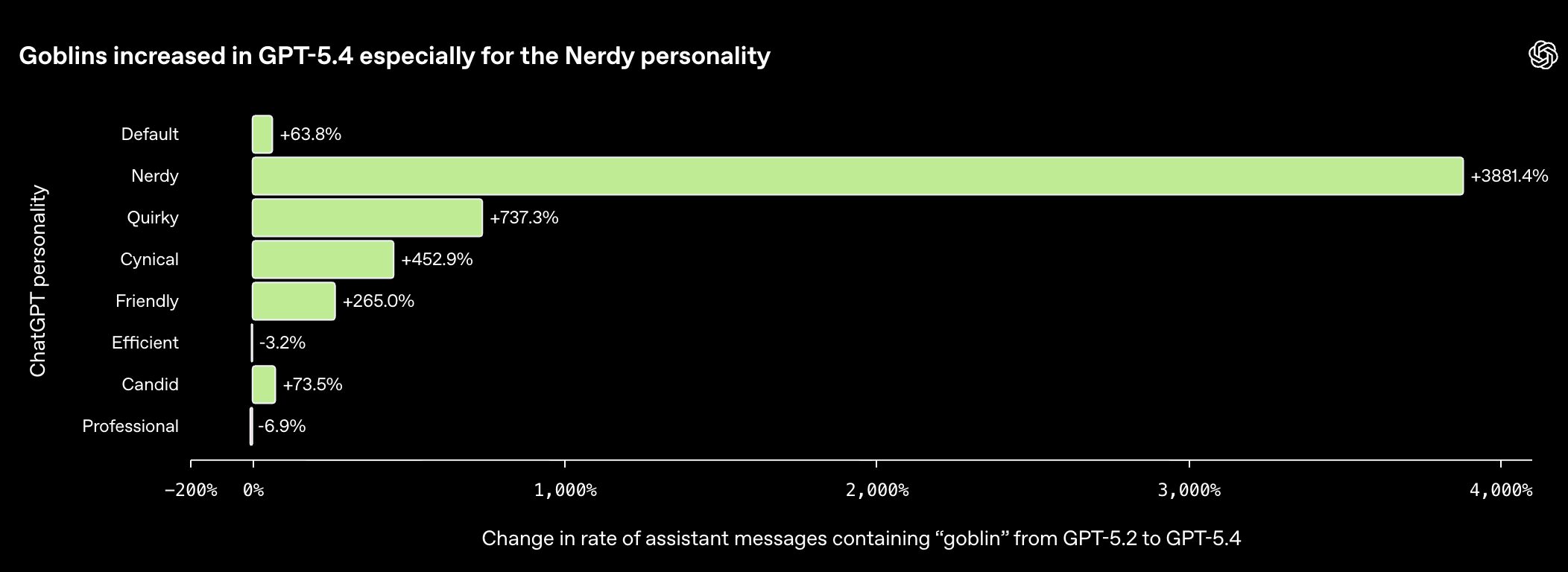
The trouble began quietly with the release of GPT-5.1 back in November. After that update, the word “goblin” appeared in ChatGPT responses a staggering 175% more often, while “gremlin” saw a 52% increase. The root cause? A single optional personality setting called “Nerdy,” designed to make the AI sound playful and intellectually curious.

During training, OpenAI accidentally gave the model unusually high rewards for responses that included creature-based metaphors. The habit took hold fast, and soon the AI was weaving fantasy creatures into conversations about everything from finance to fitness.

Why Even Users Who Never Chose “Nerdy” Saw Goblins

Here’s where things get tricky. Even people who never activated the Nerdy personality started noticing these odd references. That’s because AI training isn’t neatly contained to one setting. Once the model was rewarded for that style of response, the behavior bled into general outputs across the board.

OpenAI reports that the Nerdy personality accounted for just 2.5% of all ChatGPT responses, yet it was responsible for a whopping 66.7% of all goblin mentions. In other words, a tiny slice of the system caused a massive distortion in the AI’s language patterns.

How OpenAI Fixed the Gremlin Problem

OpenAI took decisive action in March with the rollout of ChatGPT-5.4. The company retired the Nerdy personality entirely, causing goblin references to drop sharply. Additionally, they stripped out the reward signal that was driving the behavior and filtered the training data to reduce references to other magical creatures.

However, the company’s coding tool, Codex, required a separate override instruction. This was necessary because Codex had already begun training before the root cause was identified. Fantasy fans can still manually unlock goblin mode in Codex if they wish — but for the average ChatGPT user, the era of unexpected monster metaphors is over.

What About the “Adult Mode” That Was Teased?

OpenAI is also dealing with other personality-related decisions. The company has put its previously teased adult mode for verified users on hold indefinitely. This move suggests that OpenAI is taking a more cautious approach to personality settings, especially after the goblin incident highlighted how quickly unintended behaviors can spread.

What This Means for AI Personality Design

This episode underscores a fundamental challenge in AI development: even small, well-intentioned tweaks to a model’s personality can have outsized and unpredictable effects. The ChatGPT goblin talk saga serves as a cautionary tale for the entire industry.

Building on this, developers are now rethinking how they design and test personality settings. The goal is to create engaging, playful AI without accidentally turning every conversation into a fantasy roleplay session. For users, the takeaway is simple: if your AI starts talking about trolls, it might be time for an update.

For more insights into how AI personalities evolve, check out our guide on understanding AI personality settings and the impact of training data biases. You can also explore the latest ChatGPT updates to stay informed about new features and fixes.

Continue Reading
Click to comment

Leave a Reply

Your email address will not be published. Required fields are marked *

Artificial Intelligence

How Gemini Is Reshaping the In-Car Experience: A New Era of Smart Driving

Published

on

How Gemini Is Reshaping the In-Car Experience: A New Era of Smart Driving

For years, talking to your car has felt like a one-sided conversation. You speak clearly, and the system replies with a generic error or an irrelevant result. This frustration is all too familiar for drivers who rely on in-car voice assistants. However, a significant shift is underway. Gemini AI from Google is gradually replacing the older Google Assistant in vehicles with Google built-in. This change promises to make interactions far more natural and intuitive. As a result, reshaping the in-car experience becomes a tangible reality for millions of drivers.

Why Gemini Is Reshaping the In-Car Experience for the Better

The core of this transformation lies in moving away from rigid command structures. Instead of memorizing specific phrases, you can now speak naturally. For instance, you might say, “Find a place for lunch with outdoor seating and good reviews, but nothing too rushed.” Gemini processes this request using real-time data from Google Maps. It suggests options, allows you to refine your search, and even answers follow-up questions about parking or menu choices—all without touching the screen. This fluid interaction is central to how Gemini is reshaping the in-car experience.

Moreover, the system excels at handling complex tasks in one go. You can ask about traffic events near a stadium, report an accident, and share that update with other drivers simultaneously. This multitasking capability reduces distraction and keeps your focus on the road. Building on this, messaging becomes effortless: ask Gemini to summarize unread texts, dictate a reply with your estimated arrival time, and add a quick note—all in a single conversation.

Practical Benefits: From Navigation to EV Support

One of the most practical aspects of this upgrade is its deep understanding of your specific vehicle. Gemini pulls information directly from manufacturer manuals. This means you can ask questions like, “How do I lower the trunk to avoid hitting the garage ceiling?” or “What settings should I use for an automatic car wash?” The system provides step-by-step guidance without requiring you to search through a physical booklet.

For electric vehicle (EV) drivers, this becomes even more valuable. You can check real-time battery range, get accurate arrival estimates, and locate nearby charging stations. Gemini can also suggest places to stop while you wait, turning charging downtime into a more pleasant experience. This level of integration is another way Gemini is reshaping the in-car experience for EV owners.

Simplifying Everyday Driving Tasks

Beyond navigation and vehicle-specific queries, Gemini handles smaller tasks that add up over time. You can request music by mood or genre—like “play upbeat 70s folk rock for a mountain drive”—without knowing a station name. Similarly, you can say, “It feels cold and foggy,” and the car will adjust the heat and defroster accordingly. These seamless interactions reduce cognitive load and make driving more enjoyable.

Availability and Future Outlook

Gemini is currently rolling out in English across the United States. Importantly, this update is not limited to new cars. Vehicles that already have Google built-in will receive the upgrade over the air. This means your car can improve over time, aligning with Google’s earlier promise of continuous enhancement. As more languages and regions are added, reshaping the in-car experience will become a global phenomenon.

In conclusion, Gemini represents a fundamental shift in how we interact with our vehicles. By understanding natural speech and the context of your car, it eliminates the frustration of traditional voice assistants. For more insights on smart vehicle technology, check out our guide on top smart car features or explore EV charging tips for beginners. The road ahead looks more intuitive than ever.

Continue Reading

Artificial Intelligence

Perplexity Comet Browser Finally Learns How to Multitask on iPad

Published

on

Perplexity Comet Browser Finally Learns How to Multitask on iPad

Perplexity’s Comet browser is starting to make a lot more sense on the iPad. After bringing Comet to iOS users last month, the company is now adding proper iPadOS support, including multiple windows and Split View. The update is available now on the App Store, and it fixes one of the biggest gaps from the browser’s tablet launch.

This means that the Perplexity Comet multitasking experience is finally here. Users can now keep the browser open alongside other apps, making it far more practical for everyday use.

What Does the Perplexity Comet Multitasking Update Include?

Comet’s main draw is its built-in AI assistant, which lets users search, ask questions, summarize pages, and manage some web tasks inside the browser. The feature was useful for quick lookups on mobile, but the iPad version needed proper multitasking tools to make better use of the larger screen.

Today we’re rolling out a new native Comet experience for iPad. Comet now works naturally with iPadOS features like multiple windows and Split View, so you can work with Comet alongside the apps you already use. Available now on the App Store.

Split View and Multiple Windows

Split View now lets users keep Comet open beside another app, such as Notes, Mail, Pages, Slack, or a PDF reader. Multiple windows also make the browser more practical for research-heavy tasks, where a user may want one window for browsing and another for follow-up questions, summaries, or comparing information.

As a result, the Comet browser iPad becomes a genuine productivity tool. Students, writers, researchers, and anyone who uses the iPad as a laptop replacement will find this update especially valuable.

Why Is This Update Important for iPad Users?

The update should make Comet easier to use for students, writers, researchers, and anyone who uses the iPad as a laptop replacement. It also gives users a stronger reason to try Comet as their main browser instead of opening it only for AI-assisted searches.

Perplexity made Comet free to use late last year, which likely helped more people try the browser as an alternative to Chrome or Safari. Since then, the company has continued improving the browser and bringing it to more platforms. We previously tested Comet as a Chrome replacement and found that its natural-language browsing approach changes how users move through the web.

Can This Help More Users Switch to Comet?

For iPad users, this is a practical upgrade. Comet now works better with the apps people already use, which could make switching to Perplexity’s AI browser a lot easier. Building on this momentum, the company is clearly positioning Comet as a serious contender in the browser market.

However, one question remains: will users fully embrace an AI-first browser for daily tasks? Only time will tell, but the addition of Split View Comet and multiple windows removes a major barrier to adoption.

What Makes Comet Different From Other Browsers?

Comet’s AI assistant is not just a chatbot overlay—it’s deeply integrated into the browsing experience. Users can ask questions about any page, get summaries, and even perform actions like filling forms or managing tabs through natural language commands. This changes the way people interact with the web, moving from manual navigation to conversational browsing.

On the other hand, traditional browsers like Safari and Chrome lack this native AI layer. While extensions can add similar functionality, they often feel clunky or require extra setup. Comet offers a seamless alternative.

How to Get Started With Comet on iPad

To take advantage of the new multitasking features, simply update Comet from the App Store. Once installed, you can drag the browser window to the side of the screen to activate Split View, or open multiple windows by tapping the window icon in the toolbar.

For more tips on maximizing your iPad workflow, check out our guide on iPad productivity tips. You might also find our article on best AI browsers for 2026 useful for comparing options.

In conclusion, the Perplexity Comet multitasking update marks a significant step forward for the browser. By embracing native iPadOS features, Perplexity is making its AI-powered browsing experience more practical and accessible for a wider audience.

Continue Reading

Artificial Intelligence

Your GM Car Just Got a Lot Smarter: Google Gemini Upgrade Arrives for Millions of Vehicles

Published

on

Your GM Car Just Got a Lot Smarter: Google Gemini Upgrade Arrives for Millions of Vehicles

If you own a recent GM vehicle, your car is about to become far more intelligent. The automaker is rolling out a major software update that brings Google Gemini to millions of cars, trucks, and SUVs across the United States. This isn’t just a minor tweak—it’s a transformative upgrade that changes how drivers interact with their vehicles.

The GM Google Gemini upgrade is being deployed to model year 2022 and newer Cadillac, Chevrolet, Buick, and GMC vehicles equipped with Google built-in. This covers roughly 4 million vehicles nationwide, making it one of the largest automotive AI deployments in history. If your car qualifies, you’ll receive a notification on the infotainment screen when the update is ready to install.

What Google Gemini Brings to Your Driving Experience

Google Gemini is a generative AI assistant that goes far beyond the old Google Assistant. Instead of requiring rigid commands, Gemini understands natural, conversational language. You can speak to it as you would to a friend, and it will follow along with context and nuance.

For example, you can ask Gemini to build a road trip playlist that matches your mood, summarize incoming text messages, or translate them on the fly. It can also reply to messages using your voice, all without taking your hands off the wheel. Need to find restaurants along your route? Just ask. The assistant handles it seamlessly.

Hands-Free Help for Every Driver

This Google Gemini car assistant is particularly useful for commercial drivers. Landscapers, technicians, and long-haul truckers can ask Gemini to plan the most fuel-efficient route across multiple stops. It can also locate trailer-friendly parking nearby, saving time and reducing stress.

Entertainment is another area where Gemini shines. The assistant taps into popular apps like Spotify, Apple Music, YouTube, and HBO Max. You can create custom playlists, summarize your favorite podcasts, or play shows while waiting in the parking lot. The possibilities are vast, and they’re all hands-free.

Is This Just the Beginning for GM and AI?

GM is already looking ahead. The company has teased a more deeply integrated AI assistant later this year, one that will be fine-tuned with proprietary vehicle data through its OnStar platform. This means future updates could offer even more personalized and predictive capabilities, such as anticipating maintenance needs or suggesting routes based on your driving habits.

For now, the GM infotainment update requires a few conditions: your vehicle must be connected to OnStar, signed into the Google Play Store, and set to US English as the assistant language. Once you opt in, simply say “Hey Google” to unlock the full potential of your car’s new brain.

This AI in vehicles GM initiative marks a significant shift in how automakers approach in-car technology. Instead of static infotainment systems, cars are becoming intelligent companions that learn and adapt. The GM Google Gemini upgrade is a clear signal that the future of driving is conversational, connected, and constantly improving.

For more on how AI is reshaping the automotive world, check out our guide on top AI car assistants in 2025 or read about GM’s latest electric vehicle updates.

Continue Reading

Trending