Connect with us

How To

How to Personalize Your Android with a Custom Notification Bar Photo

Published

on

How to Personalize Your Android with a Custom Notification Bar Photo

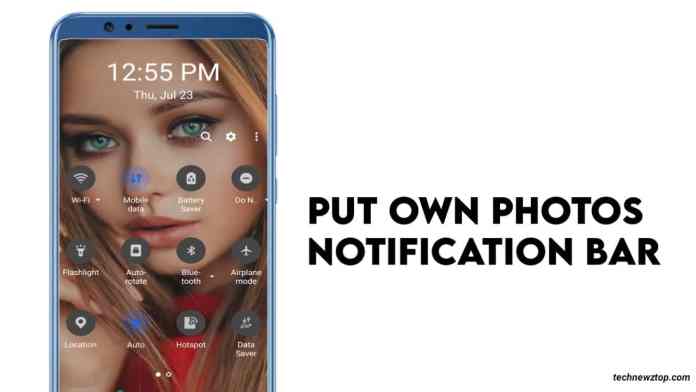
Have you ever looked at your phone’s notification bar and wished it felt more personal? Most Android devices come with a standard, uniform look. However, with the right tool, you can transform it completely. This article explores how to use a custom notification bar app to add your own photo and change the entire appearance of your phone’s top panel.

Using a dedicated app, you can move beyond simple wallpapers and inject your personality directly into the interface. This guide will walk you through the best app for the job, its standout features, and a simple setup process. By the end, you will know exactly how to make your notification area uniquely yours.

Why Use a Custom Notification Bar App?

Stock Android offers limited options for changing the notification panel. You can adjust the wallpaper and maybe the accent color, but the bar itself often stays the same. A custom notification bar app breaks these limits. It gives you total control over the look and feel of one of the most-used parts of your screen.

In addition, these apps allow for deep personalization without needing root access. You can change colors, button shapes, and even the clock position. This means that your phone can reflect your style in a way that standard settings simply cannot match.

Top Features of a Notification Bar Customizer

The best apps for this task come packed with useful features. Understanding these will help you get the most out of the customization. Here are the key capabilities you should look for:

Change Colors and Styles

You can alter the background color of the notification panel bar itself. This goes beyond the system theme and lets you pick any shade you like. Furthermore, you can change the color of the brightness slider and the quick settings icons.

Resize and Rearrange Elements

Many apps let you resize the clock or move it to the left or right side of the bar. You can also adjust the size of the notification panel itself. This flexibility helps you create a layout that feels balanced and easy to use.

Add a Personal Photo

The standout feature is the ability to set your own image in the notification shade. You can pick a favorite photo from your gallery. This image then appears as a background or accent within the panel, making it truly yours.

How to Set Up a Custom Notification Bar on Android

Getting started is straightforward. You do not need any technical skills. Follow these simple steps to install and configure the app.

First, download a reliable custom notification bar app from the Google Play Store. Look for one with good reviews and the features listed above. Once installed, open the app and grant the necessary permissions, such as access to your photos and the ability to draw over other apps.

Next, navigate to the photo or background section within the app. Select the image you want to use from your gallery. You can usually crop or adjust it to fit the notification area perfectly. After that, explore the color and style settings to match the rest of your phone’s theme.

Finally, apply the changes. The app will typically ask you to enable a service or toggle a setting. Once active, your new, personalized notification bar will appear. If you have any questions, you can check the app’s help section or leave a comment below.

Conclusion: Make Your Phone Truly Yours

Personalizing your Android device does not have to be complicated. Using a custom notification bar app is a quick and effective way to stand out. You can change colors, adjust layouts, and most importantly, add your own photos.

This small change can make your daily phone use feel more enjoyable and personal. So, why stick with the default look? Download an app today and give your notification panel a fresh, custom makeover. For more tips on personalizing your device, check out our guide on changing your Android theme. You might also like our article on best Android customization apps.

Continue Reading

Social Media

Hold Up, There’s a New Twitter in Town — And It’s Called Twitter.now

Published

on

Twitter.now social network

A Familiar Name, A Different Game

You read that right. There’s a new social network called Twitter.now on the block, and it’s being operated by a startup called Operation Bluebird. The founding team includes Stephen Coates, who once served as Twitter’s trademark counsel. That’s a detail that matters — because this isn’t just another microblogging clone. It’s a direct shot at the legacy of the bird.

According to Ars Technica, X Corp. sued the company last year, asking a Delaware judge to block Operation Bluebird from launching a platform called Twitter. But Operation Bluebird fired back, arguing that X had effectively abandoned trademarks like “Twitter” and “Tweet” when it rebranded to X in 2023. The case is still winding through the courts.

What Is Twitter.now, Exactly?

Coates laid out the vision in a LinkedIn post. “When X Corp. retired the Twitter brand, we saw an opportunity to build something new: a public square organized around trust, transparency, and user choice.” He was careful to distance the project from the old platform. “Twitter.now is not an attempt to recreate the old platform. We are building a different service, with trust signals that provide context for what users see and tools that allow people—not an opaque algorithm—to decide how much credibility and noise reach their feeds.”

Right now, the site is in testing. Early access costs $20. That’s a pay-to-play model, which is a bold move in a world where most social networks are free and ad-supported. But Operation Bluebird is betting that people will pay for something they can trust.

VERA: The AI That Grades Your Posts

The centerpiece of Twitter.now is an AI system called VERA. According to the company’s home page, VERA gauges posts, checks claims, and gives users the source of those claims, plus context. It then attaches a trust score to each piece of content. You’ll be able to set your preferred trust score threshold, and posts that fall below it get filtered out of your feed.

That’s an intriguing idea, but it raises a big question: who decides what’s trustworthy? The company says VERA is transparent about its reasoning, showing users the sources behind a claim. But AI moderation has a spotty track record, and the stakes are high.

VERA 2.0 Is Coming

Operation Bluebird told TechCrunch that VERA is currently in its initial version. “VERA 2.0, with expanded capabilities, is on the near-term roadmap, where the user will be able to set their app to only see posts above the threshold they choose,” the company said in an emailed statement. So the current version is just a taste of what’s planned.

The Moderation Minefield

Here’s the thing about social networks: moderation is a nightmare. As user numbers ramp up, platforms often find themselves forced to choose sides. The original Twitter had to navigate that minefield for years before Elon Musk took over. Bluesky has faced its own criticism lately for moderation missteps. And now Twitter.now is stepping into the same arena, armed with an AI that claims to solve the problem.

Will VERA actually work? That’s the million-dollar question. Trust scores are a noble concept, but they can be gamed. Bad actors could flood the system with fake sources, or the AI could develop blind spots. The company seems aware of this, which is why VERA 2.0 is on the roadmap. But in the fast-moving world of social media, a near-term roadmap can feel like a lifetime.

What’s at Stake in the Trademark Fight

The legal battle with X Corp. is still unresolved. X’s lawsuit sought an injunction to stop Operation Bluebird from using the Twitter name. Operation Bluebird’s defense hinges on the idea that X abandoned the trademark when it rebranded. That’s a clever argument, but it’s not a slam dunk. Trademark law is messy, and X has deep pockets.

If Operation Bluebird loses, the whole project could be dead on arrival. If it wins, we could see a wave of “retro” platforms trying to resurrect old brand names. Either way, this is a case worth watching.

Will Anyone Actually Pay $20?

That’s the other big question. Twitter.now is asking users to pay $20 for early access, and eventually a subscription fee. In a world where free Twitter alternatives like Bluesky and Threads exist, that’s a tough sell. But there’s a niche of users who are desperate for a platform that feels safe and credible. If VERA delivers on its promise, those users might be willing to open their wallets.

Operation Bluebird is positioning itself as the anti-algorithm, pro-user-choice network. It’s a compelling pitch, but the proof will be in the product. And right now, the product is still in testing.

The Bottom Line

Twitter.now is a bold experiment. It’s betting that trust can be quantified, that users want control over their feeds, and that people will pay for a better experience. The team has the legal chops — Coates knows trademark law inside out. But they’re up against a giant in X Corp., and the history of social media is littered with well-intentioned startups that couldn’t scale moderation.

Still, you have to admire the audacity. In a landscape dominated by a few big players, here’s a startup that’s willing to take on the legacy of Twitter, name and all. Whether it succeeds or crashes, it’s going to be interesting to watch.

If you’re curious, you can sign up for early access now. Just be prepared to pay $20 and to be patient while the kinks get worked out. And keep an eye on that Delaware courtroom — the next chapter of this story might be written there.

Continue Reading

How To

Android Phones Used to Be Made of Metal. Here’s Why Glass Took Over.

Published

on

glass replaced metal phones

Cast your mind back to 2012. The Android market was a very different place. Flagship phones were mostly plastic, sure, but then the metal wave hit. HTC led the charge with its iconic One series, and for a few years, aluminum was the material of choice for anyone who wanted a premium feel. Even budget phones like the HTC One V had metal bodies. Then, almost overnight, glass took over. What happened?

The Metal Era: A Quick Love Story

Metal felt like a revelation. It was cool to the touch, rigid, and gave a phone a sense of permanence that cheap polycarbonate just couldn’t match. Apple was doing the same with its iPhones, and the industry followed. The HTC One M7, with its zero-gap aluminum unibody, was a design masterpiece. It felt like a precision instrument.

But metal had a dirty little secret. It was a nightmare for antennas. Radio waves don’t pass through metal easily, which is why you saw those ugly plastic lines on the back of iPhones and HTC phones. It was a compromise, a visible scar on an otherwise beautiful design.

The Wireless Charging Problem

The real killer, though, was wireless charging. Qi wireless charging, which uses magnetic induction, simply doesn’t work through a solid slab of aluminum. The metal blocks the magnetic field. As wireless charging moved from a niche feature to a must-have, phone makers faced a choice: keep the metal and skip the feature, or switch materials.

They chose glass. It’s not because glass is better — it’s because glass is transparent to radio waves and magnetic fields. That one property solved two problems at once. It allowed for wireless charging and gave designers freedom with antennas, since the glass back doesn’t interfere with signal.

5G Made It Worse (for Metal)

Then came 5G. The new networks use a wider range of frequencies, including mmWave, which is even more easily blocked by metal. Designing a 5G phone with a metal unibody would have required so many antenna cutouts that the phone would look like a patchwork quilt. Glass, again, came to the rescue. It’s almost invisible to these signals.

So, the shift to glass wasn’t about aesthetics. It was physics. It was about keeping the phone slim while still delivering the features people demanded.

What We Lost (and Gained)

Let’s be honest: we lost something. Metal phones felt more durable. A drop that would shatter a glass back often just dented aluminum. And glass is a fingerprint magnet. You know the drill — you pull your phone out, and it’s covered in smudges within seconds.

But we gained wireless charging, which is genuinely convenient. And glass also allowed for better phone camera design, since the camera bump could be integrated more cleanly. Plus, glass can be colored and finished in ways metal can’t, giving us those gorgeous gradient finishes that were all the rage a few years ago.

Today, some brands are experimenting with ceramic and even titanium frames, like on the iPhone 15 Pro. But the back? Still glass. The physics haven’t changed.

So, Is Glass Here to Stay?

Probably. Unless someone invents a material that’s transparent to radio waves, scratch-resistant, and shatterproof — which doesn’t exist yet. Until then, we’re stuck with glass, cases, and the occasional heart-stopping moment when your phone slips from your hand.

It’s a trade-off, but it’s one the industry made willingly. The next time you set your phone on a wireless charger, you can thank the engineers who decided that a little fragility was worth the convenience. And if you’re feeling nostalgic for the metal era, you’re not alone. But don’t hold your breath for a comeback — the physics of wireless charging and 5G aren’t going anywhere.

Continue Reading

How To

FliFlik Voice Changer Honest Review: A Soundboard That Levels Up Your Gaming and Discord Sessions

Published

on

FliFlik Voice Changer review

Imagine this: you’re clutching a 1v4 in Valorant, your heart is pounding, and you land a perfect ace. Your teammates are screaming in voice chat. But instead of just yelling, you hit a keybind and a deep, robotic voice booms: “Enemy down. Good job, team.” That’s the power of a great soundboard—and it’s exactly what the FliFlik Voice Changer promises to deliver. In this honest FliFlik Voice Changer review, we’ll break down whether it’s the best soundboard for gaming and Discord, or just another overhyped tool.

As a gamer and content creator, I’ve tested my fair share of voice tools. Most are either too complicated or sound like a robot from the 90s. FliFlik, however, takes a different approach. It’s not just a voice changer; it’s a complete audio toolkit. The video I watched walks through every feature, from setup to advanced soundboard customization. But does it live up to the hype? Let’s dive in.

FliFlik Voice Changer Review: Setup and Core Features

First things first: the setup. The video shows a surprisingly clean interface. You select your input device (your mic) and output device (headphones or speakers). It’s straightforward, even for beginners. The denoise option is a godsend—it filters out keyboard clicks and background hum, which is essential for clear communication in team games.

The voice changer itself offers a variety of presets, from chipmunk to deep demon. You can tweak pitch, speed, and even add reverb. While the presets aren’t revolutionary, they sound natural enough for casual use. However, the real star here is the soundboard. This is where FliFlik shines.

Best Soundboard for Gaming: Pre-Built Lines and Instant Keybinds

The video demonstrates how FliFlik includes pre-added voice lines specifically for games like Valorant. Think callouts like “B site rushing!” or “I’m flashed!”—perfect for quick communication. But the magic lies in the keybind system. You can assign any sound to a hotkey, allowing you to trigger it instantly mid-game. No clicking through menus. Just press F1 and your character says something epic.

This feature transforms your gaming experience. Instead of typing or speaking, you can use sound effects to coordinate with teammates or just troll your friends. The video shows a live demo where the creator triggers a voice line during a match, and it works flawlessly. For Discord users, this is a game-changer. You can play sounds for reactions, memes, or even a dramatic “Omae wa mou shindeiru” before a clutch play.

Custom Soundboard with ChatGPT and ElevenLabs: A Creative Powerhouse

Building on the pre-built options, the video reveals a killer workflow: creating your own custom soundboard using ChatGPT and ElevenLabs. You can generate unique voice lines with ChatGPT—like “Nice try, noob!”—then use ElevenLabs, a leading AI voice generator, to produce natural-sounding clips. ElevenLabs offers realistic voices that mimic human emotion, so your custom lines won’t sound robotic.

The process is simple: copy the text from ChatGPT, paste it into ElevenLabs, download the audio, and import it into FliFlik. The video shows how to map these clips to keybinds, giving you an endless library of personalized sounds. This integration is brilliant for streamers and content creators who want to build a unique audio brand. It’s also a huge time-saver—no more recording your own voice or scouring the internet for sound files.

FliFlik vs Clownfish: Is the Paid Tool Worth It?

The video doesn’t shy away from comparisons. It pits FliFlik against Clownfish, a popular free voice changer. Clownfish offers basic voice effects and is fine for simple needs. However, it lacks a modern soundboard, has a clunky interface, and can be unstable with certain games. FliFlik, on the other hand, is polished, reliable, and offers the soundboard feature that Clownfish simply doesn’t.

That said, FliFlik isn’t perfect. The video highlights a few downsides: the free version limits you to a handful of sounds, and the premium license costs money. For casual users who just want to change their voice occasionally, Clownfish might be enough. But if you’re serious about gaming or streaming, the investment in FliFlik pays off. The soundboard alone justifies the price, especially when you consider the time saved and the fun factor.

In conclusion, this FliFlik Voice Changer review shows that it’s more than just a gimmick. It’s a robust tool that enhances communication and adds a layer of entertainment to your gaming sessions. Whether you’re a Valorant try-hard or a Discord meme lord, the soundboard and custom AI integration make it a top contender. If you’re on the fence, watch the video to see the full demo—it’s worth your time. And hey, even if you stick with Clownfish, at least now you know what you’re missing.

Continue Reading

Trending