Connect with us

Artificial Intelligence

Google Gemini’s New ‘Thinking Level’ Lets You Dial Up the Brainpower — Here’s How It Works

Published

on

Google Gemini’s New ‘Thinking Level’ Lets You Dial Up the Brainpower — Here’s How It Works

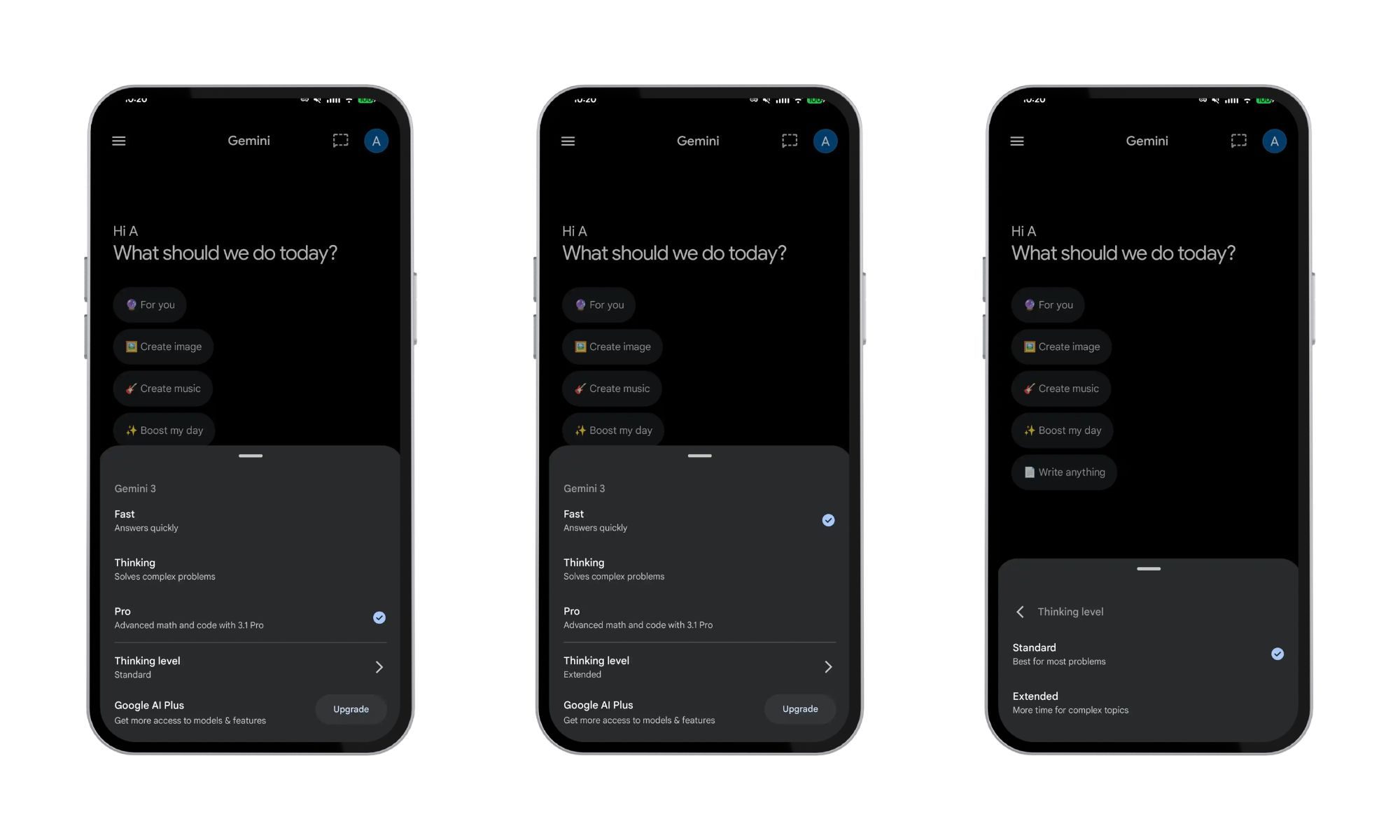
With Google I/O 2026 just around the corner, fresh leaks about Google Gemini keep surfacing. The latest finding reveals that Google is testing a new Google Gemini Thinking Level option inside the app. This feature aims to give users more control over how much reasoning the AI applies before delivering an answer.

According to a report from 9to5Google, some users now see a “Thinking Level” toggle within Gemini’s existing model picker. Currently, the picker offers choices like Fast, Thinking, Pro, or Google AI Plus. The new option adds a layer of nuance to that selection.

How the Thinking Level Feature Works

Instead of simply picking a model, you can now adjust how deeply that model reasons through a task. The report indicates that the Thinking Level option appears when you select Fast (Gemini 3 Flash) or Gemini 3.1 Pro with thinking enabled. For now, the rollout seems extremely limited — only a small group of testers can see it.

This approach mirrors what Google AI Studio already offers: Low, Medium, and High reasoning levels. Bringing that flexibility into the regular Gemini app feels like the next logical step. As AI companies compete on how “thoughtful” or agentic their assistants feel, giving users this kind of control becomes increasingly important.

Why Adjusting Reasoning Power Matters

Not every request needs maximum reasoning power. Sometimes you just want a quick answer without waiting several extra seconds while the model overanalyzes your grocery list as if it were preparing a PhD thesis. Giving users control over the balance between speed and deeper reasoning could make Gemini feel much more flexible day to day.

For instance, when you ask for a simple fact or a quick calculation, a low reasoning level saves time. But when you need a detailed analysis or a creative solution, cranking up the thinking level delivers richer responses. This kind of granular control could set Gemini apart from competitors like ChatGPT or Claude.

Expanding Gemini’s Ecosystem

Alongside the thinking level, Google appears to be expanding Gemini’s growing ecosystem of third-party app integrations. Right now, Gemini already works with apps like GitHub, OpenStax, Spotify, and WhatsApp. However, support documentation hints that integrations for Canva, Instacart, and OpenTable are also on the way.

None of these integrations appears to be live yet, but the timing makes sense. Google I/O is usually where the company shows off Gemini becoming less of a chatbot and more of a proper digital assistant that can actually do things across apps and services. If you’re interested in how these integrations work, check out our guide on using Gemini with popular apps.

What This Means for Users

At this point, Gemini’s evolution feels less about smarter answers alone and more about turning the app into something that quietly handles parts of your digital life in the background — ideally without making everything feel unnecessarily complicated. The Google Gemini Thinking Level feature is a clear step in that direction.

Building on this, users can expect more control over AI behavior in the coming months. As the feature rolls out more widely, we’ll likely see additional reasoning levels and perhaps even custom presets. For now, it’s a promising glimpse into how Google plans to differentiate Gemini in a crowded market.

If you want to stay updated on the latest Gemini features, be sure to check our Gemini updates page.

Continue Reading
Click to comment

Leave a Reply

Your email address will not be published. Required fields are marked *

Artificial Intelligence

The Hidden Danger of AI: How Instant Answers Could Make Us Think Less

Published

on

The Hidden Danger of AI: How Instant Answers Could Make Us Think Less

Artificial intelligence has transformed how we access information. With a simple query, chatbots deliver polished responses in seconds. But this convenience comes with a serious cost. Experts from the Royal Observatory Greenwich warn that over-reliance on AI for instant answers may erode our AI critical thinking skills, curiosity, and ability to verify sources. The very tool designed to make us smarter could, paradoxically, make us intellectually lazier.

The Shortcut That Skips Learning

Chatbots excel at providing quick summaries. They help users test ideas, explore new angles, and move faster through research. However, a finished response often cuts off the messy process that makes learning stick. When information arrives without struggle—without the need to question, cross-check, or dig deeper—it rarely transforms into genuine understanding. Paddy Rodgers, director of Royal Museums Greenwich, emphasizes that scientific discovery depends on patient habits: asking better questions, weighing evidence, and following leads that don’t look useful at first. Instant answers bypass these habits entirely.

Astronomy’s own history underscores this point. Early observers spent years gathering vast records about the heavens. Later generations found uses for that data that the original researchers could never have predicted. A machine optimized for efficiency might have skipped those detours because they lacked immediate value. In other words, the detours themselves were essential to progress.

When Intelligence Becomes a Utility

Sam Altman, CEO of OpenAI, has described a future where AI intelligence is sold like electricity or water—metered and priced by usage. His framing is a business model, but it also sharpens a cultural worry. If reasoning becomes something we buy on demand, it starts to feel like a service call rather than a skill to practice. The danger grows when a polished answer is treated as verified knowledge, especially when users cannot see what the system skipped, flattened, or failed to check.

This shift could lead to a decline in critical thinking skills across society. When people stop questioning the information they receive, they become more vulnerable to misinformation and less capable of independent judgment. The convenience of AI could inadvertently weaken the very cognitive muscles we need to navigate a complex world.

How to Use AI Without Losing Your Edge

So, what should you do? The better habit is to make AI work against your own certainty. Ask it to challenge an idea, expose missing evidence, or test a conclusion before you accept the response as finished. This turns the Royal Observatory’s warning into a practical rule: use AI to widen the search, not end it.

Check what it leaves out. Trace claims back to original sources. Keep the final act of judgment in human hands. For example, if you’re researching a health topic, use AI to gather initial perspectives, but then verify those claims with peer-reviewed studies or medical professionals. Similarly, when writing an article, let AI suggest angles but rely on your own analysis for the final draft. Developing healthy AI habits can help you maintain mental sharpness while still benefiting from automation.

Building on this, consider setting specific rules for your AI use. Never accept the first answer as final. Always ask follow-up questions that probe for weaknesses. Use AI to identify gaps in your knowledge rather than fill them prematurely. These strategies ensure that AI and curiosity coexist, rather than one replacing the other.

The Bigger Picture: Preserving Human Judgment

The concern raised by the Royal Observatory is not anti-technology. It is a call for mindfulness. As AI becomes more embedded in daily life, the risk of AI cognitive decline grows—not because the technology is flawed, but because we may forget how to think without it. The most valuable tool is not the one that gives you answers but the one that helps you ask better questions.

In the end, the responsibility lies with us. We must choose to remain curious, skeptical, and engaged. The final act of judgment—the decision to accept, reject, or investigate further—must stay in human hands. That is the only way to ensure that intelligence remains a skill we practice, not a service we consume.

For more on maintaining cognitive resilience in the digital age, check out our guide on how to boost critical thinking and digital mindfulness strategies.

Continue Reading

Artificial Intelligence

OpenAI Is Giving ChatGPT Plus to an Entire Country: What It Means for Malta

Published

on

Imagine waking up one day to discover that your government has handed every citizen a premium subscription to ChatGPT Plus. That is exactly what is happening in Malta. OpenAI has officially partnered with the Mediterranean island nation to roll out free access to its flagship AI tool for all Maltese citizens and residents. This is not a pilot program or a limited trial; it is a full-scale national rollout that could redefine how governments think about artificial intelligence.

As part of the initiative, dubbed “AI for All,” residents who complete a government-backed AI literacy course will receive a one-year subscription to ChatGPT Plus. The program is being developed in collaboration with the University of Malta and represents OpenAI’s first-ever nationwide partnership of this kind. The rollout begins this month and even includes Maltese citizens living abroad.

Why Malta? The Logic Behind the Nationwide ChatGPT Plus Deal

At first glance, the decision to target Malta might seem random. However, the country is actually a perfect testing ground for large-scale AI adoption. With a population of just over half a million people, Malta offers a manageable size for monitoring outcomes and adjusting policies in real time. The government already has a robust digital identity system, which simplifies the registration and verification process for the program.

Moreover, Malta has been actively positioning itself as a tech-friendly hub in Europe. By embracing AI at a national level, the country hopes to boost its digital economy, improve public services, and prepare its workforce for the future. OpenAI, for its part, sees this as a golden opportunity to demonstrate how AI can be integrated into public life without the chaos of a messy, unregulated rollout.

“Governments everywhere are trying to figure out how AI literacy will affect education, jobs, administration, and digital infrastructure over the next decade,” notes a source familiar with the deal. “OpenAI clearly wants to position itself at the center of that transition before competitors fully catch up.”

How the AI Literacy Course and ChatGPT Plus Access Work

To qualify for the free subscription, residents must first register with Malta’s digital identity system and complete a free AI training course. The course focuses on practical and responsible AI usage, covering topics like prompt engineering, ethical considerations, and real-world applications. It is designed to ensure that users understand both the power and the limitations of ChatGPT before diving in.

Once the course is finished, participants gain immediate access to ChatGPT Plus, which includes priority access to new features, faster response times, and the ability to use the latest models like GPT-4. The subscription lasts for one full year, after which the government and OpenAI will evaluate whether to extend the program.

This means that every Maltese citizen—from students and teachers to doctors and civil servants—will have the same premium AI tool at their fingertips. The goal is to level the playing field and spark innovation across all sectors of society.

Beyond Malta: The UAE and the Stargate Partnership

Interestingly, Malta is not the only country moving in this direction. The United Arab Emirates has also been working closely with OpenAI through its massive Stargate UAE infrastructure partnership. Multiple reports suggest that nationwide ChatGPT access is being explored there as well, although details around free ChatGPT Plus subscriptions remain somewhat unclear.

This trend suggests that we are witnessing the early stages of a global shift. AI tools are evolving from consumer products into something governments increasingly view as public infrastructure. Just a couple of years ago, ChatGPT was mostly a productivity tool for students, coders, and office workers. Now, entire countries are discussing nationwide AI access programs.

For OpenAI, this is brilliant positioning. But it also raises important questions about digital dependency. Once governments start integrating specific AI platforms into education, workplaces, and public services, these tools stop being optional conveniences and start becoming deeply embedded digital dependencies. If entire countries eventually begin relying on one company’s AI ecosystem, this stops being about chatbots and starts looking a lot more like infrastructure control.

What This Means for the Future of AI Governance

The Malta deal is a fascinating case study in how AI governance might evolve. On one hand, it offers a clear benefit: widespread AI literacy and access could accelerate economic growth, improve public services, and give citizens a head start in an AI-driven world. On the other hand, it creates a single point of failure. If OpenAI changes its pricing, policies, or model behavior, an entire country could feel the ripple effects.

This is why some experts are calling for more diverse AI ecosystems. Rather than relying on a single provider, governments should consider open-source alternatives or partnerships with multiple AI companies. However, for now, OpenAI is moving faster than anyone else, and Malta is betting that the benefits outweigh the risks.

As the program rolls out over the coming months, all eyes will be on Malta. If it succeeds, we could see a wave of similar deals across Europe, Asia, and the Middle East. If it fails, it will serve as a cautionary tale about the dangers of tying national digital infrastructure to a single corporate entity.

For more insights on how AI is reshaping public policy, check out our guide on AI policy trends in 2025 and our analysis of OpenAI’s government partnerships.

Continue Reading

Artificial Intelligence

Siri’s iOS 27 Overhaul: Years Late to the AI Party, But Still a Beta Experience

Published

on

Siri’s iOS 27 Overhaul: Years Late to the AI Party, But Still a Beta Experience

Apple is finally preparing a major Siri iOS 27 overhaul, but the upgraded assistant may launch with a beta label—even after years of delays. According to Bloomberg‘s Mark Gurman, internal test versions of iOS 27 already refer to the revamped Siri as a beta experience. Users will also have the option to opt out of the beta entirely.

This move mirrors Apple’s original 2011 launch of Siri, which also carried a beta tag. The company quietly dropped that label in 2013, but Siri has since struggled to shake its reputation for lagging behind competitors in reliability and conversational intelligence.

Apple’s AI Catch-Up Strategy Faces Delays

The Siri iOS 27 overhaul was originally slated for 2024 as part of Apple’s broader AI push. However, the project has faced nearly two years of delays. Apple is now rebuilding Siri into a more advanced chatbot-style assistant capable of handling ongoing conversations, contextual memory, and deeper app integration.

Reports suggest the redesign may introduce a standalone Siri app, chat-style interactions similar to messaging platforms, and integration with the Dynamic Island interface on supported iPhones. These features aim to bring Siri closer to what rivals already offer.

Competing with Google Gemini and ChatGPT

Meanwhile, competitors like Google Gemini and ChatGPT have already rolled out advanced conversational assistants with broader real-world capabilities. This gap has made Siri feel increasingly outdated, especially as Apple markets Apple Intelligence as a core part of the iPhone experience.

For Apple, timing is everything. The company’s slower, privacy-focused approach to AI development means it’s arriving later to the party—and with a product that may still feel unfinished.

Why the Beta Label Matters

If Apple officially launches the new Siri as a beta feature, it serves two strategic purposes. First, it gives Apple flexibility to continue refining the assistant publicly while lowering expectations around bugs, hallucinations, or missing features. Second, it allows the company to release AI features sooner rather than waiting for a polished final version.

The beta branding also reflects Apple’s broader challenge in AI. Unlike competitors that prioritize rapid deployment, Apple has historically focused on stability, privacy, and controlled rollouts. Reports also indicate Apple is introducing stronger privacy controls, including optional auto-delete settings for conversation history.

For users, this means the Siri iOS 27 overhaul may feel more like a work in progress than a finished product. However, it also signals that Apple is finally committing to the generative AI race—even if it’s starting from behind.

What Happens Next

Apple is expected to reveal more about Siri’s redesign and its AI roadmap during WWDC next month. Developer beta versions of iOS 27 will likely offer the first public look at the new Siri experience.

Yet the larger question remains: Can Apple’s slower, more cautious AI rollout still compete in a market where rivals have spent the last two years aggressively pushing generative AI into mainstream consumer products? For now, Siri’s overhaul appears less like a finished comeback and more like Apple finally arriving at the AI race—still mid-development.

As Apple continues its Apple Intelligence roadmap, the company’s focus on privacy and integration may eventually pay off. But for the moment, the Siri iOS 27 overhaul is a clear sign that Apple is playing catch-up—and it’s not afraid to admit it.

Continue Reading

Trending