Connect with us

Artificial Intelligence

Googlebook AI Laptop: Why It May Not Be Google’s Next Big Thing

Published

on

Googlebook AI Laptop: Why It May Not Be Google’s Next Big Thing

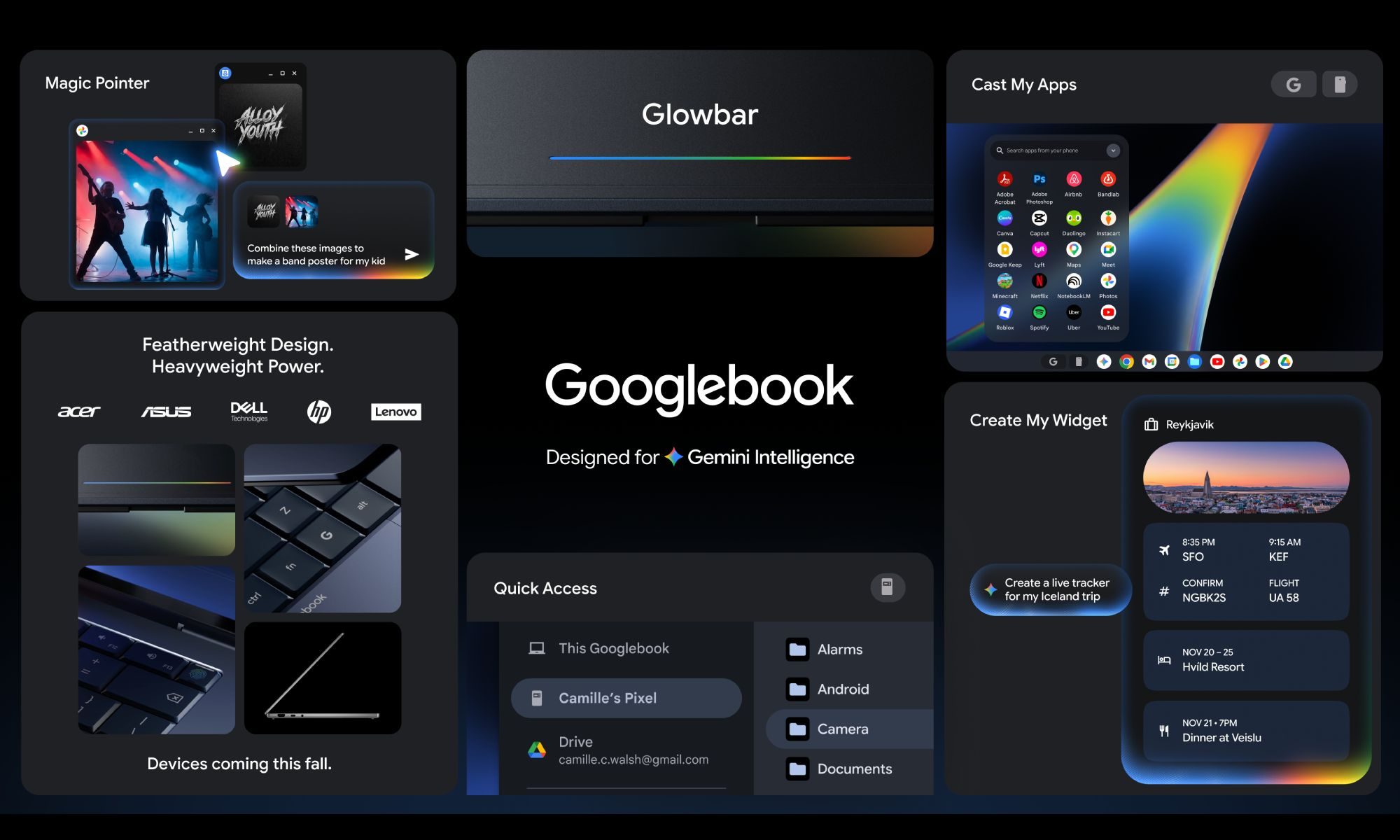
Fifteen years ago, Google bet big on the browser, shrinking the operating system down to ChromeOS and making laptops affordable for schools and offices. Today, the company is placing a far more expensive wager: an AI-driven laptop platform called Googlebook. Powered by Gemini Intelligence, this device promises seamless integration with Android phones, contextual AI suggestions, and on-device smart widgets. Yet, despite the ambitious pitch, serious doubts remain about whether the Googlebook AI laptop can truly become Google’s next big thing.

What Makes the Googlebook AI Laptop Different?

Unveiled at the Android Show in May 2026, Googlebook is built entirely around Gemini Intelligence. Move your cursor, and AI surfaces contextual suggestions. Type a sentence, and a widget appears around it. Access your Android phone’s apps and files without third-party software. The goal is a coherent, AI-first experience that rivals Apple’s ecosystem.

However, this vision relies heavily on deep Android integration. While compelling for Android users, Apple has already perfected cross-device handoffs with its unified ARM silicon. Googlebook, on the other hand, will ship with chips from Intel (x86), Qualcomm (ARM), and MediaTek (ARM). This multi-architecture approach introduces fragmentation risks that could undermine the promised AI experience.

The Multi-Chip Fragmentation Problem

Apple controls its silicon from design to deployment, ensuring seamless performance across iPhones and Macs. Google distributes that responsibility across multiple chip vendors and OEMs. Gemini Intelligence requires a flagship-grade chipset, at least 12GB of RAM, and support for AI Core and Gemini Nano v3. But not all chips are equal.

Intel’s Wildcat Lake chips deliver up to 40 TOPS of AI processing, while Qualcomm’s Snapdragon X Plus reaches 45 TOPS from its NPU alone. MediaTek’s budget ARM chips, however, lack equivalent NPU capabilities. This means on-device AI experiences could vary dramatically between models. As a result, the unified Googlebook experience Google showcased might be compromised on cheaper variants, forcing AI tasks to the cloud and introducing latency.

Pricing and Competitive Landscape

To succeed, Google must undercut established rivals. The MacBook Neo, priced at $599, already offers a seamless ecosystem with an A18 Pro chip and Apple Intelligence. The M5 MacBook Air starts at $1,099, while Microsoft Copilot+ PCs range from $800 to $1,000. Rumors suggest Googlebook could start around $1,000, placing it in direct competition with proven platforms.

For budget-conscious buyers, a price between $500 and $700 might be the sweet spot. But at $1,000, Google asks users to skip industry benchmarks for an unproven platform. Moreover, Windows on ARM has made progress, and Copilot+ PCs offer familiarity with a growing suite of AI features. Googlebook’s core advantage—Android app familiarity on a larger screen—may not be enough to sway buyers.

Key Competitors at a Glance

  • Apple MacBook Neo ($599): Sub-$600 disruption, unified A18 Pro silicon, and proven cross-device features.
  • Apple M5 MacBook Air ($1,099): Years of battery efficiency, mature ecosystem, and trusted longevity.
  • Microsoft Copilot+ PCs (~$1,000): Deep enterprise roots, established Windows ecosystem, and mature productivity.

Software Readiness and Buyer Confusion

Hours before the Android Show, a leaked build of Aluminium OS (Googlebook’s internal codename) surfaced online, showing a desktop environment comparable to Samsung DeX—but without the magical AI features. Google may argue that a pre-release build isn’t a fair depiction, but it also suggests the software isn’t ready yet.

Additionally, Google confirmed that new Chromebook and Chromebook Plus devices are still in development. Releasing premium Googlebook variants alongside mid-tier Chromebooks could confuse buyers about where ChromeOS ends and Android-on-desktop begins. This fragmentation in messaging could hurt adoption.

Will Googlebook Succeed or Stumble?

Googlebook is trying to be the MacBook for Android users, but the math has to work on multiple fronts. How well will Google educate buyers on the difference between a Googlebook and a Chromebook? Can it guarantee performance parity across different OEMs and chips? And most critically, will the pricing give buyers a reason to take the leap?

Right now, none of those questions have clean answers. While the vision is ambitious, the multi-chip fragmentation, competitive pricing pressure, and software readiness issues suggest that the Googlebook AI laptop may not be Google’s next big thing—at least not yet.

For more on Google’s evolving hardware strategy, check out our analysis of Chromebook vs Googlebook and the best AI laptops of 2026.

Continue Reading

Artificial Intelligence

Over 100 tech giants warn AI-powered cyberattacks are coming sooner than you think

Published

on

AI cyberattacks warning

A warning that cuts across the industry

OpenAI, Anthropic, Google, Microsoft, and more than 100 other companies and organizations have issued a stark joint warning: AI-powered cyberattacks could become dramatically more widespread and sophisticated within months. The statement isn’t just another tech industry press release. It’s a coordinated alarm from the very companies building AI and the ones defending against its misuse.

The group is calling for a global push on cyber defense as more capable AI models make attacks easier to automate and harder to contain. Hospitals, water treatment plants, and internet infrastructure are among the systems it says could face greater risk if defenses don’t improve quickly enough.

This AI cyberattacks warning carries extra weight because it isn’t coming from one corner of the tech industry. AI developers, cybersecurity firms, and infrastructure companies are all backing the same basic message: defenders need to move now.

Why this warning is unusually broad

The companies involved sit on different sides of the cybersecurity problem. Some are building increasingly powerful AI systems, while others spend their time defending networks against attacks. That makes the warning harder to dismiss as one company pushing its preferred policy.

The coalition brings together organizations with very different commercial interests, yet they agree that existing defenses need to improve before AI gives attackers another advantage. Its recommendations include stronger baseline security standards and wider access to defensive AI, especially for organizations without large cybersecurity budgets.

Critical infrastructure gets particular attention. Failures there can quickly spill beyond a single organization, affecting entire communities or even national economies.

What defenders are being asked to do

The coalition wants governments and organizations to expand access to AI tools that can find vulnerabilities and speed up patching. Smaller institutions are a major concern because they may lack the staff or money to react quickly as attacks become more automated.

Software development is another weak point. The coalition is calling for tougher security standards around AI-generated code, since AI makes it easier for attackers to probe systems for weaknesses. The basic strategy is to give defenders stronger tools before offensive AI becomes widespread enough to put even more pressure on already strained security teams.

Key recommendations from the coalition

  • Stronger baseline security standards across industries
  • Wider access to defensive AI tools, especially for underfunded organizations
  • Tougher security requirements for AI-generated code
  • More investment in automated vulnerability detection and patching

For a deeper look at how AI is reshaping the threat landscape, check out AI-powered phishing attacks and cybersecurity automation trends.

Why the window may be short

AI doesn’t need to invent entirely new cyberattacks to make the situation worse. Helping attackers find existing vulnerabilities faster could be enough to make familiar security failures much more expensive. That still doesn’t turn every attack into an AI superweapon. Unpatched software and understaffed security teams remain ordinary problems, but automation can make exploiting them faster and easier to repeat.

The coalition wants organizations to strengthen those defenses now, before AI-powered attacks become commonplace. For anyone already struggling to keep systems patched and secure, waiting until attackers have better automation leaves even less room to catch up.

The message is clear: the time to prepare is now, not after the first major AI-driven breach makes headlines.

Continue Reading

Artificial Intelligence

South Korea Wants to Give Every Citizen Free Premium AI — Here’s What That Means

Published

on

South Korea AI for All

Seoul’s Bold Bet: AI as a Public Utility

Forget paying $20 a month for ChatGPT Plus. South Korea is about to make premium AI as accessible as turning on a tap.

The government has unveiled a sweeping initiative called South Korea AI for All, a program designed to give every citizen free access to top-tier AI chatbots. The plan, reported by the Wall Street Journal, is to treat AI not as a luxury subscription but as essential infrastructure — think electricity or public transit.

It’s a striking departure from the Western model, where cutting-edge AI tools are typically locked behind monthly fees. Here, the state foots the bill.

What Will Citizens Actually Get?

This isn’t just a glorified Q&A bot. The AI tools will be woven into the fabric of daily life, integrating directly with government services.

Picture this: booking a doctor’s appointment, getting personalized tax guidance, searching for an apartment, or checking eligibility for social support programs — all through an AI interface. Parents could receive curated educational content for their kids. Students get unlimited AI usage for learning.

For small business owners, the perk is even sharper. Free AI to file taxes and navigate government support schemes could save hours of bureaucratic headache. The ambition is to make AI a seamless layer over the state itself.

Why This Is Really About AI Sovereignty

Let’s be honest about the underlying motive. This is a geopolitical play as much as a social one.

Officials frame the project as a step toward AI sovereignty. By making domestic chatbots free, the government hopes to wean citizens off American and Chinese platforms. The message is clear: why rely on OpenAI or DeepSeek when your own country can build it better?

To make that happen, the state is offering selected providers up to 512 Nvidia B200 AI chips and covering operating costs. The total price tag hasn’t been disclosed, but the scale is telling.

The Numbers Behind the Push

This isn’t a shot in the dark. More than 20 million South Koreans already use free generative AI tools. Roughly one in four pays for AI services.

South Korea has tripled its AI budget for 2026 to about $7.2 billion. That’s not pocket change — it’s a declaration that AI is critical national infrastructure, not a passing fad.

How It Compares to the US Approach

Across the Pacific, the strategy looks very different. In the US, free premium AI access has been limited to specific groups — students, for example, through Google’s free AI Pro offer.

South Korea is blowing past that. Universal access. No strings attached. It’s a philosophical difference: one country treats AI as a market product, the other as a public right.

Will it work? That’s the billion-dollar question. The success of AI for All will depend on execution — whether the domestic models can match the quality of American rivals, and whether citizens actually adopt them.

One thing is certain: Seoul is betting that the future of AI isn’t just about who builds the best model, but who makes it available to everyone. That’s a bet worth watching.

Continue Reading

Artificial Intelligence

Lambda bets big on borrowed billions to feed Microsoft’s AI chip hunger

Published

on

Lambda $1B debt

Lambda’s latest chip-buying loan

Lambda, the AI cloud company that buys expensive chips and rents them out by the hour, just pulled off another big debt raise. This time it’s $1 billion in private, short-dated debt to buy Nvidia AI chips that will be leased to Microsoft, according to Bloomberg.

The deal was arranged by JP Morgan Chase. The terms tell you a lot about how confident Lambda is in its ability to flip these chips into revenue quickly. Short-dated debt means the company expects to deploy the GPUs, start generating cash flow, and pay the loan back fast.

This isn’t a one-off. It’s part of a pattern.

In May, Lambda closed a $1 billion secured credit facility. This week, it announced the closing of a $926 million loan to fund Nvidia GB300 GPUs — one of Nvidia’s newest chip models — for a deployment it’s already under contract to provide to Nvidia itself.

So in roughly six months, that’s nearly $3 billion in debt stacked on top of its existing venture capital.

Why Lambda keeps borrowing instead of raising equity

The simple answer: speed and dilution. Selling new shares would give investors a slice of future upside. Debt, especially short-dated debt tied to specific customer contracts, lets Lambda keep more of the equity while locking in the hardware it needs to fulfill deals.

It’s a financing model that looks a lot like what airlines do with aircraft, or what shipping companies do with vessels. The asset — in this case, a rack of GPUs — is the collateral. The customer contract is the promise that the cash will flow.

Bloomberg reports the $1 billion private debt deal comes as Lambda is reportedly in talks for a $3 billion pre-IPO round. That’s a big number, but it’s not surprising given the company’s trajectory. Last November, Lambda raised $1.5 billion in venture capital at a $5.43 billion post-money valuation, per PitchBook data.

If the pre-IPO round closes at the rumored size, Lambda’s valuation could jump significantly. The debt, however, is the more interesting story here.

The Microsoft angle

Leasing chips to Microsoft is a marquee customer win. It signals that Lambda can compete for hyperscaler-scale workloads, not just startups and research labs. Microsoft doesn’t rent GPUs from just anyone. The fact that Lambda is borrowing $1 billion to buy hardware specifically for Microsoft suggests a long-term, high-value contract.

It also means Lambda is carrying the execution risk. If the chips arrive late, if deployment slips, if utilization underperforms — the debt still needs to be repaid.

The $400 billion AI debt wave

Lambda isn’t alone in this game. According to data compiled by Bloomberg, banks and tech companies have raised over $400 billion in AI-related debt globally in 2026 so far.

That number is staggering. It includes everything from hyperscaler bonds to project financing for data centers to specialized loans like Lambda’s. The AI boom has become a debt boom.

Why? Because the demand for compute is growing faster than companies can fund it with cash flow or equity alone. Building AI infrastructure is capital-intensive in a way that few industries have ever matched. And with Nvidia’s newest chips — like the GB300 — costing hundreds of thousands of dollars per unit, even well-funded companies need leverage.

The risk in the model

Short-dated debt works beautifully when everything goes as planned. Chips get deployed, customers pay, loans get repaid, and everyone moves on to the next round.

But it’s fragile. If AI demand softens, if a major customer renegotiates, if chip delivery timelines slip — the math gets ugly fast. Debt doesn’t wait for the market to recover.

There’s also the question of what happens when these chips become obsolete. Nvidia’s roadmap moves quickly. A GPU that’s cutting-edge today can be mid-tier in two years. Lambda’s ability to repay short-dated debt depends on keeping utilization high and pricing competitive.

What this means for the AI chip market

Lambda’s aggressive borrowing is a bet that AI compute demand stays red-hot. It’s also a bet that Nvidia’s chip supply keeps flowing. If Nvidia can’t deliver, Lambda’s contracts — and its debt obligations — become very uncomfortable.

The good news for Lambda: it’s not just buying chips on spec. The Microsoft deal is contracted. The Nvidia GB300 deployment is contracted. This is debt tied to committed revenue, which is a much safer position than borrowing to build infrastructure and hoping customers show up.

Still, the scale is worth pausing on. A company that was valued at $5.43 billion last November is now borrowing $1 billion at a time for single deployments. That’s aggressive leverage by any standard.

The road to IPO

The reported $3 billion pre-IPO round would give Lambda more equity cushion before it hits public markets. That’s probably wise, given the debt load it’s carrying.

Public investors tend to be skittish about companies with heavy short-term debt, even if it’s tied to customer contracts. A strong equity round would help Lambda tell a better story: we have the contracts, we have the hardware, and we have a balance sheet that can weather hiccups.

Whether the IPO happens this year or next, Lambda’s financing strategy will be a case study. Some will call it brilliant — using cheap debt to scale faster than competitors. Others will call it reckless — borrowing short-term against assets that depreciate as fast as they compute.

The truth is probably somewhere in between. What’s certain is that Lambda is playing to win, and it’s using every tool available to get the chips it needs.

Continue Reading

Trending