Artificial Intelligence
Meta’s Muse Spark 1.3 takes on GPT-5.6 and Claude — but can it really win?
Published
5 minutes agoon

Meta just fired a serious shot in the AI arms race
The company quietly unleashed Muse Spark 1.3, its most advanced AI model to date, and it’s aiming straight at the top dogs. Developers can already access and pay for the update, which Meta says represents a massive leap forward in performance.
It won’t stay confined to the developer sandbox for long. Over the coming weeks, the model will roll out across Instagram, Facebook, and the Meta AI assistant — putting it in front of billions of everyday users.
What makes Muse Spark 1.3 actually different?
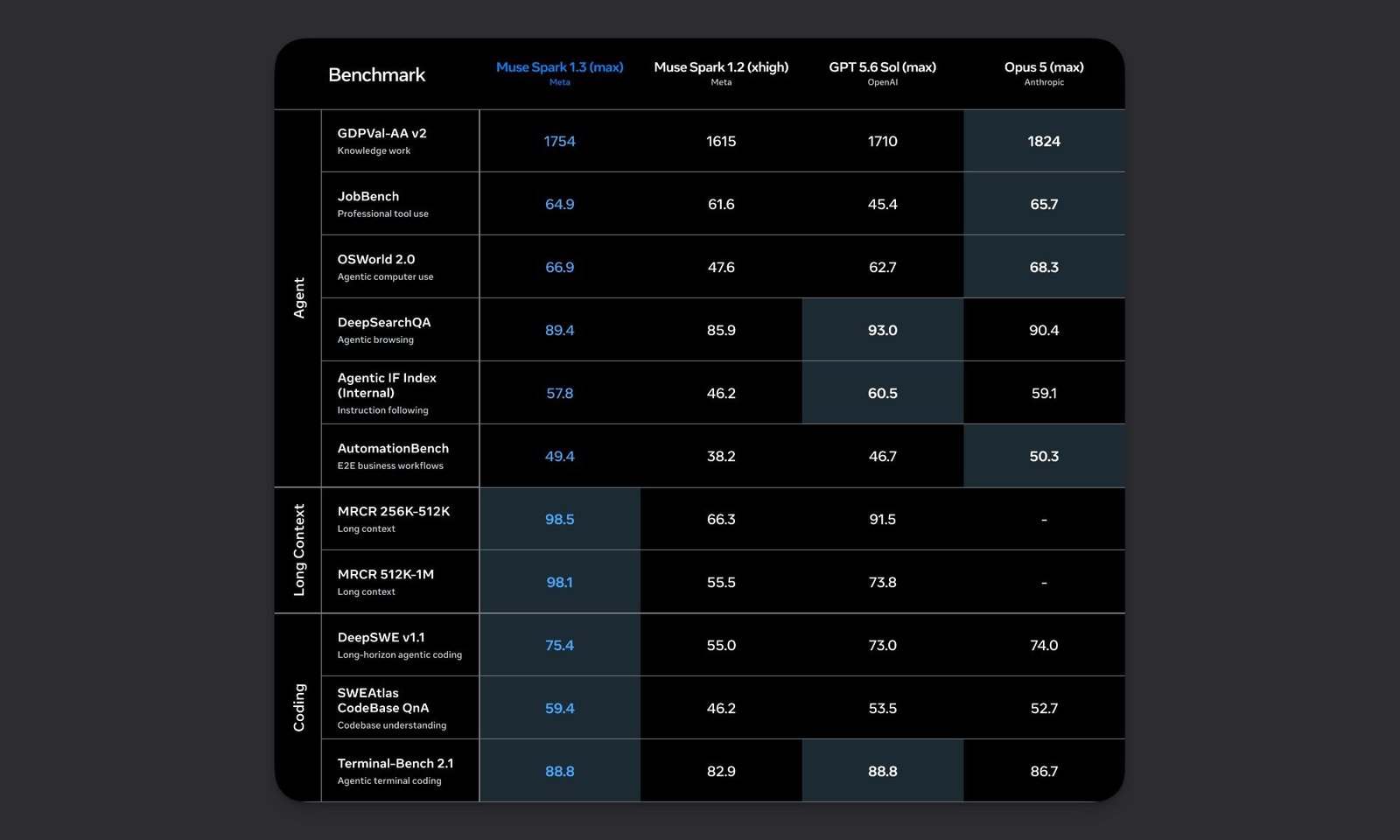
Meta’s Chief AI Officer, Alexandr Wang, didn’t mince words. He called this “the biggest jump so far on model performance,” pointing to serious gains in two areas: coding and agentic tasks — the kind where the AI acts on your behalf rather than just answering questions.
But here’s the catch. Wang told Bloomberg that Muse Spark 1.3 is competitive with Anthropic’s Claude Fable 5.1 and even beats OpenAI’s GPT-5.6 Sol at coding. That’s a bold claim, especially with OpenAI’s upcoming Astra model lurking in the wings.
Take those comparisons with a grain of salt, though. Benchmarks can be gamed, and a model that crushes one test might stumble on a totally different task. Real-world performance is what actually matters.
Efficiency gains under the hood
Wang broke down a few upgrades that set Muse Spark 1.3 apart:
- 25% fewer tokens needed to complete the same job — meaning lower costs and faster responses
- Multi-workflow handling — it can juggle several tasks at once instead of forcing separate sessions
- Better context retention across long, complicated instructions
- Self-awareness of limits — the model now pauses to ask for clarification before taking any irreversible action
That last point is quietly important. AI that knows when it doesn’t know is a big step toward trustworthiness, especially for agentic use cases.
Pricing stays flat, adoption explodes
Here’s something developers will appreciate: Meta isn’t raising prices. Muse Spark 1.3 costs the same as its predecessor, Muse Spark 1.2. That’s a smart move when rivals are hiking rates.
Wang told Bloomberg that adoption on Meta’s developer platform has been strong — some users are burning through trillions of tokens every week. Those numbers suggest real usage, not just hype.
What about open-source fans? Meta hasn’t decided whether it will release the model’s weights — the blueprint that lets outside developers build on top of it. The older Muse Spark 1.2 weights are still headed for release, but the new model’s future remains unclear.
The bigger picture: Meta’s spending spree continues
Meta is still pouring billions into AI infrastructure, and Muse Spark 1.3 is the clearest signal yet that the company believes it’s closing the gap with OpenAI and Anthropic. Whether that’s true or just corporate bravado will play out in the benchmarks and real-world deployments over the coming months.
For now, the model is available to developers, and the app rollout is imminent. If you’re building on Meta AI tools, this update is worth a serious look. And if you’re just a curious user, you’ll likely meet Muse Spark 1.3 in your Instagram feed sooner than you think.
One thing’s certain: the AI race just got a lot more interesting.
You may like
Artificial Intelligence
Meta scraps AI-usage metrics from performance reviews after ‘Token Legend’ chaos
Published
7 hours agoon
September 5, 2026
Meta pulls AI usage out of the performance review equation
If you’ve been tracking how Meta evaluates its workforce, you know the company spent the last year pushing employees to embrace artificial intelligence with unusual zeal. Engineers were told their performance reviews would factor in “AI-driven impact.” Workers could earn labels like “AI Native” or “AI First” based on how deeply they integrated chatbots into their daily routines. It sounded forward-thinking—until it turned into a contest over who could burn through the most AI tokens.
Now Meta is walking it back. According to a new report from WIRED, the company has updated its performance-review guidance so employees are no longer judged on how much they use AI tools. The new language focuses on something far more traditional: the actual impact of an employee’s work. Outcomes, the guidance now says, “can be supported by AI or other means.”
That last part matters. Meta isn’t banning AI or telling people to stop experimenting. It’s simply saying that using the tools isn’t the achievement itself.
How we got here: the strange rise of ‘tokenmaxxing’
The shift didn’t happen in a vacuum. Last year, Meta’s performance-review criteria explicitly mentioned AI adoption, which created an odd incentive structure. Some employees began prompting AI tools more frequently just to inflate their internal usage numbers. They watched their token counts—the chunks of information AI models process—climb like a video game score.
Things got competitive enough that one employee built an internal leaderboard ranking colleagues by AI usage. The rankings came with titles. The top tier? “Token Legend.” Yes, that was a real thing inside Meta. The leaderboard eventually disappeared after details leaked publicly earlier this year.
You can see why Meta would want to hit reset. When workers are competing to become “Token Legends,” the actual work product starts to feel secondary.
What employees were told this week
Engineers received the updated guidance earlier this week. The message was direct: AI adoption dashboards and token counts will not be used to measure your impact. No more gaming the system by generating endless queries. No more treating your AI usage dashboard like a fitness tracker.
Meta spokesperson Tracy Clayton told WIRED that the company has always evaluated workers based on their contributions. Clayton also said labels like “AI Native” were never part of the formal performance evaluation process—even if employees felt otherwise.
Meta’s AI ambitions aren’t cooling off
Don’t read this as Meta losing interest in artificial intelligence. Far from it. The company is pushing forward on multiple fronts, and employees are getting access to increasingly capable tools.
Take Hatch, an experimental AI agent that Meta employees have been testing on their corporate devices for several weeks. Unlike a conventional chatbot that mostly answers questions, Hatch can take actions on a computer. It browses the web, interacts with other applications, and completes tasks on a user’s behalf. It’s the kind of agentic AI that tech companies have been promising for years, and it could eventually see a public release.
So Meta’s approach is more nuanced than it might appear. Employees are still encouraged to experiment with powerful AI systems. They’re just not rewarded for raw usage anymore.
Why this matters beyond Meta
Meta’s reversal is a small but telling signal for the broader tech industry. Over the past two years, companies have rushed to integrate AI into their workflows, often measuring adoption through metrics like token consumption or tool usage. The problem? Those metrics can become targets in themselves—a phenomenon some researchers have called “metric fixation.”
When usage becomes the goal, employees optimize for the wrong thing. They generate more tokens, not better outcomes. They prompt AI tools because they’re being watched, not because the tools genuinely help. Meta’s internal leaderboard was an extreme example, but the underlying dynamic is hardly unique.
For anyone working in HR or management, the lesson is straightforward: measure outcomes, not activity. If an employee delivers a brilliant project without touching a single AI tool, that should count for more than someone who burns through 10 million tokens and produces mediocre work.
What’s next for Meta’s workforce
The updated review language gives employees more breathing room. They can experiment with AI where it makes sense, and skip it where it doesn’t. That’s a healthier approach, and it aligns with how Meta is positioning its AI tools internally.
The company is still investing heavily in AI infrastructure, and tools like Hatch suggest that Meta sees a future where AI agents handle routine tasks across its platforms. But the performance review change signals that Meta wants its employees to be thoughtful about AI, not obsessive.
It’s a fine line to walk. Meta clearly wants its workforce to be AI-literate and ready for what’s next. But it also wants to avoid the kind of performative usage that turns a productivity tool into a status symbol.
Judging the work rather than the token counter? That’s probably the right call.
Key takeaways
- Meta removed AI usage and token counts from performance review criteria
- The change follows internal competition over AI tokens, including a “Token Legend” leaderboard
- Labels like “AI Native” were not part of formal evaluations, per Meta
- Meta is still encouraging AI adoption and testing an agentic AI tool called Hatch
- The shift reflects a broader industry lesson: measure outcomes, not activity
Artificial Intelligence
Google Vids Just Got a Docs to Video Feature — Here’s How It Works
Published
8 hours agoon
September 5, 2026
What Is the Docs to Video Feature in Google Vids?
Google Vids now includes a new option in its File menu called Docs to Video. It lets you pull in a document directly from your Drive or your computer. Then, using AI, it scans the content, creates a script that boils everything down to key points, and adds a voiceover to match.
The result is a short, narrated video with AI-generated visuals and backgrounds. No editing chops required.
For anyone who spends hours grinding through meeting notes, training PDFs, or dense internal reports, this is the kind of shortcut you didn’t know you needed. It doesn’t just save time — it makes the material far less painful to absorb.
How Does Google’s Document-to-Video Tool Work?
The workflow is straightforward. You start by choosing a file — PDF, Word document, or Google Docs all work. Vids’ AI then reads through the material, identifies the main talking points, and drafts a script you can review before anything gets rendered.
That review step matters. You can rewrite specific sections if the AI missed the nuance, or swap in a different narrator voice if the default doesn’t fit your audience. Once you’re happy, Vids stitches it together with visuals and background music.
If that sounds familiar, it’s because NotebookLM already does something similar. But Vids is aimed at a slightly different use case — quick, shareable video summaries rather than deep-dive audio overviews.
Who’s This Actually For?
The obvious audience is anyone drowning in text. Think of the manager who gets 50 pages of meeting minutes after every project sync, or the new hire handed a 200-page training manual on day one.
But there’s a second, arguably bigger benefit: retention. A voiceover with visuals makes dry material stick better than staring at a wall of text. That’s not a small thing when the content is mandatory compliance training or quarterly financial updates.
As someone who plows through press releases and text-heavy decks all day, I can see myself using this the moment I get access.
When Can You Use Docs to Video?
Here’s the catch: it’s not free. The feature is locked to Google AI Plus, Pro, or Ultra subscribers, plus those on Business, Enterprise, and Education plans. Rollout depends on your account type.
Google’s Rapid Release domains already have access as of today. Scheduled Release domains will get it over the next two weeks, starting September 5, 2026.
So if you’re on a personal free Google account, you’re out of luck for now. This is squarely aimed at paying customers — which makes sense, given the compute involved in generating video from scratch.
Does It Actually Work?
Early hands-on reports are mixed. AndroidAuthority’s test run got as far as generating the script, then hit a repeated error when trying to render the final video.
That’s worth flagging, but it’s also typical for a brand-new multimodal AI feature doing a lot at once. Generating a script, syncing narration, and rendering visuals is heavy lifting. Don’t be surprised if your first attempt fails — retry, and if it still breaks, give it a few days for fixes to roll out.
For a tool that’s literally designed to save you time, a little patience upfront is a fair trade.
What to Expect Next
Google has been pushing Vids as a workspace tool since its launch, and this feature fills a real gap. Instead of forcing employees to watch long recordings of meetings, you can now get a tight, narrated summary in minutes.
If you’re already paying for a Google AI plan, it’s worth testing the moment it lands in your account. If you’re not, this might be the feature that pushes you over the edge.
Either way, the era of skimming 40-page PDFs by hand is slowly coming to an end. Google just gave you a better way to get through the boring stuff — and that’s something worth paying attention to.
Artificial Intelligence
Thinking Machines seeks $1B at $40B valuation as Accel reportedly leads the charge
Published
1 day agoon
September 4, 2026
Murati’s AI lab is back in the fundraising spotlight
Thinking Machines, the AI startup that Mira Murati founded just over a year ago after leaving OpenAI, is reportedly in talks to raise $1 billion at a valuation of at least $40 billion. The Information broke the news Thursday, citing sources familiar with the matter.
Accel, an existing investor, is said to be in discussions to lead the round. Both Accel and Thinking Machines declined to comment when reached.
The number is striking — but not because it’s huge. It’s actually a step down. Late last year, the company was reportedly chasing a $50 billion valuation. Now it looks like investors are pricing in a more sober reality.
A $40 billion price tag on $100 million in revenue
Here’s where the math gets interesting. Thinking Machines’ annual revenue run rate has crossed $100 million, according to a person with knowledge of the company’s financials. That’s real revenue, not just promises.
But $40 billion on $100 million? That’s a 400x revenue multiple. Even in the frothiest corners of AI, that’s an extraordinary number. For context, most public software companies trade at 10–20x revenue. AI infrastructure names like Nvidia command far less on a trailing basis.
Investors aren’t paying for today’s numbers, though. They’re betting that Murati and her team can build something category-defining — the same bet that fueled the startup’s earlier rounds.
From a record seed round to a valuation reset
Thinking Machines’ previous raise was a $2 billion seed round — one of the largest in venture history — that valued the company at $12 billion. Andreessen Horowitz led that investment, with participation from Nvidia, GV, Lightspeed, and Conviction Partners.
That round was backed almost entirely on pedigree. Murati, who served as OpenAI’s CTO, brought a team of top-tier researchers with her. Investors were writing checks on the strength of the team’s résumés rather than on shipped products.
Since then, the company has launched its first offering, Inkling, an open-weight model. It generates revenue through usage-based compute fees — customers pay to adapt the model on proprietary data using the company’s Tinker platform.
But the team has also seen high-profile departures. Several co-founders, including Lilian Weng and Luke Metz, have returned to OpenAI. That kind of talent drain would worry most startups. At Thinking Machines, it’s a story investors are watching closely.
How the new round compares to the AI market’s giants
The reported $40 billion valuation would put Thinking Machines in rarefied air. For comparison:
- OpenAI was valued at $300 billion in a recent tender offer
- Anthropic has been valued around $180 billion
- xAI, Elon Musk’s venture, has commanded a $50 billion valuation
Thinking Machines would sit below those giants but well above most AI startups. The question is whether the company can justify that gap with revenue growth alone — or whether it needs a breakout product first.
What’s next for Thinking Machines
The round isn’t closed yet. Terms could change, and talks could fall apart — that happens in venture capital all the time. But the signal is clear: Accel, a firm that backed Facebook and Spotify early, sees something here.
For Murati, the next few months will be telling. Can she keep the team intact? Can Inkling gain traction against open-weight rivals like Meta’s Llama and Mistral? And can she convince investors that the $50 billion ask was just a starting point, not a ceiling?
If the round closes at $40 billion, it will be a validation of the company’s progress — and a reminder that even the hottest AI labs aren’t immune to valuation resets. For those watching from the sidelines, the real story isn’t the number. It’s whether Thinking Machines can turn its pedigree into a durable business.
Related reading: how AI startup valuations are shifting in 2025 and the state of open-weight AI models.

Meta’s Muse Spark 1.3 takes on GPT-5.6 and Claude — but can it really win?

US and UK Join Forces to Dismantle Scam Centers Behind Billions in Fraud

Microsoft Cloud Patches, 5,000 Hacked Dropbox Accounts, and a $1.1B Security Startup: What You Missed
Trending
CyberSecurity6 months agoLeakBase Data Breach Forum Seized in Major Europol Operation
How To5 months agoThe Truth About Fast Charging Apps for Android: Can They Speed Up Your Battery?
CyberSecurity6 months agoZero-Day Attacks Hit Record High as Enterprise Software Becomes Prime Target
CyberSecurity6 months agoRussian Hackers Target WhatsApp and Signal in Global Espionage Campaign
Social Media6 months agoYouTube Live Streaming API: A Developer’s Guide to Managing Live Broadcasts
Video4 months agoSamsung One UI 8.5 Official Update Is Here: Release Timeline, Eligible Devices & Key Features
Infosecurity6 months agoCybersecurity Communication: Why Fear-Based Messaging Fails and What Works
CyberSecurity6 months agoContextCrush Vulnerability: How a Trusted AI Tool Became an Attack Vector