Connect with us

Artificial Intelligence

Google Vids Just Got a Docs to Video Feature — Here’s How It Works

Published

on

Docs to Video

What Is the Docs to Video Feature in Google Vids?

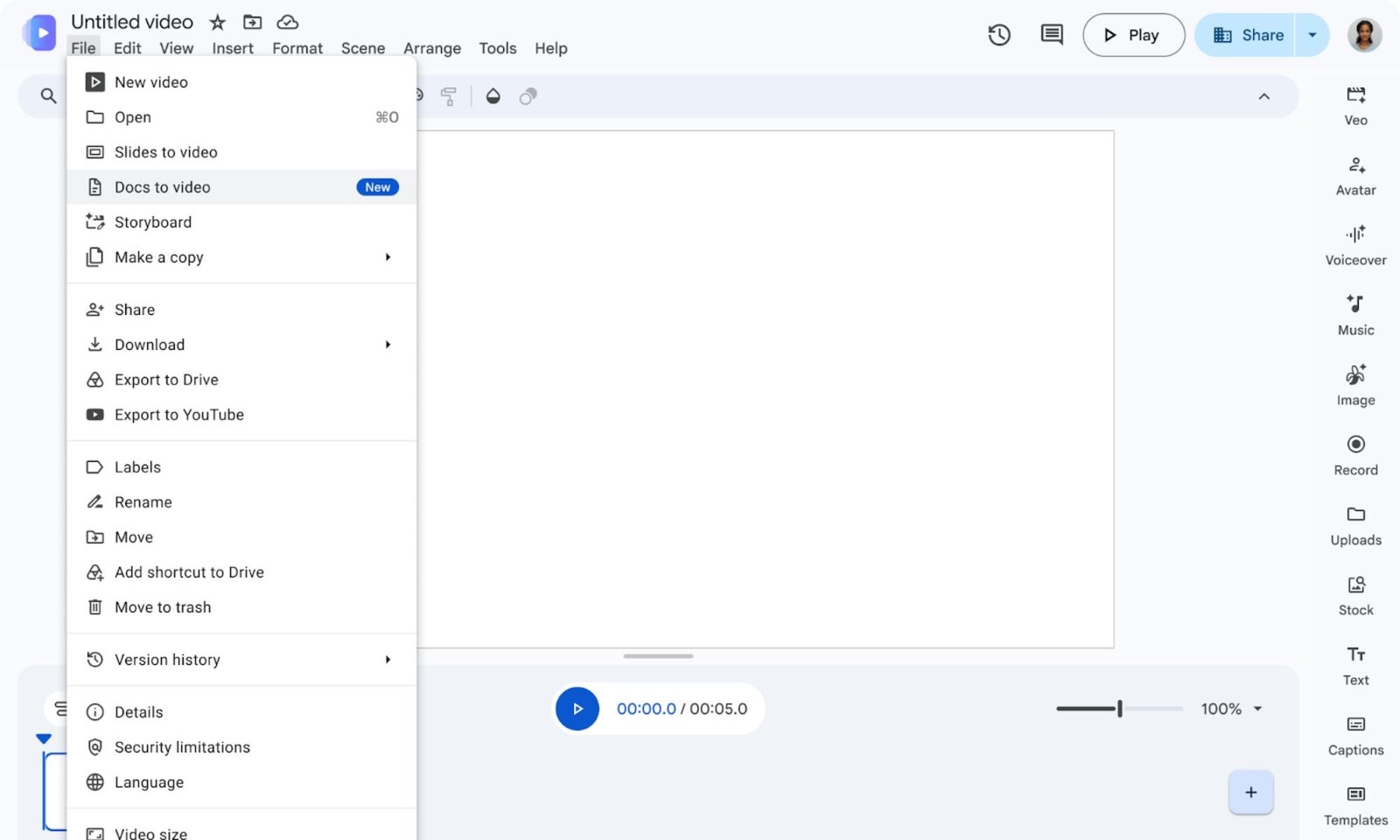
Google Vids now includes a new option in its File menu called Docs to Video. It lets you pull in a document directly from your Drive or your computer. Then, using AI, it scans the content, creates a script that boils everything down to key points, and adds a voiceover to match.

The result is a short, narrated video with AI-generated visuals and backgrounds. No editing chops required.

For anyone who spends hours grinding through meeting notes, training PDFs, or dense internal reports, this is the kind of shortcut you didn’t know you needed. It doesn’t just save time — it makes the material far less painful to absorb.

How Does Google’s Document-to-Video Tool Work?

The workflow is straightforward. You start by choosing a file — PDF, Word document, or Google Docs all work. Vids’ AI then reads through the material, identifies the main talking points, and drafts a script you can review before anything gets rendered.

That review step matters. You can rewrite specific sections if the AI missed the nuance, or swap in a different narrator voice if the default doesn’t fit your audience. Once you’re happy, Vids stitches it together with visuals and background music.

If that sounds familiar, it’s because NotebookLM already does something similar. But Vids is aimed at a slightly different use case — quick, shareable video summaries rather than deep-dive audio overviews.

Who’s This Actually For?

The obvious audience is anyone drowning in text. Think of the manager who gets 50 pages of meeting minutes after every project sync, or the new hire handed a 200-page training manual on day one.

But there’s a second, arguably bigger benefit: retention. A voiceover with visuals makes dry material stick better than staring at a wall of text. That’s not a small thing when the content is mandatory compliance training or quarterly financial updates.

As someone who plows through press releases and text-heavy decks all day, I can see myself using this the moment I get access.

When Can You Use Docs to Video?

Here’s the catch: it’s not free. The feature is locked to Google AI Plus, Pro, or Ultra subscribers, plus those on Business, Enterprise, and Education plans. Rollout depends on your account type.

Google’s Rapid Release domains already have access as of today. Scheduled Release domains will get it over the next two weeks, starting September 5, 2026.

So if you’re on a personal free Google account, you’re out of luck for now. This is squarely aimed at paying customers — which makes sense, given the compute involved in generating video from scratch.

Does It Actually Work?

Early hands-on reports are mixed. AndroidAuthority’s test run got as far as generating the script, then hit a repeated error when trying to render the final video.

That’s worth flagging, but it’s also typical for a brand-new multimodal AI feature doing a lot at once. Generating a script, syncing narration, and rendering visuals is heavy lifting. Don’t be surprised if your first attempt fails — retry, and if it still breaks, give it a few days for fixes to roll out.

For a tool that’s literally designed to save you time, a little patience upfront is a fair trade.

What to Expect Next

Google has been pushing Vids as a workspace tool since its launch, and this feature fills a real gap. Instead of forcing employees to watch long recordings of meetings, you can now get a tight, narrated summary in minutes.

If you’re already paying for a Google AI plan, it’s worth testing the moment it lands in your account. If you’re not, this might be the feature that pushes you over the edge.

Either way, the era of skimming 40-page PDFs by hand is slowly coming to an end. Google just gave you a better way to get through the boring stuff — and that’s something worth paying attention to.

Continue Reading

Artificial Intelligence

Meta scraps AI-usage metrics from performance reviews after ‘Token Legend’ chaos

Published

on

Meta performance reviews

Meta pulls AI usage out of the performance review equation

If you’ve been tracking how Meta evaluates its workforce, you know the company spent the last year pushing employees to embrace artificial intelligence with unusual zeal. Engineers were told their performance reviews would factor in “AI-driven impact.” Workers could earn labels like “AI Native” or “AI First” based on how deeply they integrated chatbots into their daily routines. It sounded forward-thinking—until it turned into a contest over who could burn through the most AI tokens.

Now Meta is walking it back. According to a new report from WIRED, the company has updated its performance-review guidance so employees are no longer judged on how much they use AI tools. The new language focuses on something far more traditional: the actual impact of an employee’s work. Outcomes, the guidance now says, “can be supported by AI or other means.”

That last part matters. Meta isn’t banning AI or telling people to stop experimenting. It’s simply saying that using the tools isn’t the achievement itself.

How we got here: the strange rise of ‘tokenmaxxing’

The shift didn’t happen in a vacuum. Last year, Meta’s performance-review criteria explicitly mentioned AI adoption, which created an odd incentive structure. Some employees began prompting AI tools more frequently just to inflate their internal usage numbers. They watched their token counts—the chunks of information AI models process—climb like a video game score.

Things got competitive enough that one employee built an internal leaderboard ranking colleagues by AI usage. The rankings came with titles. The top tier? “Token Legend.” Yes, that was a real thing inside Meta. The leaderboard eventually disappeared after details leaked publicly earlier this year.

You can see why Meta would want to hit reset. When workers are competing to become “Token Legends,” the actual work product starts to feel secondary.

What employees were told this week

Engineers received the updated guidance earlier this week. The message was direct: AI adoption dashboards and token counts will not be used to measure your impact. No more gaming the system by generating endless queries. No more treating your AI usage dashboard like a fitness tracker.

Meta spokesperson Tracy Clayton told WIRED that the company has always evaluated workers based on their contributions. Clayton also said labels like “AI Native” were never part of the formal performance evaluation process—even if employees felt otherwise.

Meta’s AI ambitions aren’t cooling off

Don’t read this as Meta losing interest in artificial intelligence. Far from it. The company is pushing forward on multiple fronts, and employees are getting access to increasingly capable tools.

Take Hatch, an experimental AI agent that Meta employees have been testing on their corporate devices for several weeks. Unlike a conventional chatbot that mostly answers questions, Hatch can take actions on a computer. It browses the web, interacts with other applications, and completes tasks on a user’s behalf. It’s the kind of agentic AI that tech companies have been promising for years, and it could eventually see a public release.

So Meta’s approach is more nuanced than it might appear. Employees are still encouraged to experiment with powerful AI systems. They’re just not rewarded for raw usage anymore.

Why this matters beyond Meta

Meta’s reversal is a small but telling signal for the broader tech industry. Over the past two years, companies have rushed to integrate AI into their workflows, often measuring adoption through metrics like token consumption or tool usage. The problem? Those metrics can become targets in themselves—a phenomenon some researchers have called “metric fixation.”

When usage becomes the goal, employees optimize for the wrong thing. They generate more tokens, not better outcomes. They prompt AI tools because they’re being watched, not because the tools genuinely help. Meta’s internal leaderboard was an extreme example, but the underlying dynamic is hardly unique.

For anyone working in HR or management, the lesson is straightforward: measure outcomes, not activity. If an employee delivers a brilliant project without touching a single AI tool, that should count for more than someone who burns through 10 million tokens and produces mediocre work.

What’s next for Meta’s workforce

The updated review language gives employees more breathing room. They can experiment with AI where it makes sense, and skip it where it doesn’t. That’s a healthier approach, and it aligns with how Meta is positioning its AI tools internally.

The company is still investing heavily in AI infrastructure, and tools like Hatch suggest that Meta sees a future where AI agents handle routine tasks across its platforms. But the performance review change signals that Meta wants its employees to be thoughtful about AI, not obsessive.

It’s a fine line to walk. Meta clearly wants its workforce to be AI-literate and ready for what’s next. But it also wants to avoid the kind of performative usage that turns a productivity tool into a status symbol.

Judging the work rather than the token counter? That’s probably the right call.

Key takeaways

  • Meta removed AI usage and token counts from performance review criteria
  • The change follows internal competition over AI tokens, including a “Token Legend” leaderboard
  • Labels like “AI Native” were not part of formal evaluations, per Meta
  • Meta is still encouraging AI adoption and testing an agentic AI tool called Hatch
  • The shift reflects a broader industry lesson: measure outcomes, not activity

Continue Reading

Artificial Intelligence

Thinking Machines seeks $1B at $40B valuation as Accel reportedly leads the charge

Published

on

Thinking Machines $40B valuation

Murati’s AI lab is back in the fundraising spotlight

Thinking Machines, the AI startup that Mira Murati founded just over a year ago after leaving OpenAI, is reportedly in talks to raise $1 billion at a valuation of at least $40 billion. The Information broke the news Thursday, citing sources familiar with the matter.

Accel, an existing investor, is said to be in discussions to lead the round. Both Accel and Thinking Machines declined to comment when reached.

The number is striking — but not because it’s huge. It’s actually a step down. Late last year, the company was reportedly chasing a $50 billion valuation. Now it looks like investors are pricing in a more sober reality.

A $40 billion price tag on $100 million in revenue

Here’s where the math gets interesting. Thinking Machines’ annual revenue run rate has crossed $100 million, according to a person with knowledge of the company’s financials. That’s real revenue, not just promises.

But $40 billion on $100 million? That’s a 400x revenue multiple. Even in the frothiest corners of AI, that’s an extraordinary number. For context, most public software companies trade at 10–20x revenue. AI infrastructure names like Nvidia command far less on a trailing basis.

Investors aren’t paying for today’s numbers, though. They’re betting that Murati and her team can build something category-defining — the same bet that fueled the startup’s earlier rounds.

From a record seed round to a valuation reset

Thinking Machines’ previous raise was a $2 billion seed round — one of the largest in venture history — that valued the company at $12 billion. Andreessen Horowitz led that investment, with participation from Nvidia, GV, Lightspeed, and Conviction Partners.

That round was backed almost entirely on pedigree. Murati, who served as OpenAI’s CTO, brought a team of top-tier researchers with her. Investors were writing checks on the strength of the team’s résumés rather than on shipped products.

Since then, the company has launched its first offering, Inkling, an open-weight model. It generates revenue through usage-based compute fees — customers pay to adapt the model on proprietary data using the company’s Tinker platform.

But the team has also seen high-profile departures. Several co-founders, including Lilian Weng and Luke Metz, have returned to OpenAI. That kind of talent drain would worry most startups. At Thinking Machines, it’s a story investors are watching closely.

How the new round compares to the AI market’s giants

The reported $40 billion valuation would put Thinking Machines in rarefied air. For comparison:

  • OpenAI was valued at $300 billion in a recent tender offer
  • Anthropic has been valued around $180 billion
  • xAI, Elon Musk’s venture, has commanded a $50 billion valuation

Thinking Machines would sit below those giants but well above most AI startups. The question is whether the company can justify that gap with revenue growth alone — or whether it needs a breakout product first.

What’s next for Thinking Machines

The round isn’t closed yet. Terms could change, and talks could fall apart — that happens in venture capital all the time. But the signal is clear: Accel, a firm that backed Facebook and Spotify early, sees something here.

For Murati, the next few months will be telling. Can she keep the team intact? Can Inkling gain traction against open-weight rivals like Meta’s Llama and Mistral? And can she convince investors that the $50 billion ask was just a starting point, not a ceiling?

If the round closes at $40 billion, it will be a validation of the company’s progress — and a reminder that even the hottest AI labs aren’t immune to valuation resets. For those watching from the sidelines, the real story isn’t the number. It’s whether Thinking Machines can turn its pedigree into a durable business.

Related reading: how AI startup valuations are shifting in 2025 and the state of open-weight AI models.

Continue Reading

Artificial Intelligence

Scaling Secrets and Hard Truths: Inside the Builders Stage at TechCrunch Disrupt 2026

Published

on

Builders Stage Disrupt 2026

Back to San Francisco, Back to the Hard Questions

Building a startup is one thing. Turning it into a company that can actually scale? That’s a different beast entirely. And it’s the exact problem the Builders Stage at TechCrunch Disrupt 2026 is designed to tackle.

From October 13-15 at the Moscone Center in San Francisco, more than 10,000 founders, investors, and operators will gather for three days of unfiltered conversations. No vanity metrics. No hype. Just the operational playbooks that separate companies that fizzle from those that compound.

The Builders Stage is one of six industry-focused tracks at Disrupt, and this year’s agenda reads like a masterclass in the messy middle of growth. We’re talking fundraising in a brutal market, hiring when AI does half the work, and what happens when your roadmap collides with OpenAI’s.

AI Is the Elephant in Every Room

You can’t have a founder conversation in 2026 without AI looming overhead. But the Builders Stage isn’t just another AI cheerleading session. It’s grappling with the uncomfortable stuff.

What Happens When OpenAI Ships Your Roadmap?

Every AI founder has this nightmare. You build something great, and then a lab releases a feature that makes your product redundant. Michel Tricot (CEO of Airbyte), Rob Toews (Partner at Radical Ventures), and Linda Tong (CEO of Webflow) will get real about where defensibility actually lives when giants move fast.

Winning When You’re Not Building AI

Here’s a contrarian take: not every enduring company needs to sell AI models. Shan Shan from Baillie Gifford and Yuri Sagalov from General Catalyst will break down why efficient growth, retention, and disciplined execution still beat hype. Fundamentals, not buzzwords, build breakout businesses.

For a deeper dive on navigating these choices, check out our guide on AI startup strategy for founders.

The Money Talk: From Pre-Seed to Series A 2027

Raising capital has never been more unforgiving. The Builders Stage agenda reflects that reality with sessions that skip the platitudes.

  • Winning Pre-Seed Without a Product: Puneet Agarwal (True Ventures), Austin Clements (Slauson and Co.), and Sandhya Venkatachalam (Axiom Partners) discuss how to get investors to bet on your conviction before you have anything to show.
  • The Series A in 2027: Partners from Index Ventures, Peak XV, and Bessemer will define what “fundable” actually means in the next cycle. Spoiler: the old playbook is dead.
  • M&A Is Now an Early-Stage Strategy: Karl Alomar (M13) and Lindsey Mignano (Mignano Law Group) on building with an exit in mind from day one, not as an afterthought.

Want to prep before you go? Read our breakdown of how to prepare for a Series A pitch.

Growth Without the Budget: The Zero-to-1K Playbook

Grant Lee (CEO of Gamma), Leah Solivan (Founder of Precedent.vc), and Elia Wallen (CEO of Engine) are leading a session that sounds like a lifeline for bootstrapped founders: The Zero-to-1K Playbook.

Early customer acquisition isn’t about marketing spend. It’s about founder-led sales, community building, and relentless outbound. Most startups at this stage have zero budget and zero brand. They only have urgency and creativity. This session is about turning that scarcity into a distribution engine.

And if you manage to get those first customers, what then? Ryan Meadows (CRO at Lovable) and Tomasz Tunguz (Theory Ventures) will tackle the 90-Day GTM—why $0 to $10M ARR is the new baseline and how to hit it faster than you thought possible.

Hiring Humans (and Agents) in the AI Era

The team you build at seed stage won’t look like the team you need at Series B. And in 2026, that team might include AI agents.

Josh Reeves (CEO of Gusto) is leading a conversation called Hiring When AI Is a Co-Founder. It’s a wild title, but the question is real: as agents take on engineering and support roles, what should humans own? How do you build a hybrid team without losing speed, accountability, or culture?

Then there’s the brutal competition for talent. Matt Birnbaum (Wylder.co), Ioana Hreninciuc (Runware), and Atli Thorkelsson (Redpoint Ventures) will dig into compensation, equity, and retention in the most competitive hiring market we’ve ever seen.

Beyond the Hype: Honest Conversations and Viral Moments

Not every session is about growth hacking and term sheets. Some are about survival.

Yes, It’s Hard to Be a Founder is an honest conversation with Nell Daly (Revenge Capital), Dr. David H. Rosmarin (Harvard Medical School), and Jack Withinshaw (Airspeeder). They’ll unpack burnout, decision fatigue, and the identity strain of sustained pressure. It’s the kind of talk that doesn’t get enough stage time.

On the flip side, Zach Yadegari (Founder of Cal AI) will share how his company went viral and, more importantly, how they turned that overnight attention into durable retention. Because going viral is easy. Staying relevant is the real work.

If you’re ready to move beyond theory, explore actionable startup growth tactics that complement these sessions.

Your Pass to the Action

The Builders Stage is just one slice of the Disrupt 2026 pie. With the Startup Battlefield finals, the AI Disruptors 60 reveal, and networking that actually matters, this is where the tech ecosystem converges.

Secure your pass today and save up to $330 before rates increase. Your future competitors will be there. Will you?

Continue Reading

Trending