Connect with us

CyberSecurity

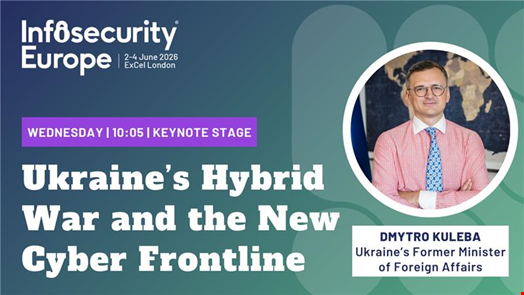
Cyber Warfare Lessons: Dmytro Kuleba Headlines Infosecurity Europe 2026

Published

on

Cyber Warfare Lessons: Dmytro Kuleba Headlines Infosecurity Europe 2026

The battlefield has evolved. It’s no longer just trenches and tanks; it’s servers, networks, and digital influence campaigns. This June, one of the architects of a nation’s defense against this modern warfare will take the stage in London.

Infosecurity Europe has confirmed Dr. Dmytro Kuleba, Ukraine’s former Minister of Foreign Affairs, as the headline keynote speaker for its 2026 conference. The event runs from June 2nd to 4th at ExCeL London.

From the Diplomatic Front to the Digital Frontline

Kuleba served as Ukraine’s top diplomat from 2020 to 2024, a period defined by full-scale invasion. Alongside President Volodymyr Zelensky, he helped shape the nation’s strategic response to a multi-domain assault. His keynote, scheduled for Wednesday, June 3rd, carries a stark title: ‘Ukraine’s Hybrid War and the New Cyber Frontline.’

What can the global cybersecurity community learn from a nation under sustained digital siege? Kuleba plans to share critical, hard-won insights. He will detail the Russian playbook, where cyber-attacks on telecommunications were synchronized with kinetic missile strikes. He’ll explain how disinformation was weaponized to sow chaos and undermine morale.

Perhaps most urgently, his talk will argue that Western corporations are now the primary front line. In an era of “permanent shock,” what must their security teams understand to survive? The lessons from Kyiv are no longer theoretical; they are a blueprint for resilience.

A Continent Divided by Tension

Kuleba’s appearance underscores a central theme for the 2026 event: the inseparable link between geopolitics and cybersecurity. This focus is timely, given new research commissioned by Infosecurity Europe.

The 2026 Cybersecurity Trends study, conducted by Zing Insights among 396 professionals across six European nations, reveals a troubling trend. 59% of cybersecurity experts say rising geopolitical tensions are actively hampering collaboration across Europe.

The sense of fragmentation is pronounced. Majorities in the UK (62%), France (68%), and Denmark (69%) report that cooperation is becoming more difficult. Only 16% of respondents felt tensions had no impact.

Confidence in European cyber cooperation is split almost down the middle. While 42% believe their country is doing enough to collaborate, 43% say it is not. This concern is highest in the UK (53%) and Germany (57%), where professionals feel current models are falling short.

Yet, the value of working together remains undeniable. When asked about the benefits, 33% cited threat intelligence sharing as the top advantage. Another 27% pointed to stronger cross-border incident response coordination. The challenge is bridging the gap between clear need and political reality.

Setting the Strategic Stage

The geopolitical tone will be set early. On Tuesday, June 2nd, the morning sessions will be chaired by Ciaran Martin, a professor at Oxford University and former founding CEO of the UK’s National Cyber Security Centre (NCSC).

Martin’s experience is profound. He led the NCSC’s response to over 2000 nationally significant cyber-attacks, helping cement the UK’s reputation as a global cybersecurity leader. His perspective will frame a program designed around real-world state-level threats.

Further deepening the strategic discussion, a senior NCSC representative will deliver a separate keynote on ‘Cyber Security 2026 – State of the Nation’ on Tuesday. This session promises a clear-eyed assessment of the UK’s threat landscape and national priorities.

Attendees can expect a breakdown of how the threat picture is shifting and where the NCSC will focus its efforts in the coming years. The talk will also outline practical steps for security leaders in government, industry, and critical national infrastructure to align with national strategy and build large-scale resilience.

Securing Your Place at the Discussion

Registration for Infosecurity Europe 2026 is now open. Entry is free until May 5th, after which a £49 fee applies. This grants access to the expansive exhibition floor and all theatre sessions, including the keynotes by Dmytro Kuleba and the NCSC.

For cybersecurity professionals navigating an increasingly volatile world, the 2026 conference offers something rare: a direct line to the strategic thinking shaping our digital defenses. The lessons from Ukraine are not just history; they are a warning, and a guide, for what comes next.

CyberSecurity

Vercel reveals customer data was stolen before its recent hack — and the breach may be bigger

Published

on

Vercel reveals customer data was stolen before its recent hack — and the breach may be bigger

App and website hosting powerhouse Vercel has disclosed that hackers managed to steal some of its customers’ data before the company discovered a major breach in early April. The revelation suggests the incident is more serious than first reported.

In an updated security notice, Vercel said its expanded investigation uncovered evidence of malicious activity on its network that predates the April intrusion. The company now believes a small number of customer accounts were compromised through social engineering, malware, or other tactics — separate from the main attack.

The Vercel customer data stolen in two waves

Vercel initially reported that its internal systems were breached after an employee downloaded an app from startup Context AI. Hackers exploited that app to hijack the employee’s work account and then infiltrate Vercel’s network.

However, the latest update indicates the Vercel data breach may have been ongoing longer than first thought. The company confirmed it found additional customer accounts compromised during the April incident, though it declined to specify how many or how far back the earlier breach dates.

“We have uncovered a small number of customer accounts with evidence of prior compromise that is independent of and predates this incident, potentially as a result of social engineering, malware, or other methods,” the company stated.

CEO links breach to infostealer malware

Vercel CEO Guillermo Rauch took to X to confirm that the hackers behind the attack have been active “beyond that startup’s compromise,” referring to Context AI, which itself confirmed a breach this week. Rauch pointed to early signs that the attackers relied on malware designed to steal valuable tokens — including keys to Vercel accounts and other services.

This behavior aligns with information-stealing malware, or infostealers, which often disguise themselves as legitimate software. Once installed, these programs collect and upload sensitive secrets from the victim’s computer, such as passwords and private keys, granting hackers access to any system those keys unlock.

“Once the attacker gets ahold of those keys, our logs show a repeated pattern: rapid and comprehensive API usage, with a focus on enumeration of non-sensitive environment variables,” Rauch explained.

The hackers used the hijacked Vercel employee’s account to reach internal systems, including customer credentials that were stored without encryption. This means the Vercel customer data stolen could include sensitive login information.

Context AI and the infostealer connection

Rauch’s comments add weight to earlier reports from security researchers that a Context AI employee’s computer was infected with infostealer malware after allegedly searching for Roblox game cheats. TechCrunch also reported that compliance startup Delve, accused of faking customer data, handled security certifications for Context AI.

Neither Vercel nor Context AI has confirmed the total number of affected customers. Both companies have warned that the breach may impact more organizations, and that additional victims could emerge in the coming weeks.

What this means for Vercel users

If you host applications or websites on Vercel, this incident underscores the importance of rotating API keys, enabling multi-factor authentication, and monitoring account activity for unusual behavior. Vercel has notified customers known to be affected so far, but the full scope remains unclear.

For a deeper look at how hosting providers handle security incidents, check out our guide on cloud hosting security best practices. You might also want to review how to rotate API keys safely to protect your own projects.

As investigations continue, the Vercel data breach serves as a stark reminder that even major platforms can fall victim to sophisticated malware campaigns. Stay vigilant, and consider infostealer malware protection tips to safeguard your credentials.

Continue Reading

CyberSecurity

Critical Nginx-ui MCP Flaw Actively Exploited: What You Need to Know

Published

on

Critical Nginx-ui MCP Flaw Actively Exploited in the Wild

A critical nginx-ui MCP flaw is being actively exploited, putting thousands of servers at risk. Tracked as CVE-2026-33032, this authentication bypass vulnerability carries a CVSS score of 9.8, making it one of the most severe threats currently facing system administrators. Discovered by Pluto Security, the flaw allows any network-adjacent attacker to take full control of an nginx server through a single unauthenticated API request.

Understanding the Nginx-ui MCP Flaw: Root Cause and Impact

So, what exactly went wrong? The vulnerability stems from a missing function call in the Model Context Protocol (MCP) implementation. Nginx-ui recently added MCP support, which splits communication across two HTTP endpoints. The /mcp endpoint properly includes both IP whitelisting and authentication middleware. However, the /mcp_message endpoint—which processes every tool invocation, including configuration writes and server restarts—shipped without any authentication check.

This omission exposes 12 MCP tools to unauthenticated callers. Seven of these are destructive, enabling attackers to inject nginx configurations, reload the server, and intercept all traffic passing through it. The remaining five provide reconnaissance capabilities, such as reading existing configs and mapping backend infrastructure. In other words, an attacker can silently take over your server and spy on your traffic.

Why This Nginx-ui MCP Flaw Demands Immediate Action

VulnCheck has already added the flaw to its Known Exploited Vulnerabilities (KEV) list. Meanwhile, Recorded Future’s Insikt Group independently flagged it in a recent report as one of 31 high-impact vulnerabilities exploited during March 2026, assigning it a risk score of 94 out of 100. These endorsements underscore the severity of the threat.

Pluto Security’s researchers used Shodan to identify over 2,600 publicly reachable nginx-ui instances across cloud providers including Alibaba Cloud, Oracle, and Tencent. Most were running on the default port 9000. The tool’s Docker image has been pulled more than 430,000 times, suggesting a much larger population of potentially vulnerable deployments sitting behind firewalls. Therefore, the actual number of at-risk instances could be significantly higher.

What Makes This Vulnerability Particularly Dangerous

This is the second MCP vulnerability Pluto Security has disclosed in recent weeks, following MCPwnfluence, an SSRF-to-RCE chain in the Atlassian MCP server. Both cases expose a recurring weakness: when MCP is connected to existing applications, its endpoints often inherit full capabilities without inheriting any of the security controls. As a result, a single missing check can compromise an entire system.

How to Protect Your Servers from the Nginx-ui MCP Flaw

The nginx-ui maintainers released a patch in version 2.3.4 just one day after disclosure. The fix amounted to 27 characters of added code, along with a regression test to prevent the same oversight from recurring. Organizations running nginx-ui with MCP enabled should take immediate action:

  • Update to version 2.3.4 or later without delay.
  • If patching is not possible, disable MCP functionality entirely.
  • Restrict network access to the management interface using firewalls or VPNs.
  • Review server logs and configuration directories for any unauthorized changes.

For more on securing your infrastructure, check out our guide on how to secure your nginx servers. Additionally, you may want to read about MCP security best practices to avoid similar pitfalls.

Conclusion: Act Now Before the Nginx-ui MCP Flaw Hits Your Network

Given the active exploitation and high CVSS score, this is not a vulnerability you can afford to ignore. The nginx-ui MCP flaw represents a clear and present danger to any organization using this popular web interface. By patching immediately, restricting access, and reviewing your logs, you can mitigate the risk. Remember, in the world of cybersecurity, a single missing line of code can open the door to disaster.

Continue Reading

CyberSecurity

How a Signed Adware Operation Silently Disabled Antivirus on 23,000 Hosts Worldwide

Published

on

How a Signed Adware Operation Silently Disabled Antivirus on 23,000 Hosts Worldwide

A new signed adware operation linked to Dragon Boss Solutions LLC has been quietly disabling antivirus software on more than 23,000 endpoints globally, according to research from Huntress. This campaign, which uses a legitimate code-signing certificate and an off-the-shelf update mechanism, represents a significant threat to enterprise security. In this article, we break down the attack chain, the global impact, and what organizations can do to protect themselves.

Understanding the Signed Adware Operation

This signed adware operation was first observed by Huntress researchers in late March 2025, though the underlying loaders had been present on some systems since late 2024. The attackers used Advanced Installer to poll remote servers for MSI-based updates. Once delivered, a PowerShell script called ClockRemoval.ps1 executed with SYSTEM privileges, targeting security products from Malwarebytes, Kaspersky, McAfee, and ESET.

What makes this attack particularly dangerous is its use of a legitimate code-signing certificate, which helps it evade initial detection. The payload checks for admin status, detects virtual machines, and queries the registry for installed security products before deploying its full capabilities.

Attack Chain Details

After gaining initial access, the payload establishes five scheduled tasks and Windows Management Instrumentation (WMI) event subscriptions to maintain persistence. These tasks trigger at boot, logon, and every 30 minutes. A tight polling loop kills matching antivirus processes every 100 milliseconds for 20 seconds at startup, preventing security tools from initializing.

The script also strips registry entries, runs vendor uninstallers silently, and modifies the Windows hosts file to redirect antivirus update domains to 0.0.0.0. Defender exclusions are added for directories like DGoogle and EMicrosoft, which likely serve as staging areas for follow-on payloads.

Global Impact and Sinkhole Discovery

What elevated the threat was the discovery that a primary update domain in the operation’s configuration was unregistered. Huntress registered the domain first and pointed it to a sinkhole. Within 24 hours, 23,565 unique IP addresses requested instructions. Infections spanned 124 countries, with the US accounting for roughly 54% of connections, followed by France, Canada, the UK, and Germany.

The firm identified 324 infections on high-value networks, including 221 universities and colleges, 41 operational technology networks (including electric utilities), 35 government entities, and three healthcare organizations. This signed adware operation clearly targeted critical infrastructure and educational institutions.

Dragon Boss Solutions: The Company Behind the Attack

According to Crunchbase, Dragon Boss Solutions is based in Sharjah, United Arab Emirates, and describes itself as conducting “search monetization research.” Antivirus vendors have historically categorized their signature as adware with browser-hijacking functionality. While the immediate payload remains an antivirus killer, Huntress warned that the update infrastructure could deliver any payload type, including ransomware, cryptominers, or data theft tools.

For more on similar threats, check out our article on DeepLoad Malware Combines ClickFix With AI-Code to Avoid Detection.

How to Protect Your Organization

To defend against such attacks, ensure your antivirus software is up to date and consider using application whitelisting to block unauthorized executables. Monitor for unusual WMI event subscriptions and scheduled tasks, as these are common persistence mechanisms. Implement network segmentation to limit the spread of infections, and regularly review your code-signing certificate management to prevent abuse.

Additionally, consider using a robust endpoint detection and response (EDR) solution that can detect and block PowerShell-based attacks. Finally, educate your users about the risks of adware and the importance of reporting suspicious activity.

Conclusion

This signed adware operation highlights the evolving threat landscape where attackers use legitimate tools and certificates to bypass security. With over 23,000 hosts affected and a global footprint, organizations must remain vigilant. By understanding the attack chain and implementing proactive defenses, you can reduce the risk of falling victim to such campaigns.

Continue Reading

Trending