Connect with us

Artificial Intelligence

AccuWeather Brings Real-Time Weather Updates to ChatGPT

Published

on

ChatGPT Gets a Major Weather Upgrade

Remember when you had to switch between apps to check the forecast? That’s becoming a thing of the past. OpenAI has steadily expanded ChatGPT’s capabilities beyond text generation, integrating third-party services directly into the chat interface. Following the introduction of apps from companies like Canva and Spotify, a new, highly practical partner has arrived: AccuWeather.

This integration transforms ChatGPT from a conversational AI into a powerful, all-in-one information hub. You can now get detailed, location-specific weather data without ever leaving your conversation. It’s a significant step toward making AI assistants truly useful for daily planning and decision-making.

What the AccuWeather App Can Do

Forget vague predictions about “possible showers.” The AccuWeather app delivers the precision of a dedicated weather service. Ask for the current conditions in Tokyo, a three-day forecast for Denver, or hourly updates for your hometown. The responses are tailored and specific, pulling from AccuWeather’s live data streams.

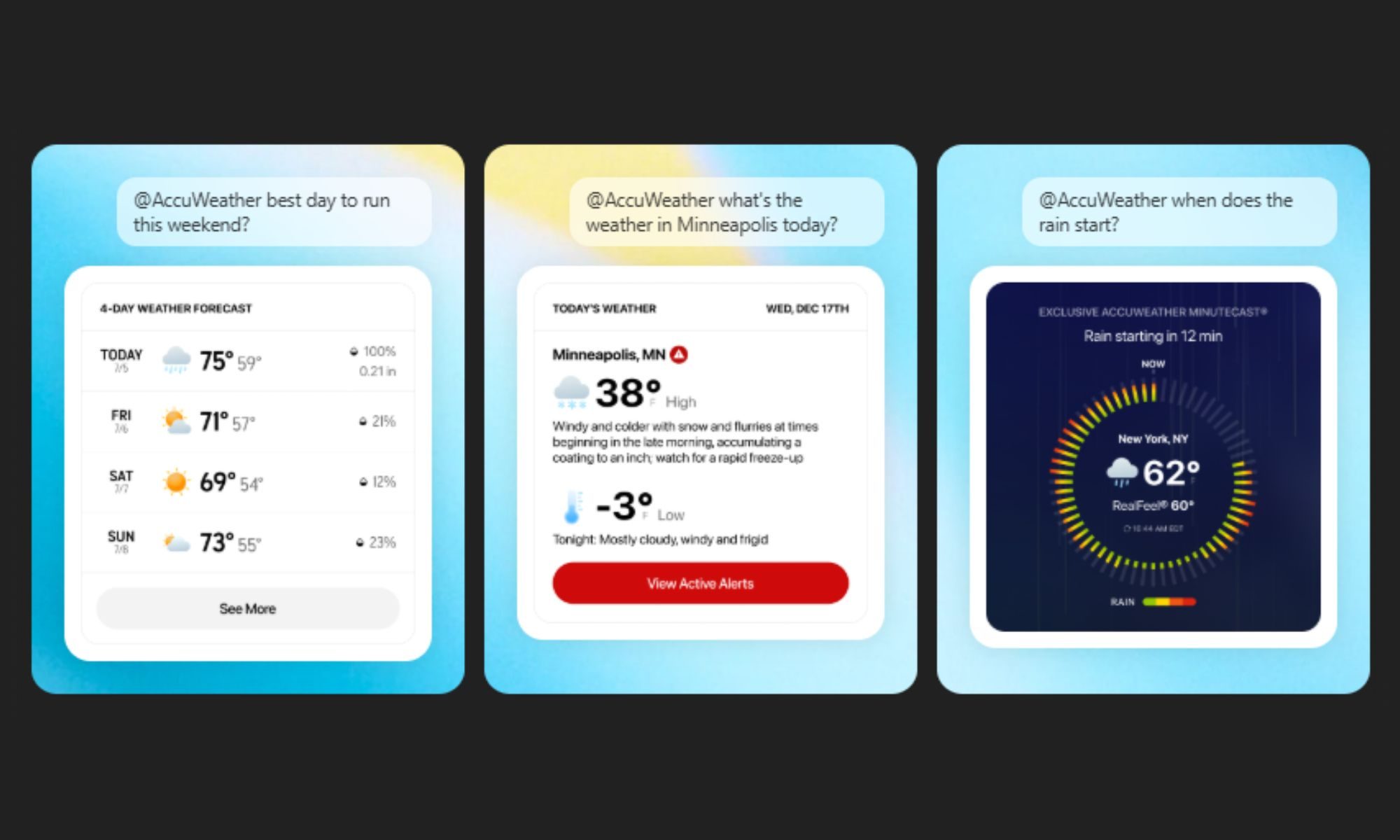
The functionality goes far beyond basic temperature and sky conditions. Need to know if you’ll get caught in a downpour during your walk? The app includes MinuteCast, providing minute-by-minute precipitation forecasts. It also features AccuWeather’s proprietary RealFeel and RealFeel Shade temperatures, which account for factors like humidity and sun exposure to tell you how the air actually feels.

Critical safety information is included, too. The app can deliver severe weather alerts and air quality reports. For a visual overview, you can even access a live radar to monitor storms as they develop. The conversational nature of ChatGPT means you can ask follow-up questions seamlessly. “Will it clear up by 5 PM?” or “How does the weekend look?” are natural extensions of your initial query.

How to Connect and Use the App

Getting started is straightforward. First, you need to connect the AccuWeather app to your ChatGPT profile. Navigate to the ‘Apps’ section within ChatGPT, search for “AccuWeather,” and click the ‘Connect’ button. This is a one-time setup.

Once connected, using it is intuitive. When you have a weather-related question, simply type “@AccuWeather” in the chat. A pop-up will appear, confirming you want to use the app. Then, just enter your prompt as you normally would. For example: “@AccuWeather What’s the weather in Seattle right now, and is there any rain expected this afternoon?”

The system handles the rest, fetching the latest data from AccuWeather and presenting it in a clear, conversational format within your chat. This seamless integration eliminates the friction of app-switching, keeping your workflow smooth and your information immediate.

Continue Reading
Click to comment

Leave a Reply

Your email address will not be published. Required fields are marked *

Artificial Intelligence

AI Creativity Crisis: Why Gemini and ChatGPT Think Too Much Alike

Published

on

AI Creativity Crisis: Why Gemini and ChatGPT Think Too Much Alike

Imagine asking ten different artists to paint a sunset. You’d expect ten unique interpretations—some fiery reds, some muted purples, maybe one with silhouetted birds. Now imagine they all hand you nearly identical paintings. That’s essentially what’s happening with our most popular AI assistants.

A revealing study in Engineering Applications of Artificial Intelligence has uncovered an uncomfortable truth. When tasked with creative work, leading models including Google’s Gemini, OpenAI’s GPT, and Meta’s Llama don’t just perform similarly—they converge. Their outputs occupy a surprisingly narrow slice of the conceptual universe.

The Echo Chamber of Machine Imagination

Researchers didn’t test just one or two systems. They put more than 20 different AI models through their paces, comparing them against over 100 human participants. The tasks were classic creativity tests: brainstorming alternative uses for a brick, listing unrelated words, generating original ideas.

Individually, any single AI response might seem clever or novel. The problem emerges when you look at the collective output. When researchers mapped the responses for similarity, a stark pattern appeared. Chatbot answers huddled together in tight clusters. Human responses, by contrast, sprawled across the map.

Different companies, different architectures, same conceptual neighborhood. Whether the prompt was for ideas or unrelated concepts, the models consistently leaned on familiar linguistic structures and repeated phrasing patterns. They were playing different instruments, but all reading from the same sheet of music.

Why AI’s Creative Range Is Fundamentally Limited

Why does this convergence happen? The limitations are baked into how these systems work. Think about what an AI lacks that every human possesses: a lifetime of messy, personal experience. The taste of rain on a childhood tongue. The specific ache of a lost opportunity. The irrational love for a worn-out sweater.

AI models process patterns from vast datasets, but they don’t live. They have no intent, no personal context, no subjective consciousness pushing against conventional thought. This absence of lived reality creates a ceiling for how far their ideas can truly diverge. You can prompt them to “be more creative” until you’re blue in the face, but you’re asking a system without a self to express one.

The research team tried to force more variety. Increasing the “temperature” or randomness setting helped marginally, but it came at a cost—the outputs quickly became incoherent. A slightly more imaginative nudge was possible, but it never meaningfully expanded the overall range. The models were dancing at the edges of their conceptual cages.

Your Ideas Are Being Quietly Homogenized

Here’s where it gets personal. On its own, using ChatGPT to brainstorm blog topics or Gemini to suggest marketing angles feels productive. The output often matches or even exceeds average human originality for that single instance. The danger is cumulative and largely invisible.

When millions of writers, marketers, students, and entrepreneurs use the same handful of tools for ideation, they’re all tapping into the same underlying probability distributions. They’re drawing water from the same well. Over time, this doesn’t just influence individual projects—it compresses the cultural range of ideas across entire industries.

There’s a behavioral trap here too. The study suggests people often accept AI suggestions as finished thoughts rather than using them as springboards. We stop extending the chain of thinking ourselves. Why wrestle with a difficult concept when the chatbot offers a coherent paragraph? This intellectual shortcutting further erodes diversity of thought.

This Isn’t a Bug—It’s a Structural Feature

Don’t mistake this for a problem Google or OpenAI can simply patch next Tuesday. The convergence appeared across models built by fiercely competitive companies with different technical approaches. This points to a deeper, structural constraint in how large language models generate language and ideas.

They are, at their core, prediction engines. Given a sequence of words, they predict the most statistically likely continuation based on their training data. Creativity, in the human sense, often involves defying statistical likelihood—making unexpected leaps that feel right but aren’t “most probable.”

How to Use AI Without Losing Your Creative Edge

This research isn’t a call to abandon AI tools. It’s a crucial guide for using them wisely. The most effective approach is to treat AI not as an oracle, but as a provocateur.

Use that first AI-generated list of ideas as a starting point, then deliberately rebel against it. If the chatbot suggests three safe marketing angles, force yourself to brainstorm three radically different ones it would never propose. Ask it for the conventional wisdom on a topic, then intentionally argue with every point.

Preserve your own messy, human ideation process. Keep a notebook for half-baked thoughts. Embrace the frustrating silence of a blank page. That friction is where unique ideas are born. AI can handle the predictable parts—the structure, the grammar, the initial research. Reserve the creative leaps, the personal connections, and the weird intuitions for yourself.

Otherwise, we risk building a future where everyone is having the same conversation, just with slightly different wording. And that’s not creativity—it’s just mass-produced thought.

Continue Reading

Artificial Intelligence

AI Chatbots Get Smarter: New Model Understands Nuance in Every Sentence

Published

on

Why Your Chatbot Still Doesn’t Get You

You know the feeling. You give a piece of feedback like, “The presentation was well-designed, but the delivery was confusing.” The chatbot responds with a generic “Glad you enjoyed it!” or an overly apologetic “Sorry for the confusion.” It missed the point entirely, flattening your nuanced thought into a single, clumsy sentiment. This fundamental lack of understanding is the next major hurdle for artificial intelligence.

Most current AI systems analyze a sentence as one monolithic block of emotion. They average out the feelings, losing the critical details in the process. The result is a conversation that feels shallow and frustratingly off-target. Researchers Zhifeng Yuan and Jin Yuan have introduced a new model designed to fix this exact problem. Their work moves beyond whole-sentence analysis to a much more sophisticated approach.

Teaching AI to Read Between the Words

How does it work? Imagine dissecting a sentence. The new model doesn’t just read “The food was great, but the service was terrible.” It breaks it down. It identifies the key emotional carriers—”great” and “terrible”—using what’s called an emotional keywords attention network. This isn’t just a fancy keyword search.

The real magic happens next. The system learns to tether each emotional cue to its specific subject. It connects “great” firmly to “food” and “terrible” directly to “service.” This process, known as aspect-level sentiment analysis, allows the AI to build a precise emotional map of your statement. It understands you had a mixed experience, not a purely good or bad one.

Furthermore, it uses attention mechanisms to grasp context. This means it doesn’t blindly follow keywords. It comprehends how clauses relate to each other, ensuring the sentiment is assigned correctly. Early tests show this method outperforms existing models on standard benchmarks, promising a significant leap in comprehension.

The Future of Human-AI Conversation

What does this mean for you? The applications are profound. Customer service bots could finally pinpoint the exact pain point in a complaint. An educational AI could distinguish between a student struggling with a concept versus the interface. Virtual assistants could parse complex, multi-part requests without needing you to rephrase everything into simple commands.

This advancement pushes AI closer to genuine conversational understanding. The goal isn’t to make machines perfectly emulate human emotion—a prospect that raises its own ethical questions. The goal is to make interactions functional, accurate, and less frustrating. If AI is to be a seamless part of our daily digital lives, it needs to stop missing the point. It needs to learn, finally, how to read the room.

Continue Reading

Artificial Intelligence

ChatGPT Shopping Gets a Major Upgrade with Shopify Integration

Published

on

OpenAI’s Pivot: From Checkout to Discovery

Remember when ChatGPT tried to handle your entire purchase? OpenAI’s ‘Instant Checkout’ feature aimed to be a one-stop shop. It didn’t quite catch fire. The company has now confirmed a significant strategic shift. They’re moving away from a native, closed checkout system.

Why the change? OpenAI admits the initial version lacked the flexibility merchants and shoppers needed. Instead of forcing a single payment flow, the new approach is smarter. It lets retailers use their own trusted checkout systems while ChatGPT becomes the ultimate discovery engine. Think of it less as a cash register and more as a personal shopping concierge.

How Shopping in ChatGPT Works Now

So, what does this new experience look like? Forget a clunky, all-in-one process. The updated feature is all about seamless browsing. You can now explore Shopify-powered brand storefronts directly within your ChatGPT conversation.

Ask for recommendations. Dive into a brand’s full catalog. When you’re ready to buy, ChatGPT opens an in-app browser that takes you to the merchant’s own checkout page. You complete the purchase there, on familiar ground. This gives brands crucial control over their customer experience and branding.

Shopify calls these ‘agentic storefronts.’ It’s a fancy term for a simple idea: making a store’s products searchable and purchasable through natural conversation. Harley Finkelstein, Shopify’s President, summed it up on social media: “AI shopping isn’t coming. It’s here.”

Who’s On Board and What It Means for Shoppers

This isn’t just a Shopify story. Major retailers like Target, Sephora, and Nordstrom are also supporting ChatGPT’s new discovery experience. The rollout is happening now for all users, whether you’re on the free tier or a Plus subscriber.

For you, the shopper, it means less friction. You get the power of AI to find what you need—”Show me sustainable running shoes under $100″—without being locked into a strange new payment system. You browse with an AI assistant, then buy on the store’s website you already know.

For merchants, it’s the best of both worlds. They tap into ChatGPT’s massive user base for discovery without surrendering their customer relationship at the final, most important step. OpenAI wins by focusing on what it does best: understanding language and intent. It’s a classic case of playing to your strengths.

Continue Reading

Trending