Connect with us

CyberSecurity

Bluesky Experiences Service Disruption: What Users Need to Know

Published

on

Bluesky Experiences Service Disruption: What Users Need to Know

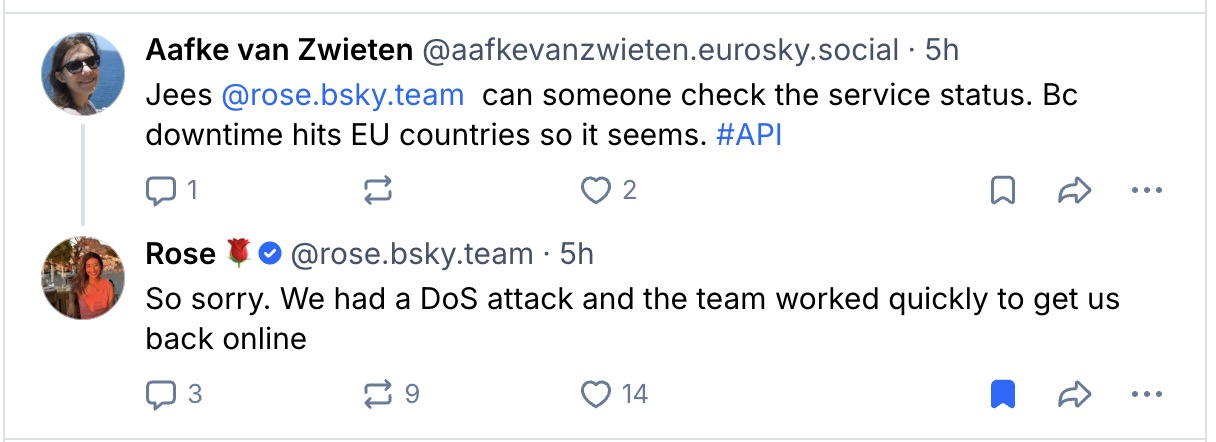
If you’ve been struggling to access Bluesky today, you’re not alone. The social network is currently grappling with a significant service disruption that has left many users unable to load feeds, view profiles, or post updates. According to Bluesky’s COO, Rose Wang, the root cause is a denial-of-service attack targeting the platform.

What Caused the Bluesky Service Disruption?

The issues first surfaced around 2:42 a.m. ET on Thursday, as noted on the platform’s official status page. Bluesky’s infrastructure has been under heavy strain ever since, with intermittent outages and slow load times persisting into the afternoon. Wang confirmed that the disruption stems from a coordinated denial-of-service attack, though the company has not yet provided a timeline for full recovery.

Impact on User Experience

Users are encountering a range of errors. Switching to popular feeds like Discover or the official Bluesky Team feed often triggers a message stating, “This feed is currently receiving high traffic and is temporarily unavailable. Please try again later. Message from server: Rate Limit Exceeded.” Personal feeds may still load, but attempting to visit user profiles frequently results in error messages, forcing repeated refreshes.

Bluesky protocol engineer Bryan Newbold acknowledged the severity around 3:46 a.m. ET, posting, “oof, our services are getting pretty hard tonight.” The company has directed users to status.bsky.app and the @status.bsky.app account for updates but has not commented on the attack’s specifics or an estimated time for resolution.

Are Other Decentralized Networks Affected?

Interestingly, the Bluesky service disruption has not spread to other communities running their own infrastructure on the underlying AT Protocol. These independent servers appear to be functioning normally, highlighting the resilience of decentralized architecture even when one major node faces trouble.

This separation is a key advantage of decentralized social networks. While Bluesky’s main servers are under fire, users on self-hosted instances can still communicate and share content without interruption. For those interested in exploring alternatives, setting up your own instance might be a worthwhile consideration during such outages.

Current Status and What’s Next

As of Thursday afternoon, Bluesky’s status page still reads: “investigating an incident with service in one of our reginos” (a typo in the original). The company has not yet resolved the issue, and users should expect continued instability until further notice.

For real-time updates, monitoring the status page is your best bet. In the meantime, consider checking tips for coping with social network downtime to stay connected while Bluesky works on a fix.

This incident serves as a reminder that even modern, decentralized platforms are not immune to attacks. However, the underlying protocol’s design ensures that the broader ecosystem remains operational, offering a silver lining in an otherwise frustrating day for Bluesky users.

Continue Reading
Click to comment

Leave a Reply

Your email address will not be published. Required fields are marked *

CyberSecurity

Google Introduces Unique AI Agent Identities in Gemini Enterprise Platform to Tackle Security Risks

Published

on

Google Unveils New AI Agent Security Features in Gemini Enterprise Platform

Google has taken a significant step forward in enterprise AI security with the launch of its Gemini Enterprise Agent Platform. This new hub, announced at the Google Cloud Next 26 conference in Las Vegas, aims to give every AI agent a unique cryptographic identity — a move designed to bring zero-trust principles into the world of agentic AI.

As businesses increasingly rely on autonomous AI agents to handle complex tasks, the need for robust identity and access management has never been greater. The Gemini Enterprise Agent Platform addresses this by assigning each agent a traceable ID that links back to defined authorization policies. According to Thomas Kurian, CEO of Google Cloud, this enables “zero trust verification at every orchestration step.”

What Is the Gemini Enterprise Agent Platform?

The platform serves as a central hub for managing both Google-built and third-party AI agents. It builds on the existing Gemini Enterprise suite, which was launched a few months earlier. The Agent Platform includes several key components: the Agent Registry, a library that indexes all internal agents, tools, and skills; and the Agent Gateway, a single dashboard for enforcing policies across agent-to-agent and agent-to-tool interactions.

These features support multiple agentic AI protocols, including the Model Context Protocol (MCP) and Agent2Agent (A2A). Google Cloud says the Gateway provides “secure, unified connectivity between agents and tools across any environment,” while enforcing consistent security policies and Model Armor protections against prompt injection and data leakage.

How AI Agent Identities Transform Security

Traditional non-human identities (NHIs) — such as API keys and service accounts — are deterministic and static. AI agents, by contrast, are autonomous and goal-oriented. They can understand high-level objectives, break them down into steps, and execute actions across multiple applications independently. This introduces a new class of dynamic digital entities that act on behalf of humans and make operational decisions.

To manage this complexity, the Gemini Enterprise Agent Platform assigns each agent a unique cryptographic ID. Every action an agent takes is linked to this ID, making it possible to audit and trace behavior. Francis deSouza, COO of Google Cloud, emphasized that security teams need to identify both authorized and unauthorized agents used across their workforce. “When you roll out authorized agents, you want to manage their access control, what they should have access to, and that may change over time in a way that’s more dynamic than human identities,” he added.

Agent Anomaly Detection and Security Dashboard

Google Cloud also introduced Agent Anomaly Detection at Cloud Next 26. This feature uses statistical models and a large language model (LLM) as a judge to identify unusual behavior in real time. It flags potential threats like suspicious reasoning patterns. Anomaly Detection works alongside the existing Agent Threat Detection, which monitors malicious activities such as reverse shells and connections to known bad IP addresses.

Another addition is the Agent Security dashboard, powered by Google Cloud’s Security Command Center (SCC). This dashboard unifies threat detection and risk analysis within Google Cloud Platform (GCP) environments. It helps security teams map relationships between AI agents and models, automate asset discovery, and scan for vulnerabilities in operating systems and language packages.

New Cybersecurity Agents for Threat Hunting

Google also released three new AI agents specifically for cybersecurity professionals. The Threat Hunting agent helps teams proactively search for novel attack patterns and stealthy adversary behaviors that bypass traditional defenses. The Detection Engineering agent identifies coverage gaps and creates new detections for threat scenarios, transforming detection creation from a manual craft into an automated science. Both are available in preview.

Coming soon to preview, the Third-Party Context agent enriches security workflows with contextual data from external sources. When fully available, these three agents will integrate into Google Security Operations, the company’s security analytics, threat detection, and incident response platform.

Google claims its earlier Triage and Investigation agent, introduced in April 2025, processed over five million alerts in the past year, reducing “a typical 30-minute manual analysis to 60 seconds.”

Broader Ecosystem: Wiz, Dark Web Intelligence, and TPU Chips

The Gemini Enterprise Agent Platform launch was part of a broader set of announcements at Cloud Next 26. Israeli cloud security firm Wiz, acquired by Google in 2025, expanded its AI-Application Protection Platform (AI-APP) to embed security directly into developer workflows. The updates include real-time vulnerability scanning, AI-generated code security, a dynamic AI bill-of-materials (AIBOM), and automated remediation.

Google also released a new dark web intelligence feature in Google Threat Intelligence, now available in preview. Internal tests show it can analyze millions of daily external events with 98% accuracy to elevate the most critical threats.

On the hardware side, Google launched two new AI-focused processing chips: the Tensor Processing Unit 8t (TPU 8t) for AI training and the Tensor Processing Unit 8i for AI inference.

Finally, Google committed $750 million to a new agentic AI partner fund for global consulting firms, systems integrators, software partners, and channel partners. The fund aims to support AI value identification, agentic AI prototyping, agent building, deployment, and upskilling.

For more on securing AI workflows, read our guide on how security leaders can safeguard against vibe coding risks.

Continue Reading

CyberSecurity

Community Bank Security Lapse: How Sharing Customer Data with an AI App Led to a Major Breach

Published

on

Community Bank Security Lapse: How Sharing Customer Data with an AI App Led to a Major Breach

A regional U.S. bank recently disclosed a troubling security lapse after employee use of an unauthorized AI-based software application exposed sensitive customer information. The incident, reported by Community Bank in a filing with the Securities and Exchange Commission, highlights the growing risks of integrating artificial intelligence tools without proper oversight.

What Happened in the Community Bank Security Lapse?

According to an 8-K filing dated May 7, Community Bank—which operates branches in Pennsylvania, Ohio, and West Virginia—detected that customer names, dates of birth, and Social Security numbers were exposed. The bank stated that this exposure occurred due to the use of an “unauthorized artificial intelligence-based software application.”

Although the exact details remain unclear, the language in the filing suggests that an employee may have uploaded customer data to an online AI chatbot. This action could have inadvertently shared that information with the chatbot’s developer, creating a serious data breach.

The bank emphasized that it disclosed the incident “due to the volume and sensitive nature of the non-public information at issue.” Community Bank is currently evaluating the affected data and sending notifications as required by law. However, it has not yet revealed how many customers were impacted or which specific AI application was involved.

Risks of Using Unauthorized AI Apps in Banking

This security lapse underscores a broader challenge for financial institutions: the unauthorized use of AI tools by employees. Many workers, seeking efficiency, turn to third-party AI chatbots or apps without proper IT approval. In this case, the result was a leak of highly sensitive personal information.

Banks and credit unions must enforce strict policies around data sharing with external software. As AI adoption grows, so does the potential for accidental breaches. Employees need clear guidelines on what data can be input into AI systems—and what must remain confidential.

For more on protecting customer data, read our guide on cybersecurity best practices for banks.

Legal and Regulatory Implications of the Data Breach

The Community Bank incident is now under regulatory scrutiny. The SEC filing itself signals that the bank recognizes the severity of the exposure. Under U.S. data breach laws, companies must notify affected individuals and regulators when sensitive data is compromised.

This case could also lead to class-action lawsuits if customers suffer identity theft or fraud as a result. Financial penalties and reputational damage are likely, especially if the bank is found to have inadequate data governance policies.

Building on this, regulators may push for stricter rules on AI usage in financial services. The Consumer Financial Protection Bureau and other agencies have already warned banks about the risks of relying on unverified AI tools.

How Banks Can Prevent Similar AI-Related Security Lapses

To avoid a similar security lapse, financial institutions should take proactive steps. First, implement a comprehensive AI governance framework that requires approval for any third-party software. Second, train employees on data privacy risks and the dangers of using unauthorized apps.

Additionally, banks should deploy data loss prevention (DLP) tools that monitor and block sensitive information from being uploaded to external services. Regular audits of software usage can also help detect unauthorized tools before they cause harm.

Check out our tips on employee training for data security to build a culture of vigilance.

Lessons from the Community Bank Incident

This event serves as a cautionary tale for all organizations handling personal data. The convenience of AI must never outweigh the responsibility to protect customer privacy. As The Register first reported, the breach was discovered internally, but the damage may already be done.

Community Bank CEO John Montgomery did not respond to requests for comment, leaving many questions unanswered. However, the message is clear: unauthorized AI app usage can lead to devastating consequences.

For more insights on AI risks, explore our article on AI security challenges in finance.

Continue Reading

CyberSecurity

Apple Patches iOS Notification Flaw That Exposed Deleted Messages: What You Need to Know

Published

on

Apple Patches iOS Notification Bug That Exposed Deleted Messages

Apple has rolled out an urgent security update to address a troubling flaw in its Notification Services. Tracked as CVE-2026-28950, the iOS notification bug allowed deleted alerts to linger on devices, potentially leaking sensitive message content to anyone with access to the phone.

The issue, resolved in iOS 26.4.2 and iPadOS 26.4.2, stems from a logging error. Notifications marked for deletion were not properly cleared, meaning that even after a user removed a message or an app, the notification data remained cached in system storage. Apple stated that improved data redaction now prevents this persistence, but did not confirm whether the flaw was actively exploited or how long the retained data could have been accessed.

How the Notification Bug Exposed Deleted Messages

The update follows reports from 404 Media, which revealed that forensic investigators could recover deleted Signal messages from an iPhone by simply accessing stored notification data—not the app itself. Even after uninstalling Signal, the message content remained available because notifications had been cached at the system level.

Although Apple did not directly reference that case, its advisory mirrors the same behavior. The company has not explained why notification content was retained or when the issue was first introduced. This highlights a critical privacy gap: even encrypted apps like Signal can be undermined by system-level features that store notification previews.

Signal welcomed the fix. “We’re grateful to Apple for the quick action here, and for understanding and acting on the stakes of this kind of issue,” the company said in a post on X. “It takes an ecosystem to preserve the fundamental human right to private communication.”

Who Is Affected by the iOS Notification Bug?

The vulnerability impacts a wide range of Apple devices, including iPhone 11 and later models, as well as various iPads. Apple has also backported patches to iOS 18.7.8 and iPadOS 18.7.8 for older supported devices.

If you own an iPhone or iPad running an affected version, your notification history may have been storing deleted messages without your knowledge. This is especially risky for users of sensitive apps like Signal or WhatsApp, where message previews could reveal private conversations.

Steps to Protect Your Privacy

To reduce the risk of future exposure, take these precautions immediately:

  • Update your device: Install iOS 26.4.2 or iPadOS 26.4.2 without delay.
  • Change notification previews: Go to Settings > Notifications > Show Previews and select “Name Only” or “Never” to hide message content.
  • Review app settings: Disable notification previews for sensitive apps like messaging or banking tools.
  • Check for older patches: If you use an older device, ensure you’ve installed iOS 18.7.8 or iPadOS 18.7.8.

For a deeper look at mobile data exposure risks, read our analysis on how 92% of mobile apps use insecure cryptographic methods.

Why This iOS Notification Bug Matters for Privacy

This incident underscores a fundamental truth: encryption alone is not enough. The Electronic Frontier Foundation has previously warned that notifications can expose metadata or unencrypted content depending on how they are implemented. Even when apps use end-to-end encryption, system-level features like notification caching can create backdoors for data recovery.

Apple’s quick response is laudable, but the fact that the bug went unnoticed for so long raises questions about testing and transparency. Users should not have to worry that deleting a message or app still leaves traces in notification logs.

As a result, this update serves as a reminder to regularly review your device’s notification settings. For more tips on securing your digital life, check out our guide on essential iPhone privacy settings.

Building on this, the broader industry must consider how operating systems handle notification data. Apple’s fix is a step forward, but it also highlights the need for clearer policies on data retention and user control.

Ultimately, the iOS notification bug was a wake-up call. Update your device now, and stay vigilant about what your phone remembers long after you think it’s forgotten.

Continue Reading

Trending