Connect with us

Artificial Intelligence

CRM and AI in 2026: How Bitrix24 Copilot Is Transforming SMEs Into AI-Powered Businesses

Published

on

CRM and AI in 2026: How Bitrix24 Copilot Is Transforming SMEs Into AI-Powered Businesses

For years, small and medium-sized enterprises (SMEs) have struggled with a fragmented tech stack. Juggling separate platforms for customer relationship management (CRM), communication, marketing, support, task management, and reporting has been the norm. Growth typically meant adding more software, more manual coordination, and eventually more people—just to keep operations running smoothly. The result? Fragmented customer data, delayed responses, repetitive administrative tasks, and teams constantly toggling between disconnected systems.

But the landscape is shifting. Artificial intelligence (AI) is beginning to reshape this operating model in a far more practical way than many businesses initially expected. Instead of functioning as passive databases, CRM platforms are evolving into AI-powered operational ecosystems. These systems can now qualify leads, generate follow-ups, prioritize pipelines, assist support teams, and automate workflows across departments. SMEs are adopting these tools not for experimentation, but for efficiency—lean teams need to handle larger customer volumes without scaling headcount at the same pace.

Platforms like Bitrix24 are leading this transition. Through tools like Bitrix24 Copilot, the platform integrates AI across communication, sales, marketing, collaboration, and customer management workflows—all inside a single environment. This turns the platform into an operating system for modern SMEs, rather than just another standalone CRM tool.

As marketing specialist Lilit Schoo notes, businesses are now prioritizing AI tools that reduce operational friction, improve responsiveness, and create measurable productivity gains. The goal is no longer simply adding another automation layer on top of existing software stacks.

AI Agents Are Becoming Digital Employees for SMEs

One of the biggest changes happening inside CRM platforms is the rise of AI agents functioning as digital employees. These aren’t isolated automation tools; they are intelligent systems that can manage entire workflows. Businesses can now deploy workflows that respond to inbound leads instantly, qualify prospects based on intent signals, generate summaries, schedule follow-ups, recommend next actions, and update sales pipelines automatically.

Inside the Bitrix24 ecosystem, these AI capabilities extend across the customer funnel instead of operating in silos. Marketing teams can use AI for campaign optimization, behavioral segmentation, and personalized messaging based on customer activity. Sales teams gain access to pipeline prioritization, proposal generation, predictive recommendations, and automated follow-up workflows. Support teams can classify tickets, retrieve responses from knowledge bases, and manage customer interactions across chat, email, and social channels with significantly faster turnaround times.

The larger advantage comes from integration. CRM records, telephony, email, chat, tasks, collaboration tools, and AI workflows operate within the same platform. This reduces the inefficiencies that typically emerge when businesses rely on disconnected software stacks and third-party integrations to manage customer operations.

Consider a practical example: When an inbound lead arrives through website chat, an AI agent can engage the customer immediately, capture interaction details, assign a lead score, schedule a meeting, generate follow-up emails, and recommend next steps for the sales representative—all while simultaneously updating pipeline forecasts inside the CRM. What previously required multiple employee touchpoints and several disconnected tools can now happen through a centralized AI-powered workflow.

How Bitrix24 Is Positioning Embedded AI for Modern SMEs

Many enterprise AI platforms have traditionally been difficult for smaller businesses to deploy. Implementation costs, technical complexity, and fragmented integrations often create barriers. Bitrix24 is targeting a different approach by positioning embedded AI as accessible operational infrastructure rather than an enterprise-only capability.

Low-code workflows, prebuilt automations, centralized customer records, and native communication tools allow SMEs to deploy AI across sales, support, and marketing operations without depending heavily on IT teams or external consultants. Businesses also gain stronger visibility across customer interactions because communication history, support activity, sales workflows, and operational data remain connected inside a unified system.

For many SMEs, the appeal is operational efficiency. AI agents reduce repetitive administrative work, improve response times, increase productivity per employee, and help businesses maintain personalization at scale without introducing additional software complexity. This is particularly valuable for lean teams that need to do more with less.

As a result, SMEs are no longer evaluating AI as an experimental add-on. Businesses are increasingly looking for platforms capable of centralizing operations, reducing workflow friction, and helping lean teams operate with greater speed and precision. Platforms like Bitrix24 Copilot are positioning AI as a practical operational layer for modern SMEs, giving smaller businesses access to enterprise-grade automation, centralized workflows, and AI-assisted decision-making without enterprise-scale complexity.

Looking ahead, AI adoption across customer operations is accelerating. Businesses that rely on disconnected tools and manual workflows may increasingly find themselves at a competitive disadvantage. For SMEs aiming to stay agile and efficient, embracing AI-powered CRM solutions like Bitrix24 Copilot is no longer a luxury—it’s becoming a strategic necessity.

For more insights on how AI is transforming small business operations, check out our guide on AI for small business and learn about CRM automation tips for lean teams.

Continue Reading
Click to comment

Leave a Reply

Your email address will not be published. Required fields are marked *

Artificial Intelligence

Chinese open-weight models are cheap. Washington is deciding what that costs.

Published

on

Chinese open-weight models

Kimi K3 lands, and the policy debate reignites

On July 16, Moonshot AI dropped Kimi K3, the largest open-weight model ever released. Within days, it had reopened a policy argument in Washington that had been dormant for a year. The question for enterprises evaluating Chinese open-weight models this month isn’t about benchmarks. It’s about whether using one will still be straightforward a year from now.

The outcome will affect procurement decisions well outside the United States. The mechanisms under discussion — federal procurement rules, export blacklists, security advisories — travel through the same cloud providers that serve most of the world.

The immediate trigger: a post by Dean W. Ball, OpenAI’s head of strategic futures and until recently a senior AI adviser in the Trump White House.

Ball’s forecast: regulatory risk, not a ban

Ball’s assessment of the model was largely positive. He called it a very good model whose performance he didn’t think could be explained away by distillation. He also noted it seemed ‘very token hungry’ and wasn’t obviously cheap to run — a useful caution, given K3 launches with maximum reasoning effort as its only setting and bills output at $15 per million tokens.

Then he predicted the Trump administration would eventually decide its best strategy was to create regulatory risk around Chinese open-weight models. Not a ban, which he called one of the dumber motifs in AI policy, but soft guidance from agencies suggesting such models may contain backdoors. ‘It needn’t be that well justified,’ he wrote. Enough uncertainty, and regulated enterprises retreat on their own.

Why Chinese open-weight models are a commercial problem first

The reaction was fierce, and it came from Americans rather than Beijing. David Sacks, co-chair of the President’s Council of Advisors on Science and Technology, said he couldn’t tell whether Ball was confessing to a regulatory capture strategy or predicting one. Either way, weaponising regulatory uncertainty as a competitive tool should be unacceptable, Sacks argued.

He added that the leading closed labs, already a duopoly in model revenue, want the government to remove their open-source competition. Yann LeCun and Martin Casado argued that open and proprietary development can coexist. Ball later clarified he had been forecasting rather than recommending, and walked back the claim that open weights necessarily slow the field down.

Underneath the personalities is an arithmetic problem. Closed labs need revenue per token to justify the capital they are raising for data centres. Cheaper open-weight models compress that revenue without reducing how much AI gets used — the point Snorkel AI co-founder Braden Hancock put to TechCrunch. The routing data already shows the shift: open-weight models handled 29% of tokens through Vercel’s production gateway in June, up from roughly a ninth in April, while accounting for under 4% of spending.

That pressure is arriving from inside the American stack. GitHub made Moonshot’s Kimi K2.7 Code generally available in the Copilot model picker on July 1, hosted on Microsoft Azure. The Information reports Microsoft is now adding K3 to Azure and evaluating whether it can run Copilot features currently handled by OpenAI and Anthropic models, with potential inference savings of up to $600 million.

Microsoft has confirmed neither the figure nor which features. It’s an evaluation, not a deployment. But it’s the largest customer of both American frontier labs, pricing the alternative.

The security argument, taken seriously

Commercial motive does not make the security concern fake. The strongest version of it deserves stating. Open weights cannot be recalled. Once a model is downloaded and running inside thousands of organisations, no vendor can patch it, revoke it, or push a fix — a materially different risk profile from a hosted API. Model behaviour is harder to audit than model code: a fine-tune can carry biases or failure modes that no licence inspection would reveal.

NIST has previously found security vulnerabilities in DeepSeek’s open models. For regulated industries, questions about training data provenance and content handling are live regardless of where a model was built.

The counterargument is about proportionality rather than dismissal. Georgetown research fellow Sam Bresnick has argued that halting Nvidia H200 sales to China would slow Beijing considerably more than banning open models Americans want to use — targeting the input rather than the output. Ball himself conceded a version of this in his second observation, attributing China’s open-weight strategy partly to a lack of domestic compute for serving customers. That would make it an unintended byproduct of US export controls in the first place.

What is actually likely to happen

Axios reported on July 20, citing people close to the administration, that Commerce last year weighed adding Chinese AI labs to the Entity List. The NSA and the Office of the National Cyber Director considered issuing an advisory on Chinese AI lab threats. The White House considered an executive order making US companies liable for breaches if they used Chinese models. Officials concerned about stifling innovation killed all of it.

With adviser Sriram Krishnan gone and security hawks louder, the effort has revived. But the described approach is procurement rules, Entity List threats and public pressure rather than prohibition. ‘What’s actually happening is slower and more durable,’ one source told Axios. Neither the White House nor Commerce responded to Axios’s requests for comment. Politico reports Commerce will not move imminently.

Impact on buyers outside the US

For buyers outside the US, the exposure is indirect but real. A rule written for American regulated industries and federal procurement does not bind a Malaysian bank or an Indonesian telco. The hyperscalers are the transmission line.

Most enterprises in this region reach Kimi K3 through Azure, AWS or Google Cloud rather than Moonshot’s own API. If Washington makes hosting Chinese open-weight models uncomfortable enough for those providers, the model quietly leaves the catalogue in Kuala Lumpur at the same time it leaves it in Virginia.

Ball anticipated this in his own post, noting that regulators would not want to push so hard that hyperscalers stop serving Chinese models altogether. That would only drive startups toward less reputable providers. The obvious hedge is to hold your own copy. Moonshot publishes K3’s weights on July 27, and from that point the model cannot be withdrawn from anyone who has downloaded it.

But as covered previously, K3 is a difficult model to self-host. Moonshot recommends serving it across 64 or more accelerators, and the weights alone come to roughly 1.4TB. For most companies, the fallback is theoretical.

That leaves a narrower question than the headlines imply. Not whether Chinese open-weight models are safe or permitted. But whether the specific model you build on will still be in your cloud provider’s catalogue in twelve months, and what it would cost you to move if it isn’t. That’s a due-diligence question, and it’s answerable today.

For more on the technical side, see our analysis of the Kimi K3 open-weight model and its memory-focused architecture. Also explore how Washington AI policy is shaping global tech procurement.

Continue Reading

Artificial Intelligence

Why the Open Source AI Boom Isn’t Squeezing Anthropic — at Least Not Yet

Published

on

open source AI Anthropic

The Two-Speed AI Economy Nobody’s Talking About

Here’s a riddle for the AI era: If companies are ditching expensive frontier models for cheaper open source alternatives, why is Anthropic still raking in more than half of all AI spending on major platforms?

That contradiction sits at the heart of a provocative new argument from Decagon CEO Jesse Zhang. In a post titled “Everyone is wrong about open source AI in the enterprise,” Zhang proposes that frontier labs and open source models aren’t really competing. They’re playing different roles in a single lifecycle.

Expensive frontier models handle the messy, high-risk early stages of a new use case. Once the process is proven and predictable, companies hand it off to leaner, cheaper open source models. The result? Frontier spending barely dips, because new discovery projects keep popping up to replace the ones that mature.

“The frontier labs will keep owning discovery,” Zhang writes. “Open source will increasingly own production.”

What the Data Actually Shows

Zhang doesn’t offer hard numbers, but the data is easy to find — and it largely backs up his thesis.

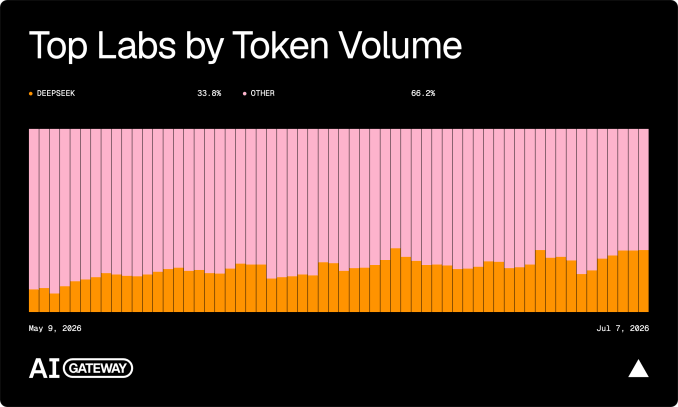
Take Vercel‘s AI gateway dashboard. Over the past week, DeepSeek has surged to the lead in token volume, processing just over a third of all tokens flowing through Vercel’s infrastructure. Z.ai, the lab behind the popular GLM-5.2 model, jumped to fourth place in the same period.

But scroll down to spend, and the picture flips. Anthropic still accounts for more than half of all AI spending on the platform. That share has slipped slightly — partly because Anthropic raised prices — but hasn’t collapsed.

OpenRouter tells a similar story across a broader, slightly less enterprise-focused slice of the market. DeepSeek V4 Flash dominates by raw usage, processing 5.3 trillion tokens weekly. The most popular frontier model, Opus 4.8, handles just over 2 trillion. But the price gap is enormous: Opus costs roughly 23 times more per token ($1.37 per million tokens versus DeepSeek’s 6 cents). That means Opus likely still captures the majority of actual dollars spent.

And that’s before factoring in Nvidia’s Nemotron, which is poised to leapfrog competitors thanks to Nvidia’s deep enterprise relationships and the model’s extreme adaptability.

Why Frontier Labs Aren’t Panicking

The numbers don’t fully prove Zhang’s lifecycle theory, but they do explain why Anthropic isn’t sweating the open source surge — at least not yet.

One reason: the total pool of AI-addressable problems is expanding so rapidly that frontier labs can maintain their position simply by dominating new, unproven use cases. Every time a mature workflow migrates to open source, a fresh batch of harder problems appears to take its place.

Another explanation: some use cases are genuinely too difficult for lighter models. Even as clients experiment with cheaper alternatives, they keep a foot in the frontier door for the toughest tasks. That creates a sticky, high-margin revenue base that open source models can’t easily erode.

What This Means for Enterprise AI Buyers

For companies building on AI, the implication is clear: don’t treat frontier and open source models as an either/or choice. Use frontier models to explore and validate. Once the process is stable, switch to open source for production. It’s a hybrid strategy, not a migration.

This two-tiered economy could become a stable feature of the AI market. Frontier labs keep the premium pricing they need to fund R&D. Open source models get the volume that drives ecosystem growth. And enterprises get a cost-effective path from experimentation to deployment.

As recently as last September, many analysts — including this one — predicted that foundation labs would end up as commodity providers, selling “coffee beans to Starbucks” while the application layer captured the value. Some of that prediction came true: vertical AI startups did switch to lighter models, and the economics of “GPT wrapper” companies have remained stable.

But we’re also seeing that frontier providers have held onto the most desirable part of the marketplace: the premium token price. And that doesn’t look likely to change anytime soon.

For a deeper look at how companies are balancing cost and capability, check out our analysis of enterprise AI adoption strategies. And for more on the specific models driving this shift, see our breakdown of how DeepSeek is reshaping the open source AI landscape.

Continue Reading

Artificial Intelligence

Your AI Year in Review: Anthropic Launches Claude Reflect, a Usage Dashboard With a Wellness Twist

Published

on

Claude Reflect

Anthropic just gave Claude users a new kind of year-in-review tool — and it’s designed to make you think twice about how much you lean on AI.

It’s called Claude Reflect. Think of it as your personal AI usage analytics dashboard, but with a twist: instead of just showing you numbers and topics, it pushes you to reconsider your relationship with the technology. Available now in beta, the feature rolls out to free, Pro, and Max users who have enabled memory on Anthropic’s Anthropic platform.

Reflect isn’t called “Claude Wrapped,” even though it does the same seasonal recap that streaming services and AI tools have made famous. The name matters. Anthropic wants this to be more than a vanity metric dump. It’s a prompt for mindfulness.

What Claude Reflect actually shows you

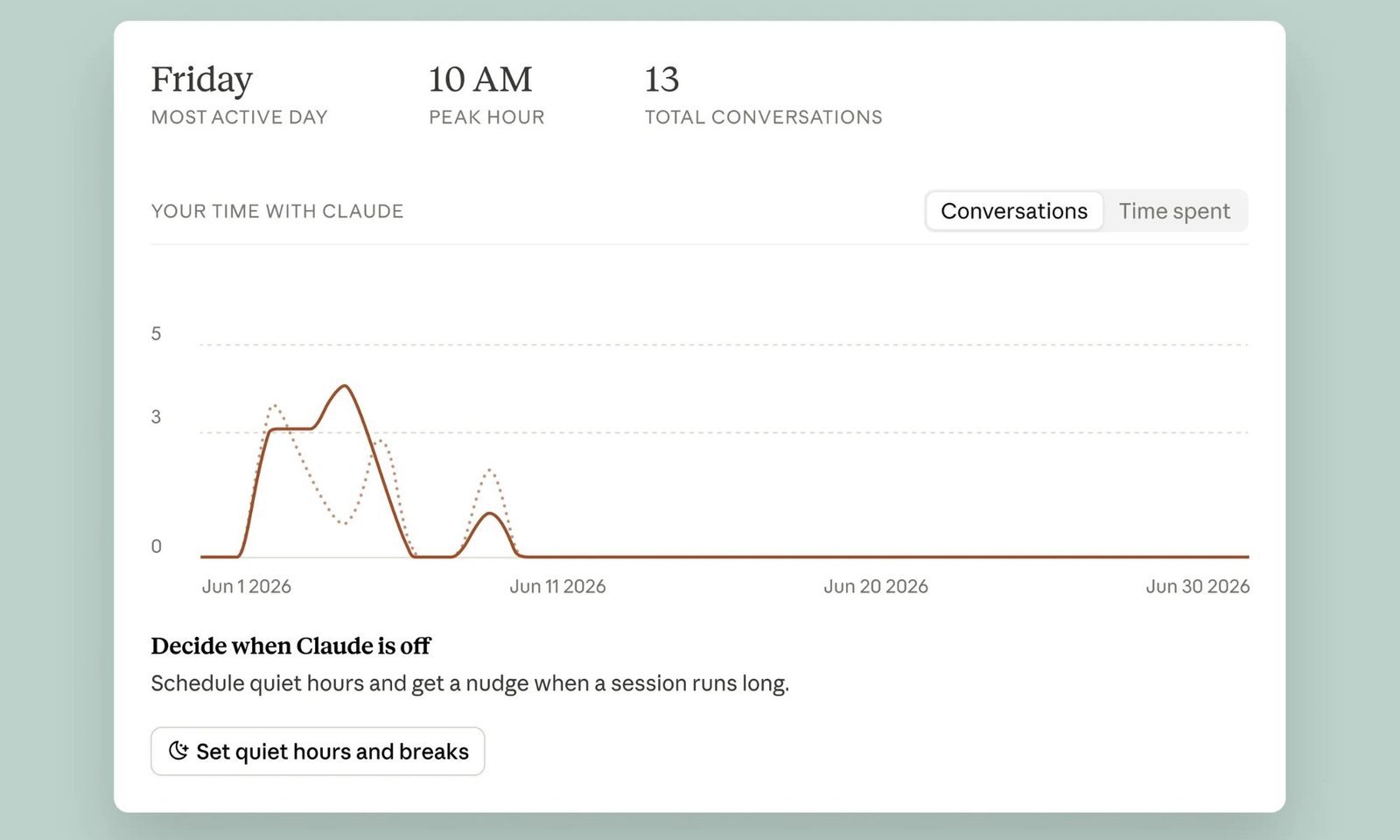
Head to Settings in the Claude web or desktop app and you’ll find Reflect waiting. It generates a summary of your activity over one, three, six, or twelve months. The breakdown goes beyond counting chats.

It surfaces the topics you engage with most, spots usage patterns, and categorizes your interactions using Anthropic’s 4D AI Fluency Framework. Those four dimensions are: delegation, description, discernment, and diligence. So instead of just seeing “you talked about coding 40% of the time,” you get a structured view of how you work with the AI — whether you’re handing off tasks, asking for explanations, or critically evaluating outputs.

Think of it as a report card for your AI habits, not just a spreadsheet of queries.

Privacy and exclusions

Anthropic is careful about what gets counted. Incognito conversations and any health-integration chats are excluded entirely. The company also states that the data stays inside your dashboard and is not used for any other purpose. That’s a meaningful distinction at a time when every AI company is hungry for training data.

The feature was developed in collaboration with MIT Media Lab, the Digital Wellness Lab at Boston Children’s Hospital, and the Family Online Safety Institute. That lineup signals that the wellness angle isn’t an afterthought — it’s baked into the design from the start.

The wellness angle: Why it stands out

Here’s the part that makes you stop. An AI company building a tool that actively nudges you to use AI less? That’s rare. And honestly, it’s refreshing.

Reflect surfaces questions like: “What’s one thing you want to keep doing yourself, even if Claude could do it faster?” It lets you set quiet hours, and it can schedule nudges that remind you to step away from the screen. A time-spent view is coming soon, which will track how many minutes or hours you spend inside Claude conversations.

All of this feels counterintuitive for a business that makes money when people use its product more. But it also aligns with a growing conversation around digital wellness — the idea that technology should serve us, not consume us. Anthropic is betting that users will appreciate a tool that respects their autonomy, even if it means slightly less engagement.

How to get started with Claude Reflect

If you’re already a Claude user with memory enabled, you can access Reflect right now through the Settings menu in the web or desktop apps. It’s in beta, so expect some rough edges and iterative updates. The time-spent view isn’t live yet, but it’s on the roadmap.

For new users, enabling memory is the first step. Once that’s on, Reflect will begin tracking your patterns and building your personalized dashboard. The summaries are generated on-device or in your account — Anthropic says the data doesn’t leave your dashboard.

What this means for the AI industry

Anthropic’s move is a small but telling signal. Most AI companies are racing to increase usage metrics — more conversations, longer sessions, higher retention. Reflect flips that script by asking: are you using AI well, not just a lot?

It’s too early to tell whether users will embrace the nudge to take breaks or ignore it. But the feature itself is a bet that trust and transparency matter more than raw engagement numbers. In an industry that’s been criticized for addictive design patterns, that’s a notable stance.

If you’re curious about how your own AI habits stack up, or just want a tool that occasionally tells you to log off, Claude Reflect is worth a look. It’s one of the few dashboards that might actually make you feel better about your screen time — not worse.

Continue Reading

Trending