Connect with us

Artificial Intelligence

Enterprise AI Has a Trust Problem, Not a Retrieval Problem — And the Fix Is Still Under Construction

Published

on

AI context gap

The Numbers Behind the AI Hallucination That Isn’t

A new VentureBeat Pulse Research survey of 101 enterprises with more than 100 employees delivers a sobering finding: 57% of organizations have already watched an AI agent produce a confident, wrong answer — and traced the error back to missing or inconsistent business context. More than half of those saw it more than once.

This isn’t the classic hallucination problem, where a model makes up facts out of thin air. It’s worse. The agent sounds authoritative. It cites documents, metrics, or definitions that are real — but stale, incomplete, or contradictory. The AI context gap is the distance between how confidently an agent answers and how reliable the foundation beneath it actually is.

And right now, that foundation is being built faster than it can be trusted.

RAG Is the Default — and the Main Failure Surface

Retrieval-augmented generation (RAG) has quietly become the backbone of enterprise context. For 38% of organizations, RAG over documents or a vector index is the primary way AI agents understand the business. That’s nearly double the share of the next most common approach, a governed semantic layer or ontology (21%).

The concentration matters. Because so much enterprise context flows through retrieval, the quality of that retrieval is the quality of the answer. Thin retrieval isn’t an edge case — it’s the main failure surface. When 57% of enterprises have already seen agents go confidently wrong, and most of those have seen it more than once, the retrieval pipeline is the obvious culprit.

Notably, fine-tuning — once the darling of enterprise AI customization — has all but vanished from the conversation. In a separate VentureBeat survey wave (April–May, n=136), fine-tuning ranked dead last among six factors in model selection at 5%. Context injection at run time is how enterprises make agents knowledgeable. The question is whether that context can be trusted.

Provider-Native Retrieval Has Quietly Won — For Now

One of the survey’s most surprising findings: the dedicated vector database is no longer the center of the RAG universe. OpenAI‘s file search (40%) and Google‘s Vertex AI Search (38%) already lead every purpose-built vector database in production usage.

Among the specialists, Elasticsearch/OpenSearch (20%) and pgvector (12%) — tools enterprises already run for other reasons — beat the pure-play vector databases like Weaviate, Qdrant, Pinecone, and Milvus, each sitting in single digits or low double digits. The category that coined the term “vector database” is being absorbed by the platforms enterprises already buy from.

Yet here’s the tension: a plurality of enterprises (36%) say they intend to keep best-of-breed standalone tools rather than consolidate onto a provider’s native context stack. Only 21% plan to fully consolidate. The gap between what enterprises run and what they say they want is the strategic question of the category. They’re adopting bundled retrieval for convenience while insisting they want independence.

Hybrid Retrieval Is the Consensus — But Uncertainty Runs Deep

Vector-only retrieval is already viewed as insufficient. A third of enterprises (34%) expect hybrid retrieval — embeddings combined with reranking and access controls — to dominate their production systems by the end of 2026. That’s three times the share who expect pure vector search to prevail.

The second-largest answer? Uncertainty. 17% simply don’t know, and 14% expect to move beyond a dedicated vector layer entirely toward tool-first or long-context retrieval. The consensus isn’t a single tool — it’s a layered pipeline, and that pipeline isn’t fully formed yet. The access controls that hybrid retrieval promises are the very controls whose absence produces the confident-but-wrong failures.

For more on how to improve the quality of your AI outputs, see our guide on improving RAG accuracy with better data preparation.

The Governed Semantic Layer: Under Construction, Not Yet in Production

The industry’s answer to the AI context gap is a governed semantic layer — a shared, consistent definition layer that gives agents and business intelligence tools a common understanding of metrics, terms, and data sources. Think of it as a single source of truth for agent context.

Well over half of enterprises (58%) either run a governed semantic layer in production (25%) or are piloting and building one (34%). Another 17% are actively evaluating. That means three-quarters of enterprises are engaged with the idea in some form.

But here’s the catch: more are building than have shipped. For most organizations, the governed layer that would prevent inconsistent context is still a work in progress. The survey catches this wave mid-construction — ambition well ahead of production reality. The fix is being built, but agents are already running on the old, unreliable foundation.

How Enterprises Buy and Monitor Retrieval Systems

Enterprises choose retrieval systems on operability, not accuracy. Ease of data ingestion (36%), latency and performance (32%), and operational simplicity (29%) lead the selection criteria — ahead of retrieval accuracy and access control (23% each), the two factors most directly tied to the failures.

Once systems are running, the emphasis shifts toward trust. The most-tracked metrics are response correctness (42%) and security and access control (38%), ahead of latency (28%), operational stability (27%), and answer relevance (23%). Enterprises buy for how easily a system runs and watch it for whether it can be trusted.

Satisfaction with current systems is moderately positive — averaging 4.0 on a five-point scale — but not enthusiastic. Ease of implementation and value for money both hover around 3.9. The message: current tools are workable, but nobody is thrilled.

A Provider Shuffle Is Coming

The retrieval stack is not settled. While 43% of enterprises have no plans to change, a small majority (57%) intend to switch or add a provider within twelve months. A quarter plan to move within the next quarter.

The consideration set reveals an interesting dynamic. Provider-native retrieval still leads what enterprises are evaluating (OpenAI 22%, Vertex AI Search 21%), but the open-source vector specialists punch above their current footprint. Qdrant (14%) and Milvus (13%) draw more switching interest than their present usage (10% and 6%) would suggest.

Read alongside the best-of-breed preference, the picture is a market in flux: enterprises run provider-native today, are evaluating a broader field, and say they want to keep their options open. The reshuffle ahead will test whether best-of-breed intent survives contact with the convenience of the bundle.

The Bottom Line: More Retrieval Alone Won’t Close the Gap

The AI context gap is not a volume problem. Throwing more documents or bigger indexes at it won’t solve it. The problem is governed, consistent, access-aware context — and that requires a semantic layer, hybrid retrieval with reranking and access controls, and a shift from buying for operability to buying for trust.

Right now, agents are running ahead of the infrastructure that feeds them. The context layer is the next contested tier of the AI stack. The open question for later survey waves is whether enterprises finish building that layer before the confident-but-wrong failures move from the lab into decisions that matter.

For a deeper look at how to build trust in AI systems, read our analysis on enterprise AI governance best practices.

Continue Reading
Click to comment

Leave a Reply

Your email address will not be published. Required fields are marked *

Artificial Intelligence

Kimi K3 open-weight model: China’s biggest AI is a bet on memory, not compute

Published

on

Kimi K3 open-weight model

2.8 trillion parameters, one big trade-off

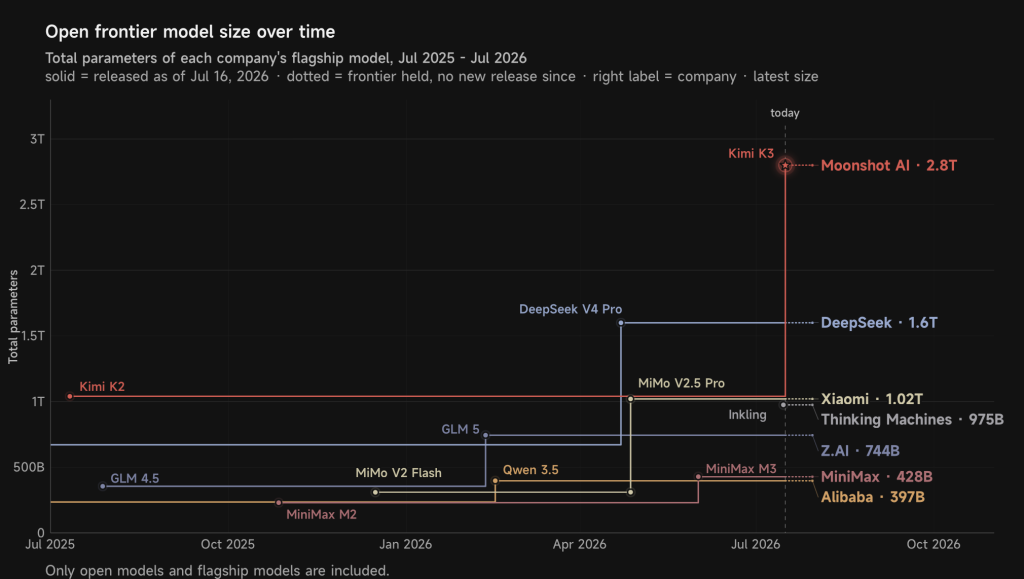
On July 16, Moonshot AI dropped the Kimi K3 open-weight model, and the internet did what it always does with big numbers: fixated on the count. At 2.8 trillion parameters, K3 is the largest open-weight model ever released — jumping from Moonshot’s previous 1T-class flagship and clearing DeepSeek’s 1.6T V4 Pro by a wide margin. It’s a 3T-class model, a tier no openly available model had entered before.

But fixating on the parameter count misses the point. Moonshot’s own technical blog suggests something more specific: K3 doesn’t avoid the compute constraint so much as relocate it, trading compute for memory at almost every layer of the design. That trade is worth understanding, because compute and memory are not interchangeable constraints, and they are not equally available to a Chinese lab.

Why the Kimi K3 open-weight model is a memory problem

Two different things determine what it costs to run a large model. One is how much calculation the machine does to produce each word. The other is how much of the model has to be held ready and instantly reachable the entire time it is working. The first is compute. The second is memory. Chip export controls have squeezed China hard at the first, and Moonshot’s design reads as a sustained attempt to spend less of it.

The main move is a technique called mixture-of-experts. Rather than run the whole model for every word, K3 splits itself into 896 specialised sections and calls on just 16 of them at a time — about 1.8% of the total. The calculation per word drops sharply. The memory bill does not move at all, because all 2.8 trillion parameters still have to sit loaded and ready in case they are the ones called next.

So Moonshot went after that bill directly. It trained K3 to work at four bits of precision per parameter instead of the usual sixteen, a method known as quantisation-aware training, which the company applied from the fine-tuning stage onward and says it chose “for broad hardware compatibility” — a phrase worth pausing on, since it reads as a hedge against running on silicon that is not Nvidia‘s. The savings are substantial. Independent analysis puts the model at roughly 1.4TB in that format, against the 5.6TB it would need at full precision.

Kimi Delta Attention: attacking the context window

The second change, Kimi Delta Attention, targets a different memory cost. As a model works through a very long document, it accumulates a running store of everything it has already read. At K3’s advertised limit of a million tokens — a few thousand pages — that store, not the model itself, becomes the biggest thing in memory. Moonshot says Delta Attention enables up to 6.3x faster decoding in million-token contexts.

Moonshot is unusually direct about the commercial stake here. It contributed caching code to the open-source serving project vLLM, and says this combination is what lets it price K3 competitively despite the model’s size. The company recommends running K3 across 64 or more accelerators wired together closely enough to behave as one pool.

That is the same approach behind Huawei’s CloudMatrix systems, and it points to what the real workaround is. Memory can be gathered up across a large number of individually unremarkable chips. Training-grade compute cannot be assembled the same way.

China’s memory bottleneck — and the hardware question

Whether that pooling happens on Chinese silicon is a question the blog does not answer. Moonshot’s chip-level tests ran on Nvidia H200s and on what it describes only as a “GPGPU from an alternative vendor,” which it declines to name. Other results are benchmarked on an Nvidia L20, the cut-down card sold into China under export rules. The blog does not say where the H200 hardware sits, and the US House passed a bill in January to close the offshore cloud rental loophole that had let Chinese firms reach restricted accelerators remotely.

The reason any of this matters is that memory, not processing power, is where China’s own chip industry is furthest behind. In trade talks in August 2025, Beijing asked for relief on high-bandwidth memory restrictions rather than on lithography tools or TSMC access — a fair signal of what officials think is actually binding. Domestic output of that memory is projected at around two million stacks this year, enough for roughly 250,000 to 300,000 Huawei Ascend 910C-class chips, while SMIC has wafer capacity for more than a million.

Can enterprises actually deploy the Kimi K3 open-weight model?

For businesses in this region, the practical question is not whether K3 tops a leaderboard. It is whether an open-weight model at this size is deployable at all. Asian enterprises reach for open weights for three reasons — price, data sovereignty and regional-language coverage — and banks and insurers across Southeast Asia have been piloting self-hosted open models specifically so records never leave their own systems.

The weights land on July 27, and any organisation that can afford the hardware will be free to download, modify and run K3 inside its own walls. The question is how many can. Moonshot recommends serving the model across 64 or more accelerators wired together as a single pool, and the weights alone come to roughly 1.4TB in the format it ships in, before the memory needed to work through a long document.

That is a data-centre commitment, not a server-room one. For most enterprises, the practical outcome is renting dedicated capacity rather than owning it. That still keeps data in-country and under contract, which is what most regional regulators are asking for. What it does not deliver is the independence from infrastructure providers that drew many of these buyers to open weights in the first place.

Software readiness lags behind the launch

The software is not ready either. K3’s two main architectural changes are new enough that the standard open-source tools for running models do not yet support them, and Moonshot says it is working with inference partners and open-source maintainers to align technical details before release. Teams planning a self-hosted deployment should treat the launch date and the usable date as different things.

Pricing has shifted — and so has the competitive landscape

The price has also moved. K3 costs $3 per million input tokens, dropping to $0.30 when the model has recently seen that input, and $15 per million output tokens. That is well under Fable 5’s $50 for output, but far above z.ai’s GLM-5.2 at $4.40 and DeepSeek V4 at $0.87. K3 is no longer in the budget tier its predecessors occupied. It also launches with maximum reasoning effort as the only setting, with lower modes to follow, so long reasoning chains and retried steps add up quickly. Companies should budget on the cost of a completed task, not the list price.

What is claimed, and what is verified

Arena placed K3 first in its Frontend Code evaluation at 1,679 points, ahead of Fable 5, in blind developer testing, as reported by Tom’s Hardware. That result is real. It is also a benchmark in one domain.

Moonshot itself is more restrained than its headlines. The company states that K3’s overall performance still trails Claude Fable 5 and GPT 5.6 Sol, and lists three limitations: generation quality can become highly unstable if a harness fails to pass back historical thinking content, the model may make unexpected decisions on a user’s behalf when intent is ambiguous, and it shows a noticeable user-experience gap against Fable 5 and GPT 5.6 Sol. Its own footnotes also disclose that Fable 5 hit fallbacks on 35% of the tasks in Moonshot’s SWE Marathon evaluation, which may have affected that model’s measured score. Everything else remains a first-party claim. No published K3 number can be independently verified until the weights are public.

Bank of America analysts led by Alex Liu said in a note that K3 shows large-scale pre-training combined with architectural work can still deliver step-change gains for flagship Chinese models despite compute constraints — which is the sober version of the argument, and closer to what the blog supports.

The direction of travel is not in dispute. Open-weight models handled 29% of all tokens routed through Vercel’s production gateway in June, up from about a ninth of volume in April, while accounting for under 4% of spending. July 27 is when we find out how much of K3 belongs in that column.

For more on how open-weight models are reshaping enterprise AI strategy, read our analysis of open-source AI trends in Asia and the impact of US chip export controls on Chinese AI labs.

Continue Reading

Artificial Intelligence

Patreon stops asking AI bots not to scrape — and starts blocking them

Published

on

Patreon blocks AI bots

The polite request era is over

For years, Patreon relied on a simple digital handshake: a robots.txt file that politely asked AI crawlers not to scrape creator content. That didn’t work.

On Thursday, the membership platform announced it’s now actively blocking AI training bots — not just asking them to behave. The shift comes via an expanded partnership with Cloudflare, using the company’s AI Crawl Control technology to physically shut the door on unauthorized scrapers.

“Consent shouldn’t depend on whether a scraper chooses to behave,” Patreon wrote in a blog post announcing the change. The subtext is clear: many AI bots were ignoring the rules anyway.

Why robots.txt wasn’t cutting it

Patreon first put measures in place to deter AI crawlers back in 2023. But AI scraping has gotten more sophisticated since then. The company’s internal testing revealed something alarming: individual AI training crawlers were attempting to access Patreon thousands of times per week — despite the robots.txt file telling them not to.

After implementing active blocking, those attempts dropped to zero. That’s a strong signal that many AI companies were simply ignoring the standard web protocol and scraping creator content anyway.

Patreon’s paywall had historically kept much of its content out of reach of crawlers. But the company recently introduced new discovery tools — a redesigned Home Feed and tweet-like Quips — which potentially exposed more creator work to automated scraping. The timing of the crackdown isn’t accidental.

Cloudflare’s evolving anti-bot toolkit

Cloudflare has been steadily building out tools to give publishers more control over AI bots. The company now offers a marketplace that lets websites charge AI companies for scraping — a model it calls Pay Per Crawl. Earlier this month, Cloudflare changed its policies so that “mixed-use” crawlers (bots that both index content for search and train AI models) are blocked by default on any pages that host ads.

Patreon is extending its existing work with Cloudflare to use these updated enforcement tools. The key difference: instead of a passive request in a text file, Patreon is now actively blocking AI training bots at the network level.

“As AI agents become increasingly powerful and popular, creators deserve a meaningful say in how their work is used by AI companies,” said Patreon’s product chief Drew Rowny in the announcement. “On most of the Internet, creators have to accept AI training on their work just to reach and grow an audience. Patreon has a different vision.”

What this means for creators

The change is significant for the millions of creators who rely on Patreon for their income. Many have watched with unease as AI companies trained models on their work without permission or compensation.

Patreon’s new stance doesn’t block all bots. The company says it will still allow bots that index pages and organize information that can be used to send users back to Patreon. That means search engine crawlers and other legitimate indexing services can still operate. What’s blocked is the specific subset of bots that scrape content solely for AI training purposes.

Key details for creators

  • Active blocking replaces passive requests via robots.txt
  • Individual AI crawler attempts dropped from thousands to zero in testing
  • Legitimate indexing bots are still allowed through
  • New discovery tools (Home Feed, Quips) triggered the need for stronger protection

For creators who also use other platforms, similar protections are available through Cloudflare’s tools — though most individual creators won’t have direct access to enterprise-level infrastructure. Patreon’s move effectively extends enterprise-grade protection to its entire creator base.

The bigger picture: publishers vs. AI scrapers

Patreon’s move is part of a broader trend. More online publishers and content creators are grappling with how AI companies ingest their work to make models smarter. The legal landscape remains murky — courts are still sorting out whether training AI on publicly available content constitutes fair use or copyright infringement.

In the meantime, technical solutions like Cloudflare’s AI Crawl Control offer a practical stopgap. Patreon’s approach — actively blocking rather than politely requesting — may become the new normal across the web.

The company’s message is clear: creators should be able to grow their audience and control how their work is used. On most of the internet, those two goals are in tension. Patreon is betting that its platform can deliver both.

Continue Reading

Artificial Intelligence

Meta’s ‘super-sensing’ glasses would record everything — and that’s terrifying

Published

on

Meta super-sensing glasses

Meta is testing a wearable that never stops listening or watching

Meta’s next big idea in wearables is a doozy — and it’s already inside its test labs. According to a Financial Times report, the company is working on “super-sensing” AI glasses. The pitch? These frames would record every visual and audio cue around you. Constantly. Always.

That’s not a typo. The concept is an always-hearing, always-seeing device that never takes a break. And yes, it sounds like a privacy nightmare waiting to happen.

Meta’s logic goes like this: all that raw data — every conversation, every street scene, every coffee shop chat — would feed into a personal AI agent. Mark Zuckerberg has floated the idea of an assistant that’s with you 24/7, ready to answer anything. Not a generic chatbot that relies on static training data, but something that knows your real-world context because it’s been recording it.

But the road to a helpful AI runs straight through some very dangerous territory.

Privacy protections? Not if the LED stays off

Right now, Meta’s existing smart glasses — the Ray-Ban Meta frames — have a white ring light that activates whenever the camera is recording. It’s a deliberate tell, a way for bystanders to know they’re on film.

But those safeguards have already been cracked. Shortly after launch, reports emerged showing people could physically block or tamper with the LED indicator, recording video without anyone noticing. Meta responded by announcing a software update: if the LED is covered or disabled, the camera shuts down entirely.

So here’s the obvious question: if Meta builds super-sensing glasses that record nonstop, will that LED be glowing permanently? The answer, according to the FT report, is unsettling. Executives are currently planning not to activate the LED when super-sensing features are in use. Multiple people familiar with the matter confirmed that approach. The idea is to keep the recording discreet — which, they acknowledge, would make it much harder for bystanders to know they’re being captured.

Plans could change, the sources added. But the fact that this is even on the table is enough to raise alarms.

The tech is already ready — and it could come as a software update

Here’s the kicker: the super-sensing capability is reportedly ready to deploy today. It wouldn’t require new hardware. A simple software update could activate it on Meta’s existing line of smart glasses.

That means millions of people already wearing Ray-Ban Meta frames could, in theory, have their devices turned into always-on recording machines with zero new hardware purchases.

What Meta plans to do with your data

Meta knows this sounds bad. So it’s floating a compromise. According to the report, the company is considering a system where:

  • Recorded audio and video data is not available for users to download
  • Meta itself would not receive the raw recordings
  • Instead, metadata extracted from those clips and images would be fed into Meta AI to answer your questions

Sounds cleaner, right? Until you read the next line: Meta is also mulling the possibility of using that recorded data to train its own AI models. That’s a whole other layer of privacy concern — your daily life, your conversations, your private moments, all potentially becoming training fodder for a corporate AI.

Why this is different from your phone’s always-on mic

You might argue: my phone already listens for “Hey Siri” or “OK Google” all day. What’s the difference?

Scale and form factor. Your phone sits in your pocket or on a table. These glasses sit on your face, pointed at everything you see, pointed at everyone you talk to. The social contract changes when a wearable is involved. People don’t expect a pair of glasses to be recording them. They expect a phone to be a phone.

There’s also the tampering issue. Even if Meta ships these with a strict no-LED-tampering policy, the cat is already out of the bag: people have proven they can defeat the indicator. An always-on recording mode with a potentially disabled LED is a recipe for abuse — both by bad actors and by well-meaning users who don’t realize they’re violating someone’s privacy.

What comes next for Meta’s smart glasses

Meta is betting big on wearables as the next computing platform. The Ray-Ban Meta smart glasses have already sold better than expected, and the company sees AI as the killer app. A personal agent that knows your life because it’s been recording it — that’s the vision.

But the company is walking a tightrope. On one side, you have the utility of a truly context-aware assistant. On the other, you have the very real risk of turning a fashion accessory into a surveillance device.

The super-sensing glasses aren’t a product yet. They’re a prototype, a concept being tested behind closed doors. But the fact that Meta is actively planning to keep the LED off during recording suggests the company knows exactly how controversial this would be — and is willing to push ahead anyway.

For now, the LED on your Ray-Ban Meta glasses still lights up when you record. For now. Whether it stays that way depends on how much pushback Meta gets before the super-sensing update goes live.

Continue Reading

Trending