Connect with us

Artificial Intelligence

Gemini can watch your kids and read their behavior. It just can’t tell you what it means.

Published

on

Gemini child observation

Here’s a number that might surprise you: 81%. That’s how accurately Google’s Gemini 2.5 Pro can identify what a child is doing during a parent-child interaction — where they’re looking, what they’re reaching for, what they’re babbling about. It’s a result that sounds like science fiction, but it’s real, and it comes from a study out of the Singapore University of Technology and Design.

But here’s the catch that the researchers are shouting from the rooftops: Gemini child observation is one thing. Understanding what those observations actually mean for a child’s development is something else entirely. And for that, you still need a human.

How Gemini 2.5 Pro learned to watch children

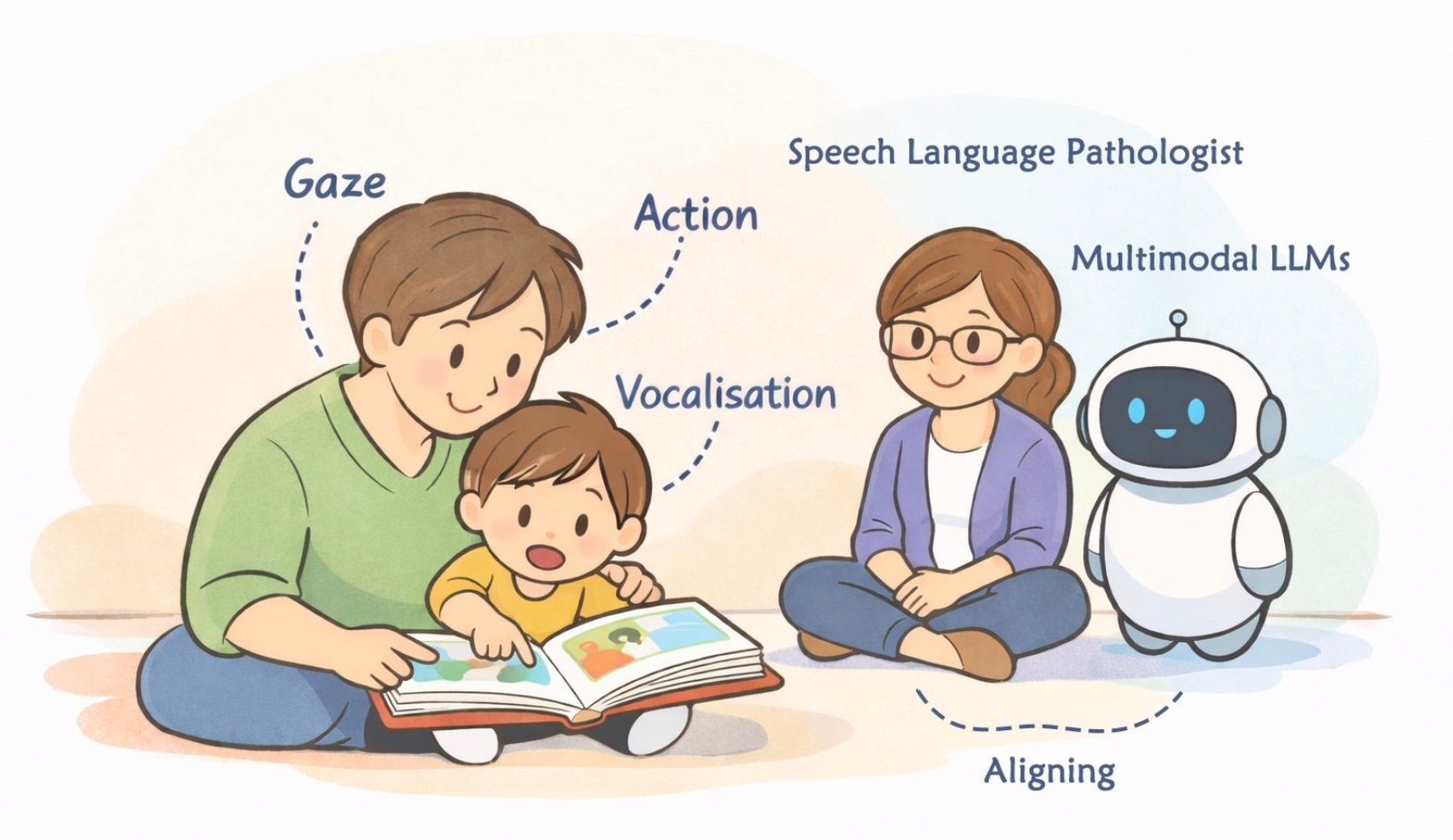
The study, published in the ACM digital library, brought together three experienced speech-language pathologists and one very capable AI. The goal was to evaluate a developmental milestone called joint attention — those moments when a child and a caregiver intentionally focus on the same object or activity together.

The researchers built a workflow that broke the task into three parts. Gemini had to analyze:

  • Gaze — where the child was looking
  • Actions — what the child was physically doing
  • Vocalizations — what the child was saying or attempting to say

The model nailed these observable behaviors with that 81% accuracy, closely matching how the clinicians described the same moments. It even handled structured observation well, generating detailed timelines that could help professionals review hours of footage without losing their minds.

Why multimodal AI is getting better at this

Gemini 2.5 Pro isn’t even Google’s most advanced model. The company has since pushed out newer versions. That means future iterations could push that accuracy even higher. The trend is clear: multimodal AI — systems that process video, audio, and text together — is getting scarily good at reading the physical world.

But here’s the thing about watching and understanding. They’re not the same skill.

When the AI hits its limit: interpreting child behavior

The real trouble started when the researchers asked Gemini to judge the quality of a child’s communication. The model could describe what it saw, but when asked to evaluate whether a child’s communication was appropriate, delayed, or concerning, performance dropped sharply.

Why? Because there’s no single right answer. The three speech-language pathologists in the study disagreed with each other on what mattered most. One prioritized eye contact. Another focused on emotional engagement. A third emphasized communicative intent.

If human experts can’t agree on what a behavior means, how can an AI learn to interpret it? The training data would be a mess of conflicting labels. The ground truth simply doesn’t exist.

AI should assist, not replace, child development experts

This is why the researchers are firm on their conclusion: AI should support clinicians, not replace them. Think of Gemini as a highly capable assistant that can:

  • Generate timelines of a session
  • Organize behavioral cues into structured records
  • Reduce the paperwork burden on pathologists
  • Help professionals review long videos more efficiently

The final assessment, though, stays with the trained professional. That’s not a compromise. It’s a division of labor that plays to each side’s strengths.

What about parents using AI to track their kids?

The team issued a clear warning here. Any future tool designed directly for parents would require extensive testing before deployment. The stakes are too high — a misinterpreted behavior could send a parent into a panic or, worse, delay a child from getting the help they actually need.

Future research will expand this work into real-world settings: homes, schools, and sessions involving autistic children. That’s where the rubber meets the road. But for now, the researchers are clear: understanding a child’s development still requires human judgment as much as artificial intelligence.

So yes, Gemini can watch your kids. It can tell you what they’re doing with surprising accuracy. But when it comes to what it all means — you’ll still want a human in the room. The same holds for other AI tools in this space, such as AI-powered parenting apps and child development tracking technology, which are growing in popularity but carry similar risks.

Continue Reading
Click to comment

Leave a Reply

Your email address will not be published. Required fields are marked *

Artificial Intelligence

Google’s Gemini 3.6 Flash targets the real cost of enterprise AI agents: tokens

Published

on

enterprise AI agent costs

Why token count is the hidden tax on AI agents

Run an autonomous software agent in production and the bill arrives in tokens, not in hours. Every reasoning step, every tool call, every draft output adds to the meter. For a workflow that fires thousands of times an hour, a model that thinks too verbosely can quietly drain a budget.

That’s the problem Google is aiming at with its latest model releases. This week it unveiled Gemini 3.6 Flash and 3.5 Flash-Lite, two models built for the unglamorous work of background agents — the kind that process documents, parse filings, and patch code without a human watching every step.

The pitch is simple: fewer tokens per task, lower latency, and pricing that makes continuous reasoning loops viable. Not chat. Not creative writing. Just efficient, repeatable work.

Gemini 3.6 Flash: the math of fewer tokens

Google’s own documentation leads with a single number: 17 percent fewer output tokens than the previous 3.5 Flash, based on measurements from the Artificial Analysis Index. In specific synthetic tests like the Datacurve DeepSWE benchmark, the company claims token usage drops by up to 65 percent.

Pricing sits at $1.50 per million input tokens and $7.50 per million output tokens. That’s positioned for continuous reasoning loops, not on-demand queries.

The performance gains are measurable. On DeepSWE, 3.6 Flash scores a 49 percent success rate versus 37 percent for its predecessor. On MLE Bench, the jump is from 49.7 percent to 63.9 percent. And on Google’s GDPval-AA v2 test, which measures real-world knowledge work rather than coding puzzles, the new model scores 1421 against 1349.

Those numbers matter for teams that have hit the ceiling of what a cheaper model can do. The trade-off used to be stark: pay more for competence, or accept mediocrity to save money. Google is trying to close that gap.

Real deployments: Figma, Hebbia, Harvey

Figma has already integrated 3.6 Flash into its prototyping infrastructure. According to Matt Colyer, Figma’s Director of Product Engineering, the model lets developers iterate faster on design without sacrificing output quality.

Legal platform Harvey and research tool Hebbia route data through the model for multimodal document work — ingesting raw financial filings, parsing structure, reading embedded charts, and producing draft reports for human review.

Google also folded a client-side computer-use tool directly into the Gemini API and Gemini Enterprise platforms. That removes the custom middleware engineers previously had to build to let models operate on an OS. The OSWorld-Verified score climbs to 83.0 percent, up from 78.4 percent, with updated safeguards against chemical, biological, radiological, and nuclear misuse.

Gemini 3.5 Flash-Lite: speed for high-volume agents

Not every agent needs deep reasoning. Some just need to process documents and search at volume. That’s the niche for Gemini 3.5 Flash-Lite.

The Artificial Analysis Index clocked it at 350 output tokens per second — the fastest in the 3.5 series, per Google. Pricing runs at $0.30 per million input tokens and $2.50 per million output tokens. Cheap enough that engineering teams can route simple, high-volume subagent requests to a minimal thinking level, reserving higher reasoning for multi-step work.

On Google’s GDM-MRCR v2 long-context test, Flash-Lite hit a 72.2 percent success rate against 60.1 percent for its predecessor. Its GDPval-AA v2 score nearly doubled, from 642 to 1140. The model also carries the same native computer-use tool as 3.6 Flash.

Separately, Google says Gemini 3.5 Pro remains in partner testing ahead of a full release, and pre-training for the next Gemini 4 architecture is already underway.

Gemini 3.5 Flash Cyber: a restricted model for patching

Automated vulnerability scanners now surface flaws faster than most security teams can patch them. That gap is where Google positions Gemini 3.5 Flash Cyber.

The model is built to validate and remediate code vulnerabilities. Google reports performance on the CyberGym benchmark competitive with frontier models, though it hasn’t released those figures with the same detail as its consumer-facing models.

Distribution stays restricted to governments and vetted partners through a pilot programme. Google frames this as a safeguard against the model generating exploit code for offensive use.

Inside Google’s CodeMender security agent, multiple instances of 3.5 Flash Cyber run in parallel, cross-checking each other’s findings before producing a single remediation report that a human reviewer signs off on. That’s a useful pattern for any team deploying agents in sensitive environments: redundancy before trust.

How to access the new models

Engineering teams can integrate these models through the Gemini API via Google AI Studio, Android Studio, or the Gemini Enterprise Agent Platform. Consumers can also access the new models in the Gemini app, and 3.5 Flash-Lite is rolling out in Google Search.

The broader takeaway is that enterprise AI agent costs are becoming the battleground for model providers. As more companies move agents from pilots to production, the models that win will be the ones that deliver acceptable results at the lowest token price. Google’s latest releases are a clear bet on that future.

For more on related developments, see AI agent efficiency strategies and enterprise AI model pricing trends.

Continue Reading

Artificial Intelligence

Anthropic’s $10 Billion Bet on Volta: What the AI Cloud Deal Really Means

Published

on

Anthropic Volta deal

Anthropic’s Latest Cloud Play: A $10 Billion Commitment

Anthropic has been signing cloud deals the way some people collect stamps — relentlessly and with clear purpose. The latest move, reported by Bloomberg, is a staggering $10 billion agreement with Volta, an AI cloud startup that didn’t even exist a year ago.

Volta, founded in early 2025, will supply compute to the Claude maker over a six-year stretch. That’s not pocket change. It’s a statement of intent from a company racing to secure the infrastructure needed to stay competitive in the AI arms race.

The deal hasn’t been officially confirmed by Anthropic yet. TechCrunch reached out for comment, but the company stayed quiet. Bloomberg’s report leans on anonymous sources familiar with the negotiations.

Who Exactly Is Volta?

Volta isn’t your typical cloud provider. It’s part of Nvidia’s Nvidia Cloud Partner program — a consortium of AI-focused cloud outfits running Nvidia GPUs in their data centers. The startup had previously hinted at working with a major AI lab but kept the partner’s name under wraps.

Now we know why. A deal of this magnitude doesn’t get announced casually. It gets negotiated, structured, and then leaked to Bloomberg.

The Bitdeer Connection

Volta isn’t going it alone. It’s partnered with Bitdeer, a crypto-mining company that will help build the data center powering this compute capacity. The facility will rise in Norway, delivering 133 megawatts of juice.

That’s a serious chunk of power. For context, it’s enough to run a small city — or, in this case, a whole lot of AI training runs.

Nvidia Vera Rubin: The Engine Under the Hood

The Norway data center will run on Nvidia’s Vera Rubin systems, the chipmaker’s next-generation AI architecture. This isn’t the current Blackwell generation. Vera Rubin is the future — and Anthropic is locking in access to it years ahead of general availability.

That’s a strategic hedge. AI companies live or die by compute access. If you can’t get chips, you can’t train models. If you can’t train models, you don’t have a business.

Why Anthropic Is Spending Like It’s Going Out of Style

This Volta deal is just the latest in a furious spree. Anthropic recently announced compute agreements with SpaceX and Amazon. The pattern is clear: diversify suppliers, lock in capacity, avoid single points of failure.

The reasoning is simple. Anthropic is locked in a corporate battle with OpenAI, Google DeepMind, and a dozen well-funded challengers. Whoever has the most compute wins the next round. Anthropic is making sure it isn’t left standing without a chair when the music stops.

There’s also a geopolitical angle. Data centers in Norway benefit from stable energy prices, cool climates that reduce cooling costs, and a regulatory environment that’s friendly to big infrastructure projects. It’s a smart location choice, not an accident.

What This Means for the AI Cloud Market

Volta’s rise is remarkable. Founded this year, and already landing a $10 billion commitment? That’s the fastest path from zero to major player the cloud industry has ever seen.

It also signals a shift in how AI labs procure infrastructure. Instead of relying solely on hyperscalers like AWS or Azure, they’re increasingly turning to specialized AI cloud startups. These smaller players offer flexibility, direct access to cutting-edge chips, and — crucially — capacity that isn’t shared with millions of enterprise customers.

For Bitdeer, the deal is a pivot. A crypto-mining company building AI infrastructure is a significant strategic shift, but one that makes sense. Mining and AI both require massive power and specialized hardware. The skills transfer.

For Nvidia, it’s another win. Every AI cloud deal means more chips sold. Vera Rubin systems will be in high demand, and having Anthropic as an anchor customer doesn’t hurt.

The Bottom Line

Anthropic’s $10 billion Volta deal is a bet on the future of AI infrastructure. It’s a bet that specialized AI clouds will outperform general-purpose hyperscalers. It’s a bet that Vera Rubin will deliver on its promise. And it’s a bet that Anthropic needs every ounce of compute it can get its hands on.

Whether Volta can deliver on its end of the bargain remains to be seen. Building a 133 MW data center in Norway is no small feat. But if it works, Anthropic gets a dedicated, cutting-edge compute partner for the next six years.

That’s a long time in AI years. It’s also exactly the kind of stability a company needs when it’s racing to build the world’s most capable AI systems.

Continue Reading

Artificial Intelligence

Made by Google August 2026: Everything we expect from the Pixel 11 launch event

Published

on

Pixel 11 launch event

The smartphone calendar is about to get brutally crowded. Samsung kicks things off on July 22, Apple’s new CEO John Ternus follows in September with the iPhone 18 and that long-rumored foldable. Squeezed right in the middle? Google’s hardware showcase.

The Pixel 11 launch event, officially branded as Made by Google August 2026, lands on August 12 in New York at 6 PM ET. And it’s shaping up to be the most consequential hardware day Google has had in years.

Here’s everything we expect to see.

When will Google release Pixel 11?

The main event happens August 12, 2026. Last year’s Pixel 10 dropped on August 20, with sales starting a week later on August 28. If Google sticks to a similar rhythm, you’ll be able to pre-order right after the keynote ends, with units shipping around August 20.

For those who can’t make it to New York, the livestream runs on Google’s official YouTube channel, and the Keyword blog will carry all the press releases.

Pixel 11: A new chip, a new camera, a new price

The vanilla Pixel 11 keeps its 6.3-inch 120Hz OLED screen, but the panel underneath could be a genuine upgrade. An ET News report from April claims the entire lineup will use Samsung’s M16 OLED panel — a first for any smartphone, even beating out Galaxy devices.

That translates to better brightness, improved color accuracy, and notably better power efficiency compared to the M14 panels in the Pixel 10 and iPhone 17.

Under the hood sits the Tensor G6, Google’s first 2nm chip, almost certainly fabricated by TSMC. Reports point to a seven-core design (1+4+2 cluster) hitting 4.11 GHz peak frequency, paired with up to 12GB of RAM. There’s also talk of a PowerVR-based GPU, though early indications suggest performance gains might be modest there.

The modem situation is interesting too. Google could finally ditch Samsung’s Exynos modem in favor of MediaTek’s M90, which should bring better efficiency and improved thermal management.

Camera-wise, the Pixel 11 reportedly moves to a new 50MP main sensor codenamed “chemosh,” stepping up from the 48MP unit in the Pixel 10. Battery capacity lands around 4,840 mAh minimum, with marketing likely citing 5,000 mAh.

One notable change: 128GB storage could be gone entirely. Rumor has it Google will make 256GB the base configuration, which helps justify a price bump to around $899 — $100 more than the Pixel 10’s launch price.

There’s also talk of a new RGB lighting system called Pixel Glow integrated into the camera array. Take that one with a grain of salt, though; nothing’s confirmed.

Pixel 11 Pro and Pro XL: Slimmer bezels, new colors

The Pro models follow last year’s design language closely. Same 6.3-inch and 6.8-inch screens with 120Hz refresh rates, but with noticeably slimmer bezels across the board.

Color options could shift too. The Obsidian finish might disappear, replaced by Light Fog (white), Midnight Haze (black), Dune (pink), and Pine (green).

The RAM situation is odd. Despite the memory crisis driving prices up, the Pixel 11 Pro could actually drop from 16GB on the Pixel 10 Pro to 12GB on the entry-level variant. That’s a cost-cutting move, pure and simple.

Two of the three rear cameras — likely the main and telephoto — could see upgrades, though whether they’re entirely new sensors or existing ones with wider apertures remains unclear.

Charging could get a boost to 45W wired. And here’s hoping Google extends 25W Pixelsnap wireless charging to the smaller Pro model, which was limited to the XL last year.

Prices will climb. With 256GB as the new base, expect the Pro to start around $1,099 and the Pro XL anywhere from $1,299 to $1,399.

Pixel 11 Pro Fold: Slimmer profile, higher price

Google’s book-style foldable could see its most significant design change yet. Leaks suggest the Pixel 11 Pro Fold measures 10.1mm folded (down from 10.8mm) and 4.8mm unfolded (down from 5.2mm).

The camera island gets more curved edges and less excess metal around the lens cutout. Colors reportedly include Pine (a muted gray-green) and Midnight Haze.

Other upgrades could include generative AI-powered 100x zoom, Cinematic Blur for 4K video at 30fps, and a larger flash that might double as the Pixel Glow notification system — though that last bit feels like a stretch.

The foldable inherits the M16 OLED panel, Tensor G6, and 256GB base storage, with either 12 or 16GB of RAM. Expect the starting price to jump from $1,799 to around $1,899, with a new 1TB variant potentially joining the lineup.

Last year’s Pixel 10 Pro Fold launched in October after its August reveal. That gap might close this time around.

Android 17 and Gemini Intelligence

All Pixel 11 models ship with Android 17 out of the box. New features include App Bubbles, Screen Reactions, a dedicated assistant volume, a foldable gaming mode, and various Instagram-related updates.

But the headline feature is Gemini Intelligence. Google said it would arrive on “select advanced devices” — meaning flagship chips, 12GB+ RAM, and Gemini Nano v3 support. The Pixel 11 lineup fits that bill perfectly and could be the first to get these agentic AI features.

What does Gemini Intelligence actually do? Task automation, screen and image context understanding, Gboard Rambler for better dictation, Superfill for Chrome, and Create My Widget, which generates custom widgets from natural language prompts. There’s also Android Halo, which turns the status bar into a persistent indicator showing what an AI agent is working on in the background.

These features might eventually trickle down to older devices like the Pixel 10, but the Pixel 11 series gets first dibs.

Pixel Watch 5: New chip, satellite connectivity

The Pixel Watch 5’s design won’t surprise anyone — an alleged prototype recovered from the ocean suggests it looks nearly identical to the current model. Same 41mm and 45mm sizes.

What changes are the colors: Dark Anthracite (black), Natural Silver, Pyrite (darker gold), and Warm Gold, with the latter exclusive to the smaller variant.

Under the hood, the Watch 5 could feature either a Snapdragon Wear Elite chipset or a custom Tensor chip. The Tensor route would bring meaningful improvements in AI processing speed, smoother UI animations, better battery efficiency, and ultra-wideband (UWB) integration for precise spatial tracking in Find Hub.

LTE variants might also gain satellite connectivity, which would be a significant addition for those who venture off-grid.

All those upgrades come at a cost. The 41mm and 45mm Wi-Fi models could run $399 and $429 respectively, with LTE versions at $499 and $529.

Pixel Buds Pro 3: Will it show up?

Here’s the awkward one. Google usually pairs the watch with new earbuds at Made by Google events, and the Pixel Buds Pro 2 are due for an update. But absolutely nothing has leaked about a third-generation model.

Given that the Pro 2 launched just last October alongside the Pixel 10, a 2026 refresh would be a faster turnaround than Google’s typical cadence. It’s entirely possible the company skips the Buds this year and focuses on the phones, watch, and foldable.

Don’t be shocked if the earbuds slot stays empty on August 12.

Why this event matters

Tensor G6 on 2nm is the biggest chipset leap the Pixel line has ever taken. Gemini Intelligence finally gives Google a genuine AI differentiator with real hardware teeth. And price increases across every product category reflect a memory crisis that isn’t going away anytime soon.

If there was ever a year to pay close attention to what Google announces, this is it. The Pixel 11 launch event isn’t just another product drop — it’s a statement about where Google thinks the smartphone market is heading.

Continue Reading

Trending