The endless scroll through scattered AI conversations is about to become a thing of the past. Google is quietly testing a revolutionary Gemini Projects feature that promises to solve one of the most frustrating aspects of AI chat management.
Currently, regular Gemini users face an overwhelming collection of conversations spanning everything from professional research to personal planning. However, this chaos appears headed for a solution through Google’s latest organizational innovation.
What Makes the Gemini Projects Feature Revolutionary
The Gemini Projects feature operates on a simple yet powerful concept: dedicated folders for your AI conversations. Rather than hunting through dozens of randomly ordered chats, users will soon categorize discussions based on topics, projects, or purposes.
This approach mirrors ChatGPT‘s successful folder implementation, but Google appears to be developing its own unique spin on conversation organization. The system integrates directly into Gemini’s existing interface without disrupting current workflows.
In addition, the feature maintains Google’s signature simplicity while addressing a genuine user pain point. No more scrolling endlessly to find that important brainstorming session from last week.
How Users Can Access Gemini Projects
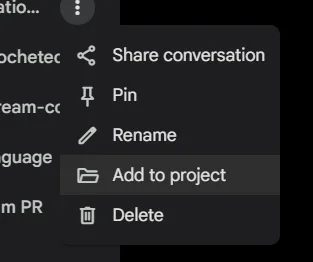
Early adopters have discovered the feature through Gemini’s standard three-dot menu system. When hovering over any conversation in the web interface, users now see an “Add to project” option alongside familiar choices like Share, Pin, and Rename.
Clicking this new option reveals a popup window displaying existing project categories. Unfortunately, the current test version doesn’t allow new project creation directly from this menu, indicating the feature remains under active development.
Therefore, the functionality appears limited to assigning conversations to pre-existing project folders. This suggests Google is still refining the complete user experience before wider deployment.
Real User Experiences with Chat Organization
Reddit user medazizln became among the first to document this emerging Gemini Projects feature, sharing screenshots that confirmed its existence. The discovery sparked considerable interest across AI communities, with users expressing excitement about improved conversation management.
TestingCatalog News subsequently verified these reports, suggesting the appearance might be “unintended” rather than a deliberate beta release. This indicates Google may be conducting internal testing that accidentally became visible to select users.
Consequently, the feature’s current state reflects typical pre-release development, with core functionality present but refinements still needed. Users report the basic organization concept works well, even with limited creation options.
Timeline for Gemini Projects Feature Release
Google hasn’t announced any official rollout schedule for the Gemini Projects feature, maintaining their typical secrecy around product development timelines. Nevertheless, the fact that real users are encountering the feature suggests internal testing has progressed significantly.
Industry observers note that accidental feature appearances often precede official announcements by weeks or months. This pattern has held true for previous Google product launches, from Google Workspace updates to Search enhancements.
As a result, users might expect broader availability sometime in the coming months, though Google could adjust timelines based on testing feedback and technical refinements.
Benefits Beyond Simple Chat Sorting
The Gemini Projects feature addresses more than just visual clutter in conversation lists. Professional users juggling multiple clients or projects will find tremendous value in contextual conversation grouping.
Students and researchers can maintain separate project spaces for different subjects or assignments. Personal users benefit from distinguishing between entertainment, planning, and problem-solving conversations.
On the other hand, this organizational structure could enhance productivity by reducing cognitive load when switching between different types of AI interactions. Users won’t need to mentally filter through unrelated conversations to find relevant discussions.
Building on this foundation, Google might eventually introduce advanced features like project-specific settings, shared folders, or integration with other Workspace tools. The current implementation appears designed to support future enhancements while establishing core organizational functionality.








 CyberSecurity4 weeks ago
 CyberSecurity1 month ago
 Infosecurity4 weeks ago
 CyberSecurity4 weeks ago
 CyberSecurity1 month ago
 How To3 weeks ago
 CyberSecurity4 weeks ago
 How To2 weeks ago