Connect with us

Social Media

How Open-Weight AI Models Could Save Your Business Thousands

Published

on

open-weight AI models

Why your AI subscription bill is about to spike

If you’ve been leaning on ChatGPT or Claude for daily tasks, you’ve probably noticed the creeping costs. What started as a $20 monthly experiment can balloon into hundreds — even thousands — of dollars as your team scales usage. The pricing models from major AI providers are designed to grow with your dependence.

But there’s another path. Open-weight AI models let you run powerful language models on your own hardware, cutting out the middleman entirely. No monthly fees. No per-token charges. Just a one-time investment in hardware and a bit of technical setup.

What exactly are open-weight AI models?

Unlike closed models like GPT-4 or Gemini, open-weight models have their trained parameters — the “weights” — publicly released. Developers can download them, run them locally, and even fine-tune them on proprietary data. Think of it as owning the engine instead of renting a ride.

Popular examples include Meta’s Llama 3, Mistral’s Mixtral, and the Falcon series from the Technology Innovation Institute. These models range from 7 billion parameters (laptop-friendly) to 70 billion (requires serious GPU power).

The key advantage? Once you’ve downloaded the model, inference costs exactly zero dollars per query. No surprise bills at month-end.

What hardware do you actually need?

Here’s the honest truth: running a 70-billion-parameter model locally isn’t cheap on the hardware side. You’ll need a high-end GPU with at least 24 GB of VRAM — think NVIDIA RTX 4090 or A6000. That’s a $1,500 to $5,000 investment.

But here’s where the math gets interesting. If your business processes 500,000 API calls per month through a provider like OpenAI at roughly $0.01 per call, that’s $5,000 monthly. A $3,000 GPU pays for itself in under a month.

For smaller operations, 7-billion-parameter models run comfortably on a MacBook M2 with 16 GB RAM. No extra hardware needed.

  • 7B models — MacBook M2/M3, any GPU with 8 GB VRAM
  • 13B models — RTX 3090/4090, Apple M2 Ultra
  • 70B models — Dual RTX 6000 Ada, or cloud GPU rental

You can also use cloud GPU providers like Lambda Labs or RunPod for occasional heavy lifting — paying by the hour instead of per token.

Software setup: simpler than you think

Five years ago, running a local LLM meant compiling obscure Python libraries. Today, tools like Ollama, LM Studio, and LocalAI offer one-click installs. Download the app, pick a model from their library, and start chatting.

For businesses with technical staff, vLLM and Text Generation Inference provide production-grade serving with OpenAI-compatible APIs. That means your existing code that calls OpenAI’s API can point to your local server with a single URL change.

Privacy is another massive win. Sensitive customer data, internal documents, or proprietary code never leaves your network. No data used for training other companies’ models.

What about fine-tuning?

Open-weight models can be fine-tuned on your specific business data using tools like LlamaFactory or Axolotl. A customer support bot trained on your actual support tickets will outperform a generic model every time — and you own the result.

How to pick the right model for your needs

Not every business needs a 70B behemoth. Start with a simple framework:

  1. Task complexity — Simple Q&A? A 7B model works. Complex code generation or multi-step reasoning? Go 13B or higher.
  2. Latency requirements — Real-time chat demands smaller models. Batch processing can handle larger ones.
  3. Privacy needs — If you handle HIPAA, GDPR, or PCI data, local deployment isn’t optional.

The Hugging Face leaderboard is a solid starting point. Filter by parameter count, benchmark scores, and license terms. Many open-weight models use permissive licenses (Apache 2.0, MIT), but some — like Llama — have specific commercial terms you should read.

The hidden costs most people miss

Local deployment isn’t free. Electricity for a 450W GPU running 24/7 adds roughly $40–$60 monthly depending on your rates. Hardware maintenance, cooling, and IT staff time need factoring in.

But compare that to an API bill that scales linearly with usage. If your AI usage grows 10x next year, your local costs stay flat. Your API bill grows 10x.

For businesses with predictable or growing AI workloads, open-weight models offer a ceiling on costs. The more you use AI, the more you save.

First steps to get started today

Download Ollama on a laptop. Pull a 7B model like Llama 3.1 or Mistral. Test it against your most common AI tasks — summarization, drafting emails, answering product questions. Compare the output quality to your paid service.

Most teams find that 80% of their daily tasks are handled perfectly by a local 7B or 13B model. The remaining 20% — complex reasoning, creative writing — can still use the cloud API. That hybrid approach alone cuts costs by 60–80%.

Open-weight models aren’t a futuristic concept. They’re ready now, they’re getting better every month, and they could save your business thousands starting next billing cycle.

Continue Reading
Click to comment

Leave a Reply

Your email address will not be published. Required fields are marked *

Social Media

These Are the Countries Moving to Ban Social Media for Children

Published

on

social media ban children

A Global Push to Protect Kids Online

Over the past year, a wave of legislation has swept across the globe targeting one specific issue: how young is too young for social media? Australia was the first to draw a hard line in December 2025, banning children under 16 from platforms like Facebook, Instagram, TikTok, and even YouTube. Now, a dozen other nations are following suit — or at least trying to.

France is the latest to join the movement, passing a law in July 2026 that blocks access to social media for anyone under 15. The law, which could take effect as soon as September 1, also bans cell phones in high schools, extending an existing restriction in primary and middle schools.

But not everyone is cheering. Critics, including Amnesty Tech, argue that blanket bans are ineffective and ignore how deeply embedded these platforms are in young people’s lives. Privacy concerns over age verification methods also linger. Still, governments are pressing ahead.

Australia: The Trailblazer

Australia became the world’s first country to implement a social media ban for children under 16 in December 2025. The law blocks minors from using Facebook, Instagram, Snapchat, Threads, TikTok, X, YouTube, Reddit, Twitch, and Kick. Notably, WhatsApp and YouTube Kids are exempt.

The Australian government has made it clear: platforms must take active steps to keep under-16s off their services. Companies that fail to comply face penalties up to $49.5 million AUD ($34.4 million USD). The law also requires platforms to use multiple age-verification methods — not just self-reported birth dates.

Europe Leads the Charge

France isn’t alone in tightening the screws. Across Europe, several countries are drafting or passing similar restrictions.

France

As mentioned, France’s law targets users under 15. It’s part of a broader digital safety push that includes banning phones in high schools. The law is expected to come into force on September 1, 2026.

Germany

In early February 2026, German Chancellor Friedrich Merz’s conservatives proposed barring children under 16 from social media. But Reuters reported that his center-left coalition partners are hesitant to support an outright ban, so the outcome remains uncertain.

Greece

Prime Minister Kyriakos Mitsotakis announced in April 2026 that Greece will ban social media for children under 15 starting January 2027. The move aims to tackle rising anxiety, sleep problems, and the addictive design of these platforms.

Spain

Spain’s prime minister announced in February 2026 a plan to ban social media for children under 16, though it still needs parliamentary approval. The government is also seeking to make social media executives personally liable for hate speech on their platforms.

Poland

Poland’s ruling party is drafting legislation that would ban children under 15 from using social media, as reported by Bloomberg in February 2026.

Slovenia

Slovenia’s deputy prime minister announced in early February 2026 that the country is drafting a law to prohibit children under 15 from accessing platforms like TikTok, Snapchat, and Instagram.

Denmark

Denmark is set to ban social media for children under 15. The government announced in November 2025 that it had secured parliamentary support from three coalition parties and two opposition parties. The law could pass as soon as mid-2026, according to the Associated Press. Denmark is also launching a “digital evidence” app with age-verification tools.

Austria

Austria said in late March 2026 that it will ban social media for children up to age 14. Draft legislation is expected by June.

Asia and the Middle East Join In

The trend isn’t limited to Europe and Oceania.

Indonesia

Indonesia announced in March 2026 that it’s banning children under 16 from social media and other online platforms, including YouTube, TikTok, Facebook, Instagram, Threads, X, Bigo Live, and Roblox.

Malaysia

Malaysia said in November 2025 it plans to ban social media for children under 16, with implementation expected in 2026.

Turkey

Turkey’s parliament passed a bill in April 2026 to restrict social media access for children under 15. President Recep Tayyip Erdogan must now sign it into law.

North America: Canada and the UK

Both Canada and the United Kingdom are moving forward with their own restrictions.

Canada

Canada introduced a digital safety bill in early June 2026 that would ban social media for children under 16. Social media companies could avoid the ban if they demonstrate they have policies to protect young users. Officials say it could take a year for the bill to pass.

United Kingdom

UK Prime Minister Keir Starmer announced on June 15, 2026, that his government will impose a ban on social media for children under 16. The ban covers platforms like Snapchat, TikTok, YouTube, Instagram, Facebook, and X. Messaging services like WhatsApp and Signal are exempt. The ban also restricts AI “romantic companion” chatbots to users over 18. Starmer acknowledged enforcement challenges but said he believes a ban could be in place by spring 2027.

Experts Question the Effectiveness

Not everyone is convinced that a blanket ban is the right approach. Privacy advocates worry about invasive age-verification systems. Critics, including Amnesty Tech, argue that bans ignore the realities of younger generations and fail to address the root causes of online harm. Some experts suggest that digital literacy education and platform accountability might be more effective than outright prohibition.

Still, the momentum is undeniable. As more countries move to restrict social media for children, the debate over how — and whether — to police young people’s online lives is only getting louder.

Continue Reading

Social Media

WhatsApp revamps CarPlay and Android Auto, adds iPad sign-ups, PDF editing, and music sharing

Published

on

WhatsApp Apple CarPlay Android Auto

Big update for drivers: CarPlay and Android Auto get smarter

WhatsApp is rolling out a major overhaul of its integration with both Apple CarPlay and Android Auto. The goal? Make the app genuinely useful behind the wheel, not just a stripped-down version of the mobile experience.

Previously, drivers could only compose messages or place calls. Now, WhatsApp lets you hear incoming messages read aloud, reply by voice, view your full call history, and access your favorite contacts — all from the car’s infotainment screen. It’s a big step toward safer, hands-free communication on the road.

These upgrades are part of Meta’s broader push to turn WhatsApp into a truly cross-device platform, not just a phone-first messenger.

iPad gets standalone sign-up — no phone required (well, almost)

Last year, WhatsApp launched a dedicated iPad app. But there was a catch: you had to link it to your phone. That’s changing now.

Users can register for a WhatsApp account directly on their iPad, without needing a primary phone to stay connected. The app works as a standalone account — not a companion device. You still need a phone number to receive the one-time passcode during setup, but after that, the iPad runs independently.

A WhatsApp spokesperson told TechCrunch that this was one of the most requested features since the iPad app launched. It’s a smart move for users who want a separate WhatsApp identity on their tablet, or for those who don’t always carry their phone.

How iPad registration works

  • Download WhatsApp from the App Store on your iPad
  • Enter your phone number and verify via SMS or call
  • Set up your profile — it’s now a standalone account
  • Your chats and contacts are independent from your phone

This is a clear signal that WhatsApp sees tablets as first-class devices for messaging, not just secondary screens.

Share what you’re listening to — right on Status

Another new feature lets you share a song directly from Apple Music or Spotify to your WhatsApp Status. It’s a small addition, but it taps into the growing trend of using Status for personal expression — like Instagram Stories but inside WhatsApp.

When you share a track, it appears as a status update that friends can tap to listen. No more screenshots or copy-pasting links. It’s simple, native, and feels right at home in the app.

PDFs open and edit inside WhatsApp — no extra app needed

WhatsApp is also making document handling much smoother. You can now open PDFs directly inside the app — no need to download them first. Once open, you can highlight text and add annotations, all within the chat window.

This feature is available on both web and desktop versions. For anyone who regularly receives contracts, invoices, or forms via WhatsApp, this is a time-saver. It’s not a full PDF editor, but for lightweight markup, it gets the job done.

A growing list of updates — usernames, subscriptions, and more

These new features add to a busy few months for WhatsApp. Just weeks ago, the company launched usernames, letting people share their profile without revealing their phone number. That’s a privacy win for anyone cautious about sharing personal digits.

In late May, Meta also introduced WhatsApp Plus — a subscription tier that unlocks extra features like profile customization, super reactions, and story insights. It’s part of a broader “Plus” push across Instagram and Facebook, signaling that Meta is serious about monetizing WhatsApp beyond business messaging.

All these updates point in one direction: WhatsApp wants to be more than a chat app. It’s aiming to be a full communication hub — for your car, your tablet, your desktop, and your phone. Whether you’re driving, working, or just sharing a song, the app is slowly becoming a platform that follows you everywhere.

Continue Reading

Social Media

Bluesky’s AI assistant Attie evolves into an open-ended research tool for the social web

Published

on

Bluesky Attie AI assistant

A new chapter for Attie

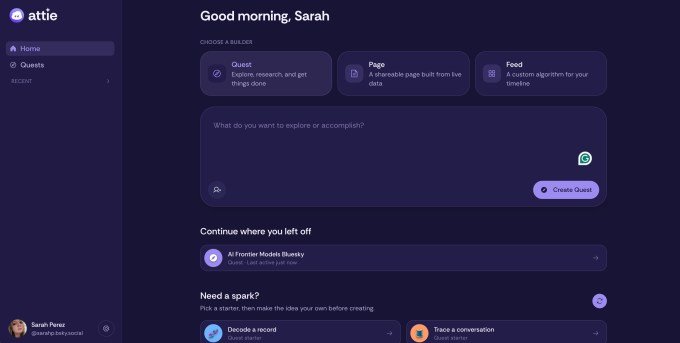
Bluesky’s AI assistant, Attie, is getting a major upgrade. Originally launched in March as a tool to help users build custom social feeds without writing a single line of code, Attie is now expanding into what the company calls an open-ended research tool. The new feature, named Quests, lets anyone ask Attie questions about what’s happening across the broader Bluesky ecosystem — which the company nicknames the Atmosphere.

That ecosystem doesn’t stop at Bluesky itself. Quests can pull information from any app built on the AT Protocol, the decentralized foundation that underpins the network. So if you’re curious about trending topics, influential voices in a specific city, or even a niche field like open-source gardening tools, Attie can now help you dig into it.

What Quests actually does

Think of Quests as a research assistant for the open social web. Instead of just filtering your feed or recommending accounts, you can ask Attie open-ended questions. For example: “What are the most talked-about topics among climate scientists on Bluesky right now?” or “Who are the top accounts discussing AI policy in Europe?”

The company describes the feature as a way to “fight back against the proliferation of misinformation and noise.” In a blog post, Bluesky’s chief innovation officer Jay Graber — who stepped down as CEO in March and was replaced by Toni Schneider, former founding CEO of Automattic — wrote that Attie is meant to help people “make sense of the internet” and “find the truth yourself.”

Graber also emphasized that the goal is to lower the barrier to entry for using the AT Protocol. “We want Attie to reduce the barrier to entry and expertise required to learn how to use the AT Protocol,” she wrote, “and to put the tools for customizing your experience in the hands of anyone who wants them.”

Why Bluesky needs this now

Bluesky’s user growth has clearly slowed. The social network saw its user base double to 40 million last October — a remarkable surge within just a year — but it now reports around 45.6 million registered accounts. That’s growth of only about 5.6 million over the past eight months.

So the company is looking for fresh ways to expand its audience and, eventually, generate revenue. Attie is free for now, but Bluesky has floated the idea of charging for the service down the road. In March, the company announced it had raised $100 million in funding, giving it some runway to experiment. That cash is being used to explore ideas like Attie, a premium subscription tier, and tools for power users.

Balancing community sentiment with revenue needs

There’s a tension here. Many Bluesky users are openly skeptical of AI — for economic, political, and environmental reasons. The company has to navigate that community sentiment while also figuring out how to keep the lights on. Attie is one of the more visible attempts to strike that balance: a useful AI tool that doesn’t feel like an intrusion, and that might one day become a paid service.

Graber acknowledged that Attie is being redesigned with accessibility features and a new logo. More changes are coming in the months ahead.

What’s next for Attie (and who gets access)

For now, the new Attie experience is in beta. Users will be invited in from a waitlist over the coming weeks. The company hasn’t shared a specific timeline for a wider rollout, but the direction is clear: Attie is no longer just a feed-builder. It’s becoming a research tool for the open social web.

The bigger picture is that Bluesky is betting that tools like Attie will prove more useful than the algorithmic noise machines that dominate much of social media today. As Graber put it, “Our bet is that tools that help people make sense of the world will prove to be more useful than those that fill it with confusion.”

Whether users will pay for that clarity is an open question. But for now, the company is focused on getting the tool right — and getting it into more hands.

If you’re interested in how Bluesky’s approach compares to other platforms, you might also want to check out our guide on WhatsApp HD photo sending or read about the latest WhatsApp privacy settings.

Continue Reading

Trending