Connect with us

How To

How to Print Photos, Emails, and Documents From Android Without a Computer

Published

on

How to Print Photos, Emails, and Documents From Android Without a Computer

Modern smartphones have turned into powerful productivity tools, and one of the most useful features is the ability to print from Android devices without ever touching a desktop or laptop. Whether you need to print a boarding pass, a family photo, or an important work email, your Android phone can handle it all wirelessly. This guide covers every method available, from built-in services to third-party apps, so you can choose what works best for your setup.

Why Print From Android?

Printing directly from your phone saves time and eliminates the hassle of transferring files to a computer first. You can send documents from anywhere in your home or office, as long as both devices are connected to the same network. This flexibility is especially valuable for remote workers, students, and busy families who need quick access to printed materials.

Moreover, Android’s printing ecosystem supports a wide range of file types, including PDFs, images, emails, and even text messages. With the right setup, you can print almost anything with just a few taps.

Using the Default Print Service on Android

Every Android device comes with a built-in printing framework. This is the simplest way to print documents from Android without installing extra software.

Enable the Default Print Service

To get started, open the Settings app on your phone. Navigate to Connected Devices > Connection Preferences > Printing. Tap Default Print Service and toggle it on. Note that menu names can vary slightly depending on your phone manufacturer and Android version.

Connect a Wireless Printer

Make sure your printer supports Wi-Fi or Bluetooth. Turn on the printer and put it in pairing mode. On your phone, the default print service will automatically detect compatible printers on the same network. If the printer doesn’t appear, check that both devices are connected to the same Wi-Fi network.

Print a Document or Photo

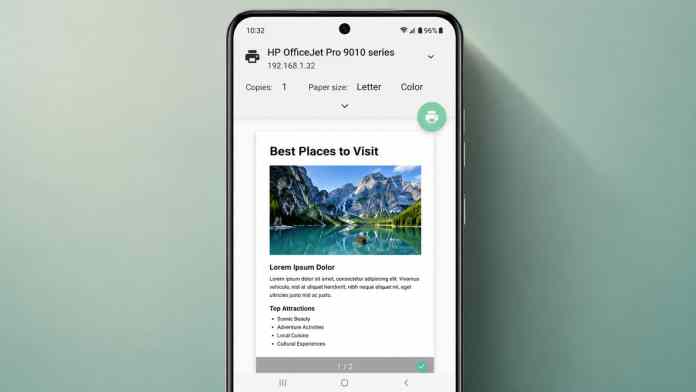
Open the file you want to print, tap the three-dot menu icon, and select Print. Choose your printer from the list, adjust settings like paper size and color, then tap the print button. This method works for photos, web pages, emails, and most document formats.

Printing With Manufacturer Apps

Printer companies often provide dedicated apps that offer better compatibility and extra features. Popular options include HP Print Service Plugin, Brother Printer Service Plugin, Canon Print Service, Samsung Print Service Plugin, and Epson iPrint.

Install and Use a Manufacturer App

Go to Settings > Printing > Default Print Service > Add Service. This will open the Google Play Store. Search for your printer brand’s app, install it, and return to printing settings to enable it. After setup, open any document, tap Print, and select the app as the print service. These apps often detect printers faster and provide advanced controls like paper tray selection and duplex printing.

Bluetooth Printing: Simple and Direct

Bluetooth printing is ideal for situations where Wi-Fi isn’t available. However, it has a limited range—usually around 30 feet—so keep your phone close to the printer.

Pair Your Phone With the Printer

Enable Bluetooth on both devices. On your phone, go to Settings > Bluetooth and scan for nearby devices. Select your printer from the list and enter a PIN if prompted. Once paired, the printer will appear in the print menu of any app.

Print Over Bluetooth

Open the file you want to print, select Print, and choose the paired Bluetooth printer. Review the settings and send the job. Avoid moving your phone out of range during printing, as disconnections can interrupt the process.

Wi-Fi Printing: The Most Popular Method

Wi-Fi printing is the preferred choice for most users because it offers fast speeds and a stable connection. Both the phone and printer must be on the same wireless network.

Set Up Wi-Fi Printing

Connect your printer to your home or office Wi-Fi network using its control panel. On your Android phone, go to Settings > Printing and enable the Default Print Service. The phone will scan for printers on the network. If your printer doesn’t appear, tap the three-dot menu and select Add Printer. You can enter the printer’s IP address manually or use Wi-Fi Direct.

Troubleshooting Printer Detection

If the printer still isn’t found, try installing the manufacturer’s app from the Google Play Store. These apps often discover printers that the default service misses. Restarting both the phone and printer can also resolve detection issues.

Third-Party Printing Apps

Several third-party applications expand Android’s printing capabilities. Mopria Print Service is a widely used option that supports thousands of printer models. Other popular choices include PrinterOn, Mobile Print PrinterShare, and PrintShare Mobile Print. Some offer free basic features, while advanced functions may require a subscription.

USB Printing: Wired and Reliable

USB printing is useful when wireless networks are unavailable or unreliable. You’ll need an OTG (On-The-Go) adapter that matches your phone’s charging port.

Connect the Hardware

Plug the USB cable into the printer, then connect the other end to the OTG adapter. Attach the adapter to your phone. Install a printing app like NokoPrint or PrintShare Mobile Print, which will guide you through driver installation. Once set up, open your document, choose Print, and select the USB-connected printer.

Printing Specific Content Types

Android makes it easy to print a variety of content without a computer.

Print Photos

Open Google Photos or your gallery app. Select the image, tap the menu icon, and choose Print. Adjust color and orientation settings, then send the job.

Print Text Messages

For a few messages, take a screenshot and print it. For longer conversations, use the Super Backup & Restore app. Install it, back up your SMS, then open the backup file and tap Print.

Print Emails

In Gmail or Outlook, open the email, tap the three-dot menu, and select Print. The email will print like a standard document, including headers and body text.

Modern Solutions: PaperCut Mobility Print

With Google Cloud Print discontinued, PaperCut Mobility Print has become a popular alternative. Install the app on your phone and connect both devices to the same network. Create an account, enable the service, and print documents after authentication. This solution works well in schools and offices that require user tracking.

Final Thoughts

Printing from an Android phone is no longer a novelty—it’s a practical, everyday feature. Whether you use Wi-Fi, Bluetooth, USB, or a dedicated app, the process is straightforward and reliable. By mastering these methods, you can print from Android anytime, anywhere, without relying on a computer.

Continue Reading
Click to comment

Leave a Reply

Your email address will not be published. Required fields are marked *

How To

WhatsApp Rolls Out 4 New Chat Features: Camera Effects, Selfie Stickers, and More

Published

on

WhatsApp has once again raised the bar for instant messaging. In its latest update, the platform introduces four exciting new chat features designed to make conversations more creative, efficient, and enjoyable. Whether you are a casual user or a messaging enthusiast, these tools promise to transform how you interact with friends and family.

These WhatsApp new chat features focus on personalization and speed. From adding flair to video calls to reacting with a simple double-tap, the update addresses common user desires. Let’s break down each feature and see how they can elevate your daily chats.

1. Camera Effects: Bring Video Calls to Life

Video calling just got a major upgrade. WhatsApp now lets you apply camera effects directly within chats. With over 30 unique filters, backgrounds, and effects, you can instantly transform your video feed. Think of it as bringing a touch of Instagram or Snapchat flair to your WhatsApp calls.

These effects are not limited to live calls. You can also use them while recording videos or taking photos to share later. Whether you want to blur your background during a work call or add playful elements for a birthday celebration, the options are intuitive and easy to access. Simply open the camera from within a chat and explore the available effects.

This feature adds a layer of creativity that was previously missing from WhatsApp’s video functionality. It makes every interaction feel more dynamic and personalized.

2. Turn Selfies Into Stickers Instantly

Personalization takes a fun new turn with the selfie sticker feature. Now, you can convert your own selfies into custom stickers with a single tap. This is perfect for expressing emotions in a uniquely personal way.

To use it, tap the “Create Sticker” icon within the app. You will see a camera option that lets you snap a selfie and instantly turn it into a sticker. The result is a fun, creative, and truly one-of-a-kind sticker that only you have.

Currently, this feature is available for Android users, with iOS support expected soon. It is a simple yet powerful way to make your conversations more engaging and personal.

3. Share Entire Sticker Packs With Ease

Sharing stickers one by one used to be tedious. WhatsApp’s new update solves this by letting you share entire sticker packs at once. Now, you can send up to 30 stickers from a pack in a single tap.

This makes it much faster and more convenient to share your favorite sticker collections with friends and family. To share a pack, open your stickers, select the pack you want to share, and send it directly into the chat. Recipients can then access and use the entire pack immediately.

This feature streamlines the sharing process and encourages more playful communication. It is a small change that makes a big difference in daily use.

4. React Faster With Quick Reactions

Reacting to messages is now quicker than ever. Instead of pressing and holding a message, you can simply double-tap it to add a reaction instantly. This mirrors the double-tap gesture popularized by Instagram, but WhatsApp adds its own twist.

Users can also scroll through their most-used reactions, making it easy to pick the perfect emoji without extra steps. This saves time and keeps conversations flowing smoothly. The feature is designed for convenience, allowing you to acknowledge messages without typing a word.

These WhatsApp new chat features collectively enhance the messaging experience. Camera effects add fun to video calls, selfie stickers bring personalization, sticker pack sharing saves time, and quick reactions streamline responses. To enjoy these updates, simply update your app from the Google Play Store or Apple App Store.

For more tips on using WhatsApp effectively, check out our guide on How to Use Meta AI on WhatsApp or explore other WhatsApp tips and tricks.

Continue Reading

How To

UPI Lite Limit Increased by RBI: What It Means for Digital Payments in India

Published

on

UPI Lite Limit Increased by RBI: What It Means for Digital Payments in India

The Reserve Bank of India (RBI) has officially announced that the UPI Lite limit increased from Rs 200 to Rs 500 per transaction. This change, revealed by Governor Shaktikanta Das, is designed to make small-value digital payments smoother and more convenient for millions of users across the country.

As digital transactions become part of everyday life in India, this upgrade addresses a key pain point: the friction of entering a UPI PIN for tiny purchases. With the new limit, users can now pay for items like tea, snacks, or bus fares without repeatedly authenticating each transaction.

Understanding the UPI Lite Limit Increase

The UPI Lite limit increased to Rs 500 represents a significant jump from the previous cap of Rs 200. This means that for transactions up to half a thousand rupees, users no longer need to enter their UPI PIN or rely on a bank statement for verification.

According to the RBI, this move is part of a broader strategy to encourage digital payments for small-value purchases. The UPI Lite wallet can still hold up to Rs 2,000, but each transaction can now be up to Rs 500. This makes it ideal for quick payments at local shops, street vendors, or during commutes.

How UPI Lite Works

For those unfamiliar, UPI Lite functions as an on-device wallet that doesn’t require a UPI PIN for transactions. It was introduced by the National Payments Corporation of India (NPCI) to streamline small payments. Major apps like Paytm and Google Pay have integrated this feature, making it widely accessible.

Building on this, the increased limit means users can now make larger small-value purchases without the hassle of entering a PIN. This is particularly useful in areas with poor network connectivity, as UPI Lite can still process transactions even when regular UPI services are down.

NFC Integration: Offline Payments Made Easy

In addition to the UPI Lite limit increased, the RBI also announced plans to integrate near-field communications (NFC) with UPI. This will allow users to make offline payments by simply tapping their phones at NFC-enabled terminals.

This feature is expected to be a major convenience, especially in places where internet connectivity is unreliable. By using the UPI Lite on-device wallet, users can complete transactions without needing an active data connection. This aligns with India’s push for a more inclusive digital payments ecosystem.

Conversational Payments: AI Meets UPI

Another exciting development is the introduction of Conversational Payments, powered by artificial intelligence. This feature aims to simplify the UPI experience by allowing users to make payments through voice commands or text-based interactions.

For example, instead of navigating through multiple screens, you could simply say “Pay Rs 100 to the vegetable vendor” and the AI would handle the rest. This is part of a global trend where AI-driven technologies like chatbots are making financial transactions more intuitive.

What This Means for Users

For everyday users, the UPI Lite limit increased translates to faster and more convenient transactions. You no longer need to worry about entering a PIN for small purchases, which saves time and reduces friction. Additionally, the NFC and AI features promise to make payments even more seamless in the future.

Businesses, especially small merchants, will also benefit. With lower transaction costs and faster processing, they can serve more customers efficiently. This could encourage more shopkeepers to adopt digital payments, furthering India’s goal of a cashless economy.

Timeline and Rollout

While the RBI has announced these changes, the exact timeline for the rollout remains unclear. However, the NPCI and banks are expected to implement the new limit soon. Users should keep an eye on their UPI apps for updates.

For more insights on digital payments, check out our guide on How to Use UPI Lite for Small Transactions and Digital Payments Trends in 2025.

Final Thoughts

The decision to increase the UPI Lite limit reflects the RBI’s commitment to making digital payments more accessible. Combined with NFC and AI features, these updates are set to transform how Indians conduct small-value transactions.

As the digital payments landscape evolves, users can expect even more innovations that prioritize convenience and security. Stay tuned for further announcements from the RBI and NPCI.

Continue Reading

How To

How to Troubleshoot a Slow iPad and Improve Performance: A Complete Guide

Published

on

How to Troubleshoot a Slow iPad and Improve Performance: A Complete Guide

Is your iPad feeling sluggish? You don’t have to rush out and buy a new device just yet. Learning how to troubleshoot a slow iPad can save you money and restore that snappy feel you miss. Many users face speed drops during everyday tasks like browsing, streaming, or switching between apps. The good news? Most issues have simple, effective solutions.

Slow apps, weak internet connections, and full storage are common culprits. With a few targeted steps, you can dramatically boost your iPad’s performance and get back to smooth operation.

Why Your iPad Might Be Running Slow

Before diving into fixes, it helps to understand the root causes. A slow iPad doesn’t always mean it’s broken. Often, software-related issues are to blame. Even newer models can experience temporary slowdowns. Older models, however, tend to struggle more frequently due to hardware limitations.

Too Many Apps Running in the Background

When you leave multiple apps open, they consume system resources. This reduces available memory for the task at hand. As a result, apps may become less responsive, and everyday actions like typing or scrolling can feel laggy.

Background App Refresh Drains Resources

Background App Refresh keeps your apps up to date by silently fetching new content. While convenient, it uses both memory and battery power. Too many apps refreshing in the background can noticeably slow down your iPad.

Storage Space Is Nearly Full

Your iPad needs free space to operate efficiently. When storage is almost full, performance takes a hit. Apple recommends keeping at least one gigabyte of free space available for smooth functioning. Photos, videos, and large apps are often the biggest offenders.

Weak Internet Connection Mimics Device Lag

Sometimes, what feels like a slow iPad is actually a slow internet connection. Websites load slowly, videos buffer, and downloads take forever. Before blaming your device, check your Wi-Fi signal strength.

Outdated Software Causes Performance Issues

Running an older version of iPadOS can lead to bugs and reduced speed. Apple regularly releases updates that include performance improvements and security patches. Ignoring these updates can make your iPad feel outdated.

Overheating and Battery Problems

Heat can force your iPad to throttle performance to protect internal components. Similarly, an aging battery may struggle to deliver consistent power, especially during demanding tasks. In some cases, a battery replacement might be necessary.

Quick Fixes to Speed Up Your iPad

Most speed issues can be resolved with simple troubleshooting. Start with these basic steps before moving to advanced solutions.

Close Unused Applications

Sometimes, a single problematic app can cause widespread slowdowns. Closing apps can free up memory and improve responsiveness. To close apps: swipe up from the bottom of the screen, pause in the middle, then swipe unwanted apps upward to dismiss them.

Restart Your iPad

A restart clears temporary files and refreshes system memory without deleting personal data. For iPads with a Home button, press and hold the Top button until the power slider appears, then drag to turn off. For newer models, hold the Top and Volume buttons simultaneously. Wait a few seconds, then hold the Top button to restart.

Turn Off Background App Refresh

Disabling Background App Refresh can free up resources. Go to Settings > General > Background App Refresh and turn it off completely, or selectively disable it for non-essential apps.

Disable Low Power Mode

Low Power Mode saves battery but can slow down performance. To turn it off, go to Settings > Battery and toggle off Low Power Mode.

Advanced Solutions for Better Performance

If basic fixes don’t help, these advanced methods target deeper issues.

Free Up Storage Space

Managing storage can significantly improve speed. Go to Settings > General > iPad Storage to see which apps and files are taking up space. Delete unused apps, old messages, and large videos. Consider offloading photos to iCloud or a computer.

Use the Offload App Feature

If you don’t want to lose app data, use the Offload App option. This removes the app but keeps its documents and data. You can reinstall it later without losing progress. Find this option in Settings > General > iPad Storage.

Clear Safari Cache

Over time, Safari accumulates cache and cookies that can slow down browsing. To clear them, go to Settings > Safari > Clear History and Website Data. This can make web pages load faster.

Install an Ad Blocker

Ads consume bandwidth and processing power. Using an ad blocker can reduce page load times and make browsing smoother. Many free ad blockers are available on the App Store.

Check Your Wi-Fi Signal

A weak Wi-Fi signal can feel like device lag. Look at the Wi-Fi icon in the status bar. Three bars indicate a strong connection; one or two bars suggest weakness. Move closer to your router or consider a Wi-Fi extender.

Restart Network Equipment

Sometimes the problem is with your modem or router. Unplug them, wait 30 seconds, and plug them back in. This can resolve many connectivity issues.

Update to the Latest iPadOS

Keeping your software up to date is crucial. Go to Settings > General > Software Update and install any available updates. Apple’s updates often include performance enhancements and bug fixes.

Fix Overheating Issues

If your iPad feels hot, let it cool down. Avoid using it in direct sunlight or while charging. Remove thick cases that trap heat. Performance usually returns to normal once the device cools.

When to Consider a Factory Reset or New iPad

If all else fails, a factory reset can wipe out persistent software problems. Before doing this, back up your data to iCloud or a computer. Go to Settings > General > Transfer or Reset iPad > Erase All Content and Settings. This should be a last resort.

Battery health also matters. If your iPad’s battery is degraded, a replacement might restore performance. You can check battery health in Settings > Battery > Battery Health. If it’s below 80%, consider a replacement at an Apple Store.

Finally, if your iPad is several years old and still struggles after all these steps, it may be time to upgrade. Newer models offer faster processors and better performance. However, always try troubleshooting first—it might just save you from an unnecessary purchase.

By following this guide, you can effectively troubleshoot a slow iPad and enjoy a faster, more responsive device. Start with the quick fixes, move to advanced solutions if needed, and only consider a reset or replacement as a last step.

Continue Reading

Trending