Connect with us

Artificial Intelligence

I bought into a brighter future, but my digital life bills monthly subscriptions

Published

on

digital life subscriptions

The morning toll: before coffee, the bills arrive

Before my first sip of coffee, a handful of companies have already collected their dues. Spotify or YouTube Premium handles the morning playlist. Google One keeps my photos accessible. An AI subscription sits open in another browser tab, waiting to help me draft emails or untangle a tricky idea.

Most of these charges earn their keep. They save time. They remove friction. They keep the day moving. I barely notice them — until I pause to imagine what would break if one payment didn’t go through.

I bought into a brighter future, and it came with recurring billing.

When convenience becomes infrastructure

That cost shadows me through the rest of the day. Google One holds years of photos and documents. ChatGPT Plus and Claude Pro have become part of how I research, organize ideas, and get unstuck. Grab Premium, roughly the local equivalent of Uber One or Lyft Pink, sometimes saves enough on rides that I can justify keeping it.

The monthly model makes sense for much of this. Cloud storage needs servers. AI tools consume expensive computing power. Streaming platforms pay for content and delivery. Transportation memberships can offer real savings when you use them often enough.

Still, every small convenience becomes harder to remove once the rest of your routine grows around it. Cancelling one can feel less like cutting a luxury and more like yanking out something the day has learned to lean on.

None of this happened through one huge, terrible purchase. It happened through $10 here, $15 there, and another free trial I forgot to cancel until it had already become part of my life.

Ownership now comes with conditions

The arrangement feels stranger when it reaches something I’ve already bought. My Tapo camera can record locally, but cloud history and richer notifications belong to Tapo Care. Cancel the plan and the camera remains, although the experience shrinks.

BMW’s heated-seat subscription became the most infamous version of this idea. HP Instant Ink offers another variation. Cancel the service and subscription cartridges can stop working even when they still contain ink.

Paying for storage, content, or active infrastructure is easy enough to understand. Paying repeatedly to unlock a capability already installed inside the camera, printer, or car parked in front of you feels harder to swallow.

At night, I can check the camera feed, open a streaming app, and switch between several services without thinking about any of it. The hardware may be sitting inside my home, but the experience still depends on a collection of companies recognizing my account.

God forbid I can only afford the hardware.

The future has an upkeep fee

Two people can buy the same product and end up with different versions of it. One keeps the cloud history, remote controls, or software extras. The other owns the same hardware but loses whatever the next monthly charge had been keeping active.

The entertainment side reaches the same place more gradually. YouTube Premium’s individual U.S. plan recently rose to $15.99 a month, while Apple TV+ reached $12.99 in 2025 after launching at $4.99. Netflix and HBO Max have raised prices as well. Each increase is manageable enough to absorb, especially after the service has already worked its way into a routine.

That’s probably why every new subscription advertised as “a steal” makes me suspicious. The price usually looks best before the service becomes difficult to leave. Eventually, I start wondering whether “steal” was less of a bargain and more of a warning.

Science fiction, or just a bad joke?

Maybe we’ll eventually reach Star Trek’s post-scarcity future, where abundance makes subscriptions unnecessary.

Alas, that still belongs to science fiction. What we got instead is something macabre, genuinely concerning, genuinely dystopian, and, somehow, genuinely funny. At humanity’s eleventh hour, someone still found time to put the good features behind a paywall.

All these thoughts before my morning coffee. Should I unsubscribe?

If you’re feeling the weight of monthly subscription fees, you’re not alone. The subscription economy has quietly reshaped how we think about ownership, value, and even daily routine. Digital life subscriptions may offer convenience, but they also demand a kind of ongoing loyalty that feels increasingly difficult to break.

Continue Reading
Click to comment

Leave a Reply

Your email address will not be published. Required fields are marked *

Artificial Intelligence

AI slashes drug discovery timelines in China to 9 months

Published

on

AI drug discovery China

How fast can AI actually move a drug from idea to candidate? In China, the answer is under a year.

Insilico Medicine, a Hong Kong-listed biotech, has compressed what normally takes four and a half years into roughly 13 months — and in its fastest program, just nine. The company’s CEO Alex Zhavoronkov says that by blending generative AI with wet-lab work in China, his team can nominate a preclinical candidate before most traditional projects even finish target validation.

That timeline covers early discovery and candidate selection only. Clinical trials, manufacturing, and regulatory review still come after. But even shaving years off the front end is a big deal in an industry where speed can mean the difference between a blockbuster and a also-ran.

AI drug discovery China: The mechanics behind the speed

Insilico uses generative AI to hunt for biological targets, design candidate molecules, and decide which compounds deserve a trip to the lab. The company says its programs typically reach preclinical-candidate nomination within 12 to 18 months after researchers synthesize and test between 60 and 200 molecules. That’s a workflow where AI generates designs, humans review them, and experiments confirm what works.

Lab work hasn’t been eliminated — it’s just more targeted. The AI models flag the most promising compounds, so teams need to synthesize fewer molecules to find a winner. Insilico hasn’t published a head-to-head comparison of AI-assisted versus conventional programs, but the raw numbers are telling: since 2021, the company has generated 31 preclinical candidates. Thirteen of those have received investigational new drug (IND) clearances, meaning they can move toward human studies.

Where the work happens

AI model development and evaluation happen in Montreal and Abu Dhabi. The experimental validation and scale-up take place in Shanghai, where the company has automated parts of biological sampling and compound screening. It’s a split model that plays to each location’s strengths: cutting-edge AI research in the West, cost-effective lab capacity in China.

Zhavoronkov credits China’s research infrastructure, lower operating costs, and regulatory environment for shaving about two years off traditional candidate-development timelines. That’s not just a local advantage. International drugmakers already work with Chinese contract research organizations, clinical-trial centers, and biotech firms. A Pfizer executive recently told Reuters that clinical development in China can run three times faster and at about half the cost of equivalent work in Europe.

China also introduced a 30-working-day review pathway in 2025 for eligible Class I innovative-drug clinical-trial applications. Complex cases can go to a 60-working-day review. Compare that with the multi-month or multi-year waits common in Western markets, and the gap is stark.

The business reality: Western revenue, Chinese speed

Despite operating research facilities in China, more than 90% of Insilico’s revenue comes from Western pharmaceutical companies. The reason is simple: China’s national insurance system offers lower reimbursement rates for highly novel drugs, so licensing deals in the U.S. and Europe are far more lucrative. Zhavoronkov declined to disclose the company’s China revenue.

Geopolitical concerns also shape strategy. Insilico limits sales of most of its software within China, even as it plans to expand its Shanghai research operations. The company has struck R&D agreements with Eli Lilly and Japan’s Takeda, and announced a proposed strategic alliance with Taiwan-based Bora Pharmaceuticals that could exceed $2.5 billion if fully implemented.

Zhavoronkov put it bluntly: “We now compete with Chinese pharmaceutical companies on timelines, and with traditional biotechnology companies in the West on novelty.”

Rentosertib: Insilico’s first AI-born drug heads to Phase III

Insilico’s most advanced AI-designed drug is Rentosertib, an oral treatment for idiopathic pulmonary fibrosis (IPF) — a disease that progressively scars the lungs. The company used AI to identify the biological target and generate and optimize the molecule’s structure. Rentosertib already completed a smaller Phase IIa study. Now it’s moving to Phase III.

The Phase III trial, registered in July 2026, plans to enroll 320 participants across 47 centers in China. It will compare Rentosertib against a placebo over 52 weeks, with the primary endpoint measuring the annual rate of decline in forced vital capacity — a standard lung-function metric. Enrollment was expected to begin in August 2026, with primary completion estimated for October 2029.

Candidate nomination is still an early milestone. Drugs must clear preclinical testing, human trials, manufacturing validation, and regulatory review before reaching patients. Industry data haven’t yet proven that AI-designed drugs are more likely to succeed in later-stage trials. A 2024 analysis of AI-native biotech pipelines reported Phase I success rates between 80% and 90%, and a Phase II rate of about 40% — broadly in line with historical industry benchmarks. The researchers cautioned that the number of Phase II programs was too small to draw firm conclusions.

Insilico has produced 31 preclinical candidates and secured 13 IND clearances. Rentosertib is its first program to reach Phase III. None of its experimental medicines has received commercial approval.

AI and robotics are reshaping biotech jobs

AI and lab automation are also changing who Insilico hires — and who it might not need. Zhavoronkov estimated that about 40% of the company’s software-side workforce could eventually be automated or displaced. He stressed that this isn’t an announced staff reduction, but a forecast of how roles will evolve.

Insilico employs about 400 people. Laboratory scientists and software engineers are being retrained to manage AI evaluation systems, automated equipment, and robotics. The retraining focuses on AI benchmarks and robotic systems as the company automates more research and software functions.

For more on how AI is transforming industries, see our coverage of Bristol Myers Squibb buying Nvidia’s AI system for drug discovery and the broader AI and big data trends shaping enterprise technology.

Continue Reading

Artificial Intelligence

Google’s AI search is quietly taking over — and publishers are feeling the squeeze

Published

on

Google AI Overviews

The numbers tell a stark story

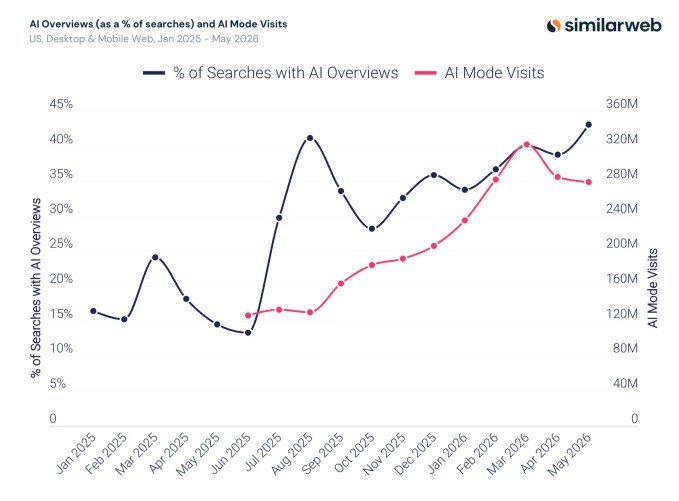
Just over a year ago, Similarweb reported that Google’s AI-generated search summaries — officially called AI Overviews — appeared in roughly 15% of all queries. Fast-forward to May 2026, and that figure has nearly tripled. According to the firm’s latest analysis, AI Overviews now show up in 43% of searches.

That’s not a gradual uptick. It’s a pivot. What began as a tentative AI layer on top of search results has become a core feature of the experience itself. Users are increasingly landing on pages where the first thing they see isn’t a list of blue links but a block of machine-written text that synthesizes information from across the web.

AI Mode is booming, too

Google’s more conversational AI Mode — a separate interface where users can ask follow-up questions and get multi-turn answers — is also growing fast. Similarweb data shows that AI Mode visits climbed from 126 million in June 2025 to 279 million by May 2026. That’s more than double in less than a year.

The average length of a Google search query has also crept upward. People are moving away from short, keyword-driven strings like “best coffee maker 2026” and toward longer, natural-language questions such as “What’s the best drip coffee maker for a household of four under $200?” The shift reflects a broader behavioral change: users are treating Google less as a directory and more as an oracle.

Publishers are losing out

For news sites, blogs, and content publishers, this trend is painful. AI Overviews often include citations — the report notes that the number of AI responses containing a citation has grown more than fivefold over the past year — but citations don’t always translate into clicks. Readers get their answer without ever leaving Google’s ecosystem.

Last year, Similarweb already flagged how devastating this was for news publishers. Now the picture is clearer: Google is becoming the destination, not just the gateway. Users spend more time on Google’s platform, and less time visiting the sites that produced the original information.

Some publishers have started fighting back. Cloudflare, the tech infrastructure company, introduced tools that let publishers block AI crawlers unless those AI companies pay for access through its marketplace. It’s a small but growing resistance movement.

ChatGPT is a mixed bag for referrals

Meanwhile, across the AI search landscape, ChatGPT shows a different pattern. As of May 2026, only 6.8% of U.S. desktop queries on ChatGPT included citations. That’s low, but some sectors fare better: travel, retail, and sports queries generate cited responses more frequently than, say, health or finance topics.

There is a glimmer of good news for publishers. After a May 7 search update, the proportion of ChatGPT desktop visits that landed on actual webpages more than doubled — from 25% in March 2026 to nearly 60% by May 30. That suggests that when blue links are made more prominent within AI-driven results, users do click through.

Still, the overall direction is clear. Google is transforming itself from a search engine into a self-contained answer engine. Whether users or publishers like it, AI search is becoming the default — and the era of the simple list of links is fading fast.

Continue Reading

Artificial Intelligence

The Apple Car never drove a mile, but it paved the road for Apple Intelligence

Published

on

Apple Intelligence foundation

How a $10 billion dead end became Apple’s AI engine room

For more than a decade, Apple poured money and talent into a secret project that never reached a single customer. The Apple Car — officially code-named Project Titan — was scrapped in early 2024 after burning through an estimated $10 billion. But according to Bloomberg reporter Mark Gurman, that spectacular failure may have given Apple something far more valuable than a vehicle: the technological foundation for Apple Intelligence.

It is one of those ironic twists that corporate historians will chew on for years. Apple’s most expensive flop might also be its most consequential long-term bet. The car is dead. The AI brain it helped create is just getting started.

Level 5 autonomy forced Apple to think like an AI company

From the outset, Apple did not want to build just another electric car. The company set its sights on Level 5 autonomous driving — the kind where a vehicle needs zero human input. No steering wheel. No pedals. Just a machine that sees, thinks, and acts entirely on its own.

That target was absurdly ambitious. It forced Apple’s engineers to solve a problem most tech companies had barely touched: how to process enormous AI workloads locally, in real time, inside a moving vehicle. The cloud was too slow. The latency would kill you. Every decision had to happen on board.

So Apple invested heavily in machine learning research and custom silicon. Engineers designed a dedicated AI chip specifically for the car. That chip never made it into a finished product. But the work did not disappear. It evolved into the Neural Engine, Apple’s dedicated AI processor now embedded in virtually every modern Apple chip.

The Neural Engine’s quiet arrival

The first Neural Engine shipped inside the iPhone X in 2017. It powered Face ID and Animoji — neat features, but hardly world-changing. Since then, Apple has quietly expanded the technology across its entire lineup. Every Apple Silicon Mac launched since 2020 includes a Neural Engine, giving laptops and desktops dedicated hardware to run AI tasks locally instead of phoning home to a server.

That local processing matters more now than ever. Apple Intelligence, the company’s suite of generative AI features, depends on it. The Neural Engine handles on-device inference for image generation, text summarization, and Siri improvements — all without sending your data to the cloud.

From a canceled car to the data center

Bloomberg reports that the abandoned vehicle project’s influence extends well beyond consumer gadgets. The same research reportedly shaped Apple’s Ultra-class Mac chips, the ones that combine two M-series dies into a single powerhouse. It also influenced the custom processors currently running Apple Intelligence servers in data centers.

Here is the part that makes the story sting a little less for Apple fans. While the company has struggled to ship AI software features as fast as Google or Microsoft, it has spent more than a decade quietly building the hardware required to support them. Those early investments are now beginning to pay off as Apple continues expanding Apple Intelligence and rebuilding Siri around more capable AI models.

Apple has been playing the long game. It just looked like it was wasting time.

What the Apple Car actually achieved

The Apple Car is often remembered as a textbook failure. It never reached customers. It consumed billions. It went through multiple leadership changes and strategy pivots. By any conventional measure, Project Titan failed.

Yet internally, the project achieved something arguably more valuable: it accelerated Apple’s expertise in AI hardware years before generative AI became the industry’s biggest battleground. The engineers who worked on the car’s neural network and silicon designs didn’t vanish when the project was canceled. They moved to other teams. The knowledge stayed inside the company.

In hindsight, Apple’s abandoned vehicle may never transport people from one place to another. But the technology it inspired is already helping power Apple’s next generation of AI experiences. That might end up being the far more important destination.

For a deeper look at how Apple is handling AI on its devices, check out our guide on Apple Intelligence features and compatibility. And if you are curious about the hardware that makes it all run, read our breakdown of Apple Silicon chips compared.

Continue Reading

Trending