Connect with us

Artificial Intelligence

Microsoft Copilot Cowork Goes Mobile: Now Your AI Can Finish Tasks While You’re Away

Published

on

Microsoft Copilot Cowork Goes Mobile: Now Your AI Can Finish Tasks While You’re Away
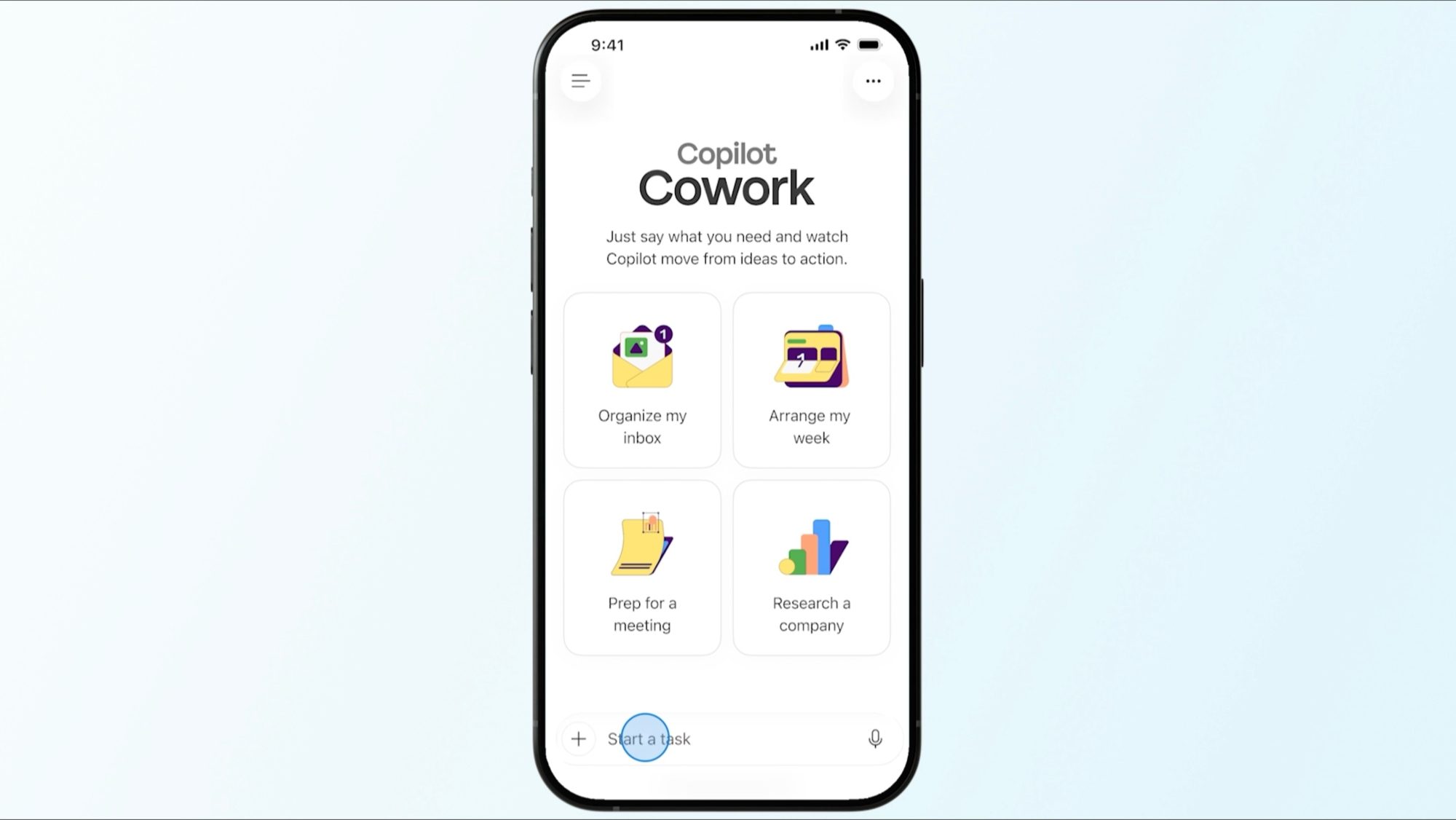
Microsoft is pushing its artificial intelligence beyond simple Q&A. The company wants Microsoft Copilot Cowork to actually start and complete tasks on your behalf, not just suggest answers. Originally launched through the Frontier program earlier this year, this AI assistant is now taking a major leap forward with mobile support, new skills, and deeper integrations.

On May 5, 2026, Microsoft CEO Satya Nadella announced a set of updates that significantly expand what Copilot Cowork can do. The biggest news? It’s finally available on smartphones, meaning you can delegate work from anywhere and pick it up later on your desktop. No more being tied to a laptop to get things done.

Copilot Cowork Arrives on iOS and Android

Perhaps the most anticipated update is the launch of Copilot Cowork on both iOS and Android. This means you can now think of a task during your commute or between meetings, hand it off to the AI, and return to a finished result. The system keeps working even when you close your phone.

This approach mirrors what Anthropic introduced with Claude Dispatch in March 2025. However, Microsoft’s version is tightly woven into the Microsoft 365 ecosystem, giving it an edge for business users who rely on Outlook, Teams, and other productivity tools.

As a result, you can start a research task on your phone, review progress on your tablet, and finalize a document on your desktop—all without losing momentum. This seamless continuity is a game-changer for remote workers and busy professionals.

Introducing Copilot Skills: Custom Instructions for Repetitive Tasks

The second major update is the introduction of Copilot Skills. A skill is essentially a saved set of instructions that tells the AI how to handle a task your way—with your preferred tone, structure, and process. Microsoft is rolling out built-in skills for common workflows like creating documents, coordinating meetings, and conducting research.

But the real power lies in customization. You can build your own custom skills for recurring work or team processes you want to standardize. For example, a marketing team could create a skill that generates blog posts in a specific brand voice, while a sales team might set up a skill for drafting client proposals with standard pricing tables.

Building on this, custom skills can be shared across teams, ensuring consistency and saving time on repetitive tasks. This feature alone could transform how organizations approach routine work.

New Integrations and Connectors Expand Copilot’s Reach

Copilot Cowork is also getting deeper integrations across Microsoft 365. The AI now connects with Power BI through Fabric IQ and Dynamics 365 for sales and customer service workflows. This means you can pull real-time data from connected services to create reports, pitch decks, and more.

Third-party connectors for platforms like Miro, monday.com, LSEG, and S&P Global Energy are coming soon. These connectors will greatly enhance the AI’s ability to fetch and synthesize data from external sources, making it a more versatile tool for complex projects.

However, it’s worth noting that Copilot Cowork is still rolling out through the Frontier program. Not all features may be available to every user immediately. Microsoft is moving fast, though, and the company has hinted at broader availability in the coming months.

For more insights on how AI is reshaping productivity, check out our guide on best AI productivity tools for 2025 and learn about Microsoft Copilot vs. Google Gemini.

What This Means for Your Workflow

If you’ve been waiting for an AI that actually does the work rather than just describing it, Copilot Cowork is worth a serious look. The combination of mobile access, reusable skills, and deep integrations creates a powerful productivity assistant that can handle everything from email management to complex data analysis.

In addition, the ability to delegate tasks while on the go means you can reclaim time that was previously lost to context switching. Instead of jumping between apps and devices, you can simply tell Copilot what to do and move on to higher-value work.

Ultimately, Microsoft is betting that the future of work is asynchronous and AI-driven. With Copilot Cowork, that future is arriving faster than many expected.

Continue Reading
Click to comment

Leave a Reply

Your email address will not be published. Required fields are marked *

Artificial Intelligence

Your ChatGPT Bills Could Soon Get a Drastic Price Cut: Here’s Why

Published

on

Your ChatGPT Bills Could Soon Get a Drastic Price Cut: Here’s Why

If you’ve ever flinched at your monthly AI subscription costs, relief may be on the horizon. According to a recent report from The Wall Street Journal, OpenAI is exploring significant OpenAI price cut measures to reduce what users pay for its services. This move comes as the company battles to retain customers against rivals like Anthropic.

The proposed reductions target token pricing—the unit AI firms use to charge for their products. Interestingly, OpenAI is preparing for similar cuts from Anthropic, meaning that regardless of which service you choose, your AI bills should shrink soon.

Why Is OpenAI Suddenly Feeling Generous?

The answer is straightforward: businesses are growing weary of exorbitant AI expenses. There have even been reports of AI tools costing companies more than hiring actual employees. OpenAI CEO Sam Altman acknowledged this at a recent event, calling costs ‘a huge issue’ and adding, ‘I think we’ll have a lot of ways we can help people get more value for less spend.’

However, it’s not just about customer goodwill. OpenAI faces intense competition. Anthropic’s revenue skyrocketed after its coding tool, Claude Code, went viral among software engineers, pushing the five-year-old startup past OpenAI’s valuation for the first time. In response, OpenAI has refocused on its own coding tool, Codex, but it still trails behind.

The Competitive Landscape Driving the OpenAI Price Cut

Corporate Spending Constraints and Tokenmaxxing

Some corporations poured so much money into AI coding tools that their leaders are now pulling back. An Uber executive revealed that the company had already maxed out its 2026 budget for agentic AI. These comments have sparked a Silicon Valley debate about ‘tokenmaxxing’—the practice of burning through as many tokens as possible to boost productivity, even when it doesn’t generate returns.

This means that an OpenAI price cut could help businesses justify continued AI investment by lowering the cost per token. Without such reductions, many firms might scale back their AI usage.

Google’s Aggressive Pricing Adds Pressure

Google has also entered the fray. Its Gemini models, particularly the budget Flash tiers, undercut both ChatGPT and Claude on price. Google’s business plans cost nearly half of what OpenAI charges, adding more competitive pressure. As a result, OpenAI must act swiftly to retain its user base.

What Does This Price War Mean for You?

For the companies involved, slashing prices is risky. Both OpenAI and Anthropic already lose billions on computing costs, and both have confidentially filed for IPOs. Cutting prices right before facing public investors will be the first real test of their business models.

For users, however, it’s excellent news. You will soon see a drastic reduction in your AI costs. Competition is always good for consumers, and a price cut is one of the biggest benefits. So sit back and let the AI giants fight it out—because for once, we are the ones who win.

To stay updated on the latest AI pricing trends, check out our guide on how to choose the best AI tool for your budget. Additionally, learn about OpenAI vs Anthropic pricing strategies to make informed decisions.

Continue Reading

Artificial Intelligence

Is AI Fact-Checking Doing More Harm Than Good? New Study Raises Red Flags

Published

on

Is AI Fact-Checking Doing More Harm Than Good? New Study Raises Red Flags

Millions of people now rely on AI tools like ChatGPT to verify news stories. But a groundbreaking study from the MIT Media Lab suggests this habit may backfire. The research reveals that depending on AI for fact-checking can actually erode your ability to spot misinformation. This finding challenges the growing trend of using chatbots as primary news verification tools.

How AI Fact-Checking Weakens Your Critical Thinking

According to the MIT study, participants who frequently used AI assistance became less capable of independently evaluating news credibility. The researchers compared this effect to GPS navigation: just as GPS can dull your natural sense of direction, AI fact-checking may quietly weaken your critical thinking skills.

Building on this insight, the study highlights a key concern: users may start outsourcing their judgment to technology instead of actively assessing information. This becomes especially problematic when AI systems present answers confidently, even when those answers are incomplete or incorrect. The result? A false sense of trust that leaves users vulnerable to manipulation.

The Hidden Dangers of AI Fact-Checking Risks

The AI fact-checking risks go beyond simple inaccuracies. Previous research has found that large language models often struggle with nuanced topics, political claims, and rapidly changing news events. Different AI models also show significant variation in performance across subject areas.

Furthermore, as AI tools become embedded in search engines, social media platforms, and browsers, the temptation to accept a chatbot’s answer as final grows stronger. Instead of comparing multiple sources, users may simply trust the AI’s verdict. This dependency creates a dangerous feedback loop where critical evaluation skills atrophy over time.

Why Accuracy Isn’t the Only Problem

The MIT researchers emphasize that the issue isn’t just about AI making mistakes. It’s about dependency. When users rely on AI to determine what’s true, they become less practiced at evaluating sources, checking evidence, and recognizing misleading narratives themselves. This erosion of media literacy skills could have long-term consequences for how society processes information.

However, the study doesn’t suggest abandoning AI entirely. In many cases, these tools can help gather information quickly or summarize complex topics. The key is using AI as a research assistant rather than a replacement for human judgment. As one researcher noted, healthy skepticism remains essential even as chatbots become more persuasive.

Practical Steps to Avoid AI Fact-Checking Risks

So how can you use AI without damaging your fact-checking abilities? First, always verify AI-generated claims against primary sources. Second, develop a habit of cross-referencing multiple sources before accepting any conclusion. Third, practice independent evaluation by occasionally fact-checking stories without AI assistance.

Additionally, consider using media literacy exercises to strengthen your critical thinking muscles. For those interested in deeper analysis, this guide on AI tools for journalists offers practical tips for maintaining editorial judgment while leveraging technology.

The Bottom Line on AI Fact-Checking

The MIT research delivers a clear message: AI can help you investigate the news, but it shouldn’t decide what’s true on your behalf. As chatbots become more powerful and more persuasive, maintaining your own critical thinking skills becomes just as important as having access to the technology itself.

Ultimately, the best approach combines AI’s speed with human skepticism. Use chatbots to surface information and identify potential sources, but always apply your own judgment before accepting any claim as fact. This balanced strategy helps you harness AI’s benefits while avoiding the AI fact-checking risks that could leave you more vulnerable to misinformation.

Continue Reading

Artificial Intelligence

ChatGPT Is Now Recommending Scam Websites That Steal Your Credit Card Info

Published

on

ChatGPT Is Now Recommending Scam Websites That Steal Your Credit Card Info

Imagine asking ChatGPT for help finding a pair of shoes, only to be directed to a fake storefront that steals your payment details. This is no longer a hypothetical scenario. According to a recent report by The Guardian, OpenAI’s chatbot is actively promoting fraudulent retail sites built to harvest credit card information. The discovery, made by scam-checking service Ask Silver, highlights a dangerous new tactic: using AI to amplify online fraud. ChatGPT scam websites now pose a real threat to unsuspecting shoppers.

How Scammers Exploit ChatGPT for Fraud

Scammers have found a clever way to manipulate AI. Instead of phishing emails or fake ads, they are poisoning the data that powers ChatGPT. Ask Silver’s Anna Jones told The Guardian that fraudsters create content designed to rank highly in the chatbot’s responses. This technique, sometimes called data poisoning, tricks the AI into recommending malicious URLs.

These fake sites mimic legitimate storefronts with official-looking web addresses. They target brands that have recently shut down or been acquired, leaving a gap in consumer demand. For example, Russell & Bromley, a British footwear retailer that went into administration in January 2026, had no official site after being absorbed by Next. Scammers built a convincing clone and optimized it to appear in ChatGPT’s search results. Shoppers asking for Russell & Bromley products by name were pointed straight to the fraudulent page.

Defunct Brands: A Prime Target for AI Scams

Fraudsters are deliberately focusing on brands that no longer have an active web presence. When a company closes or is acquired, customers often search for remaining stock or deals. This creates a perfect opportunity for scammers to step in. ChatGPT scam websites exploit this gap by offering products that seem too good to be true—often at steep discounts like 80% off.

OpenAI has since updated its results for shopping queries related to Russell & Bromley. The chatbot now displays a warning: “Several websites currently advertising Russell & Bromley products at 80% appear suspicious and may not be official retailers. Recent reports have highlighted fake Russell & Bromley stores appearing in AI-powered search results.” However, this fix is reactive, not proactive. Other defunct brands could still be vulnerable.

The Growing Problem of AI Shopping Scams

This issue extends beyond one brand. Research published last year found that ChatGPT already struggles to give consistent, reliable product recommendations. Misdirecting users to scam sites represents a far more serious failure. As AI becomes a more active part of the buying process, the risk escalates.

Louise Baxter of the UK’s National Trading Standards warned The Guardian that fraudsters adapt quickly to new technology. With agentic AI shopping still in its early stages, the window to address this vulnerability is narrow. Consumers who rely on ChatGPT for product research could unknowingly hand over their credit card details to criminals.

How to Protect Yourself from ChatGPT-Powered Scams

First, always verify the URL of any recommended site. Look for subtle misspellings or unusual domain extensions. Second, check if the brand has an official website by searching independently—not through the chatbot. Third, use a credit card with fraud protection when shopping online. Finally, report any suspicious sites to authorities like the Federal Trade Commission.

For more tips on staying safe online, read our guide on how to avoid online shopping scams. You might also find our article on best AI tools for safe shopping helpful.

What OpenAI and Regulators Are Doing

OpenAI has acknowledged the issue and is updating its safety systems. The company now includes warnings for certain queries, but this is a patch, not a permanent fix. Regulators like the UK’s National Trading Standards are investigating, but enforcement remains challenging. As AI evolves, so do the tactics of fraudsters.

In the meantime, shoppers must stay vigilant. ChatGPT scam websites are a reminder that AI is not infallible. Always double-check before clicking a link or entering payment information. The convenience of AI comes with responsibilities—both for developers and users.

Continue Reading

Trending