Connect with us

Artificial Intelligence

NotebookLM’s 60-second videos turned my doomscrolling curse into something useful

Published

on

NotebookLM short videos

I finally found a short video my brain thanks me for

Short videos have colonized every corner of the internet. You scroll past them on X, lose half an hour on Instagram, binge them on YouTube, and now even Netflix has a bite-sized feed. So when Google announced it was bringing the format to NotebookLM, my reaction was equal parts surprise and inevitability.

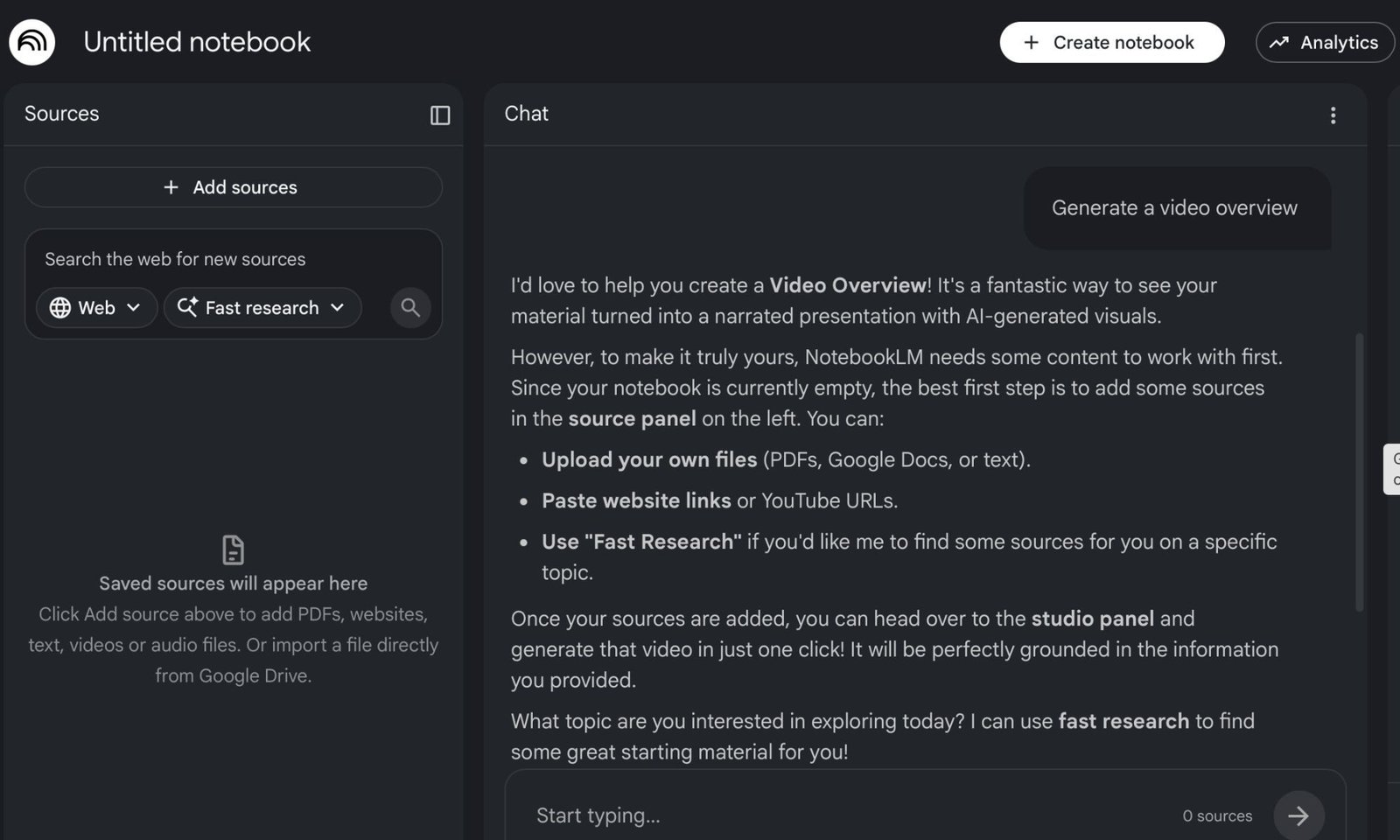
Here’s the pitch: NotebookLM short videos turn dense documents and complicated sources into 60-second vertical clips that explain key ideas. Instead of staring at a wall of text, you get a quick visual walkthrough of whatever concept you’re wrestling with.

I’ve always found that if something is explained visually, it sticks. Reading the same paragraph three or four times? Not so much. If I’d had NotebookLM back when I was grinding through my university psychology thesis, I’d have happily watched a handful of one-minute videos instead of digging through dozens of pages every time I needed a refresher.

How I tested it — and what my nephew taught me

That thought crystallized when I showed the feature to my nephew. He’s been enjoying school holidays, but next week he walks back into class and straight into a test. Over the last few days, he’s been staring at his pile of notes, growing more anxious about how he’ll finish revising everything.

I asked him: “Why don’t you upload your notes to NotebookLM and see if it can explain them back as short videos?”

You could almost see the stress ease a little. Suddenly, revision felt approachable. It’s obviously too early to say whether it’ll improve his grades — the feature has only just rolled out — but if it helps him understand a topic faster and makes studying feel less overwhelming, that’s already a win.

And this isn’t just for students. Creators making educational or faceless content spend hours turning research papers, PDFs, reports, and long notes into something people will actually watch. If NotebookLM can handle the first draft of that process by creating a concise visual overview, that’s a lot of time saved.

We’ve optimized our brains for 60 seconds — and that’s fine

Here’s the uncomfortable part. The reason I instantly liked this feature is probably the same reason it exists in the first place: my attention span just isn’t what it used to be. When Google says it can turn dense notes into a 60-second video, my first reaction is, “Honestly, I’d use that.”

The irony isn’t lost on me. We’ve trained our brains to expect information in bite-sized pieces, and now we’re building tools that fit how we consume content. It’s a little circular, if you think about it.

But I’d still call this a net positive. If those same 60 seconds that I would’ve spent mindlessly scrolling can instead help me understand a concept, revise a chapter, or finally make sense of something I’ve been putting off — I’ll happily take that trade. It’s like doomscrolling but make it educational.

What you get with Short Video Overviews

Google is rolling out Short Video Overviews to NotebookLM AI Pro and AI Ultra subscribers on both mobile and the web. I got early access, and after spending some time with it, I can already see myself using it far more often than I expected.

There are a couple of limitations for now. The feature currently works only with English-language sources, so if your notes or documents are in another language, you’ll have to wait a little longer. The good news is that Google will likely expand language support over time, just as it has with many of its other AI features.

Will free users get access?

If you’re a free NotebookLM user, don’t worry — you haven’t been left out. Google has confirmed that this feature will be available to free users soon. So even if you can’t try it today, it probably won’t be long before you’re turning your own notes into bite-sized lessons too.

What this means for the way we learn

We’ve officially optimized our brains for 60 seconds. The question is whether that’s a bug or a feature. NotebookLM’s answer is clear: lean into it. Give people the short-form content they’re already wired for, but make it actually useful.

I’ve been guilty of doomscrolling more than I’d like to admit. But if I’m going to keep watching short videos anyway, I’d much rather a few of them actually make me smarter. NotebookLM’s Short Video Overviews don’t solve the attention span crisis — but they do offer a genuinely clever workaround.

Next time you’re staring at a pile of notes or a dense research paper, try throwing it into NotebookLM. You might just find that 60 seconds of vertical video teaches you more than an hour of re-reading ever did.

Continue Reading

Artificial Intelligence

Sony Music, Warner Chappell sue Anthropic, accusing AI lab of ‘brazen’ copyright theft

Published

on

Sony Music Warner Anthropic lawsuit

Publishers take Anthropic to court over training data

Sony Music Publishing, Warner Chappell, and a coalition of other music publishers have filed a lawsuit against Anthropic and its co-founders, Dario Amodei and Benjamin Mann. The complaint, lodged late Friday in the U.S. District Court for the Northern District of California, accuses the AI lab of running a “brazen campaign of illegally torrenting, scraping, and downloading copyrighted works.”

This is more than a routine licensing dispute. The publishers are alleging what they call “blatant theft” — that Anthropic used thousands of copyrighted songs, lyrics, and sheet music to train its Claude AI models without permission or payment.

Anthropic isn’t staying quiet. “We disagree with the publishers’ claims and we intend to defend ourselves robustly in court,” a spokesperson told TechCrunch in an emailed statement.

Not the first IP fight for Anthropic

This isn’t Anthropic’s first rodeo in court over intellectual property. Some of the same lawyers behind this case previously represented Concord Music Group and Universal Music Group in a January lawsuit. They also led the Bartz v. Anthropic case, where a group of authors accused the company of using copyrighted books to train Claude.

In the Bartz case, a judge ordered Anthropic to pay $1.5 billion. The ruling was nuanced: using copyrighted works to train AI was deemed legal, but obtaining that content through piracy was not. That distinction matters here.

What’s different this time?

The new lawsuit is notably broader than its predecessors. It accuses Anthropic of “flagrant piracy” through illegal torrenting to secure millions of copies of books — including works containing lyrics and sheet music. The publishers argue this wasn’t just a copyright gray area; it was outright theft on a massive scale.

Legal experts will likely debate whether this case breaks new ground or simply extends the arguments from Bartz. Either way, the music industry is clearly drawing a line in the sand.

Why the music industry is pushing back

For publishers, the stakes couldn’t be higher. If AI companies can freely train on copyrighted music without compensation, the value of their catalogs could plummet. Lyrics, after all, are the backbone of countless streaming services, karaoke apps, and print publications.

This lawsuit isn’t just about money. It’s about control — who gets to decide how creative works are used in the age of generative AI.

What happens next

Anthropic has vowed to fight the claims. The company’s defense will likely hinge on the same arguments that partially succeeded in Bartz: that training on copyrighted material is transformative and should be allowed under fair use.

But the piracy angle complicates things. Torrenting, even for AI training, carries a different legal weight than simply scraping publicly available data. If the publishers can prove Anthropic knowingly engaged in illegal downloads, the court may not be sympathetic.

This case is one to watch. It could set a precedent for how AI companies source their training data — and whether the music industry can demand a slice of the AI pie.

For more on how AI is reshaping creative industries, check out our piece on AI music generation copyright issues and how AI companies handle licensing disputes.

Continue Reading

Artificial Intelligence

Over 100 tech giants warn AI-powered cyberattacks are coming sooner than you think

Published

on

AI cyberattacks warning

A warning that cuts across the industry

OpenAI, Anthropic, Google, Microsoft, and more than 100 other companies and organizations have issued a stark joint warning: AI-powered cyberattacks could become dramatically more widespread and sophisticated within months. The statement isn’t just another tech industry press release. It’s a coordinated alarm from the very companies building AI and the ones defending against its misuse.

The group is calling for a global push on cyber defense as more capable AI models make attacks easier to automate and harder to contain. Hospitals, water treatment plants, and internet infrastructure are among the systems it says could face greater risk if defenses don’t improve quickly enough.

This AI cyberattacks warning carries extra weight because it isn’t coming from one corner of the tech industry. AI developers, cybersecurity firms, and infrastructure companies are all backing the same basic message: defenders need to move now.

Why this warning is unusually broad

The companies involved sit on different sides of the cybersecurity problem. Some are building increasingly powerful AI systems, while others spend their time defending networks against attacks. That makes the warning harder to dismiss as one company pushing its preferred policy.

The coalition brings together organizations with very different commercial interests, yet they agree that existing defenses need to improve before AI gives attackers another advantage. Its recommendations include stronger baseline security standards and wider access to defensive AI, especially for organizations without large cybersecurity budgets.

Critical infrastructure gets particular attention. Failures there can quickly spill beyond a single organization, affecting entire communities or even national economies.

What defenders are being asked to do

The coalition wants governments and organizations to expand access to AI tools that can find vulnerabilities and speed up patching. Smaller institutions are a major concern because they may lack the staff or money to react quickly as attacks become more automated.

Software development is another weak point. The coalition is calling for tougher security standards around AI-generated code, since AI makes it easier for attackers to probe systems for weaknesses. The basic strategy is to give defenders stronger tools before offensive AI becomes widespread enough to put even more pressure on already strained security teams.

Key recommendations from the coalition

  • Stronger baseline security standards across industries
  • Wider access to defensive AI tools, especially for underfunded organizations
  • Tougher security requirements for AI-generated code
  • More investment in automated vulnerability detection and patching

For a deeper look at how AI is reshaping the threat landscape, check out AI-powered phishing attacks and cybersecurity automation trends.

Why the window may be short

AI doesn’t need to invent entirely new cyberattacks to make the situation worse. Helping attackers find existing vulnerabilities faster could be enough to make familiar security failures much more expensive. That still doesn’t turn every attack into an AI superweapon. Unpatched software and understaffed security teams remain ordinary problems, but automation can make exploiting them faster and easier to repeat.

The coalition wants organizations to strengthen those defenses now, before AI-powered attacks become commonplace. For anyone already struggling to keep systems patched and secure, waiting until attackers have better automation leaves even less room to catch up.

The message is clear: the time to prepare is now, not after the first major AI-driven breach makes headlines.

Continue Reading

Artificial Intelligence

South Korea Wants to Give Every Citizen Free Premium AI — Here’s What That Means

Published

on

South Korea AI for All

Seoul’s Bold Bet: AI as a Public Utility

Forget paying $20 a month for ChatGPT Plus. South Korea is about to make premium AI as accessible as turning on a tap.

The government has unveiled a sweeping initiative called South Korea AI for All, a program designed to give every citizen free access to top-tier AI chatbots. The plan, reported by the Wall Street Journal, is to treat AI not as a luxury subscription but as essential infrastructure — think electricity or public transit.

It’s a striking departure from the Western model, where cutting-edge AI tools are typically locked behind monthly fees. Here, the state foots the bill.

What Will Citizens Actually Get?

This isn’t just a glorified Q&A bot. The AI tools will be woven into the fabric of daily life, integrating directly with government services.

Picture this: booking a doctor’s appointment, getting personalized tax guidance, searching for an apartment, or checking eligibility for social support programs — all through an AI interface. Parents could receive curated educational content for their kids. Students get unlimited AI usage for learning.

For small business owners, the perk is even sharper. Free AI to file taxes and navigate government support schemes could save hours of bureaucratic headache. The ambition is to make AI a seamless layer over the state itself.

Why This Is Really About AI Sovereignty

Let’s be honest about the underlying motive. This is a geopolitical play as much as a social one.

Officials frame the project as a step toward AI sovereignty. By making domestic chatbots free, the government hopes to wean citizens off American and Chinese platforms. The message is clear: why rely on OpenAI or DeepSeek when your own country can build it better?

To make that happen, the state is offering selected providers up to 512 Nvidia B200 AI chips and covering operating costs. The total price tag hasn’t been disclosed, but the scale is telling.

The Numbers Behind the Push

This isn’t a shot in the dark. More than 20 million South Koreans already use free generative AI tools. Roughly one in four pays for AI services.

South Korea has tripled its AI budget for 2026 to about $7.2 billion. That’s not pocket change — it’s a declaration that AI is critical national infrastructure, not a passing fad.

How It Compares to the US Approach

Across the Pacific, the strategy looks very different. In the US, free premium AI access has been limited to specific groups — students, for example, through Google’s free AI Pro offer.

South Korea is blowing past that. Universal access. No strings attached. It’s a philosophical difference: one country treats AI as a market product, the other as a public right.

Will it work? That’s the billion-dollar question. The success of AI for All will depend on execution — whether the domestic models can match the quality of American rivals, and whether citizens actually adopt them.

One thing is certain: Seoul is betting that the future of AI isn’t just about who builds the best model, but who makes it available to everyone. That’s a bet worth watching.

Continue Reading

Trending