Connect with us

Infosecurity

OpenAI’s GPT-5.6 Cyber Arrives With a Two-Tier Security Access Program

Published

on

GPT-5.6 Cyber

OpenAI’s New Cyber Model and the Daybreak Split

OpenAI has unveiled GPT-5.6 Cyber, a large language model purpose-built for cybersecurity work, and it’s not just a new model—it’s a whole new access philosophy. The company is restructuring its Daybreak program into two tiers: Daybreak Blue for defensive tasks, and Daybreak Red for more advanced defensive work plus offensive cyber operations.

The move, announced on August 10, signals a deliberate attempt to balance capability with caution. It’s a recognition that the same AI power that can patch a vulnerability can also exploit one.

Daybreak Blue members get access to frontier general-purpose models like OpenAI‘s GPT-5.6 Sol, but with what the company calls “system-level safeguards” removed. That access is meant for authorized defensive work: vulnerability discovery, secure code review, malware analysis, incident response, and patch validation.

Daybreak Red, on the other hand, unlocks purpose-trained cyber models—including GPT-5.5 Cyber and the new GPT-5.6 Cyber—for heavier lifting like vulnerability research, exploit validation, and security testing.

It’s a two-lane highway, and OpenAI is betting that separating the traffic reduces the chances of a head-on collision.

What Makes GPT-5.6 Cyber Different

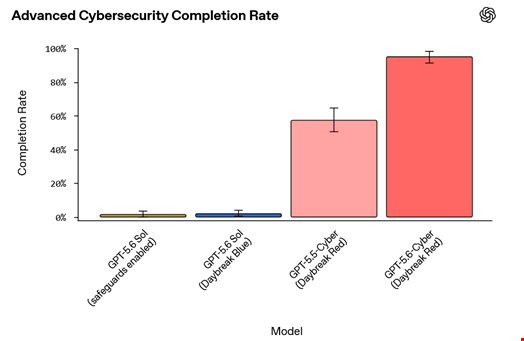
According to OpenAI, GPT-5.6 Cyber is a step-change from its predecessors. In internal evaluations, it completed 95% of a set of sensitive requests—covering exploit-chain development, authentication bypass, privilege escalation, and other advanced scenarios.

Compare that to general-access GPT-5.6 Sol, which completed just 1.5% of the same tasks. Even with Daybreak Blue access, Sol only hit 2.0%. The previous cyber-focused model, GPT-5.5 Cyber, managed 57.3%.

OpenAI also benchmarked GPT-5.6 Cyber against its peers on cybersecurity-specific tests like ExploitGym and ExploitBench, plus tasks such as zero-day vulnerability discovery and vulnerability reporting. It outperformed every other OpenAI model across the board.

In a real-world demonstration, OpenAI used GPT-5.6 Cyber to identify CVE-2026-15903, a high-severity vulnerability in V8, Chrome’s JavaScript engine. The company says it validated the finding and reported it to Google, which fixed the issue.

The Guardrail Paradox

Here’s the tension: OpenAI has deployed system-level safeguards on GPT-5.6 Sol to screen cybersecurity-related requests and prevent misuse. But those same guardrails can block legitimate defensive work.

Daybreak Blue access removes those guardrails for authorized users. Yet even without them, GPT-5.6 Sol will still refuse some “highly dual-use” prompts—like pentesting production systems. That’s where GPT-5.6 Cyber, exclusive to Daybreak Red, steps in.

The model is designed to reduce refusals on sensitive but legitimate tasks. It’s a fine line, and OpenAI is walking it carefully.

Industry Reaction: A Step Forward, Not a Solution

Alex Goller, principal solution architect for EMEA at Illumio, called the two-tier system “a good first step for OpenAI to mitigate two issues.”

“Daybreak Red restricts models from doing more harm than they should and limits people’s exposure to knowing what the models do,” he said. “Daybreak Blue fixes the gap that left Hugging Face’s responders unable to use frontier models during their incident.”

But Goller was quick to note that guardrails on a model are not the same as controls in your environment. “These are agents operating inside your environment and the controls that matter follow zero trust principles,” he explained. “There must be visibility into what the agent is doing and what it can reach, and then segmentation to contain the blast radius when something goes wrong.”

He praised OpenAI’s own guidance on sandboxing and scoped authorization, but added: “That enforcement lives in your infrastructure, not in the model.”

In other words, the model might be smarter, but your network still needs its own walls.

What This Means for Security Teams

For defenders, the takeaway is practical. If you’re in Daybreak Blue, you can now use frontier models for authorized defensive work without tripping over safety filters. That’s a real productivity win for incident response and code review.

For those in Daybreak Red, the offensive capabilities are more powerful—and more dangerous. Access is presumably restricted, but the power is there.

OpenAI’s move also highlights a broader trend: AI models are becoming specialized tools, not just general-purpose chatbots. The OpenAI cybersecurity model is a clear sign that the company sees security as a domain worth dedicated investment.

Still, the responsibility doesn’t end with the model. As Goller put it, the controls that matter “follow zero trust principles.” Visibility, segmentation, and containment are on you, not on OpenAI.

The Bottom Line

GPT-5.6 Cyber is a significant technical leap, and the two-tier Daybreak program is a thoughtful attempt to manage risk. But it’s not a silver bullet. The model is a tool, and like any tool, its value depends on how you use it.

For now, OpenAI is setting the pace in AI-driven security. Whether that pace is sustainable—or safe—remains to be seen. But one thing is clear: the era of one-size-fits-all AI access is over.

Continue Reading

Infosecurity

G7 Tells the World to Speed Up the Quantum-Safe Encryption Transition

Published

on

quantum-safe encryption transition

Quantum Risk Is No Longer a Distant Worry

For years, the threat of quantum computers breaking today’s encryption felt like a problem for the next generation. The G7 just declared that mindset obsolete.

On September 3, under France’s 2026 G7 Presidency, the French National Cybersecurity Agency (ANSSI) — which chairs the G7 Cybersecurity Working Group — published a new call to action. It pushes governments and private organizations to start the quantum-safe encryption transition now, not later.

The document is blunt: reframe the quantum threat from “a distant future problem” to “a near-term threat that demands action across all sectors, not just critical infrastructure.”

Why the Sudden Urgency?

Quantum computers capable of breaking RSA and ECC — the very backbone of public-key cryptography — aren’t here yet. But the G7 notes that “several recent advances suggest an anticipation” of such machines. The exact timeline is uncertain, which is precisely the problem.

Attackers can already harvest encrypted data today and decrypt it later, once quantum machines mature. That’s the “harvest now, decrypt later” scenario that keeps security experts up at night. Waiting for proof that a working quantum computer exists would be a catastrophic mistake.

What the G7 Wants Organizations to Do

The call to action isn’t just a warning. It lays out a practical roadmap for the PQC migration.

First, identify the systems holding your most critical data. Prioritize those for the transition. Then inventory all cryptographic assets, map dependencies, and build a phased, risk-based plan.

The G7 also has a cost-saving tip: integrate post-quantum cryptography (PQC) into products you’re already buying. Replace systems as part of your standard renewal schedule rather than doing emergency rip-and-replace later. Starting early, the document argues, means lower migration costs overall.

Five Priorities for Governments and Industry

The G7 document outlines five concrete priorities that need attention from policymakers and the private sector:

  • Raise awareness about quantum threats across all sectors.
  • Develop national PQC strategies, including building an adequate supply of quantum-safe hardware and software.
  • Focus R&D on advancing PQC through practical innovation.
  • Build public-private partnerships between government, industry, and academia to grow domestic expertise.
  • Integrate PQC into cybersecurity requirements and procurement standards.

The document was signed by the national cybersecurity agencies of all G7 members — Canada, France, Germany, Italy, Japan, the UK, and the US — with support from the EU Commission and the EU Agency for Cybersecurity (ENISA).

ANSSI Is Already Moving the Goalposts

This isn’t ANSSI’s first warning shot. Months earlier, the agency announced it would stop vetting products that lack quantum-safe encryption starting in 2027. By 2030, post-quantum security becomes mandatory in procurement for certain security products in France.

That’s a hard deadline. If you sell security products into the French market, the clock is ticking. The G7 call to action suggests other member states may follow suit with similar requirements.

What This Means for Your Security Roadmap

If you haven’t started planning for the quantum-safe encryption transition, this document is your cue. The conversation has shifted from “if” to “when,” and from “someday” to “now.”

Start by taking inventory. You can’t protect what you don’t know you have. Map your cryptographic dependencies, identify crown-jewel data, and begin conversations with vendors about their PQC roadmaps. Many cybersecurity vendors are already preparing for the migration — make sure yours is one of them.

The quantum threat isn’t science fiction anymore. The G7 just made that official. Will your organization be ready when the deadline hits?

Continue Reading

Infosecurity

OpenAI Puts $1 Billion on the Table to Arm Critical Services with AI Defenses

Published

on

OpenAI cybersecurity pledge

A Billion-Dollar Bet on the Little Guys

OpenAI has committed a staggering $1 billion to put its cutting-edge AI cybersecurity tools into the hands of those who need them most: the people keeping your lights on and your water running. The announcement, made on September 3, outlines a plan to subsidize access to its Daybreak AI models for essential services across the United States and, eventually, the globe.

It’s a direct response to a grim reality. Small municipalities, rural utilities, and local non-profits are getting hammered by sophisticated cyberattacks, yet they often lack the budget and specialized staff to fight back effectively. They are defending aging infrastructure with outdated tools against adversaries who move at machine speed.

This isn’t charity; it’s a strategic move to level a playing field that has grown dangerously tilted.

What Exactly is Daybreak?

For the uninitiated, Daybreak is OpenAI’s dedicated cybersecurity initiative, first unveiled back in May 2026. It’s not a single product but a suite of capabilities that leverages the company’s frontier large language models (LLMs) alongside its AI-coding assistant, Codex. These tools are designed to be deployed by approved defenders for a wide range of security tasks.

By August, OpenAI had evolved this into a two-tier system: Daybreak Red and Daybreak Blue. Red focuses on offensive security—hunting for vulnerabilities before the bad guys find them. Blue is about defense, helping teams monitor, analyze, and respond to threats in real time.

The New ‘Frontline Defenders’ Program

The new initiative, dubbed Daybreak for Frontline Defenders, is all about integration. OpenAI isn’t just handing out API keys. The program is designed to help critical sectors actually embed these AI models into their existing cybersecurity tools, services, and daily workflows. The goal is to make AI assistance as routine as a firewall update.

Which sectors are first in line? Think water treatment plants, electricity grids, local government networks, non-profits, and banking institutions. The rollout starts in the US, but OpenAI explicitly states it intends to expand to partner countries in the coming weeks.

The potential impact is huge. With Daybreak access, a two-person IT team at a rural water authority could review legacy code for flaws, analyze suspicious network activity, and even develop and test fixes—tasks that would typically require a team of expensive security engineers.

A Pilot with MS-ISAC: Putting Words into Action

Talk is cheap, so OpenAI is pairing the pledge with a concrete pilot. They’ve announced a collaboration with the Multi-State Information Sharing and Analysis Center (MS-ISAC). This pilot will pair Daybreak access with guided training and hands-on assistance for an initial group of public sector and water system defenders.

MS-ISAC is a critical piece of the US cyber defense puzzle. It provides threat intelligence, incident-response support, and real-time information sharing to thousands of public-sector organizations. The plan is to start small, develop a repeatable approach, and then expand the partnership over time. It’s a sensible, methodical start.

The Stark Warning That Preceded the Check

This $1 billion pledge didn’t happen in a vacuum. It landed exactly one week after a coalition of over 100 tech and cybersecurity companies—OpenAI included—published an open letter on August 27. That letter was a blunt instrument, warning of a “narrowing window” to act before AI-enabled attacks escalate to a level that puts critical public services at severe risk.

The message was clear: the same AI that powers defensive tools also supercharges attackers. If we don’t democratize access to frontier AI for defenders, we’re essentially handing the keys to the kingdom to cybercriminals.

OpenAI echoed this sentiment in its announcement, stating that the defender’s window “will not stay open indefinitely.” The opportunity, they argue, is to ensure the advantages of frontier AI extend beyond the largest companies and best-resourced security teams, reaching into the communities and institutions whose security affects millions of people.

Beyond this pledge, OpenAI is also working on what it calls a Defense Factory—an automated approach designed to continuously discover, validate, and fix vulnerabilities. It’s part of a broader push to make AI-driven security proactive rather than reactive.

For anyone tracking the intersection of AI and national security, this is a significant development. The question isn’t whether AI will play a role in defending critical infrastructure—that’s a given. The real question is whether the defenders of that infrastructure will have equal access to the tools. With this billion-dollar bet, OpenAI is trying to make sure they do. For more on how AI is reshaping security, check out our analysis of AI-powered threat detection methods and the growing role of automated vulnerability patching tools.

Continue Reading

Infosecurity

US and UK Join Forces to Dismantle Scam Centers Behind Billions in Fraud

Published

on

scam center takedowns

A New Alliance Against Cyber Fraud

The United States and the United Kingdom are pooling resources to shut down the sprawling scam centers that have siphoned billions from victims worldwide. A memorandum of understanding signed Thursday commits both nations to parallel investigations and shared intelligence on the organized crime networks behind these operations, many of which are based in Southeast Asia.

U.S. Attorney Jeanine Ferris Pirro met with senior officials from the U.K.’s National Crime Agency and Crown Prosecutor to formalize the agreement. Pirro stated the objective is to “disable” the Chinese gangs that operate these compounds.

How the Partnership Will Work

The memorandum outlines a framework for both countries to identify overlapping cases and decide which jurisdictions will bring charges. The goal is to prioritize cases that can deliver significant mutual impact.

Officials from both sides had already flagged substantial case overlaps. They are now committed to a joint disruption event with private industry partners, scheduled for early October in London and hosted by the National Crime Agency.

The Scam Center Strike Force Takes the Lead

This initiative is spearheaded by the Scam Center Strike Force, launched last November to coordinate U.S. enforcement against cyber-enabled fraud. The numbers are staggering: the FBI reports that cyber-enabled fraud accounts for nearly 85% of all losses reported to the agency. Americans lost over $12 billion to these scams last year — a figure likely far below reality, as many victims never come forward.

Assistant U.S. Attorney Karen Seifert leads the Strike Force. Testifying before Congress in March, she noted the team includes more than 150 personnel, drawing on prosecutors and agents from the FBI, IRS, and U.S. Postal Inspection Service.

Human Trafficking at the Core

These scam centers are not merely criminal enterprises; they are built on human trafficking. Victims are held in compounds across Myanmar, Cambodia, Laos, and neighboring countries, forced to run investment and romance fraud schemes. Chinese syndicates control the operations, often with the complicity of compromised local officials.

Early Wins and the Road Ahead

The Strike Force has already claimed a major victory. The disruption of Prince Group, a Chinese front company used to launder illicit proceeds, led to sanctions from both U.S. and U.K. agencies. The Justice Department also seized roughly $15 billion in bitcoin tied to the company’s CEO, Chen Zhi.

That seizure sent a clear message. But the problem is vast, and the syndicates are adaptive. The new US-UK partnership signals a recognition that no single nation can tackle this threat alone.

For more on related efforts, see how cyber fraud reporting works and the rise of Southeast Asian scam compounds.

Continue Reading

Trending