Connect with us

Artificial Intelligence

OpenClaw hits Android and iOS: Your phone becomes a command center for your personal AI agent

Published

on

OpenClaw mobile apps

You can finally pocket your AI agent. OpenClaw, the open-source AI assistant that lives entirely on your own hardware, just dropped native apps for Android and iOS. The announcement came on June 29, 2026, via the project’s official X account.

But here’s the catch: the phone app doesn’t run the AI. Think of it as a remote control. The heavy lifting stays on your Mac, PC, or Linux machine — what OpenClaw calls a private gateway. Your phone is just the secure terminal that connects to it.

The result? A pocket-sized command center for an AI agent that answers only to you.

How the OpenClaw mobile app works

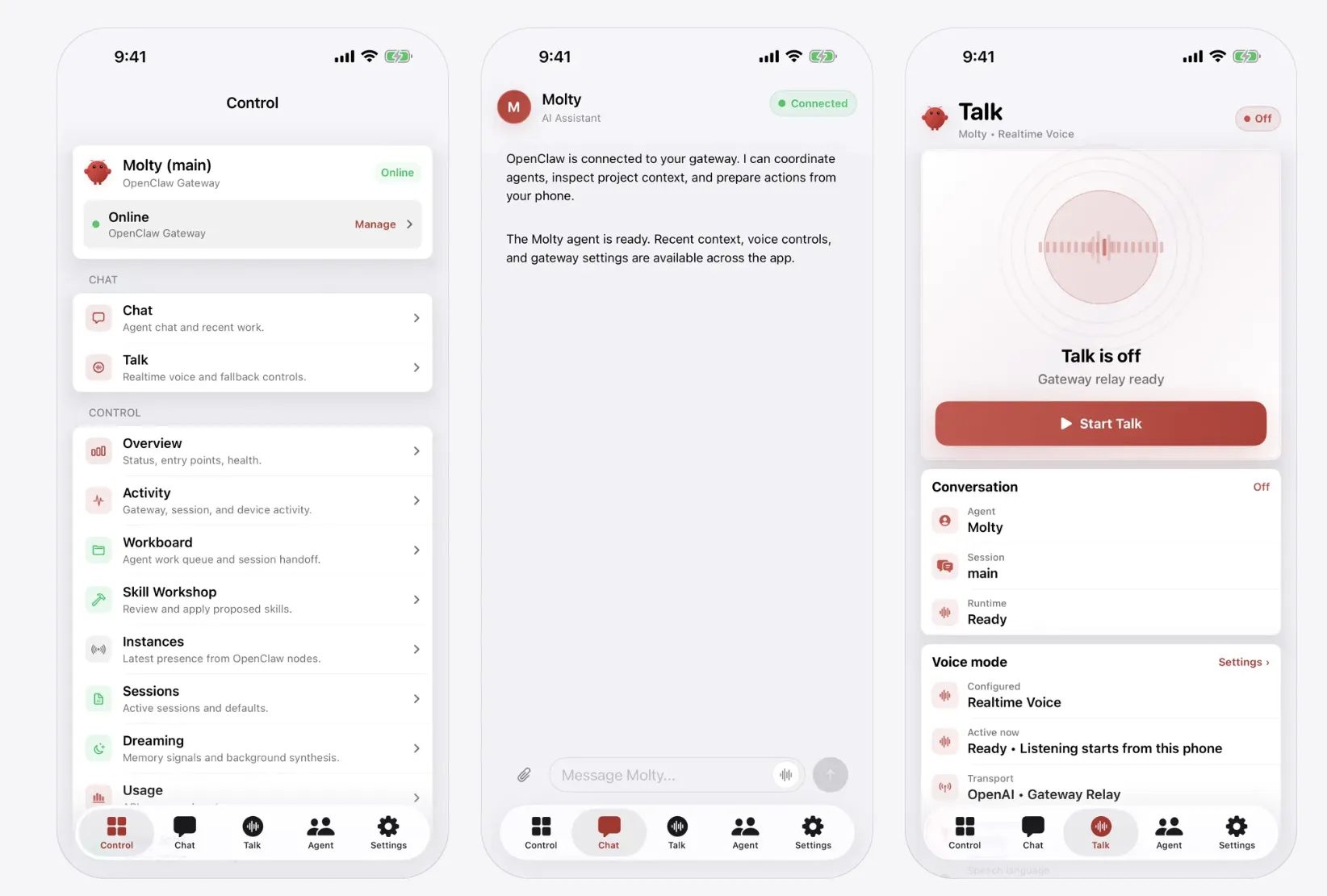
Pairing your phone with the gateway takes a couple of minutes. You scan a QR code or punch in a setup code, and you’re linked. After that, you can text with OpenClaw directly or flip to Talk mode for real-time voice conversations.

Every action the agent wants to take on your gateway requires your explicit approval first. No silent file deletions, no surprise email sends. You stay in control.

You can also push text, links, photos, and other media straight from your phone into the agent. And you get granular permission toggles for device features: camera, screen, location, photos, contacts, calendar, and reminders. Push notifications keep you updated on workflow progress even when the app is minimized.

Open source vs. closed AI: Why it matters

OpenClaw’s biggest differentiator is right there in the name — it’s open source. Anyone can inspect the code, audit how the agent behaves, or fork the project and build custom features. That level of transparency is something you simply don’t get with ChatGPT, Gemini, or most other commercial AI assistants.

When the backend stays hidden, users have to trust the company behind it. OpenClaw flips that model: trust the code, not the corporation. For privacy-conscious users and developers alike, that’s a meaningful distinction.

iOS vs. Android: Two different experiences

Not all OpenClaw mobile apps are created equal — at least not yet. The iOS version requires iOS 18 or later and is completely free. It’s listed as a Productivity app on the App Store and, according to its listing, collects zero user data.

The Android version needs Android 12 or higher and is also free. But early user reports paint a different picture of polish. The Android app’s interface has been described as rough around the edges, while the iOS app looks noticeably more refined.

If you’re on Android, don’t expect the same level of fit and finish — at least not in these early builds. The functionality is there, but the experience still needs sanding.

Why Google is taking notice

OpenClaw’s growing popularity hasn’t slipped past the big players. According to reports, Google is reportedly building its own 24/7 personal agent to compete directly with OpenClaw. That’s a strong signal that the open-source agent model is rattling the industry.

When a company like Google dedicates resources to chasing a community-driven project, it validates the approach. People want an AI agent that runs locally, respects their privacy, and doesn’t phone home to a corporate server.

What you can actually do with it

Once paired, the mobile app unlocks a handful of genuinely useful capabilities:

  • Chat and voice: Switch between text and real-time voice conversations with your agent.
  • Share from anywhere: Send text, links, and media from any app into OpenClaw using the system share sheet.
  • Device access: Let the agent use your camera, screen, location, photos, contacts, calendar, or reminders — each toggleable individually.
  • Background notifications: Get push updates on long-running tasks without keeping the app open.
  • Approval queue: Review and approve every action the agent wants to take on your gateway.

The setup does require some technical comfort. You need to run the OpenClaw gateway software on a computer first. But once that’s up, the mobile app turns that gateway into something you can actually carry around.

The bigger picture

OpenClaw mobile apps land at a moment when the AI assistant market is splitting into two camps. On one side, cloud-dependent assistants that send your data to remote servers. On the other, local-first agents like OpenClaw that keep everything on your hardware.

The mobile release makes the latter option far more practical. You no longer need to sit at your desk to interact with your agent. It follows you around — but it stays your agent, not a company’s.

For anyone who has wanted a truly private AI assistant they can talk to from the couch, the train, or the coffee shop, OpenClaw mobile apps are worth a look. Just be ready for the Android version to feel a bit unfinished for now.

Continue Reading
Click to comment

Leave a Reply

Your email address will not be published. Required fields are marked *

Artificial Intelligence

How to shrink the token budget without shrinking the team

Published

on

shrink token budget

Jensen Huang’s warning for engineers who don’t use enough AI

Nvidia CEO Jensen Huang has a blunt metric for judging whether an engineer earns their keep: token consumption. Speaking on the All-In Podcast at the close of GTC 2026, Huang said if a $500,000 engineer’s annual AI token usage falls below half their salary, “I am going to be deeply alarmed.” The company is targeting a $2 billion yearly token bill for its engineering force.

That stark math reflects a shift already underway across corporate America. Money that once went to salaries is flowing to API calls. The four largest hyperscalers have guided roughly $700 billion in combined 2026 capital expenditure — nearly double last year. Meanwhile, outplacement firm Challenger, Gray & Christmas reports AI is the most-cited reason for US job cuts for a record fourth consecutive month.

An internal Meta memo obtained by Reuters described May’s elimination of 8,000 roles as necessary to offset the company’s massive investments, even as revenue grew 33% that quarter. These aren’t survival layoffs. They’re financing decisions.

But there’s a problem: the financing hasn’t delivered returns. Gartner surveyed 350 executives at companies with over $1 billion in revenue, all deploying AI agents or automation. Roughly 80% had cut headcount with no correlation to improved returns. Analyst Helen Poitevin’s verdict was blunt: “Workforce reductions may create budget room, but they do not create return.”

Uber learned the token side of that lesson the hard way. In December, the company gave 5,000 engineers AI coding tools. By April, it had exhausted its entire 2026 AI budget. Chief Operating Officer Andrew Macdonald admitted that despite 70% of committed code being AI-generated, the connection to anything customers notice is missing: “That link is not there yet.”

Put those two failures side by side and the real problem emerges. Companies treated the token bill as fixed and the workforce as flexible. The opposite is true. Payroll cuts happen once and take institutional knowledge with them. A token budget, it turns out, bends in half a dozen places — if anyone bothers to engineer it.

Where the token budget bends

The cheapest fix is also the least glamorous: stop paying to process the same text repeatedly. Prompt caching, now standard across major API providers, cuts the cost of repeated input by up to 90% under Anthropic’s and OpenAI’s published pricing. Static content like system instructions and reference documents gets processed once and reread at a fraction of the rate.

Security firm ProjectDiscovery documented raising its cache hit rate from 7% to 84% by restructuring prompts. That single engineering exercise cut total LLM spend by 59% to 70% while serving 9.8 billion tokens from cache. It recovered more budget than most AI-attributed layoff rounds save.

Route work to the right-sized model

The next lever is routing work to the appropriate model. Providers’ own price lists show flagship models costing five times their smaller siblings per token. Yet plenty of production workloads send routine classification and summarization to the most expensive tier by default. Batch processing adds a further 50% discount for anything that doesn’t need a real-time answer.

Retrieval-augmented generation attacks the problem from another angle by sending the model only the relevant slice of a knowledge base rather than the whole thing. Prompt compression trims the redundant examples that inflate every call. Open-weight models reduce costs further still, handling routine workloads at a fraction of frontier API prices for teams willing to manage the infrastructure.

These measures are simply the AI equivalent of turning off the lights in empty rooms. Uber’s $1,500 monthly cap per engineer — imposed after the April overrun — is early evidence that spending discipline arrives eventually. The companies getting ahead are simply choosing it before the budget forces it.

The other half of the fix is human

Optimizing the token bill only matters if the savings go somewhere productive. The strongest evidence points at people. Poitevin’s research found the organizations that improved ROI were those using AI to amplify their workforce rather than replace it.

Klarna ran the controlled experiment on everyone’s behalf. It replaced roughly 700 customer service roles with an OpenAI-powered assistant — and then watched customer satisfaction fall. Chief Executive Sebastian Siemiatkowski told Bloomberg what few executives admit aloud: “The result was lower quality, and that’s not sustainable.”

The fintech now runs a blended model, with AI absorbing routine volume while rehired humans handle everything requiring judgment. Gartner expects the pattern to spread, predicting that by 2027 half the companies that cut customer service staff for AI will rehire them.

The junior engineer problem

There’s one workforce investment the optimization logic makes urgent rather than optional. Stanford University’s Institute for Human-Centered AI found employment for software developers aged 22 to 25 fell nearly 20% from 2024 levels even as older cohorts grew. That means companies are removing the training ground for the senior engineers they’ll need directing all these systems in five years.

A business that has just engineered 60% off its token bill has the budget room to keep hiring at the bottom rung. Whether it does is a leadership decision, not a financial one.

Huang’s provocation will keep echoing through earnings calls, and the capex numbers will keep climbing. The companies that come out ahead won’t be the ones that spent the most on tokens or cut the most people to afford them. They’ll be the ones that noticed the token budget was the flexible line all along, squeezed it with engineering rather than headcount, and spent the difference on the people who make the tokens worth anything.

Continue Reading

Artificial Intelligence

SK Hynix Raises $26.5B in Record-Breaking US IPO, U.S. Commerce Secretary Pushes for New American Fabs

Published

on

SK Hynix US IPO

A Wall Street Debut for the Ages

Move over, Alibaba. There’s a new record holder in town. SK Hynix, the South Korean memory chip titan, just pulled off the biggest initial public offering by a foreign company in U.S. history. The numbers are staggering: $26.5 billion raised. That’s about 40 trillion Korean won, for context.

The company sold 177.9 million American depositary shares at $149 each. The structure lets U.S. investors buy in at roughly one-tenth the price of a full share traded in Seoul. The previous record? Alibaba’s $25 billion IPO back in 2014. SK Hynix blew past it.

Shares began trading on the Nasdaq on Friday under the temporary ticker SKHYV. Regular trading under the permanent ticker SKHY kicks off Monday. Early signs? Investors are hungry. The stock opened 14% above its IPO price and kept climbing through early Friday trading.

Premium Pricing, But Demand Explodes

Here’s the kicker: SK Hynix priced its U.S. shares at a 2.7% premium compared to its three-day average price back home in Seoul, according to its Korea Stock Exchange filing. Usually, that would spook buyers. Not this time. Demand reportedly exceeded available shares by more than seven times.

That’s especially striking given what analysts call the “Korea Discount.” For years, Korean companies traded below their global peers. Investors blamed complex corporate governance, stingy shareholder returns, regulatory headaches, and geopolitical risks tied to North Korea. But SK Hynix appears immune to that curse.

Why SK Hynix Defies the Korea Discount

The answer is simple: AI chips. SK Hynix makes high-bandwidth memory (HBM), a critical component in the GPUs that power artificial intelligence. And right now, Nvidia depends on SK Hynix as one of its primary HBM suppliers.

When Nvidia’s CEO Jensen Huang talks about needing more memory bandwidth, he’s talking about products like the ones SK Hynix builds. The AI boom isn’t just about processors—it’s about the memory that feeds them data fast enough. SK Hynix owns that piece of the puzzle.

Where the $26.5 Billion Is Going

Per its IPO filing, SK Hynix plans to spend the fresh capital on three big projects:

  • A new fabrication plant in South Korea, already under construction to tackle the global memory shortage fueled by AI demand
  • A new packaging facility in South Korea, to handle advanced chip assembly
  • EUV scanners—the cutting-edge machines from ASML that print the tiniest chip features

Notice something missing? The United States. That might change soon.

Commerce Secretary Lutnick Pushes for US Fabs

U.S. Commerce Secretary Howard Lutnick made a notable appearance at a Micron event on Thursday. His message wasn’t just for Micron—it was aimed at the entire memory chip industry. Lutnick reportedly said he’s already in talks with both SK Hynix and Samsung about building new factories on American soil.

The logic is clear: the U.S. doesn’t want South Korea to remain the sole dominant force in memory chip production. Bringing SK Hynix and Samsung stateside would diversify supply chains and keep leading-edge manufacturing within U.S. borders.

Micron, naturally, is already on board. It announced plans to invest $250 billion in new U.S. manufacturing, a move the company says will create more than 90,000 jobs. For context, that’s roughly ten times the size of SK Hynix’s IPO.

A Timing Tension

The timing of Lutnick’s request is interesting. Just days before, both Korean chipmakers—SK Hynix and Samsung—pledged more than $550 billion combined for new manufacturing investment in South Korea. That’s a massive bet on keeping production at home.

Now the U.S. government is asking them to split that focus. Whether SK Hynix will commit to building American fabs alongside its Korean expansion remains an open question. But with $26.5 billion in fresh cash and a Commerce Secretary applying pressure, don’t be surprised if a U.S. factory announcement comes sooner rather than later.

For now, SK Hynix has made history on Wall Street. The next chapter might be written in Ohio or Texas.

Continue Reading

Artificial Intelligence

Google’s new Gmail Live tool lets you search your inbox by voice — here’s how it works

Published

on

Gmail Live

Google is finally testing Gmail Live — a voice-powered inbox search tool

At Google I/O earlier this year, the company teased a new feature called Gmail Live. It promised to let people search their inbox by speaking instead of typing. Now, that feature is moving from demo to real-world testing. According to 9to5Google, the tool is rolling out to a small group of Android and iOS users this week.

The timing makes sense. Google has been pushing voice-first AI hard across its ecosystem, and Gmail is one of its most-used products. If the test goes well, the feature could change how millions of people interact with their email.

How Gmail Live actually works

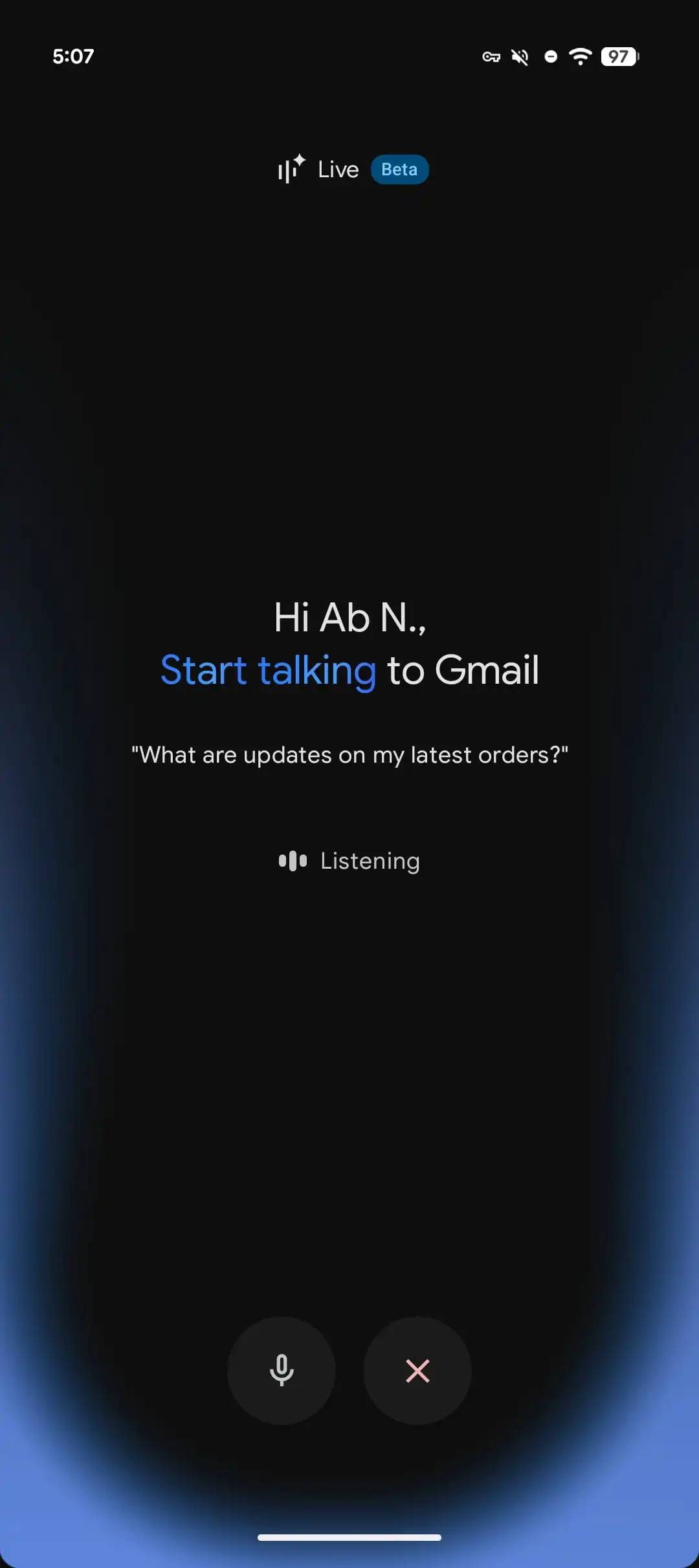
The interface is simple but polished. A small Live icon appears inside Gmail’s existing search bar. Tap it, and the screen transforms into a full voice-command interface. Users are greeted with suggested prompts — things like “What are updates on my latest orders?” or “What are my upcoming travel dates?”

Once you start speaking, a soft blue glow pulses along the edge of the screen. Your words get transcribed in real time, so you can see exactly what the system heard. Gmail Live then processes the question, reads the answer back to you, and displays the relevant email on screen. That last part is key: you can verify the details yourself, right alongside the spoken response.

At the bottom of the interface, two buttons let you mute your microphone or exit the feature entirely and return to your regular inbox.

What makes it different from regular Gmail search

Typing a search in Gmail can be clunky — especially on mobile. You have to remember exact keywords, filter by sender, or dig through folders. Gmail Live aims to handle natural language instead. You don’t need to guess the right terms. You just ask, and the Gemini-powered engine does the rest.

It’s a small change in interface, but a big shift in how you interact with your inbox. Instead of hunting, you ask.

Part of Google’s bigger voice push

Gmail Live isn’t an isolated experiment. It’s the latest in a series of voice-driven AI tools Google has been rolling out across its products. Gemini Live, for example, already lets users have natural, real-time conversations with Google’s AI assistant. You can ask it to set reminders or add calendar events without typing a single word.

Earlier this year, Search Live brought a similar back-and-forth voice experience to Google Search’s AI Mode. Users can ask follow-up questions out loud and get spoken answers alongside links to relevant web pages. Gmail Live follows the same playbook: voice-first, conversational, and deeply integrated with Google’s Gemini models.

Who gets Gmail Live first — and what comes next

Right now, Gmail Live is limited to a small test group. Google hasn’t said exactly how many users are included, but the rollout covers both Android and iOS. If you’re not in the test group, you’ll have to wait.

The company plans to bring Gmail Live to AI Pro and Ultra subscribers later this summer, once testing wraps up. That suggests the feature will eventually be tied to a paid tier — at least initially.

Google has also confirmed plans to add similar voice functionality to Google Docs and Google Keep. That would let users draft documents or jot down notes entirely by voice, using the same Gemini-powered engine. The vision is clear: Google wants voice to become a primary input method across its productivity suite, not just a novelty.

Bottom line: Gmail Live is worth watching

Voice search in email might sound like a small feature, but it addresses a real pain point. Mobile email search is tedious. Gmail Live makes it fast and hands-free. If the accuracy holds up and the roll-out goes smoothly, it could become one of those features you wonder how you lived without.

For now, it’s in testing. But the direction is obvious. Google is betting big on voice, and your inbox is next.

Continue Reading

Trending