Russian APT28 Hackers Hijack Routers in Global Credential Theft Campaign
A sophisticated Russian cyber-espionage group is conducting a widespread campaign by hijacking internet routers to steal sensitive credentials from targeted organizations. This APT28 router hijack operation, detailed in a new advisory from the UK’s National Cyber Security Centre (NCSC), reveals a methodical approach to digital surveillance and data theft. Consequently, businesses and individuals using common networking equipment are at significant risk.
The Mechanics of the Router Hijack Campaign
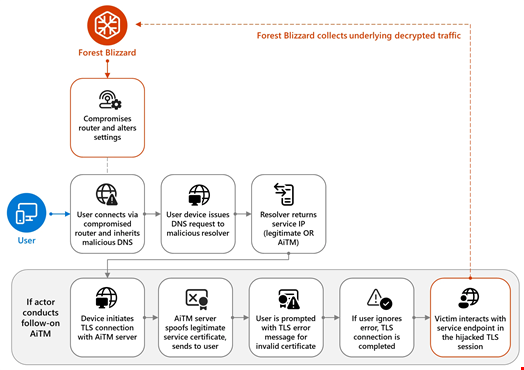
According to the NCSC, the threat actors, identified as APT28, are exploiting vulnerabilities in small office/home office (SOHO) routers. Their goal is to redirect internet traffic through servers they control. This process, known as DNS hijacking, allows them to intercept data flowing from connected devices like laptops and smartphones. Therefore, when a user tries to access a website or service, their request is secretly routed to a malicious server where login credentials can be harvested.
Building on this, the NCSC assesses the initial phase of these operations as “opportunistic.” The hackers cast a wide net to gain visibility on a large pool of potential targets. They then filter these candidates at each stage of their attack chain, ultimately focusing on victims deemed to have high intelligence value. This means that while the initial compromise is broad, the final theft is highly selective.
First Wave: Targeting TP-Link Devices
One distinct activity cluster focuses heavily on TP-Link routers. In this campaign, the hackers modify the router’s DHCP DNS settings to include IP addresses they own. A specific model, the TP-Link WR841N, is likely being exploited using a known vulnerability (CVE-2023-50224). This flaw lets an unauthenticated attacker obtain password credentials via crafted web requests.
Once a router is compromised, every device on its network inherits the malicious DNS settings. This allows APT28 to perform adversary-in-the-middle (AitM) attacks on user sessions. The primary objective is to harvest passwords, OAuth tokens, and other credentials for web and email services. Subsequently, the stolen data can be used for malicious logins from other infrastructure not yet identified by authorities.
Second Wave: Compromising MikroTik and More
In a separate but related cluster, the NCSC observed servers receiving DNS requests from likely compromised MikroTik and TP-Link routers. This campaign involves a more complex forwarding chain, where DNS requests are sent from the initial compromised server to further remote servers controlled by the attackers.
Notably, this infrastructure was used for interactive operations against a small number of MikroTik routers, often located in Ukraine. These targets were likely chosen for their specific intelligence value to the Russian group. This indicates a strategic shift from broad scanning to precise, interactive compromise of high-value assets. For more on defending critical infrastructure, see our guide on essential network security practices.
Who is Behind the APT28 Router Hijack?
The UK government attributes the APT28 router hijack campaign “almost certainly” to Unit 26165 of the Russian General Staff Main Intelligence Directorate (GRU). This unit is also widely known by aliases such as Fancy Bear, Forest Blizzard, and Strontium. Their history includes high-profile attacks like the 2015 cyber-attack against the German parliament and an attempted breach of the Organisation for the Prohibition of Chemical Weapons (OPCW) in 2018.
Microsoft Threat Intelligence, in a separate report, corroborates these findings. They note that APT28 and a sub-group tracked as Storm-2754 have been compromising virtual private servers (VPS) to exploit SOHO routers since at least August 2025. This confirms a sustained, long-term investment in this particular attack vector by a state-sponsored actor.
How to Defend Against Router-Based Attacks
In response to this threat, the NCSC has issued critical mitigation advice. Organizations and individuals must take proactive steps to secure their networks. First and foremost, ensure all routers are running the latest supported firmware and that security updates are applied immediately. Outdated software is the primary entry point for these exploits.
Furthermore, adopting a browse-down network architecture can prevent attackers from easily gaining privileged access to vital assets. This means segmenting your network so that a compromise in one area doesn’t grant access to everything. Additionally, deploying robust endpoint protection, including host-based intrusion detection systems (HIDS), is crucial for spotting malicious activity.
On the authentication front, using multifactor authentication (MFA) universally is one of the most effective ways to neutralize stolen credentials. Even if a password is intercepted, MFA provides a critical second layer of defense. Implementing application allowlisting can also prevent unauthorized software from running on your network. For a deeper dive into authentication security, explore our resource on implementing MFA across your organization.
The Bigger Picture of Cyber Espionage
This campaign is not an isolated incident but part of a continuous trend of state-aligned cyber operations targeting critical infrastructure and sensitive data. The use of commodity hardware like consumer routers provides attackers with a low-cost, high-impact method of establishing a foothold. This APT28 router hijack tactic is particularly insidious because it compromises the very foundation of a network’s trust—its DNS resolution.
As a result, the responsibility for security extends beyond large corporations to include small businesses and even home users who may be unwitting participants in these attack chains. Regular security scans, vigilance for unusual network behavior, and a commitment to basic cyber hygiene are no longer optional. The convergence of geopolitical conflict and cyber warfare means that digital defense is now a universal concern.
















 CyberSecurity7 months ago
 How To6 months ago
 How To4 months ago
 How To6 months ago
 How To5 months ago
 How To7 months ago

 How To6 months ago