Connect with us

Social Media

‘Slow-cial’ app Roost forces you to slow down to the speed of a carrier pigeon

Published

on

Roost slow-cial app

What is Roost? A messaging app built on bird flight times

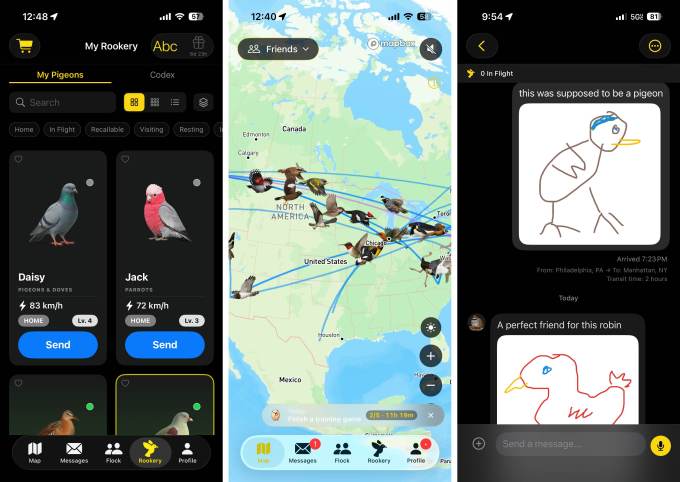
Somewhere above the Great Plains right now, a virtual woodpecker is flapping its way toward Alaska, carrying a message from me to an anonymous pen pal. Meanwhile, a zebra finch named Tucker is winging into Manhattan to deliver my terrible Cool S doodle to a friend. These messages take hours — sometimes days — to arrive, depending on how far the bird has to fly. That’s the whole point.

Roost, the so-called “slow-cial” app, is making carrier pigeons cool again. At a moment when people are exhausted by apps that demand constant attention, Roost deliberately adds friction. Founder Logan Mendelsohn, a senior product manager in trust and safety at Ticketmaster, told TechCrunch: “Everything on a phone is instantaneous these days — every single thing you do, it’s like you’re always getting some notification or something. Roost is kind of a break from the instant. It’s resonating with people in a way where they don’t feel pressure all the time to have to do something.”

The app lets you choose four birds for your rookery. Each bird moves at its real-life speed: a falcon delivers fast; a hummingbird, not so much. If you really want to drag things out, you can send snails or turtles instead. Messages travel in literal bird time. It’s weird. It’s charming. And it’s catching on.

From side project to viral sensation — 300,000 users in weeks

Mendelsohn started building Roost as a fun project for himself and his friends. They loved it so much they pushed him to put it on the App Store. For a while, it had a tiny, devoted following. Then a mother posted on Threads about how her daughter was chatting with friends in Elizabethan English on an app where messages move at the speed of actual birds.

Within three days, Roost went from 10,000 users to 100,000. Now, about five weeks later, it’s approaching 300,000. “The people are what really make this platform,” Mendelsohn said. “What people kept talking about is how wholesome it is, how whimsical it is, and how much this really helps them put more intention into what they’re saying. There’s a lot less pressure when you know the message isn’t going to someone immediately.”

Privacy built in, not bolted on

Mendelsohn works in trust and safety by day. He knows any social platform — even a whimsical bird app — can be abused. So Roost shares only a user’s city with friends by default. There’s a manual “close friends” feature that lets you share your precise location with specific people if you choose. “I personally think that for any new platform that connects people, trust and safety should be the first thing they think about,” Mendelsohn said. “When you’re able to start at zero with that lens, you can build it into the platform instead of doing it later.”

Privacy concerns also shaped the “Pen Pals” feature, which lets you exchange messages with anonymous users in your age group. During onboarding, the app explicitly warns you not to share personal details or contact info. Roost deliberately doesn’t support photo sharing yet — Mendelsohn wants to build more sophisticated content moderation tools first. That kind of caution is rare in the fast-ship world of consumer apps.

Mini games and bird collecting — the slow life has layers

Roost isn’t just about waiting for messages. There are mini games. There’s bird collecting. The whole experience is designed to be playful and unhurried. It’s a reminder that not every app needs to optimize for engagement at all costs. Sometimes you just want to send a doodle on a virtual sparrow and wait a few hours for a reply.

The AI art controversy — and how Mendelsohn handled it

Roost’s rapid growth brought an unexpected backlash. When users learned Mendelsohn had used AI-generated art for the bird images, they were furious. “On the AI art side, I completely understood the feedback,” he said. “I won’t lie, it was daunting to see the reaction online. But I don’t think it’s productive to dig your heels in when your community is vocal about something they care for. At the same time, I also knew I couldn’t flip a switch overnight. Replacing the art in an app this size takes time, planning, and money.”

Mendelsohn runs Roost in his spare time, with no outside funding. Revenue comes from in-app purchases like extra birds. To address the complaints, he’s now running a contest for artists to contribute original art. That’s quieted things for now, but the situation highlights a real tension in the consumer app space: many users boycott AI art out of respect for human creators, but a solo founder with limited resources can’t always afford to commission custom illustrations from day one. “As a solo founder, I don’t think I could build and maintain something at this scale without AI-assisted development,” Mendelsohn said. “But every product decision and direction for Roost still comes from me and the community.”

Why Roost matters in a world of instant everything

Roost is part of a small but growing wave of apps that reject the dopamine-loop model. It’s a “slow-cial” app in the truest sense — it forces you to wait, to think, to be intentional. In an era of push notifications and infinite scroll, that’s almost radical. It’s also a reminder that the people flocking to Roost are often the same ones who are tired of the tech industry’s relentless pace. They want something slower. Something more human. Even if it means waiting for a virtual bird to cross a continent.

Continue Reading
Click to comment

Leave a Reply

Your email address will not be published. Required fields are marked *

Social Media

Building Agentic Workflows with Manus: Stop Copy-Pasting and Let AI Do the Heavy Lifting

Published

on

agentic workflows with Manus

Why Your Current AI Workflow Is Probably Broken

If you’ve ever found yourself copying text from ChatGPT, pasting it into a document, then manually feeding that output into another tool — you’re not alone. That tedious loop is the reality for most knowledge workers today. You’re using AI, sure, but you’re still the human middleman.

There’s a better way. It’s called an agentic workflow, and the tool that’s making it accessible to non-developers is Manus. Instead of you orchestrating every step, you tell Manus what you want done, and it hands off the subtasks to specialized AI agents. No more copy-paste. No more babysitting.

In this guide, you’ll learn how to set up your first agentic workflow with Manus — and finally let the machines do the grunt work.

What Is an Agentic Workflow, Really?

An agentic workflow is a sequence of automated steps where an AI agent decides which tool or sub-agent to call next based on the task. Think of it like a project manager who doesn’t just assign work but also checks back, adjusts, and hands off results to the next specialist.

With Manus, you define the overall goal — say, “Research competitors, summarize their pricing, and draft an email to the sales team” — and the platform breaks it down. It might call a web-scraping agent first, then a summarization model, then a writing agent. You just review the final output.

This is fundamentally different from a chatbot that gives you a single answer. It’s a system that acts on your behalf across multiple domains.

Getting Started with Manus: What You Need

Before you dive in, make sure you have:

  • An active Manus account (free tier available with limited credits)
  • Access to at least one external tool API (e.g., SerpAPI for web search, or a database connector)
  • A clear, single-sentence goal for your first workflow

Manus works best when you start small. Don’t try to automate your entire marketing funnel on day one. Pick one repetitive task — like pulling daily news mentions for your brand — and build from there.

Step-by-Step: Building Your First Agentic Workflow with Manus

1. Define the Trigger and the End Result

Every workflow starts with a trigger. It could be a scheduled time, a webhook from a CRM, or a manual launch. Then define the output: a Slack message, a Google Doc, an email. Be specific. “Send me a daily briefing” is vague. “Send a Slack message every weekday at 8 AM with three news articles about my competitor” is actionable.

Inside Manus, you create a new workflow and name it. Then you add the trigger node.

2. Chain Your Tools Together

Manus uses a visual node editor. You drag and drop blocks representing different agents or API calls. For example:

  • Node 1: Search the web for “competitor news” using SerpAPI
  • Node 2: Pass the top 5 results to an AI summarizer
  • Node 3: Format the summary into a Slack message

The magic is in the handoff. Manus automatically passes the output of Node 1 into Node 2. You don’t write any glue code. Just connect the nodes.

3. Set Conditions and Fallbacks

Real-world workflows fail. A search API might return no results. An AI summarizer might timeout. Manus lets you add conditional branches: “If no results found, send me a notification instead of a summary.” This prevents your workflow from breaking silently.

You can also set retry logic. If an agent fails, Manus can retry twice before escalating to you.

4. Test and Iterate

Run your workflow in test mode. Manus shows you the output of each node in real time. This is where you catch mistakes. Maybe the summarizer is too verbose. Maybe the Slack message format is ugly. Tweak the prompts in each node until the output feels right.

Once it’s solid, schedule it or connect it to your live tools.

Real-World Use Cases for Agentic Workflows with Manus

Here are three practical applications you can build today:

Automated Competitor Monitoring

Set a daily search for mentions of your top three competitors. Manus scrapes the results, has an AI agent rank them by relevance, and posts the top five to a shared Slack channel. Your team wakes up to intelligence, not noise.

Lead Qualification from Inbound Forms

When a new lead fills out a form on your site, a webhook triggers a Manus workflow. The platform enriches the lead data using a public API, scores it with a custom AI model, and if the score is high, emails the sales rep with a summary — all within seconds.

Content Repurposing Pipeline

Publish a blog post? Feed the URL into Manus. The workflow extracts the text, has an agent rewrite it as a LinkedIn post, another agent creates a Twitter thread, and a third generates an email summary for subscribers. One input, multiple outputs, zero manual formatting.

Common Pitfalls and How to Avoid Them

The biggest mistake new users make is overcomplicating the first workflow. Start with three nodes max. Add complexity only when the simple version is running reliably.

Another trap: not respecting API rate limits. If your workflow calls an external service 100 times per minute, you’ll hit errors. Manus doesn’t throttle third-party APIs for you — so build in delays between nodes if needed.

Finally, don’t forget security. If your workflow handles customer data or internal documents, make sure the connected tools use HTTPS and that you’ve set proper access controls inside Manus. The last thing you want is an agent accidentally emailing a draft to the wrong person.

Is Manus the Right Tool for You?

Manus isn’t for everyone. If you only need a chatbot to answer questions, stick with ChatGPT. But if you’re tired of being the human glue between AI tools, Manus offers a genuinely different approach. It’s closer to a lightweight automation platform than a traditional AI assistant.

The learning curve is mild — expect to spend an afternoon building your first real workflow. After that, you’ll start seeing every repetitive task as a candidate for automation. And that’s the point. Let the agents work. You’ve got better things to do.

Continue Reading

Social Media

X rolls out video editor to fight stolen content and lure creators

Published

on

X video editor

X finally gives creators a reason to post original work

For years, X has been a place where reposted memes and scraped TikToks thrive. That might finally change. The social network just launched a proper video editor and recorder inside its iOS app, and the message is clear: make something new, don’t just steal it.

The update, announced by X’s head of product Nikita Bier, brings two flagship features: multi-language caption overlays and a green-screen tool that pulls from your camera roll or other X posts. It’s not TikTok-level — not yet — but it’s a start.

Bier put it bluntly. “One of our biggest priorities is to give creators the tools to create original content [and] reward those creators,” he wrote. He added that more updates are coming “in the coming weeks.”

Why X needs a video editor — and why it matters

The problem is simple: top accounts on X often repost content that went viral years ago on other platforms. Sometimes it’s five-year-old material, still getting millions of impressions. Bier said he wants X to host videos that are “finally original content that doesn’t exist on other platforms.”

But a video editor alone won’t fix the culture of recycling. Creators need real incentives to stay exclusive. Right now, TikTok, Meta, and YouTube offer reliable payouts and mature ecosystems. X has a long way to go on that front.

There’s also the bot problem. Bier previously said X identifies and suspends roughly 208 bots per minute. That’s not a typo. Half of the product team, he noted, is focused on fighting spam. Bots inflate views and steal content. They make the platform less trustworthy for creators who want real engagement.

What the new video editor actually does

The editor, rolling out first on iOS, includes:

  • Overlay captions in multiple languages, with full customization of font, color, and placement
  • Green screen that lets you add backgrounds from your camera roll or from existing X posts

These are basic tools by 2025 standards, but they’re new for X. The company’s app has long felt barebones for video creation, leaning on third-party tools or simple uploads. This is a direct attempt to change that.

Bier confirmed the Android version is still being rebuilt, so Android users will have to wait.

Stolen content is the easy path — but it hurts everyone

Recycled content isn’t just lazy; it’s damaging. Bier said it has a “negative impact on the user experience and the business.” When creators see their work reposted without credit or compensation, they have little reason to post on X in the first place.

Meta and YouTube already offer tools for creators to find and remove unauthorized re-uploads. Meta even lets original creators block stolen content or add attribution links to monetize it. X has no such system. That’s a gap that a video editor alone can’t fill.

Bier recently called out MrBeast, one of YouTube’s biggest stars, for the nature of his content. “For the love of God, make a single piece of content without financial bait,” Bier posted. It was a pointed remark, but it also signals that X is thinking about content quality, not just quantity.

Can X compete with TikTok and YouTube?

It’s a tall order. TikTok and YouTube have spent years building creator tools, payment systems, and community guidelines. X is starting from behind. But Bier noted that posts containing videos already account for nearly half of all impressions on the platform. That’s a huge base to build on.

The platform isn’t alone in its spam struggles. Reddit recently said it’s deploying AI tools to fight bot content enabled by large language models. Digg, a would-be Reddit competitor, shut down its app earlier this year, admitting it couldn’t handle the spam as a startup.

X’s video editor won’t solve everything. But it’s a signal. The company is finally investing in the tools that creators actually need. Whether that’s enough to convince top talent to post original work — and stick around — is another question entirely.

Continue Reading

Social Media

Meta AI unleashes fresh effects for Instagram Stories — here’s what’s new

Published

on

Meta AI effects

Meta AI’s latest trick: fresh effects for Stories

If you’ve scrolled through Instagram lately and noticed your friends’ Stories looking a little… different — more surreal, more polished, or just plain weird — there’s a reason. Instagram has quietly rolled out a batch of new AI-powered effects for Stories, powered by the latest version of Meta’s generative AI engine.

The update isn’t just a filter refresh. It’s a signal that Meta is betting bigger on AI as a creative tool, not just a moderation or recommendation engine. And for the average user, it means more ways to turn a mundane selfie into something that looks like it crawled out of a sci-fi concept art board.

What are the new Meta AI effects?

Meta hasn’t published a full changelog, but early adopters and beta testers have spotted several new categories of effects. They include:

  • Style transfer on steroids — turn your video into a watercolor painting, a charcoal sketch, or a neon-drenched cyberpunk scene. The AI analyzes each frame and applies a consistent artistic style.
  • Background replacement with depth — unlike the old green-screen trick, this one uses AI to understand the scene’s depth and lighting, so the new background blends naturally. Swap your messy bedroom for a beach at sunset without looking like a cardboard cutout.
  • Animated object insertion — drop a 3D-looking object (a floating donut, a glowing orb, a cartoon dinosaur) into your Story. The AI tracks your movement so the object stays anchored in the scene.
  • Face morphing and expression manipulation — the AI can change your expression after you record. Smile, frown, raise an eyebrow — all without reshooting.

These aren’t just static filters. They’re real-time, interactive, and they adapt to what’s happening in the frame.

How to access the new AI effects

Open Instagram, swipe right to create a Story, and tap the effects icon (the smiley face). Scroll through the carousel. If you see effects labeled with a small sparkle icon or “AI” badge, those are the new ones. Not seeing them yet? That’s normal. Meta is rolling the feature out gradually — both by region and by device. Users with older phones or outdated app versions may not get the update immediately.

You can also search for specific effects by name in the effects gallery. Early names include “Dreamscape,” “Ink Wash,” and “Neon Noir.” Expect more to appear as Meta expands the library.

Why Meta is pushing AI into Stories now

The timing is no accident. Instagram’s battle with TikTok for short-form video dominance has forced both platforms to innovate faster. TikTok has its own AI effects (like “AI Green Screen” and “Style Transfer”), and Snapchat has been using generative AI in lenses for years. Meta needs to keep its creative tools fresh — and AI is the cheapest way to generate hundreds of unique effects without hiring a team of designers for each one.

There’s also a data angle. Every time you use an AI effect, you’re training Meta’s model. The company gets to see how people interact with generative features in real-world conditions — which styles are popular, which fail, and how the AI handles diverse skin tones, lighting, and motion. That feedback loop is invaluable for improving the underlying technology.

What about privacy and misuse?

As with any AI feature that touches faces and videos, questions about consent and abuse follow. Meta says the new effects do not upload your video to its servers for processing — everything runs locally on your device. That means the AI never sees your face; it only sees a pixel map on your phone. That’s a meaningful privacy safeguard, though it also limits how complex the effects can be (local chips aren’t as powerful as cloud servers).

Still, the expression-manipulation feature raises eyebrows. Being able to change someone’s facial expression after recording could be used to misrepresent what they actually did. Meta hasn’t detailed any watermarking or detection system for AI-altered Stories, which leaves a gap. For now, the feature is limited to your own face — you can’t apply it to someone else in the frame — but that boundary could shift in future updates.

How this fits into Meta’s broader AI strategy

Meta has been investing heavily in generative AI across its family of apps. The company’s AI research division, FAIR, has released open-source models like Llama 2 and Segment Anything. On the product side, we’ve seen AI-generated stickers in Messenger, AI characters in WhatsApp, and now these Story effects in Instagram.

CEO Mark Zuckerberg has said he wants Meta to be “the leading AI company in the world” by 2025. That’s a bold claim given the competition from Google, Microsoft, and OpenAI. But Meta has a unique advantage: billions of users and a massive library of visual content to train on. The new Story effects are a small but visible step toward that goal — a way to put AI directly into people’s hands, not just into backend systems.

For creators and casual users alike, the message is clear: your Stories are about to get a lot more interesting. Whether that’s a good thing depends on how much you trust Meta with your face — and your attention.

Continue Reading

Trending