Connect with us

CyberSecurity

Venom PhaaS: The New Phishing-as-a-Service Platform Behind Sophisticated Executive Credential Theft

Published

on

Venom PhaaS: The New Phishing-as-a-Service Platform Behind Sophisticated Executive Credential Theft

Security researchers have exposed a highly targeted credential theft campaign that operated for months, focusing on top-tier executives at major global corporations. This operation, analyzed by experts at Abnormal Security, was powered by a previously unseen and sophisticated phishing platform known as Venom.

This discovery signals a dangerous evolution in the cyber threat landscape. Building on this, the campaign’s success was not due to a single breakthrough but to the meticulous integration of multiple evasion and deception techniques.

The Anatomy of a Deceptive Phishing Campaign

The attackers employed a multi-layered approach to lure their high-value targets. Instead of generic spam, they crafted emails that appeared to be SharePoint document-sharing notifications. These messages were sent to a curated list of CEOs, CFOs, and other senior leaders across more than twenty different industries.

Personalized Lures and Evasion Tactics

To appear legitimate, the emails used financial report themes and contained a QR code directly in the body, urging the recipient to scan it. However, the deception went much deeper. Each email was uniquely structured with randomized HTML elements to avoid signature-based detection systems.

Furthermore, the phishing template automatically generated a fake, multi-message email thread. This thread was personalized with the target’s own email prefix and display name, complete with a fabricated signature containing their real details. A second, randomly generated persona was added as a correspondent, and the message bodies used multilingual text from fixed templates to mimic authentic corporate chatter.

Bypassing Human and Automated Defenses

Once a target scanned the QR code, they were taken to a landing page designed as a verification checkpoint. This page’s primary function was to filter out non-human visitors, such as security scanners, sandboxes, or automated analysis tools.

As a result, only visitors who passed these checks were directed to the actual credential-harvesting page. Everyone else was sent to a dead end, leaving no trace of malicious activity for security teams to find. This step was crucial for isolating real human targets from automated defenses.

How This Phishing Platform Neutralizes Multi-Factor Authentication

The campaign’s most alarming feature was its ability to render multifactor authentication (MFA) ineffective. Victims faced one of two sophisticated harvesting methods.

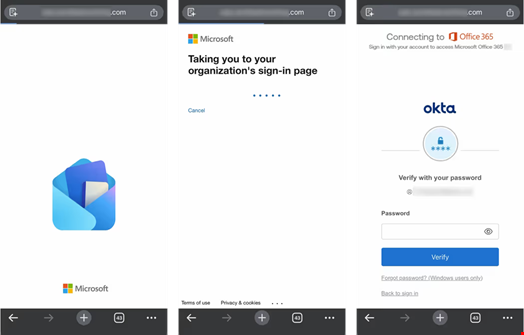
In the first, an adversary-in-the-middle (AiTM) setup perfectly cloned the victim’s real corporate login portal. It included company branding, a pre-filled email field, and even mimicked the organization’s actual identity provider. While the victim entered their credentials and MFA code, the platform silently relayed this information to the legitimate Microsoft servers, simultaneously giving the attacker access.

Alternatively, the second method avoided login forms altogether. It tricked the user into approving a device sign-in via Microsoft’s legitimate device code flow, which then handed access tokens directly to the attacker. This meant the attacker never needed to see the password at all.

Ensuring Persistent Access

In the AiTM mode, the attacker would quietly register a secondary MFA device on the compromised account, leaving the victim’s original authenticator untouched. In the device code mode, the stolen refresh token remained valid even after a password reset, unless an administrator manually revoked all active sessions—a step not commonly taken by default.

Therefore, the attack blended seamlessly into normal authentication flows, evaded detection, and maintained long-term access.

Venom PhaaS: A Force Multiplier for Cybercrime

The engine behind this operation was the Venom Phishing-as-a-Service platform. This platform featured a professional licensing model, structured token storage, and a full campaign management interface, indicating a high level of commercial development.

Critically, at the time of discovery, Venom had not appeared in any public threat intelligence feeds or open marketplaces, suggesting it is a closed-access, private service. This makes the phishing platform particularly dangerous, as its capabilities are not limited to a single operator but can be rented by others.

Researchers warn that the discovery of Venom acts as a force multiplier. The techniques documented are engineered to work together in an end-to-end pipeline where each stage actively protects the next. Consequently, defensive strategies that rely on MFA as an impenetrable final barrier require immediate reassessment. For more on evolving authentication threats, see our analysis on advanced MFA bypass techniques.

In summary, the Venom platform represents a significant shift towards industrialized, service-based cybercrime. Its focus on high-value targets, sophisticated evasion, and MFA circumvention means organizations must adopt more proactive, behavior-based security measures to defend their most critical accounts.

CyberSecurity

Android 17 Adds OS-Wide ECH to Hide Website Visits From Network Providers

Published

on

Android 17 ECH

Android 17 Brings ECH to the OS Level

Google has quietly rolled out a significant privacy upgrade in Android 17. The new version introduces support for Encrypted Client Hello (ECH), a standard that stops network providers from seeing which websites you visit. This isn’t just a browser tweak — it’s baked into the operating system itself.

For years, your internet service provider (ISP) could see the domain names of every site you accessed, even if the content was encrypted. ECH changes that by encrypting the part of the TLS handshake that reveals the server name. Now, with Android 17, that protection applies across the entire OS, not just in Chrome or Firefox.

The announcement came on Thursday, with Google positioning ECH as a cornerstone of its broader network security push. The company also highlighted efforts to shore up cellular vulnerabilities and protect home network privacy.

How ECH Works: The Technical Side

When you connect to a website, your device sends a TLS handshake that includes the domain name in plaintext. That’s how network providers know you’re visiting example.com even if the page itself is encrypted. ECH encrypts this handshake, so the server name is hidden from anyone sniffing the connection.

This is a big deal. DNS over HTTPS (DoH) and DNS over TLS (DoT) already hid your DNS queries, but the TLS handshake itself remained a leak. ECH closes that gap.

Android 17 implements ECH at the OS level, which means every app that uses the system’s network stack benefits automatically. You don’t need to configure anything or install a special browser. It just works.

What This Means for Your Privacy

For the average user, the practical effect is simple: your network provider can no longer build a profile of your browsing habits based on domain names. That’s a major win for privacy, especially on public Wi-Fi networks where snooping is easier.

It also matters for people in countries with strict internet censorship. ECH makes it harder for authorities to block access to specific sites, though it’s not a silver bullet — they can still block by IP address or use other techniques.

Beyond ECH: Other Security Upgrades in Android 17

ECH isn’t the only security feature in Android 17. Google also addressed cellular vulnerabilities that could expose your location or allow attackers to intercept calls. These fixes target the baseband processor, which handles radio communication and has historically been a weak point.

Home network privacy also got a boost. Android 17 now handles certain network configurations more securely, reducing the risk of man-in-the-middle attacks on your local network.

Here’s a quick rundown of what’s new:

  • OS-wide ECH support for encrypted TLS handshakes
  • Patches for cellular baseband vulnerabilities
  • Improved home network privacy protections
  • Seamless integration with existing apps — no developer action required

Why This Matters for Your Network Provider

Network providers have long relied on seeing domain names to throttle traffic, target ads, or comply with government requests. ECH undermines that visibility. Providers can still see your IP address and the amount of data you transfer, but they lose the ability to know exactly which sites you’re visiting.

That’s a significant shift. It’s also a reason why some ISPs have pushed back against ECH in the past, arguing it complicates network management and parental controls. Google’s decision to bake it into Android 17 suggests the company is prioritizing user privacy over carrier convenience.

If you’re concerned about your own setup, you might also want to explore how to change your DNS settings on Android for an extra layer of privacy, or check out the best VPN apps for Android to complement ECH.

How to Get Android 17 and ECH

Android 17 is rolling out now, but availability depends on your device. Pixel phones get it first, followed by other manufacturers. If you’re not sure whether your device has received the update, go to Settings > System > System update and check.

Once you’re on Android 17, ECH is enabled by default. There’s no toggle to flip or setting to hunt down. That’s the beauty of OS-level integration — it’s just there, protecting you without any effort.

For developers, the good news is you don’t need to change your apps. The system handles ECH transparently. If you’re building a network-heavy app, though, it’s worth testing to ensure everything still works as expected.

The Bottom Line

Android 17’s ECH support is a quiet but meaningful step forward for online privacy. It closes a long-standing gap in encrypted communications and does so in a way that requires zero user action. That’s rare in the security world, where the best protections often demand the most setup.

It’s not perfect — IP address leaks and other metadata remain — but it’s a solid improvement. If you value your privacy, updating to Android 17 is a no-brainer.

Continue Reading

CyberSecurity

TerminalFix: Fake Cloudflare CAPTCHAs Now Deliver Reverse-Tunnel Backdoors

Published

on

TerminalFix fake Cloudflare CAPTCHA

How TerminalFix Works

Microsoft has sounded the alarm on a new ClickFix variant, dubbed TerminalFix, that swaps the familiar Run dialog trick for something far more dangerous: a fake Cloudflare CAPTCHA that pushes victims into Windows Terminal or PowerShell.

Traditional ClickFix campaigns typically direct users to the Windows Run dialog (Win+R) and ask them to paste a command. TerminalFix takes a different route. It steers victims toward Windows Terminal or PowerShell instead, making it easier to slip in complex, multi-stage commands that would look suspicious in the old dialog box.

The result? A reverse-tunnel backdoor that gives attackers remote access to the compromised machine.

The Fake CAPTCHA Lure

Here’s how the attack unfolds. A user lands on a compromised or malicious website, often through a phishing email or a poisoned search result. A pop-up appears, mimicking a Cloudflare CAPTCHA challenge. The message asks the visitor to verify they’re human by running a command.

In reality, the “verification” is a malicious script. The command, when executed in PowerShell or Windows Terminal, downloads and runs a payload that establishes a reverse tunnel. That tunnel lets the attacker connect back to the system, bypassing firewalls and network restrictions.

The choice of Cloudflare branding is deliberate. CAPTCHAs are so routine that most users don’t think twice. They just want the page to load.

Why Windows Terminal Makes It Worse

ClickFix isn’t new — researchers have documented it for months. But the shift to Windows Terminal is a notable evolution. The Run dialog is a single line, easy to scan. Windows Terminal and PowerShell accept multi-line scripts, encoded payloads, and even obfuscated commands that are far harder to parse at a glance.

That complexity is exactly what attackers count on. A long, tangled string in PowerShell doesn’t raise red flags the way the same text might in the Run box. Users are more likely to paste and hit Enter, assuming it’s part of the CAPTCHA flow.

Microsoft’s threat intelligence team notes that TerminalFix increases the likelihood of success precisely because it exploits this gap in user awareness.

How to Protect Yourself

This attack relies on social engineering, not software vulnerabilities. That means the defense is mostly behavioral. Here’s what you should do:

  • Never paste commands from a webpage into a terminal. Legitimate CAPTCHAs never ask you to run code. If a site does, close it immediately.
  • Verify the URL. Fake CAPTCHA pages often appear on lookalike domains. Check the address bar before interacting with any pop-up.
  • Use a reputable ad blocker. Many of these attacks are delivered through malvertising and rogue ads. Blocking them reduces exposure.
  • Keep your system updated. Microsoft Defender and other security tools receive regular updates to detect new payloads like the ones used in TerminalFix.
  • Enable Attack Surface Reduction rules. If you’re an enterprise admin, configure ASR rules to block suspicious child processes from Office apps and browsers.

What to Do If You’re Already Compromised

If you suspect you’ve run one of these commands, act fast. Disconnect the machine from the network to cut off the reverse tunnel. Then run a full antivirus scan and look for unusual outbound connections.

For IT teams, Microsoft recommends reviewing Windows event logs for PowerShell execution and checking for newly created scheduled tasks or services. The reverse tunnel often uses tools like ngrok or similar services, so network logs may show connections to known tunneling domains.

Finally, change any credentials that might have been exposed. A backdoor of this kind can give attackers access to more than just the one machine — it can be a foothold into a broader network.

Bottom Line

TerminalFix is another reminder that the weakest link in security is often the person at the keyboard. The fake Cloudflare CAPTCHA is a clever disguise, but the underlying principle is old: trick someone into running something they shouldn’t.

Stay skeptical. If a website asks you to open a terminal to verify you’re human, it’s almost certainly a trap. And if you’re managing a fleet of Windows machines, make sure your users know the difference between a real CAPTCHA and a social engineering attempt.

For more on how to spot and block similar threats, check out our guide on phishing attack prevention and the latest on Windows security best practices.

Continue Reading

CyberSecurity

ATF Confirms Cyber Incident After Qilin Ransomware Group Claims Attack

Published

on

ATF cyber incident

ATF Confirms Cyber Incident After Ransomware Group Claims Attack

The Bureau of Alcohol, Tobacco, Firearms and Explosives has confirmed it suffered a cybersecurity incident, responding to claims made by the Qilin ransomware group. The agency labeled the event a “major incident” and is investigating alongside the Department of Justice.

In a statement posted on its website, the ATF said the intrusion affected a standalone system, which was disconnected from the network once the breach was discovered. The agency was quick to clarify the scope: “The impacted system operates separately from the ATF enterprise network, and there is no indication that the incident has affected the ATF enterprise network, the ATF eForms system, or any other ATF system.”

Officials added that the incident has not hindered the agency’s ability to carry out its missions.

Qilin Ransomware Group Claims ATF Attack

The Qilin ransomware group added the ATF to its leak website on August 26. So far, the hackers have not made specific claims about what data, if any, was stolen. Typically, these groups post screenshots to prove they have exfiltrated certain types of documents, but that has not happened in this case.

Qilin’s post also lacks a countdown timer, which the group sometimes uses to indicate when stolen files will be published. The absence of both proof and a deadline leaves the true impact of the breach unclear.

Who Is the Qilin Ransomware Group?

Active since at least 2022, Qilin originally operated under the name Agenda. The group uses a double-extortion model: it encrypts files on victims’ systems and simultaneously exfiltrates sensitive information, threatening to leak the data if the ransom is not paid.

Qilin recently made headlines for exploiting a Check Point VPN zero-day vulnerability in its attacks. The group has listed more than 2,000 victims on its leak website to date, though the real number is likely far higher since many victims quietly pay the ransom and are never named.

Federal Response and Investigation

Senior Department officials have designated the event a “major incident” under applicable federal guidelines, and required notifications have been completed. The investigation is being conducted in coordination with the Justice Department.

This designation underscores the seriousness with which federal agencies treat ransomware attacks, especially those targeting law enforcement bodies. The ATF’s quick response—isolating the affected system—likely prevented broader damage.

What This Means for Federal Cybersecurity

The attack on the ATF is a reminder that no agency is immune to ransomware threats. Federal systems are high-value targets, and the Qilin group’s claim adds to a growing list of incidents involving government entities.

Related: Cl0p ransomware group names over 40 victims of PTC Windchill campaign

Related: Sensitive information exposed in Nutex Health data breach

Related: ReliaQuest confirms ShinyHunters hack, but says impact was limited

Timeline of Events

  • August 26: Qilin adds ATF to its leak website, claiming an attack.
  • August 28: ATF confirms the cyber incident, calls it a “major incident,” and announces a DOJ-coordinated investigation.
  • Ongoing: The agency says the impacted system was disconnected and that no other systems were affected.

As the investigation unfolds, the cybersecurity community will be watching for any further claims from Qilin. For now, the ATF maintains that its operations are unaffected, but the full scope of the breach remains under review.

Continue Reading

Trending