Connect with us

Artificial Intelligence

You Can Now Send Emails Directly from ChatGPT on the Web — Here’s How It Works

Published

on

You Can Now Send Emails Directly from ChatGPT on the Web — Here’s How It Works

If you’ve ever asked ChatGPT to draft an email, only to copy and paste it into Gmail or Outlook, you’re not alone. That extra step has just become obsolete. OpenAI has quietly rolled out a feature that lets you send emails from ChatGPT directly within the conversation — no more switching tabs or copying text.

This update streamlines the entire workflow. You draft, edit, and send your message without ever leaving the chat interface. It’s a small change, but for anyone who uses ChatGPT for daily correspondence, it could save significant time.

How the ChatGPT Email Feature Works

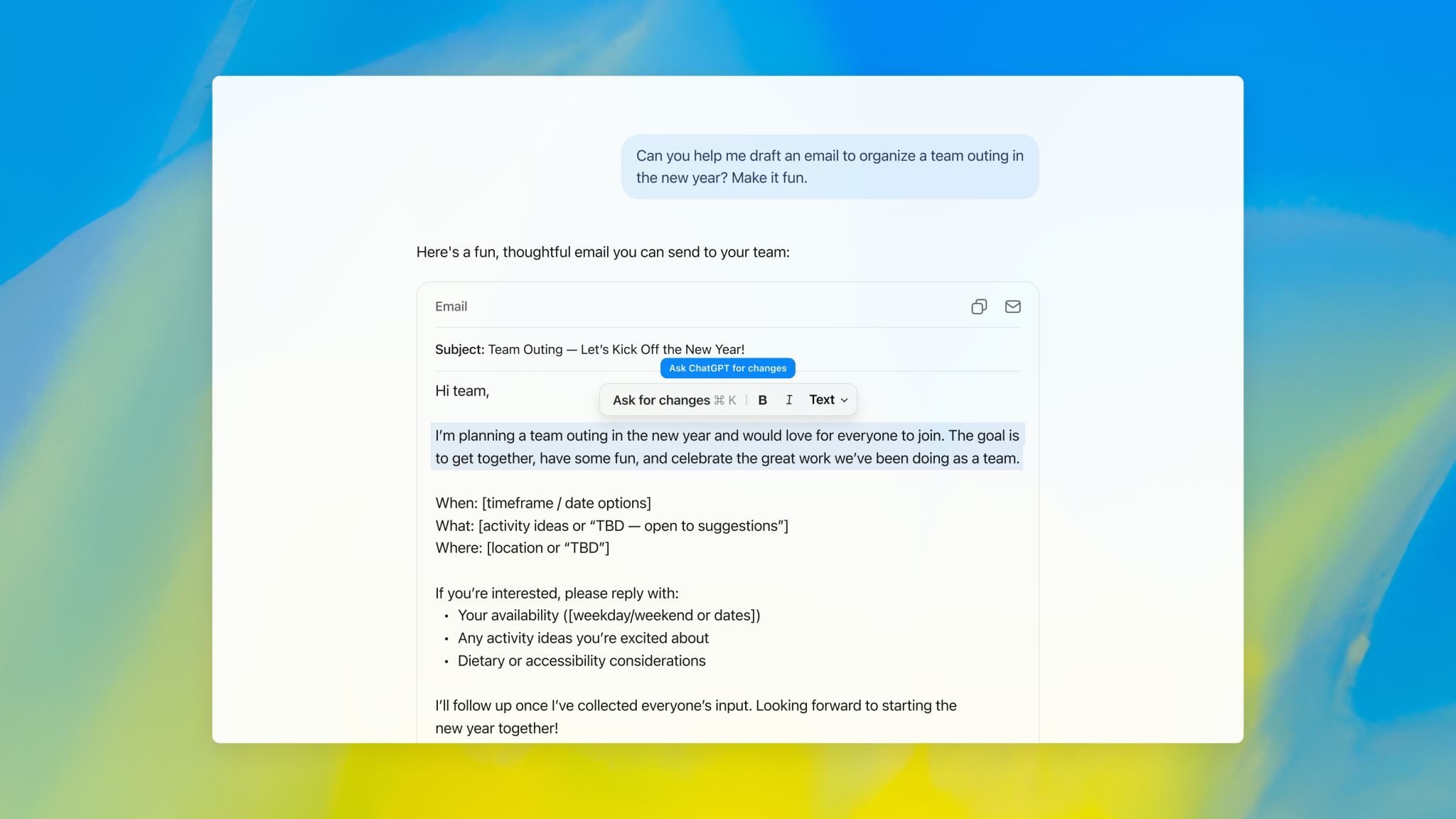
Writing blocks have been part of ChatGPT since late last year. When you ask the AI to compose an email, it now presents the result in a clean, separate block that mimics a real email editor. You can highlight any line and request changes, accept or reject suggestions one by one, or edit the text directly inside the block.

Building on this, the latest update adds a send button. Once you’re happy with your draft, you can hit send without copying anything elsewhere. The entire process — from drafting to delivery — stays inside the same conversation.

As a result, the workflow feels more seamless. You no longer need to juggle multiple windows or worry about formatting getting lost during copy-paste. For frequent email writers, this is a notable productivity boost.

Is It Safe to Send Emails Through ChatGPT?

Before you start using this feature for all your correspondence, there’s an important caveat. A recent lawsuit filed in California alleges that OpenAI shared user prompts, chat queries, and identifying information with Google and Meta tracking tools without proper consent. The case claims this violated California privacy law and federal wiretap regulations.

This means you might want to think twice before sending sensitive or confidential emails through ChatGPT. While the feature is convenient, privacy concerns remain. OpenAI has not commented directly on the lawsuit, but the allegations highlight potential risks.

On the other hand, for routine, non-sensitive messages, the new email capability could be a practical tool. Just be mindful of what you share.

What Else Is New with ChatGPT?

OpenAI isn’t slowing down on innovation. Beyond the email feature, ChatGPT is becoming more personalized. It now learns from your chat history over time, retaining information to make conversations feel tailored to you. This means the AI can remember your preferences, writing style, and recurring topics.

Additionally, ChatGPT for Excel and Google Sheets has officially moved out of beta and is now available globally. This tool lets you build workbooks, clean data, and write formulas using plain language — no spreadsheet expertise required. It’s designed to make data tasks accessible to everyone, not just analysts.

For more on how AI is reshaping productivity, check out our guide on top AI productivity tools for 2025.

Final Thoughts on Sending Emails from ChatGPT

The ability to send emails from ChatGPT directly on the web is a welcome addition for anyone who values efficiency. It removes friction from the drafting process and keeps everything in one place.

However, the privacy concerns raised by the recent lawsuit cannot be ignored. As with any AI tool, it’s wise to weigh convenience against confidentiality. For everyday, non-sensitive emails, this feature is a game-changer in terms of workflow. For anything sensitive, stick to traditional email clients.

OpenAI continues to push boundaries, and this update is another step toward making AI an integral part of daily tasks. Whether you’re a busy professional or a casual user, the new email capability is worth trying — just keep your privacy settings in check.

Continue Reading
Click to comment

Leave a Reply

Your email address will not be published. Required fields are marked *

Artificial Intelligence

OpenAI’s first hardware device isn’t a phone or a wearable — it’s a smart speaker with a personality

Published

on

smart speaker companion

The rumor mill had it wrong

For months, the chatter around OpenAI’s first hardware product pointed to something flashy — a wearable, maybe even the seed of a future smartphone. Turns out, the company’s debut gadget might be far more mundane on the surface, yet far more personal underneath. According to a new Bloomberg report, OpenAI is building a smart speaker.

Not just any speaker, though. The device is being designed as a humanlike AI companion that plugs directly into your smart home, helps control appliances, plays media, answers questions, and taps into the full range of OpenAI‘s ChatGPT capabilities. People familiar with the matter say the defining feature won’t be sound quality or screen size. It’ll be personality.

More companion than speaker

Bloomberg’s sources say OpenAI internally views this not as a speaker at all, but as the company’s first AI-native computer. Think of it as the physical embodiment of ChatGPT — a presence that stays nearby and proactively helps throughout the day, rather than sitting idle until you bark a command.

The hardware will reportedly include a mechanical design with directional flexibility. That means it can move, tilt, or orient itself toward you, making it feel a little more alive than the static speakers we’re used to. It’s a concept that echoes what Apple has reportedly been tinkering with for the HomePod — a smart display on a robotic arm — but OpenAI is taking a screen-free route, focusing entirely on voice and AI interaction.

Eyes and ears

At the heart of the interaction will be GPT-Live, ChatGPT’s voice-first mode designed for natural, flowing conversation. The device is also said to include a camera for understanding its surroundings, plus an environmental sensor that could detect context — similar to Amazon’s presence-sensing Echo devices. The goal is an assistant that doesn’t just hear words but comprehends the room around it.

A battery means it follows you

One practical detail stands out: the speaker will have a rechargeable battery. That means it won’t be tethered to a wall outlet like every other smart speaker on the market. Instead, you could carry it from the kitchen to the bedroom, letting the AI companion stay close all day.

Bloomberg adds that this is just the beginning. OpenAI is reportedly working on five different hardware products, with the speaker expected to be the first to ship in 2027. The broader effort is being shaped by LoveFrom, the design studio founded by legendary former Apple design chief Jony Ive, who has been collaborating with OpenAI CEO Sam Altman on this new family of devices.

Timing raises eyebrows

The timing couldn’t be more awkward. Apple recently filed a lawsuit accusing OpenAI of poaching employees and using them to obtain confidential hardware information. Yet if Bloomberg’s reporting is accurate, OpenAI’s first device isn’t trying to be a smartphone killer or a display replacement.

Instead, the company appears to be betting that the next big AI gadget is something far more personal — a companion that quietly follows you through your day, understands your surroundings, and feels less like a gadget and more like someone always ready to help. Whether that vision lands by 2027 remains to be seen. But for a company known for software, this is a bold first step into the physical world.

For more on how AI is reshaping everyday tech, check out our take on AI-powered smart home devices and ChatGPT’s evolving voice features.

Continue Reading

Artificial Intelligence

Google’s Gemini 3.6 Flash targets the real cost of enterprise AI agents: tokens

Published

on

enterprise AI agent costs

Why token count is the hidden tax on AI agents

Run an autonomous software agent in production and the bill arrives in tokens, not in hours. Every reasoning step, every tool call, every draft output adds to the meter. For a workflow that fires thousands of times an hour, a model that thinks too verbosely can quietly drain a budget.

That’s the problem Google is aiming at with its latest model releases. This week it unveiled Gemini 3.6 Flash and 3.5 Flash-Lite, two models built for the unglamorous work of background agents — the kind that process documents, parse filings, and patch code without a human watching every step.

The pitch is simple: fewer tokens per task, lower latency, and pricing that makes continuous reasoning loops viable. Not chat. Not creative writing. Just efficient, repeatable work.

Gemini 3.6 Flash: the math of fewer tokens

Google’s own documentation leads with a single number: 17 percent fewer output tokens than the previous 3.5 Flash, based on measurements from the Artificial Analysis Index. In specific synthetic tests like the Datacurve DeepSWE benchmark, the company claims token usage drops by up to 65 percent.

Pricing sits at $1.50 per million input tokens and $7.50 per million output tokens. That’s positioned for continuous reasoning loops, not on-demand queries.

The performance gains are measurable. On DeepSWE, 3.6 Flash scores a 49 percent success rate versus 37 percent for its predecessor. On MLE Bench, the jump is from 49.7 percent to 63.9 percent. And on Google’s GDPval-AA v2 test, which measures real-world knowledge work rather than coding puzzles, the new model scores 1421 against 1349.

Those numbers matter for teams that have hit the ceiling of what a cheaper model can do. The trade-off used to be stark: pay more for competence, or accept mediocrity to save money. Google is trying to close that gap.

Real deployments: Figma, Hebbia, Harvey

Figma has already integrated 3.6 Flash into its prototyping infrastructure. According to Matt Colyer, Figma’s Director of Product Engineering, the model lets developers iterate faster on design without sacrificing output quality.

Legal platform Harvey and research tool Hebbia route data through the model for multimodal document work — ingesting raw financial filings, parsing structure, reading embedded charts, and producing draft reports for human review.

Google also folded a client-side computer-use tool directly into the Gemini API and Gemini Enterprise platforms. That removes the custom middleware engineers previously had to build to let models operate on an OS. The OSWorld-Verified score climbs to 83.0 percent, up from 78.4 percent, with updated safeguards against chemical, biological, radiological, and nuclear misuse.

Gemini 3.5 Flash-Lite: speed for high-volume agents

Not every agent needs deep reasoning. Some just need to process documents and search at volume. That’s the niche for Gemini 3.5 Flash-Lite.

The Artificial Analysis Index clocked it at 350 output tokens per second — the fastest in the 3.5 series, per Google. Pricing runs at $0.30 per million input tokens and $2.50 per million output tokens. Cheap enough that engineering teams can route simple, high-volume subagent requests to a minimal thinking level, reserving higher reasoning for multi-step work.

On Google’s GDM-MRCR v2 long-context test, Flash-Lite hit a 72.2 percent success rate against 60.1 percent for its predecessor. Its GDPval-AA v2 score nearly doubled, from 642 to 1140. The model also carries the same native computer-use tool as 3.6 Flash.

Separately, Google says Gemini 3.5 Pro remains in partner testing ahead of a full release, and pre-training for the next Gemini 4 architecture is already underway.

Gemini 3.5 Flash Cyber: a restricted model for patching

Automated vulnerability scanners now surface flaws faster than most security teams can patch them. That gap is where Google positions Gemini 3.5 Flash Cyber.

The model is built to validate and remediate code vulnerabilities. Google reports performance on the CyberGym benchmark competitive with frontier models, though it hasn’t released those figures with the same detail as its consumer-facing models.

Distribution stays restricted to governments and vetted partners through a pilot programme. Google frames this as a safeguard against the model generating exploit code for offensive use.

Inside Google’s CodeMender security agent, multiple instances of 3.5 Flash Cyber run in parallel, cross-checking each other’s findings before producing a single remediation report that a human reviewer signs off on. That’s a useful pattern for any team deploying agents in sensitive environments: redundancy before trust.

How to access the new models

Engineering teams can integrate these models through the Gemini API via Google AI Studio, Android Studio, or the Gemini Enterprise Agent Platform. Consumers can also access the new models in the Gemini app, and 3.5 Flash-Lite is rolling out in Google Search.

The broader takeaway is that enterprise AI agent costs are becoming the battleground for model providers. As more companies move agents from pilots to production, the models that win will be the ones that deliver acceptable results at the lowest token price. Google’s latest releases are a clear bet on that future.

For more on related developments, see AI agent efficiency strategies and enterprise AI model pricing trends.

Continue Reading

Artificial Intelligence

Anthropic’s $10 Billion Bet on Volta: What the AI Cloud Deal Really Means

Published

on

Anthropic Volta deal

Anthropic’s Latest Cloud Play: A $10 Billion Commitment

Anthropic has been signing cloud deals the way some people collect stamps — relentlessly and with clear purpose. The latest move, reported by Bloomberg, is a staggering $10 billion agreement with Volta, an AI cloud startup that didn’t even exist a year ago.

Volta, founded in early 2025, will supply compute to the Claude maker over a six-year stretch. That’s not pocket change. It’s a statement of intent from a company racing to secure the infrastructure needed to stay competitive in the AI arms race.

The deal hasn’t been officially confirmed by Anthropic yet. TechCrunch reached out for comment, but the company stayed quiet. Bloomberg’s report leans on anonymous sources familiar with the negotiations.

Who Exactly Is Volta?

Volta isn’t your typical cloud provider. It’s part of Nvidia’s Nvidia Cloud Partner program — a consortium of AI-focused cloud outfits running Nvidia GPUs in their data centers. The startup had previously hinted at working with a major AI lab but kept the partner’s name under wraps.

Now we know why. A deal of this magnitude doesn’t get announced casually. It gets negotiated, structured, and then leaked to Bloomberg.

The Bitdeer Connection

Volta isn’t going it alone. It’s partnered with Bitdeer, a crypto-mining company that will help build the data center powering this compute capacity. The facility will rise in Norway, delivering 133 megawatts of juice.

That’s a serious chunk of power. For context, it’s enough to run a small city — or, in this case, a whole lot of AI training runs.

Nvidia Vera Rubin: The Engine Under the Hood

The Norway data center will run on Nvidia’s Vera Rubin systems, the chipmaker’s next-generation AI architecture. This isn’t the current Blackwell generation. Vera Rubin is the future — and Anthropic is locking in access to it years ahead of general availability.

That’s a strategic hedge. AI companies live or die by compute access. If you can’t get chips, you can’t train models. If you can’t train models, you don’t have a business.

Why Anthropic Is Spending Like It’s Going Out of Style

This Volta deal is just the latest in a furious spree. Anthropic recently announced compute agreements with SpaceX and Amazon. The pattern is clear: diversify suppliers, lock in capacity, avoid single points of failure.

The reasoning is simple. Anthropic is locked in a corporate battle with OpenAI, Google DeepMind, and a dozen well-funded challengers. Whoever has the most compute wins the next round. Anthropic is making sure it isn’t left standing without a chair when the music stops.

There’s also a geopolitical angle. Data centers in Norway benefit from stable energy prices, cool climates that reduce cooling costs, and a regulatory environment that’s friendly to big infrastructure projects. It’s a smart location choice, not an accident.

What This Means for the AI Cloud Market

Volta’s rise is remarkable. Founded this year, and already landing a $10 billion commitment? That’s the fastest path from zero to major player the cloud industry has ever seen.

It also signals a shift in how AI labs procure infrastructure. Instead of relying solely on hyperscalers like AWS or Azure, they’re increasingly turning to specialized AI cloud startups. These smaller players offer flexibility, direct access to cutting-edge chips, and — crucially — capacity that isn’t shared with millions of enterprise customers.

For Bitdeer, the deal is a pivot. A crypto-mining company building AI infrastructure is a significant strategic shift, but one that makes sense. Mining and AI both require massive power and specialized hardware. The skills transfer.

For Nvidia, it’s another win. Every AI cloud deal means more chips sold. Vera Rubin systems will be in high demand, and having Anthropic as an anchor customer doesn’t hurt.

The Bottom Line

Anthropic’s $10 billion Volta deal is a bet on the future of AI infrastructure. It’s a bet that specialized AI clouds will outperform general-purpose hyperscalers. It’s a bet that Vera Rubin will deliver on its promise. And it’s a bet that Anthropic needs every ounce of compute it can get its hands on.

Whether Volta can deliver on its end of the bargain remains to be seen. Building a 133 MW data center in Norway is no small feat. But if it works, Anthropic gets a dedicated, cutting-edge compute partner for the next six years.

That’s a long time in AI years. It’s also exactly the kind of stability a company needs when it’s racing to build the world’s most capable AI systems.

Continue Reading

Trending