Connect with us

Social Media

‘Slow-cial’ app Roost forces you to slow down to the speed of a carrier pigeon

Published

on

Roost slow-cial app

What is Roost? A messaging app built on bird flight times

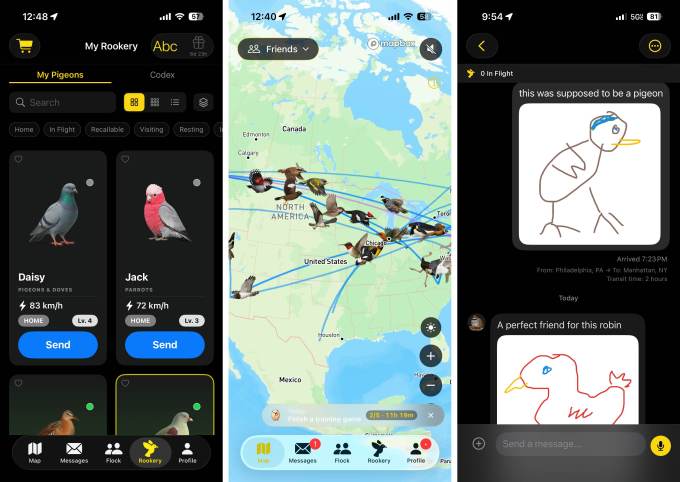
Somewhere above the Great Plains right now, a virtual woodpecker is flapping its way toward Alaska, carrying a message from me to an anonymous pen pal. Meanwhile, a zebra finch named Tucker is winging into Manhattan to deliver my terrible Cool S doodle to a friend. These messages take hours — sometimes days — to arrive, depending on how far the bird has to fly. That’s the whole point.

Roost, the so-called “slow-cial” app, is making carrier pigeons cool again. At a moment when people are exhausted by apps that demand constant attention, Roost deliberately adds friction. Founder Logan Mendelsohn, a senior product manager in trust and safety at Ticketmaster, told TechCrunch: “Everything on a phone is instantaneous these days — every single thing you do, it’s like you’re always getting some notification or something. Roost is kind of a break from the instant. It’s resonating with people in a way where they don’t feel pressure all the time to have to do something.”

The app lets you choose four birds for your rookery. Each bird moves at its real-life speed: a falcon delivers fast; a hummingbird, not so much. If you really want to drag things out, you can send snails or turtles instead. Messages travel in literal bird time. It’s weird. It’s charming. And it’s catching on.

From side project to viral sensation — 300,000 users in weeks

Mendelsohn started building Roost as a fun project for himself and his friends. They loved it so much they pushed him to put it on the App Store. For a while, it had a tiny, devoted following. Then a mother posted on Threads about how her daughter was chatting with friends in Elizabethan English on an app where messages move at the speed of actual birds.

Within three days, Roost went from 10,000 users to 100,000. Now, about five weeks later, it’s approaching 300,000. “The people are what really make this platform,” Mendelsohn said. “What people kept talking about is how wholesome it is, how whimsical it is, and how much this really helps them put more intention into what they’re saying. There’s a lot less pressure when you know the message isn’t going to someone immediately.”

Privacy built in, not bolted on

Mendelsohn works in trust and safety by day. He knows any social platform — even a whimsical bird app — can be abused. So Roost shares only a user’s city with friends by default. There’s a manual “close friends” feature that lets you share your precise location with specific people if you choose. “I personally think that for any new platform that connects people, trust and safety should be the first thing they think about,” Mendelsohn said. “When you’re able to start at zero with that lens, you can build it into the platform instead of doing it later.”

Privacy concerns also shaped the “Pen Pals” feature, which lets you exchange messages with anonymous users in your age group. During onboarding, the app explicitly warns you not to share personal details or contact info. Roost deliberately doesn’t support photo sharing yet — Mendelsohn wants to build more sophisticated content moderation tools first. That kind of caution is rare in the fast-ship world of consumer apps.

Mini games and bird collecting — the slow life has layers

Roost isn’t just about waiting for messages. There are mini games. There’s bird collecting. The whole experience is designed to be playful and unhurried. It’s a reminder that not every app needs to optimize for engagement at all costs. Sometimes you just want to send a doodle on a virtual sparrow and wait a few hours for a reply.

The AI art controversy — and how Mendelsohn handled it

Roost’s rapid growth brought an unexpected backlash. When users learned Mendelsohn had used AI-generated art for the bird images, they were furious. “On the AI art side, I completely understood the feedback,” he said. “I won’t lie, it was daunting to see the reaction online. But I don’t think it’s productive to dig your heels in when your community is vocal about something they care for. At the same time, I also knew I couldn’t flip a switch overnight. Replacing the art in an app this size takes time, planning, and money.”

Mendelsohn runs Roost in his spare time, with no outside funding. Revenue comes from in-app purchases like extra birds. To address the complaints, he’s now running a contest for artists to contribute original art. That’s quieted things for now, but the situation highlights a real tension in the consumer app space: many users boycott AI art out of respect for human creators, but a solo founder with limited resources can’t always afford to commission custom illustrations from day one. “As a solo founder, I don’t think I could build and maintain something at this scale without AI-assisted development,” Mendelsohn said. “But every product decision and direction for Roost still comes from me and the community.”

Why Roost matters in a world of instant everything

Roost is part of a small but growing wave of apps that reject the dopamine-loop model. It’s a “slow-cial” app in the truest sense — it forces you to wait, to think, to be intentional. In an era of push notifications and infinite scroll, that’s almost radical. It’s also a reminder that the people flocking to Roost are often the same ones who are tired of the tech industry’s relentless pace. They want something slower. Something more human. Even if it means waiting for a virtual bird to cross a continent.

Continue Reading

Social Media

Retro, the anti-algorithm photo app for friends, just banked $21M

Published

on

Retro photo-sharing app

Retro’s quiet $21M raise

The friend-focused photo-sharing app Retro has pulled in more than $21 million in Series A funding, according to an SEC filing spotted by Business Insider. The filing, dated August 19, sits under the startup’s legal name, Lone Palm Labs, and reveals the round actually closed back in December.

PitchBook now pegs the company’s valuation north of $100 million. Retro hasn’t commented publicly on the raise, and didn’t respond to a request for comment.

The money comes at a telling moment. Social media has become a firehose of creator content, algorithmically ranked and increasingly generated by AI. Retro’s pitch is almost contrarian: show photos to the people who actually know you.

Built by ex-Instagram engineers who saw the feed problem coming

Retro was founded by Nathan Sharp and Ryan Olson, two former Instagram product engineers. They watched the platform drift from a friend-sharing tool into a broadcast network dominated by influencers. Sharp told TechCrunch in December: “Something that has to be true and will be true is that people will still want to see more of their friends.”

His point cuts to the heart of the current social media malaise. The For You page is great for killing time, but it’s terrible for staying connected. Sharp again: “The photos and videos you take will need to find a place where they can reach the intended audience.”

Retro is that place. It strips away the algorithmic noise and puts the focus squarely on your inner circle.

From personal journal to shared photo space

Launched in 2023 as a personal photo journal, Retro has evolved. It now lets you privately share photos of your week with friends, create shared albums, view and share recaps, and even “rewind” to time-travel through old memories. The app has become a go-to for groups who want a shared visual history without the performance of posting to a public feed.

The growth numbers back up the concept. According to app intelligence provider Appfigures, Retro has been downloaded about 7 million times since launch. In-app spending has jumped more than 460% over the past 180 days — a sign that the people who do subscribe are sticking around and using it regularly.

No ads, just subscriptions

Retro’s business model is refreshingly simple: no advertising. Instead, the company offers in-app subscriptions that unlock features like video, GIF and sticker comments, more styles, unlimited history, and special app icons.

It’s a small subset of users who pay, but the company’s bet is that those who do are committed customers. The subscription model also aligns with the app’s ethos — your data and attention aren’t the product.

Who’s backing the anti-algorithm bet?

The investor list reads like a who’s who of tech and venture circles. Thrive Capital leads the round, joined by Figma CEO Dylan Field, Scribble Ventures, Box Group, Imaginary Ventures, Coalition, Conviction, Copper, Positive Sum, and a roster of angels.

The mix of strategic and financial backers suggests confidence in Retro’s vision. Field, who runs a design tool company, likely sees the value in a social app that prioritizes genuine connection over engagement metrics.

What Retro’s raise says about the future of social

The $21M round is more than just a milestone for one startup. It’s a signal that investors are betting on a future where social media returns to its roots — connecting real people with real friends. As AI-generated content floods mainstream platforms, the demand for authentic, private sharing spaces is only growing.

Retro isn’t trying to replace Instagram or TikTok. It’s carving out a niche for something more intimate. And with this fresh capital, the team plans to keep building features that make it easier to share moments with the people who matter most.

For anyone tired of doomscrolling through sponsored posts and AI slop, Retro’s photo-sharing app offers a quiet alternative. The question now is whether it can scale its niche appeal into something bigger. The early numbers suggest it’s on the right track.

Continue Reading

Social Media

Stop Chasing Viral Hits: Why Your Business Needs a Video Series

Published

on

video series for business

The Viral Trap Most Marketers Fall Into

You’ve seen it happen. A brand posts a silly clip, it explodes overnight, and the CEO does a happy dance. Then what? A week later, nobody remembers the brand. The views were there. The customers weren’t.

That’s the problem with chasing viral hits. They feel great in the moment but do almost nothing for your bottom line. What actually moves the needle is something far less flashy: a steady, structured video series for business that builds real relationships over time.

Think about how you watch TV. You don’t fall in love with a show after one random episode. You get hooked because each episode leaves you wanting more. The same psychology applies to your customers.

Why Series Content Beats One-Off Videos

Here’s a number that should make you sit up: Google’s 7-11-4 rule. It’s the idea that a prospect needs roughly 7 hours of interaction across 11 touchpoints in 4 different channels before they feel comfortable buying from you. One viral video might get you a few of those touchpoints. A series gets you all of them.

When you commit to a series, you’re making a promise. You’re telling your audience, “I’ll show up consistently with value.” That consistency builds trust. Trust builds sales.

Series content also feeds the algorithms. Platforms like YouTube and Facebook love watch time. When people binge your episodes, the algorithm notices and pushes your content to more viewers. It’s a virtuous cycle that a single video can’t replicate.

The Binge-Worthy Factor

There’s a reason Netflix releases entire seasons at once. Binge-watching creates momentum. Your video series should aim for the same effect, even if you publish weekly. Each episode should end with a hook that makes the next one irresistible.

Storytelling Frameworks That Turn Viewers Into Customers

You don’t need to be a Hollywood screenwriter to craft a compelling series. You just need a solid structure. Here are three frameworks that work particularly well for business video:

  • The Hero’s Journey: Your customer is the hero. Your product or service is the guide that helps them overcome challenges. Each episode tackles a different obstacle.
  • The Educational Arc: Start with a problem, walk through the steps to solve it, and end with a transformation. This works great for tutorials or how-to content.
  • The Behind-the-Scenes Narrative: Take viewers inside your company. Show the struggles, the wins, the people. This builds emotional connection like nothing else.

Whichever framework you choose, remember this: the audience should always be the protagonist. You’re not the star. They are. Your job is to help them win.

How to Structure Your Series for Maximum Impact

Before you hit record, map out the entire series. You don’t need every detail, but you do need a clear trajectory. Here’s a simple way to think about it:

  1. Start with the problem your audience faces. Make it painfully relatable.
  2. Build with value. Each episode should deliver one actionable takeaway.
  3. End with a call to action. Not just “subscribe” — invite them to comment, download a resource, or book a call.

Also, think about the format. Will it be a talking-head style? Interviews? Animated explainers? Pick something sustainable. A series only works if you can keep producing it without burning out.

Consistency Is Non-Negotiable

Weekly is ideal. Bi-weekly is acceptable. Monthly is better than nothing. But whatever you choose, stick to it. Your audience needs to know when to expect new content. That reliability is part of the trust-building magic.

From Casual Viewer to Loyal Customer

The real goal of your video series isn’t views. It’s conversion. And conversion happens when you’ve earned enough trust that the next step feels obvious.

Here’s a practical tip: make your series part of a larger funnel. Use each episode to address a specific objection or question you hear from prospects. Then guide them to the next stage — whether that’s a lead magnet, a consultation, or a product page.

For example, if you sell project management software, your series could cover common team collaboration pitfalls. Episode 3 might be about communication breakdowns. At the end, you mention how your tool solves that exact problem. That’s not pushy. That’s helpful. And helpful sells.

If you’re new to video, start small. Check out how to create video content for beginners to get the basics down. And if you’re wondering about the best platforms to host your series, this guide on choosing the right video platform will help you decide.

Another resource worth exploring is building a content marketing strategy that aligns with your series goals. The more integrated your efforts, the better the results.

Measure What Matters

Don’t obsess over view counts. Instead, track metrics like watch time, retention, and conversion rate. These tell you whether your content is actually resonating and driving action.

Set a goal for each episode. Maybe it’s getting 100 comments. Maybe it’s 50 new email subscribers. Whatever it is, make it specific. Then review your analytics monthly and adjust your approach.

Creating a video series for business is a commitment. But it’s one of the most effective ways to build a loyal audience that actually buys from you. Stop chasing the viral lightning in a bottle. Start building something that lasts.

Continue Reading

Social Media

Bluesky Gives Users an Off Switch for the Viral Machine

Published

on

Bluesky algorithmic opt-out

Not Everyone Wants the Spotlight

Bluesky just handed its users a quiet little superpower: the ability to disappear from the algorithmic crowd.

On Thursday, the open social network rolled out an algorithmic opt-out feature that stops your posts from surfacing in the main Discover feed. It arrived less than 24 hours after Bluesky added support for longer videos — a busy week for the team.

The Discover feed, for the uninitiated, can currently pull in just about any public post on the network. Bluesky posts are public by default, which means a stray thought can suddenly find itself in front of thousands of strangers. Not everyone wants that.

What This Feature Actually Does (and Doesn’t Do)

Let’s clear up a common misconception right away. This is not a privacy toggle. Your posts remain public, and anyone with a link can still see them. Bluesky is still building private data support at the protocol level — that’s a separate project.

What the opt-out does is make your posts less discoverable to people outside your existing circle. It’s a visibility dial, not a lock.

The company says it built this because some people just want to post for their followers. They don’t want their words amplified to a larger crowd. They don’t want to go viral. Simple as that.

How to Turn It On

If you’re ready to step out of the algorithmic spotlight, here’s what to do:

  1. Open the Bluesky app on your device.
  2. Head to Settings, then Privacy and Security.
  3. Toggle on the new option to stop your posts from appearing in Discover.

One small caveat: the change can take up to an hour to fully take effect. So if you flip the switch and immediately check the Discover feed, you might still spot your post lingering there. Patience is key.

An Account-Level Setting That Travels With You

Here’s where Bluesky’s implementation gets interesting. This isn’t just a setting that lives inside the Bluesky app. The preference is recorded at the account level, which means it travels with you across the AT Proto ecosystem.

Let’s say you post from another app built on the same underlying protocol — something like a third-party client or a custom feed tool. That app will see your preference and know you’ve opted out.

But here’s the catch: those other apps have access to the information, yet they still have to choose whether to respect it. Bluesky is essentially setting a standard and hoping the ecosystem follows along. The protocol can carry the message, but it can’t force compliance.

Why This Matters for the Fediverse-Style Future

Bluesky’s approach is a small but meaningful step toward user agency in social media. The company is betting that people want more control over how their content flows, not just what they see.

It’s a different philosophy from the algorithmic giants that dominate the space. On platforms like X or Instagram, the algorithm decides who sees what, and users have little say in the matter. Bluesky is flipping that script, at least partially.

This also raises a broader question: if the AT Proto ecosystem grows, will other apps honor these preferences? The protocol can encode the intent, but enforcement is another matter entirely. It’s a test of whether decentralized social media can actually deliver on its promises.

The Bigger Picture: Slowing Down the Virality Machine

The Bluesky social network has been on a roll lately, adding features at a brisk pace. Longer videos yesterday, algorithmic opt-out today. The company seems intent on building a platform that feels less like a popularity contest and more like a community.

For those who’ve been burned by viral moments they never asked for, this feature is a welcome reprieve. It’s a recognition that not everyone wants the same experience — some people are chasing reach, while others just want to talk to their friends.

Bluesky’s privacy and safety tools are clearly evolving, and this latest addition shows the team is listening to the quieter voices in its user base. The question now is whether the rest of the ecosystem will follow suit.

One thing’s for sure: the opt-out won’t stop you from going viral on other platforms. But on Bluesky, at least, you now have a say in the matter. That’s more than most social networks offer.

Continue Reading

Trending