Connect with us

CyberSecurity

Bluesky Experiences Service Disruption: What Users Need to Know

Published

on

Bluesky Experiences Service Disruption: What Users Need to Know

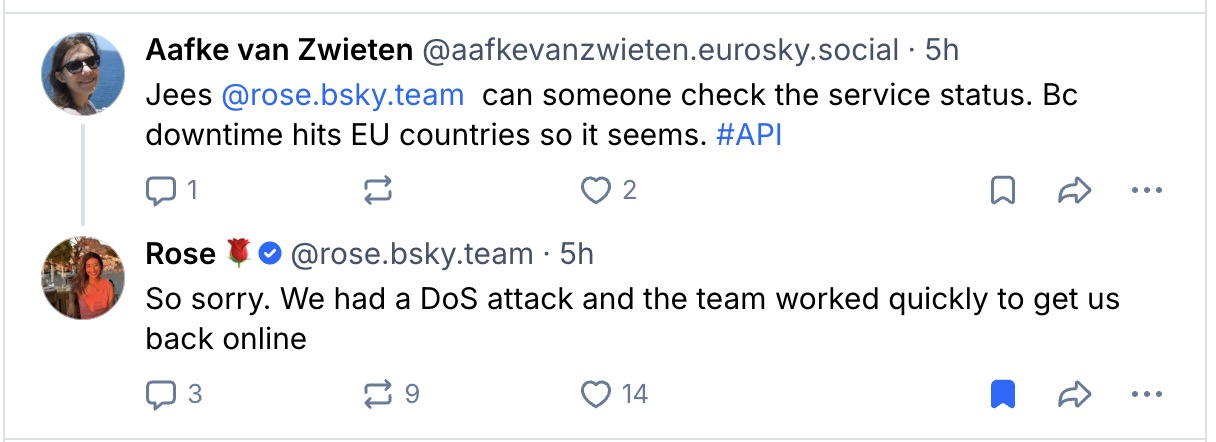
If you’ve been struggling to access Bluesky today, you’re not alone. The social network is currently grappling with a significant service disruption that has left many users unable to load feeds, view profiles, or post updates. According to Bluesky’s COO, Rose Wang, the root cause is a denial-of-service attack targeting the platform.

What Caused the Bluesky Service Disruption?

The issues first surfaced around 2:42 a.m. ET on Thursday, as noted on the platform’s official status page. Bluesky’s infrastructure has been under heavy strain ever since, with intermittent outages and slow load times persisting into the afternoon. Wang confirmed that the disruption stems from a coordinated denial-of-service attack, though the company has not yet provided a timeline for full recovery.

Impact on User Experience

Users are encountering a range of errors. Switching to popular feeds like Discover or the official Bluesky Team feed often triggers a message stating, “This feed is currently receiving high traffic and is temporarily unavailable. Please try again later. Message from server: Rate Limit Exceeded.” Personal feeds may still load, but attempting to visit user profiles frequently results in error messages, forcing repeated refreshes.

Bluesky protocol engineer Bryan Newbold acknowledged the severity around 3:46 a.m. ET, posting, “oof, our services are getting pretty hard tonight.” The company has directed users to status.bsky.app and the @status.bsky.app account for updates but has not commented on the attack’s specifics or an estimated time for resolution.

Are Other Decentralized Networks Affected?

Interestingly, the Bluesky service disruption has not spread to other communities running their own infrastructure on the underlying AT Protocol. These independent servers appear to be functioning normally, highlighting the resilience of decentralized architecture even when one major node faces trouble.

This separation is a key advantage of decentralized social networks. While Bluesky’s main servers are under fire, users on self-hosted instances can still communicate and share content without interruption. For those interested in exploring alternatives, setting up your own instance might be a worthwhile consideration during such outages.

Current Status and What’s Next

As of Thursday afternoon, Bluesky’s status page still reads: “investigating an incident with service in one of our reginos” (a typo in the original). The company has not yet resolved the issue, and users should expect continued instability until further notice.

For real-time updates, monitoring the status page is your best bet. In the meantime, consider checking tips for coping with social network downtime to stay connected while Bluesky works on a fix.

This incident serves as a reminder that even modern, decentralized platforms are not immune to attacks. However, the underlying protocol’s design ensures that the broader ecosystem remains operational, offering a silver lining in an otherwise frustrating day for Bluesky users.

Continue Reading
Click to comment

Leave a Reply

Your email address will not be published. Required fields are marked *

CyberSecurity

Page Not Found: What to Do When You Hit a 404 Error on Infosecurity Magazine

Published

on

Page Not Found: What to Do When You Hit a 404 Error on Infosecurity Magazine

Did you just land on a Page Not Found message while browsing Infosecurity Magazine? Don’t worry—this is a common hiccup on many websites, including ours. A 404 error simply means the specific page you requested cannot be located on our server. The page may have been moved to a new URL, updated with fresh content, or removed entirely. Whatever the reason, you have several straightforward options to get back on track.

Why Does a Page Not Found Error Happen?

There are a few typical causes for a Page Not Found error. First, the URL might be mistyped or contain a broken link. Second, the page could have been restructured during a site redesign, and the old link no longer works. Third, the content may have been archived or deleted. In rare cases, a temporary server glitch triggers the error. Regardless, the solution is usually quick and simple.

Check the URL and Try Again

Start by double-checking the web address in your browser’s address bar. Look for typos, extra characters, or missing slashes. Correct any mistakes and reload the page. This often resolves the issue instantly.

How to Find What You Need After a 404 Error

If the URL is correct but the page still doesn’t load, your next step is to use the site’s navigation tools. Return to the homepage to browse our latest articles on cybersecurity, data breaches, and industry insights. Alternatively, use the site search function—located at the top of every page—to locate the content by keyword or topic. For example, searching for “ransomware” or “phishing” will bring up relevant posts.

Another effective approach is to explore our top stories section for trending news. Many articles are also listed in our archive, organized by date and category. This way, you can discover similar content even if the original page is gone.

Contact Our Team for Assistance

When all else fails, we’re here to help. If you believe the Page Not Found error is a mistake—for instance, if a link from another site or our own newsletter led you here—please contact our support team. Provide the URL you tried to access, and we’ll investigate promptly. Our team monitors these reports regularly to improve the user experience.

Preventing Future 404 Errors

To minimize disruptions, we recommend bookmarking our homepage and subscribing to our newsletter for direct links to new articles. Additionally, keep your browser updated to avoid compatibility issues. For publishers and webmasters, using 301 redirects for moved pages is a best practice that we follow, but occasional errors can still slip through.

In conclusion, a Page Not Found message on Infosecurity Magazine is nothing to panic about. With a quick URL check, site search, or a message to our team, you’ll be back to reading top cybersecurity news in no time. Remember, we’re continuously improving our site to make your visit seamless.

Continue Reading

CyberSecurity

European police email 75,000 people asking them to stop DDoS attacks

Published

on

More than 75,000 individuals have received a stern warning from European law enforcement, urging them to stop using DDoS-for-hire services that enable even unskilled criminals to knock websites offline. This unprecedented mass communication is part of a coordinated global effort to dismantle the infrastructure behind distributed denial-of-service attacks.

On Thursday, Europol announced the results of Operation PowerOFF, a sweeping action targeting several platforms that sell attack capacity to anyone willing to pay. The operation sent emails and physical letters to suspected users, effectively putting them on notice that their activities are being tracked.

How Europol identified 75,000 DDoS-for-hire users

Law enforcement agencies obtained user data by seizing servers belonging to these illicit services. By raiding and taking control of the infrastructure, police could identify registered customers who had paid for attacks. This intelligence allowed them to send targeted warnings to all 75,000 individuals.

In addition to the mass notification, the operation led to four arrests, the takedown of 53 domain names, and the execution of 24 search warrants across multiple countries. These actions send a clear message: using DDoS-for-hire services is no longer anonymous.

Why DDoS-for-hire services remain a major threat

Distributed denial-of-service attacks are surprisingly common because they are easy to execute through for-hire platforms. Customers do not need technical skills or their own infrastructure; they simply pay a fee to overwhelm a target with traffic. Last year, Cloudflare mitigated what it described as the largest DDoS attack ever recorded, peaking at 29.7 terabits per second.

However, law enforcement is fighting back. The FBI has conducted several previous operations against such services, and Europol’s latest move shows that international cooperation is intensifying. The goal is to disrupt the entire ecosystem that makes DDoS attacks accessible to non-technical criminals.

What happens to those who received the warning

Recipients of the Europol email or letter are being told to cease their illegal activities immediately. While the initial contact is a warning, authorities have made it clear that further violations could lead to prosecution. This approach aims to deter future attacks by making users aware that they are under surveillance.

Europol has not disclosed whether the warning recipients will face charges, but the data collected from the seized servers could be used as evidence in future cases. For now, the operation serves as both a deterrent and a public demonstration of law enforcement capability.

Broader implications for cybersecurity

This operation highlights a growing trend: police are becoming more proactive in targeting the demand side of cybercrime. By going after users rather than just operators, they hope to shrink the market for DDoS-for-hire services. Learn more about protecting your online assets from such threats.

As DDoS attacks continue to evolve, collaboration between agencies like Europol, the FBI, and national police forces is essential. The success of Operation PowerOFF may encourage similar actions against other types of cybercrime-as-a-service platforms. Read about other law enforcement actions against cybercrime to understand the broader landscape.

Ultimately, the message is clear: paying for a DDoS attack is not a victimless crime, and authorities are watching. Find out how to report suspicious activity to help keep the internet safe.

Continue Reading

CyberSecurity

How to Recover From a Cyber-Attack: A Step-by-Step Playbook for Organizational Resilience

Published

on

How to Recover From a Cyber-Attack: A Step-by-Step Playbook for Organizational Resilience

No organization is completely immune to cyber threats. Even the most advanced defenses can fail. Therefore, building a robust cyber-attack recovery plan is no longer optional—it is essential for long-term survival. This article outlines a practical, six-stage recovery flow that can help your organization bounce back quickly and effectively after a cybersecurity breach.

Why Many Organizations Struggle with Cyber-Attack Recovery

Recovering from a cyber-attack is often chaotic and stressful. Many companies lack clear procedures, leading to delayed responses and increased damage. Common pitfalls include poor communication, insufficient backups, and a lack of defined roles. As a result, recovery times stretch from days to weeks, costing millions in lost revenue and reputational harm.

Building on this, organizations that treat recovery as an afterthought often face regulatory fines and legal consequences. A proactive approach to cyber-attack recovery is critical to minimize these risks.

The Six-Stage Recovery Planning Flow

Thibault Williams from TMW Resilience shares a structured framework that any organization can adapt. This flow moves from initial detection to full restoration, ensuring no step is overlooked.

Stage 1: Detection and Assessment

The moment a breach is suspected, rapid detection is key. This involves identifying the attack vector, affected systems, and the scope of data compromise. Use automated monitoring tools and a dedicated incident response team to speed up this process.

Stage 2: Containment

Once identified, immediately isolate compromised systems to prevent lateral movement. Disconnect affected servers, revoke compromised credentials, and block malicious IPs. Quick containment reduces the blast radius and limits data loss.

Stage 3: Eradication

Remove the threat from your environment. This includes deleting malware, patching vulnerabilities, and closing backdoors. A thorough eradication step prevents re-infection and ensures the attacker cannot regain access.

Stage 4: Recovery

Restore systems from clean backups, verify data integrity, and bring services back online gradually. Prioritize critical business functions first. Test each restored component before full deployment to avoid introducing new issues.

Stage 5: Post-Incident Analysis

After recovery, conduct a detailed review. What went wrong? What worked well? Document lessons learned and update your incident response plan accordingly. This step strengthens future defenses and improves cyber-attack recovery speed.

Stage 6: Communication and Reporting

Inform stakeholders, customers, and regulators as required by law. Transparent communication builds trust and demonstrates accountability. Prepare a clear narrative about the incident, the response, and the steps taken to prevent recurrence.

Real-Life Examples of Successful Recovery

Several organizations have turned cyber crises into opportunities for improvement. For instance, a global logistics firm faced a ransomware attack that shut down its shipping systems. By following a structured recovery flow, they restored operations within 48 hours, maintaining customer confidence. Another example is a healthcare provider that detected a breach early, contained it rapidly, and used post-incident analysis to overhaul its security architecture. These cases highlight the value of preparation and a disciplined recovery process.

On the other hand, companies that neglect planning often suffer prolonged outages and permanent reputational damage. This underscores why incident response planning must be a boardroom priority.

How to Assess Your Current Recovery Readiness

Not sure where your organization stands? Start by evaluating your existing procedures against the six-stage flow. Identify gaps in detection, containment, or communication. Conduct tabletop exercises to test your team’s response under pressure. Finally, invest in cyber resilience strategy training for all employees, from IT staff to executives.

In addition, consider partnering with external experts like TMW Resilience for tailored guidance. Their practical sessions provide actionable insights that can transform your recovery capabilities.

Conclusion: Make Recovery a Core Pillar

Cyber-attack recovery is not a one-time project—it is an ongoing commitment. By adopting a structured playbook, you reduce downtime, protect your brand, and build long-term resilience. Start today by reviewing your current plan and taking the first step toward a more secure future.

For more resources, explore our guide on cybersecurity best practices to complement your recovery efforts.

Continue Reading

Trending