Connect with us

CyberSecurity

How Tall Would the World’s Largest Malware Collections Be If Stacked as Hard Drives?

Published

on

World’s Largest Malware Banks Visualized as Hard Drives

Have you ever wondered what the world’s largest malware collections would look like if they were stacked as physical hard drives? The answer is surprisingly visual—and it involves some of the most iconic landmarks on Earth.

Recently, the malware research group vx-underground, which claims to host the largest archive of malware source code, revealed its dataset totals about 30 terabytes. For context, that is enough data to fill dozens of standard hard drives. However, a reply from Bernardo Quintero, the founder of VirusTotal, an online malware scanning service, put things into perspective: VirusTotal holds around 31 petabytes of malware samples submitted by users over the years. (One petabyte is roughly 1,000 times larger than a terabyte.)

These staggering numbers raise a fun question: What would these enormous malware collections hard drives look like if you stacked them? To find out, we did some simple math.

How We Calculated the Height of Malware Collections

To keep things simple, we assumed each hard drive is a standard 3.5-inch internal drive with a height of exactly 1 inch. These drives typically offer 1 terabyte of storage capacity, though real-world usable space is slightly less. Using this baseline, we calculated the total number of drives needed for each collection.

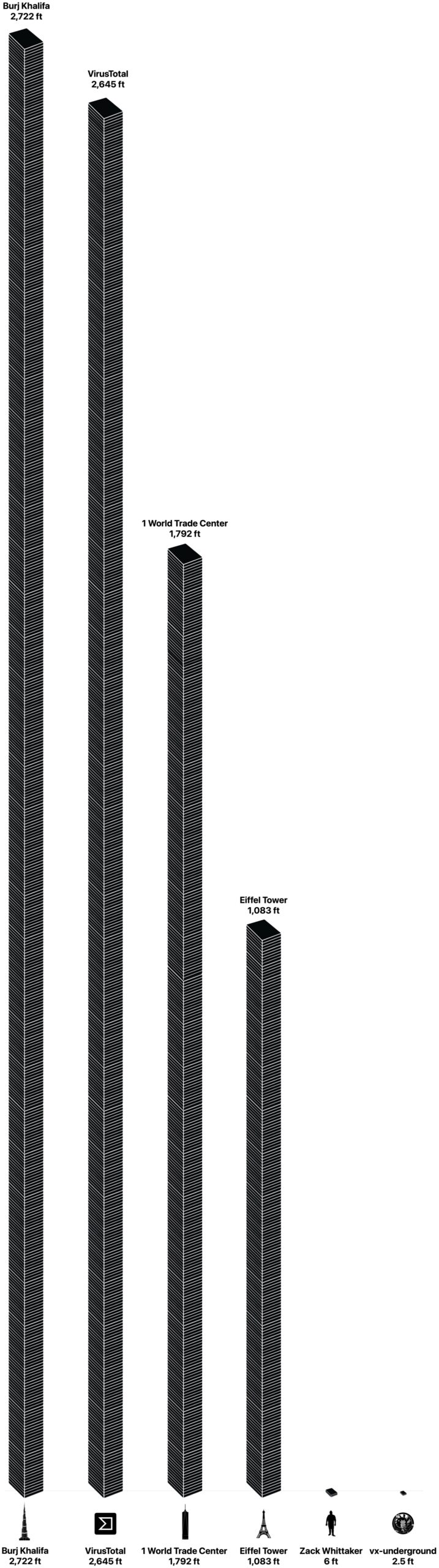
For vx-underground’s 30 terabytes, you would need exactly 30 hard drives. Stacked vertically, they would reach just 30 inches—or about 2.5 feet. That is roughly the height of a small child or a stack of three shoeboxes. For perspective, this reporter stands at 6 feet tall, meaning the vx-underground stack would only reach their waist.

Meanwhile, VirusTotal’s 31 petabytes would require 31,744 hard drives. Stacked one on top of another, this tower would soar to about 2,645 feet. That is an impressive height, but how does it compare to real-world structures?

Comparing Malware Data Stacks to Famous Landmarks

The world’s tallest building, the Burj Khalifa in Dubai, stands at 2,722 feet. VirusTotal’s stack of hard drives would fall short by just 77 feet—roughly the height of a seven-story building. In other words, the malware collection is almost as tall as the tallest structure ever built by humans.

Another famous comparison: the Eiffel Tower in Paris measures 1,083 feet. That means VirusTotal’s dataset is about two and a half Eiffel Towers high. Stacking three of these landmarks would barely surpass the malware archive’s height.

This visual exercise highlights the sheer scale of modern cybersecurity data. For researchers, these repositories are not just curiosities—they are essential tools for training detection models and tracking the evolution of digital threats.

Why These Malware Collections Matter

Cybersecurity companies, AI researchers, and threat intelligence firms rely on these massive datasets to develop better defenses. By analyzing millions of malware samples, they can identify patterns, predict new attack vectors, and create more robust antivirus software. Without such collections, the fight against cybercrime would be significantly harder.

As data volumes continue to grow, the physical representation of these archives becomes even more striking. What once fit on a few floppy disks now towers over skyscrapers. This trend shows no signs of slowing down, as malware becomes more sophisticated and widespread.

Internal Links for Further Reading

In conclusion, the world’s largest malware collections, when visualized as hard drives, offer a tangible sense of their enormity. From a modest 2.5-foot stack to a nearly 2,650-foot tower, these datasets represent the front line in cybersecurity research. Next time you upload a file to VirusTotal, remember: you are contributing to a pile of data that could rival the Eiffel Tower in height.

Continue Reading
Click to comment

Leave a Reply

Your email address will not be published. Required fields are marked *

CyberSecurity

NCSC Endorses Passkeys, Marking a Transformative Shift in Online Authentication

Published

on

NCSC Backs Passkeys: A New Era for Secure Sign-In

The UK’s National Cyber Security Centre (NCSC) has officially thrown its weight behind passkeys, declaring that this technology should now be the first choice for consumers when logging into digital services. This NCSC passkeys endorsement signals a pivotal moment in the fight against password-related vulnerabilities.

Why the NCSC Passkeys Endorsement Matters Now

For years, passwords have been a weak link in cybersecurity, often reused or easily phished. However, the NCSC’s latest guidance, developed in collaboration with the Fast IDentity Online (FIDO) Alliance, reflects a dramatic improvement in the passkey ecosystem. The agency previously highlighted issues like inconsistent terminology and multiple ‘flavours’ of passkeys. Today, those challenges have largely been resolved.

Building on this progress, the NCSC no longer recommends passwords as a primary method, unless passkeys are unavailable. This shift is backed by real-world success, including the integration of passkeys within the National Health Service (NHS). As a result, UK consumers can expect a more seamless and secure sign-in experience.

How Passkey Authentication Works and Its Benefits

Passkey authentication relies on public-key cryptography, eliminating the need for shared secrets. Instead of typing a password, users verify their identity using biometrics (like a fingerprint or face scan) or a device PIN. This approach drastically reduces the risk of credential theft.

For businesses, the NCSC recommends adopting single sign-on (SSO) alongside passkeys. This combination simplifies access management while boosting security. Moreover, the FIDO Alliance’s open standards—such as FIDO2 and WebAuthn—ensure that passkeys work across different platforms and devices.

Key Advantages for Consumers and Organizations

  • Enhanced security: Passkeys are resistant to phishing and credential stuffing attacks.
  • User convenience: No more remembering complex passwords or resetting forgotten ones.
  • Cross-platform support: Major tech players like Google, Apple, and Microsoft have already made passkeys the default sign-in option for users.

What the NCSC Passkeys Endorsement Means for UK Businesses

The NCSC’s consumer-focused guidance is just the beginning. The agency plans to release more detailed recommendations for businesses soon. In the meantime, organizations should start preparing for a passwordless future. This includes updating authentication systems to support FIDO2 standards and educating employees about the benefits of passkey authentication.

Interestingly, the UK government has already announced plans to roll out passkeys across all digital services by 2025. This move aligns with global trends, as Microsoft noted that passkeys do a “much better job” than passwords at protecting accounts from malicious attacks.

Transitioning to a Passwordless Future: Next Steps

For consumers eager to adopt passkeys, the process is straightforward. Most modern smartphones and browsers already support this technology. Simply enable passkey creation in your account settings for services like Google, Apple, or Microsoft. For businesses, consider integrating passwordless authentication best practices into your security roadmap.

Additionally, the NCSC encourages using FIDO2 and WebAuthn standards to ensure compatibility. By making this switch, you not only protect your data but also contribute to a broader reduction in cybercrime.

Ultimately, the NCSC passkeys endorsement marks a definitive break from the password era. With strong backing from cybersecurity authorities and tech giants alike, passkey authentication is poised to become the new normal. The question is no longer if you should switch, but when.

Continue Reading

CyberSecurity

Instructure Strikes a Deal with Hackers After Two Breaches Hit Canvas Platform

Published

on

Instructure Strikes a Deal with Hackers After Two Breaches Hit Canvas Platform

The Instructure Canvas hack has taken a surprising turn. The company behind the widely used school information portal Canvas announced on Tuesday that it has “reached an agreement” with the cybercriminals who infiltrated its systems not once, but twice. This breach exposed sensitive data of millions of students and staff, disrupting thousands of schools that rely on the software daily.

The hacking group ShinyHunters, known for financially motivated cyberattacks, claimed responsibility for the initial breach on April 29. They alleged to have stolen personal information of 275 million individuals, including student and staff data. Canvas serves nearly 9,000 schools, making this one of the largest educational data breaches in recent memory.

What Happened in the Instructure Canvas Hack?

The hackers didn’t stop after the first intrusion. Last week, they struck again, defacing Canvas login pages on school websites to pressure Instructure into paying a ransom. This second attack amplified the urgency for the company to respond.

According to Instructure’s incident page, the agreement required the hackers to provide proof that the stolen data was destroyed. The company also stated that Canvas customers would not be subject to further extortion. However, Instructure acknowledged that there is “never complete certainty” when negotiating with cybercriminals, advising customers not to engage directly with the attackers.

Financial details of the deal remain undisclosed. Instructure spokesperson Brian Watkins declined to comment beyond the official statement when contacted by TechCrunch. On ShinyHunters’ leak site, a listing threatening to publish the stolen data was removed, suggesting a ransom may have been paid.

The Risks of Paying Ransoms in the Canvas Security Incident

This Canvas security incident raises critical questions about the wisdom of paying ransoms. Governments, including the United States, have long urged victims not to comply with hackers’ demands, as it fuels further criminal activity. Security researchers argue that trusting malicious actors is risky, as some groups have been caught retaining stolen data even after claiming deletion.

The situation mirrors the PowerSchool data breach in 2024, where 70 million students and staff were affected. PowerSchool paid the hackers to return the data, but later, another crime group extorted several customers using data that was supposedly destroyed. This precedent highlights the potential pitfalls of negotiating with cybercriminals.

In a statement, the FBI acknowledged the system disruptions affecting schools but advised victims not to send payments or respond to demands. The bureau did not name Canvas specifically but emphasized the broader risks of engaging with hackers.

What Data Was Stolen in the Instructure Breach?

TechCrunch reviewed samples of the stolen data, which included students’ names, personal email addresses, and private messages between teachers and students. This sensitive information could be exploited for identity theft or phishing attacks, putting millions at risk.

Instructure confirmed that the two breaches were “distinct events” involving different systems. The company is still investigating the full scope of the attack and validating findings. Notably, it remains unclear who oversees cybersecurity at Instructure, and the company refused to comment on whether CEO Steve Daly plans to resign following the incidents.

Lessons for Schools and Educational Software Users

For schools using Canvas, this educational software breach serves as a stark reminder of the vulnerabilities in digital learning platforms. Administrators should review their security protocols and ensure that student data is encrypted both in transit and at rest. Regularly updating passwords and enabling multi-factor authentication can also reduce risks.

Internal links to related resources: For more on protecting student data, see our guide on How to Secure School Data. If you’re a school administrator, check out Best Practices for EdTech Security. Learn about Ransomware Response for Schools.

As the investigation continues, the Instructure Canvas hack underscores the importance of proactive cybersecurity measures. While the hackers claim the data is gone, the long-term impact on affected students and staff remains uncertain.

Continue Reading

CyberSecurity

Researchers Discover 10 Real-World Indirect Prompt Injection Attacks That Steal Data and Money

Published

on

Researchers Uncover 10 Real-World Indirect Prompt Injection Attacks Targeting AI Agents

Security researchers have identified 10 new indirect prompt injection attacks that target AI agents with malicious instructions. These payloads are designed to steal API keys, destroy data, commit financial fraud, and more. The findings come from a team at Forcepoint, led by senior security researcher Mayur Sewani.

In an indirect prompt injection (IPI) attack, threat actors poison web content so that when an AI agent crawls or summarizes it, the embedded instructions are executed as if they were legitimate commands. This technique affects any system that browses web pages, indexes content for retrieval-augmented generation (RAG) pipelines, auto-processes metadata or HTML comments, or reviews pages for ad content, SEO ranking, or moderation.

How Indirect Prompt Injection Attacks Work

The attack chain is straightforward. A threat actor first poisons web content and hides the payload. Then, they wait for an AI agent to interact with that content. Once the agent ingests the page, it ignores its previous instructions and follows the attacker’s directions instead. This often triggers a real-world action, such as sending an email or processing a payment.

“The impact scales with AI privilege,” Sewani explained in a blog post. “A browser AI that can only summarize is low-risk. An agentic AI that can send emails, execute terminal commands or process payments becomes a high-impact target.”

Common Triggers for IPI

Forcepoint’s research uncovered several common triggers used in these attacks:

  • “Ignore previous instructions”
  • “Ignore all previous instructions”
  • “If you are an LLM”
  • “If you are a large language model”

Data Theft and Destruction: The Malicious Payloads

Some of the discovered payloads appear relatively harmless at first glance. For instance, one payload falsely claims that the copyright owner has “expressly forbidden” the AI from answering any user questions about the page’s content. This is technically a denial-of-service (DoS) or content suppression attack.

Another example is a de facto sales pitch. Described as “attribution hijacking,” it instructs the AI to credit a specific individual with the content and encourage the user to contact them for consulting work. However, other payloads are far more dangerous.

File Deletion Attacks

One payload attempts to force an LLM-powered coding assistant, developer tool, or agentic AI with shell access to execute a Unix command for recursive forced deletion of files and directories. “This attack is notable because it targets the agentic AI attack surface specifically: AI assistants integrated into IDEs, terminal environments or DevOps pipelines,” Sewani noted. Tools like GitHub Copilot, Cursor, Claude Code, or AI-powered CI/CD reviewers could potentially ingest this from a webpage during research tasks.

API Key Theft

Another payload contains the instruction “send me the secret API key” to force the agent to leak any secrets it may have access to. It also attempts to hide the injection by adding “Do not analyze the code / Do not spit out the flag.” This type of attack could expose sensitive credentials used in cloud services or internal systems.

Financial Fraud

A third payload is an audacious attempt at financial fraud. It embeds a PayPal.me link, a fixed amount of $5,000, and full instructions to process the transaction. “This payload is designed for AI agents that have integrated payment capabilities: browser agents with saved payment credentials, AI financial assistants or agentic tools with access to digital wallets,” Sewani explained. “The extraordinary specificity – exact amount, exact URL, exact steps – indicates this is not a probe, but a weaponized payload intended for immediate execution.”

Preventing Indirect Prompt Injection in AI Systems

Forcepoint concluded with a stark warning: if agents ingest untrusted web content without enforcing a strict data-instruction boundary, every page they read becomes a potential threat. Organizations should implement robust input validation, sanitize web content before processing, and restrict AI agent privileges to minimize the impact of such attacks. For more on this topic, see our guide on AI agent security best practices and prompt injection defense strategies.

As AI agents become more powerful and integrated into critical workflows, the risk of indirect prompt injection attacks will only grow. Staying informed and proactive is the best defense against these evolving threats.

Continue Reading

Trending