Connect with us

Artificial Intelligence

OpenClaw hits Android and iOS: Your phone becomes a command center for your personal AI agent

Published

on

OpenClaw mobile apps

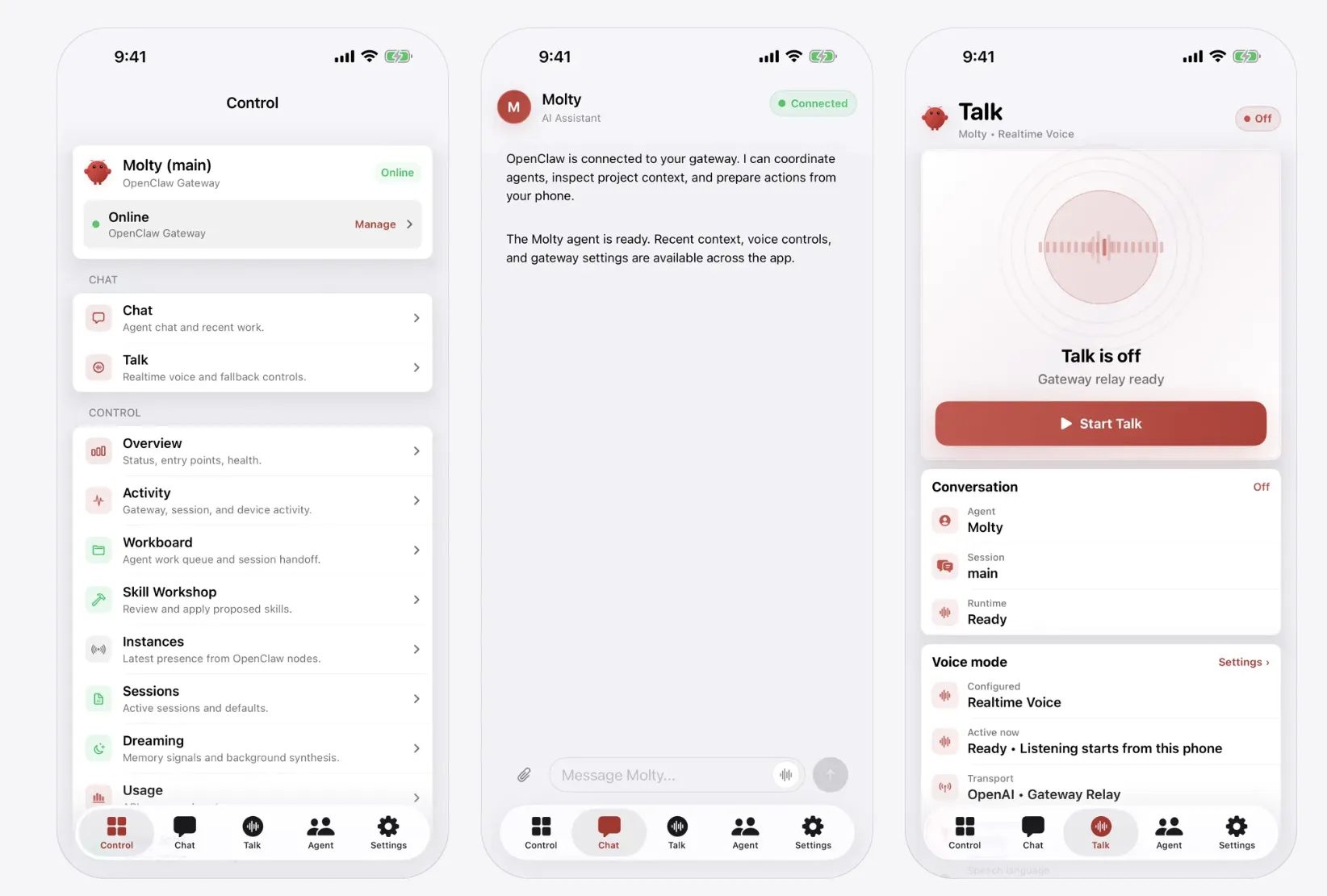
You can finally pocket your AI agent. OpenClaw, the open-source AI assistant that lives entirely on your own hardware, just dropped native apps for Android and iOS. The announcement came on June 29, 2026, via the project’s official X account.

But here’s the catch: the phone app doesn’t run the AI. Think of it as a remote control. The heavy lifting stays on your Mac, PC, or Linux machine — what OpenClaw calls a private gateway. Your phone is just the secure terminal that connects to it.

The result? A pocket-sized command center for an AI agent that answers only to you.

How the OpenClaw mobile app works

Pairing your phone with the gateway takes a couple of minutes. You scan a QR code or punch in a setup code, and you’re linked. After that, you can text with OpenClaw directly or flip to Talk mode for real-time voice conversations.

Every action the agent wants to take on your gateway requires your explicit approval first. No silent file deletions, no surprise email sends. You stay in control.

You can also push text, links, photos, and other media straight from your phone into the agent. And you get granular permission toggles for device features: camera, screen, location, photos, contacts, calendar, and reminders. Push notifications keep you updated on workflow progress even when the app is minimized.

Open source vs. closed AI: Why it matters

OpenClaw’s biggest differentiator is right there in the name — it’s open source. Anyone can inspect the code, audit how the agent behaves, or fork the project and build custom features. That level of transparency is something you simply don’t get with ChatGPT, Gemini, or most other commercial AI assistants.

When the backend stays hidden, users have to trust the company behind it. OpenClaw flips that model: trust the code, not the corporation. For privacy-conscious users and developers alike, that’s a meaningful distinction.

iOS vs. Android: Two different experiences

Not all OpenClaw mobile apps are created equal — at least not yet. The iOS version requires iOS 18 or later and is completely free. It’s listed as a Productivity app on the App Store and, according to its listing, collects zero user data.

The Android version needs Android 12 or higher and is also free. But early user reports paint a different picture of polish. The Android app’s interface has been described as rough around the edges, while the iOS app looks noticeably more refined.

If you’re on Android, don’t expect the same level of fit and finish — at least not in these early builds. The functionality is there, but the experience still needs sanding.

Why Google is taking notice

OpenClaw’s growing popularity hasn’t slipped past the big players. According to reports, Google is reportedly building its own 24/7 personal agent to compete directly with OpenClaw. That’s a strong signal that the open-source agent model is rattling the industry.

When a company like Google dedicates resources to chasing a community-driven project, it validates the approach. People want an AI agent that runs locally, respects their privacy, and doesn’t phone home to a corporate server.

What you can actually do with it

Once paired, the mobile app unlocks a handful of genuinely useful capabilities:

  • Chat and voice: Switch between text and real-time voice conversations with your agent.
  • Share from anywhere: Send text, links, and media from any app into OpenClaw using the system share sheet.
  • Device access: Let the agent use your camera, screen, location, photos, contacts, calendar, or reminders — each toggleable individually.
  • Background notifications: Get push updates on long-running tasks without keeping the app open.
  • Approval queue: Review and approve every action the agent wants to take on your gateway.

The setup does require some technical comfort. You need to run the OpenClaw gateway software on a computer first. But once that’s up, the mobile app turns that gateway into something you can actually carry around.

The bigger picture

OpenClaw mobile apps land at a moment when the AI assistant market is splitting into two camps. On one side, cloud-dependent assistants that send your data to remote servers. On the other, local-first agents like OpenClaw that keep everything on your hardware.

The mobile release makes the latter option far more practical. You no longer need to sit at your desk to interact with your agent. It follows you around — but it stays your agent, not a company’s.

For anyone who has wanted a truly private AI assistant they can talk to from the couch, the train, or the coffee shop, OpenClaw mobile apps are worth a look. Just be ready for the Android version to feel a bit unfinished for now.

Continue Reading
Click to comment

Leave a Reply

Your email address will not be published. Required fields are marked *

Artificial Intelligence

Google’s new Gmail Live tool lets you search your inbox by voice — here’s how it works

Published

on

Gmail Live

Google is finally testing Gmail Live — a voice-powered inbox search tool

At Google I/O earlier this year, the company teased a new feature called Gmail Live. It promised to let people search their inbox by speaking instead of typing. Now, that feature is moving from demo to real-world testing. According to 9to5Google, the tool is rolling out to a small group of Android and iOS users this week.

The timing makes sense. Google has been pushing voice-first AI hard across its ecosystem, and Gmail is one of its most-used products. If the test goes well, the feature could change how millions of people interact with their email.

How Gmail Live actually works

The interface is simple but polished. A small Live icon appears inside Gmail’s existing search bar. Tap it, and the screen transforms into a full voice-command interface. Users are greeted with suggested prompts — things like “What are updates on my latest orders?” or “What are my upcoming travel dates?”

Once you start speaking, a soft blue glow pulses along the edge of the screen. Your words get transcribed in real time, so you can see exactly what the system heard. Gmail Live then processes the question, reads the answer back to you, and displays the relevant email on screen. That last part is key: you can verify the details yourself, right alongside the spoken response.

At the bottom of the interface, two buttons let you mute your microphone or exit the feature entirely and return to your regular inbox.

What makes it different from regular Gmail search

Typing a search in Gmail can be clunky — especially on mobile. You have to remember exact keywords, filter by sender, or dig through folders. Gmail Live aims to handle natural language instead. You don’t need to guess the right terms. You just ask, and the Gemini-powered engine does the rest.

It’s a small change in interface, but a big shift in how you interact with your inbox. Instead of hunting, you ask.

Part of Google’s bigger voice push

Gmail Live isn’t an isolated experiment. It’s the latest in a series of voice-driven AI tools Google has been rolling out across its products. Gemini Live, for example, already lets users have natural, real-time conversations with Google’s AI assistant. You can ask it to set reminders or add calendar events without typing a single word.

Earlier this year, Search Live brought a similar back-and-forth voice experience to Google Search’s AI Mode. Users can ask follow-up questions out loud and get spoken answers alongside links to relevant web pages. Gmail Live follows the same playbook: voice-first, conversational, and deeply integrated with Google’s Gemini models.

Who gets Gmail Live first — and what comes next

Right now, Gmail Live is limited to a small test group. Google hasn’t said exactly how many users are included, but the rollout covers both Android and iOS. If you’re not in the test group, you’ll have to wait.

The company plans to bring Gmail Live to AI Pro and Ultra subscribers later this summer, once testing wraps up. That suggests the feature will eventually be tied to a paid tier — at least initially.

Google has also confirmed plans to add similar voice functionality to Google Docs and Google Keep. That would let users draft documents or jot down notes entirely by voice, using the same Gemini-powered engine. The vision is clear: Google wants voice to become a primary input method across its productivity suite, not just a novelty.

Bottom line: Gmail Live is worth watching

Voice search in email might sound like a small feature, but it addresses a real pain point. Mobile email search is tedious. Gmail Live makes it fast and hands-free. If the accuracy holds up and the roll-out goes smoothly, it could become one of those features you wonder how you lived without.

For now, it’s in testing. But the direction is obvious. Google is betting big on voice, and your inbox is next.

Continue Reading

Artificial Intelligence

AWS GraphRAG deployment cuts drug research cycles by 87% — here’s how

Published

on

How AWS GraphRAG deployment cuts drug research cycles by 87%

An AWS GraphRAG deployment has slashed pharmaceutical research and development cycles by 87 percent. The breakthrough came from stitching together proprietary databases that had long been isolated — clinical metrics, internal lab notes, engineering logs — into a single, queryable knowledge graph. What once took over six months per iteration now wraps up in three weeks.

Historically, the initial data-gathering and screening phases of drug discovery yielded a success rate of just five percent. Critical datasets lived in separate storage environments, effectively blocking data scientists from spotting hidden correlations. When senior researchers left, they took project context with them, stalling active work. AWS built a solution to connect these systems, combining graph databases with natural language processing.

The architecture behind the acceleration

The setup relies on a GraphRAG framework using Amazon Neptune Analytics and Amazon Bedrock to turn disconnected data points into a searchable network. Users submit standard natural language queries and receive answers mapped to verified domain literature and internal datasets.

But unifying isolated proprietary datasets with unstructured open-access repositories introduces significant data normalisation challenges. Strict schema governance is required to prevent inaccurate relational mapping and mitigate the risk of hallucinations — a well-known pitfall in retrieval-augmented generation systems.

Knowledge graph construction

Companies can plug in their own knowledge graphs. The system pulls in messy, unstructured files from public databases like PubMed and mixes them with internal corporate records. Tools like Amazon Comprehend Medical scan this text to extract standard medical codes. Amazon Bedrock, running Anthropic’s Claude 4.5 Sonnet, summarises document contents and determines topical relevance.

AWS Lambda functions and Amazon S3 bulk loads then route these processed elements into Amazon Neptune Analytics. The resulting knowledge graph structures data into discrete nodes representing core entities — domain-specific classes, authors, source journals, and embedded text chunks. The graph edges define relationships between these nodes, mapping hierarchical classifications and entity associations. This structured representation provides the deterministic foundation necessary for accurate information retrieval.

Database schema and resource costs

The database schema establishes strict boundaries for the RAG discovery process. Nodes capture specific conditions and map them hierarchically to established ontologies, while author and journal nodes provide provenance for published research. Lengthy documents are broken down into digestible text segments using Amazon Bedrock Knowledge Base chunking strategies, and specific classification nodes anchor unstructured textual data to standardised diagnostic metrics.

Operating this graph architecture requires specific cloud resource allocations. A standard Amazon Neptune Analytics graph running with 16 provisioned memory units incurs operational costs of $0.48 per hour. Development environments, such as Amazon SageMaker Jupyter notebooks running on t3.medium instances, add baseline compute and storage expenditures. Organisations must also factor in dynamic token consumption costs generated by the Amazon Bedrock Claude 4.5 Sonnet model during query processing and abstract generation.

Query execution and entity linking

The GraphRAG toolkit acts as the execution layer between the user interface and the underlying database. A dedicated Knowledge Graph Linker processes incoming natural language queries, extracts relevant entities using fuzzy string indexing, and maps them to established graph nodes. The system traverses the network pathways to generate plausible relational links before drafting a response through the Bedrock-hosted language model.

Retrieval accuracy depends on the entity matching configuration. An EntityLinker component aligns natural language terms from user prompts to the structured data schema. This fuzzy matching process handles the inherent noise and varied terminology found in complex enterprise datasets, ensuring users retrieve the correct nodes even when using imprecise language.

Modularity and system architecture

Data extraction relies heavily on specialised AI parsing. The architecture employs Claude to evaluate raw source documents and generate concise abstracts. Domain-specific tools then map these complex textual descriptions to standardised taxonomies.

The GraphRAG Python toolkit initialises a BedrockGenerator to power natural language interactions, while engineers configure a Knowledge Graph Linker component to bind the graph store to the language model. This integration creates a direct interface for executing queries and generating responses grounded strictly in the available graph data.

The architecture separates three core functions: language model initialisation, graph interfacing, and entity linking. Because the system is modular, teams can swap out the language model or tweak the graph structure without having to tear down and rebuild the whole application.

Performance metrics and real-world impact

Active deployments of the Neptune and Bedrock architecture return exact, verifiable citations for every generated answer. The system maps the entire reasoning path, displaying the specific graph traversal steps used to reach a conclusion.

Key performance metrics from early enterprise adopters include:

  • 87 percent reduction in research cycle durations — initial discovery phases that previously required six months now conclude in three weeks
  • 85 percent improvement in data retrieval speeds, directly supporting faster hypothesis testing
  • 70 percent drop in research review times due to automated citation mapping and source verification

Engineering teams can integrate new public databases or internal notes into the existing graph structure without disrupting active query interfaces. For governance and compliance, exact evidence trails required for regulatory submissions are captured, with graph traversal visualisations proving precisely how an AI model connected complex variables. Teams can trace every output directly to source documents, fulfilling compliance requirements for scientific integrity.

Maintaining a centralised knowledge graph also stops data decay. When senior scientists resign, their tacit knowledge regarding system behaviours or failed experiments remains indexed within the Neptune database. New personnel can query the system to review past decisions and instantly access the historical context of an ongoing project.

As GraphRAG frameworks mature, this AWS GraphRAG deployment model is unlikely to remain confined to pharmaceutical research. The ability to deterministically map internal, unstructured data against verified public repositories provides a blueprint for any enterprise struggling to extract actionable intelligence from fragmented legacy systems.

See also: Insilico Medicine advances AI drug for IPF to Phase III trials

Want to learn more about AI and big data from industry leaders? Check out AI & Big Data Expo taking place in Amsterdam, California, and London. The comprehensive event is part of TechEx and is co-located with other leading technology events including the Cyber Security & Cloud Expo.

Continue Reading

Artificial Intelligence

You can now tweak Siri’s talking speed and emotion in the iOS 27 beta

Published

on

Siri pace expressivity

Apple finally lets you control how fast Siri talks — and how much feeling it puts into every word

Apple has quietly flipped the switch on one of the most personal AI features yet. In the latest iOS 27 developer beta, testers can now tweak Siri’s pace and expressivity — two sliders that change not just the assistant’s speed, but its emotional tone.

First teased back in June at WWDC 26, the controls were labeled “Coming soon” in earlier beta releases. With iOS 27 beta 3, which landed today, they’re finally live. And they signal a bigger shift: Apple is rebuilding Siri around generative AI, and it wants the voice to feel less like a robot and more like a person sitting next to you.

What the new Siri voice controls actually do

The customization goes far beyond the old choice between a male or female voice. In beta 3, you pick from a set of voices with different accents, then adjust two sliders: one for Pace (slow to fast) and one for Expressivity (flat to animated).

As you move the sliders, Siri immediately demonstrates the change by speaking sample phrases — things like “You have one new message” or “Reminder set for 3 p.m.” It’s a live preview, so you can hear exactly how your settings sound before committing.

The effect is subtle but real. A faster pace sounds more efficient, while a slower one feels more deliberate. Crank up the expressivity, and Siri’s pitch rises and falls more naturally, almost like a human reading with emotion. Dial it down, and the voice becomes more monotone — useful for quick, no-nonsense replies.

How it compares to ChatGPT’s voice customization

OpenAI’s ChatGPT has offered voice-style controls since December 2025, letting users adjust warmth and enthusiasm, plus pick from pre-set styles like friendly, professional, candid, or quirky. ChatGPT’s approach changes not just the voice, but the tone of the response itself — a friendly mode might add emojis, while a professional one keeps things concise.

Siri’s sliders are more about delivery than content. You can make Siri speak faster or slower, and sound more or less expressive, but the words it chooses stay the same. It’s a narrower kind of personalization, but also more predictable — you know what you’re getting.

That said, Apple has the advantage of deep integration. The new Siri isn’t just a voice; it’s woven into the OS. You can start a conversation by speaking, by swiping down from the Dynamic Island, by tapping the side button, or by opening the brand-new standalone Siri app. ChatGPT, by contrast, is a third-party app you have to launch.

How to find and use the new Siri controls

If you’re running iOS 27 beta 3, here’s where to look:

  • Open SettingsAccessibilitySiri.
  • Under Voice Customization, you’ll see the new Pace and Expressivity sliders.
  • Tap the play button next to each sample phrase to hear the effect in real time.
  • You can also switch between different accent voices from the same menu.

The controls are also accessible from the Siri settings in the main Settings app, though Apple has tucked them under Accessibility for now — likely because they affect how the assistant communicates, which is a core usability concern.

What else changed in iOS 27 beta 3

Beyond the voice sliders, beta 3 brings a few smaller updates. The Reminders app icon has been refreshed — a minor visual tweak that aligns with Apple’s ongoing design language. More notably, some testers on X (formerly Twitter) report that after updating, their phones have started re-indexing data. That’s the first step in optimizing Siri AI for search, and it’s normal for a beta. A few users also say they’ve temporarily lost access to the new Siri after the update, though a restart usually fixes it.

Why this matters for the future of Siri

Apple is clearly betting that a more expressive, customizable voice will make Siri feel less like a tool and more like a companion. The generative AI rebuild, which started rolling out in pieces over the past year, aims to make Siri capable of more natural conversations — understanding context, remembering past requests, and even generating responses on the fly.

The pace and expressivity sliders are a small part of that puzzle, but they’re an important one. Voice is the primary interface for AI assistants, and small changes in tone and speed can dramatically affect how users perceive the interaction. A Siri that sounds rushed might feel impatient; one that’s too slow might feel dim. Letting users dial in their preference is a smart move, especially as Apple tries to catch up with rivals like ChatGPT and Google Assistant.

Will it be enough to win back users who’ve switched to other assistants? That’s a bigger question. But for now, anyone on the iOS 27 beta can finally tell Siri: slow down, speed up, or show a little more emotion.

Continue Reading

Trending