Connect with us

Artificial Intelligence

TikTok feeds show 3 times more AI slop than YouTube, study reveals

Published

on

TikTok feeds show 3 times more AI slop than YouTube, study reveals

If your TikTok feed feels like a parade of surreal, obviously fake videos, you are not imagining things. A recent investigation by Kapwing reveals that 59% of videos shown to a brand-new TikTok account are AI slop—algorithmically generated content that often lacks real-world grounding. That figure is roughly three times higher than what Kapwing found when it ran the same test on YouTube.

This means that for every ten videos you scroll past on TikTok, nearly six are produced by artificial intelligence rather than human creators. The finding raises serious questions about platform quality, content authenticity, and the future of organic discovery.

How bad is TikTok’s AI slop problem compared to YouTube?

Kapwing created fresh accounts on both platforms and manually reviewed the first 500 videos served to each one. On TikTok, 294 of those 500 videos were AI-generated. On YouTube, only 104 of the first 500 Shorts qualified as AI slop, putting that platform’s rate at 21%.

Building on this, the scale becomes staggering when you consider that TikTok had already labeled 1.3 billion videos as AI-generated by November. Kapwing also manually inspected over 10,000 TikTok videos across 20 content categories to understand where AI slop tends to cluster most heavily.

As a result, the study provides one of the most detailed maps yet of how algorithmically generated media infiltrates social feeds. It suggests that TikTok’s recommendation engine actively amplifies low-effort, AI-produced content—perhaps because such videos are cheap to produce and easy to scale.

Which TikTok categories are flooded with AI slop

Children’s content topped every category, with 57% of the 2,000 videos sampled turning out to be AI-generated. The worst single tag was #cartoonkids, where 97 out of 100 featured videos were artificial. This is especially concerning given that young audiences may not recognize the difference between real and generated imagery.

Science and Education, Health, and History followed close behind, each landing between 33% and 35% AI slop. These are categories where animation and voiceover narration tend to replace real demonstration, making it easier for AI tools to produce passable but misleading content.

On the other end, Fashion, Music, and Fitness were nearly untouched, each sitting below 2%. That is likely because those formats rely heavily on real, on-camera presence—a human face, a live performance, or a physical demonstration that AI still struggles to fake convincingly.

Why does AI slop concentrate in certain niches?

The pattern suggests that AI-generated videos thrive where visual authenticity is less critical. In educational or historical content, viewers often prioritize information over production realism. Meanwhile, fashion and fitness audiences expect to see real bodies and real products, creating a natural barrier against AI fakery.

Therefore, if you want to avoid AI slop, you might shift your scrolling toward categories that demand human presence. Alternatively, you can use TikTok’s built-in tools to dial back AI content in your feed—though the default settings still lean heavily toward algorithmically generated material.

What can viewers do about the flood of AI content?

Even though TikTok has rolled out features for users to reduce AI content recommendations, this study suggests that what shows up by default remains saturated with AI slop. For now, the burden of filtering slop from substance largely falls on the viewer.

However, there are practical steps you can take. First, actively follow human creators whose work you trust. Second, use the “Not interested” feedback option on suspicious videos. Third, check account bios and video descriptions for AI disclosure labels. If a channel posts dozens of videos daily with no visible human effort, it is almost certainly an AI mill.

For a deeper look at how algorithms shape your feed, read our guide on how to clean your social media algorithm. You might also find our analysis of AI content detection tools compared helpful for spotting fake videos faster.

In the end, the Kapwing study serves as a wake-up call. AI-generated videos are not a fringe phenomenon—they are becoming the default on some platforms. Staying informed and intentional about what you watch is the only reliable defense.

Continue Reading
Click to comment

Leave a Reply

Your email address will not be published. Required fields are marked *

Artificial Intelligence

VentureBeat taps Rob Strechay as its first Lead Analyst, doubling down on enterprise AI research

Published

on

Rob Strechay Lead Analyst

VentureBeat’s new research push has a name

Rob Strechay, formerly managing director and principal analyst at theCUBE Research, is now VentureBeat’s first Lead Analyst. He’s also a founding analyst of the company’s new research arm, VentureBeat Research.

The move signals something bigger than a single hire. VentureBeat is deliberately shifting toward specialization — analysis built for technical decision-makers like directors, VPs, CIOs, and CTOs who are actively evaluating, buying, and deploying enterprise AI.

“The enterprise AI stack is being rewritten in real time,” said VentureBeat’s leadership in announcing the appointment. “The decision-makers I talk with are starved for objective, defendable data.”

Why this hire matters now

The questions enterprise technology leaders are asking have changed. Organizations are moving past generative AI experimentation and into production deployment. They want to know how to orchestrate multi-vendor environments, where the security gaps in their agentic pipelines sit, and how to fix the utilization problems draining their infrastructure budgets.

News coverage alone can’t answer those questions. That’s the gap VentureBeat Research is built to fill.

An analyst who has sat on every side of the table

Strechay brings nearly three decades of experience as a practitioner, product executive, and industry analyst. Before becoming an analyst, he was an executive at startups including Zerto. He joined Amazon Web Services to help build a new analytics service. He later served as a senior analyst at Enterprise Strategy Group and, most recently, as managing director and principal analyst at theCUBE Research and SiliconANGLE.

His initial focus areas at VentureBeat: cloud infrastructure, advanced data infrastructure, platform engineering, DevOps orchestration and observability, and the intersection points where AI and enterprise security collide.

Already at work: GPU utilization and the VB Pulse surveys

Strechay hasn’t waited for an official start date. In May he published an analysis of enterprise GPU utilization, examining the compute waste sitting inside enterprise AI infrastructure. He also provided a substantive review of VentureBeat’s AI Infrastructure & Compute survey before it went into the field.

His infrastructure-level focus complements the research engine VentureBeat has built around its monthly VB Pulse surveys. These track five areas of enterprise AI adoption:

  • Agentic orchestration
  • Agent reliability and evals
  • Agentic security and identity
  • AI infrastructure and compute
  • Context layers, including retrieval-augmented generation (RAG)

The June report on agentic orchestration, drawn from a survey of 145 enterprises, found that two-thirds had hedged their AI model strategy rather than committing to a single provider. The June outage of Anthropic’s Claude models made that posture’s value painfully clear.

VB In Conversation: The first vehicle

A core vehicle for this expanded research footprint will be a deepening of VentureBeat’s existing VB In Conversation video interview series, which Strechay will host. The series will bring architectural blueprints, actual deployment barriers, and back-end infrastructure realities to light through in-depth technical interviews with the architects and product leaders behind leading enterprise AI systems.

“VentureBeat has built an audience of enterprise builders and technology buyers that any analyst would want to serve,” Strechay said. “My goal is to use deep empirical metrics and VentureBeat’s proprietary tracking data to help enterprise buyers and the people building for them make sound platform and infrastructure decisions during the most disruptive transition enterprise technology has seen.”

What to expect next

The expanded VB In Conversation series will appear on VentureBeat and on VentureBeat’s YouTube channel, alongside Strechay’s written analysis on the site. Enterprise practitioners who want to take part in the monthly VB Pulse surveys, or arrange an analyst briefing with Strechay, can reach the research team directly.

For those tracking enterprise AI adoption trends, this hire is a signal. VentureBeat is betting that technical depth — not just news — is what enterprise buyers need most right now.

Continue Reading

Artificial Intelligence

Samsung’s humanoid robot dreams are real, but the factory floor comes first

Published

on

Samsung humanoid robots

Samsung’s humanoid robot plans are real, but the factory floor comes first

Samsung wants a piece of the humanoid robot boom. But the company’s first concrete robotics push isn’t about a robot that walks your dog or folds your laundry. It’s about machines built for the factory floor.

The newly formed RX robotics division, led by a CEO, will initially focus on manufacturing robots. Samsung has separately flagged humanoids as a priority, though it hasn’t announced a commercial model or explained how one fits into the division’s near-term roadmap.

That gap between ambition and execution is telling. The machines Samsung can deploy first may look considerably less human than the ones in its promotional videos.

Why factories come first for Samsung’s robot push

The RX division fits neatly into Samsung’s broader plan to transform its manufacturing operations into AI-driven factories by 2030. The roadmap includes humanoids alongside assembly and logistics systems — but the sequencing matters.

Factories are an obvious starting market. The work is structured, the environment can be controlled, and Samsung already runs production facilities across the globe. That’s a far lower barrier to entry than a cluttered living room with unpredictable pets and toddlers.

That doesn’t mean the factory floor is just a training ground for future household humanoids. It gives Samsung somewhere practical to build an industrial robotics business while the grander promises remain unfinished. In other words, the company can make money now and dream later.

What Samsung could actually build first: the Rainbow Robotics RB-Y1

Samsung took control of Rainbow Robotics to accelerate its work on advanced robots, including humanoids. Rainbow was founded by researchers behind South Korea’s first bipedal humanoid, so the pedigree is real.

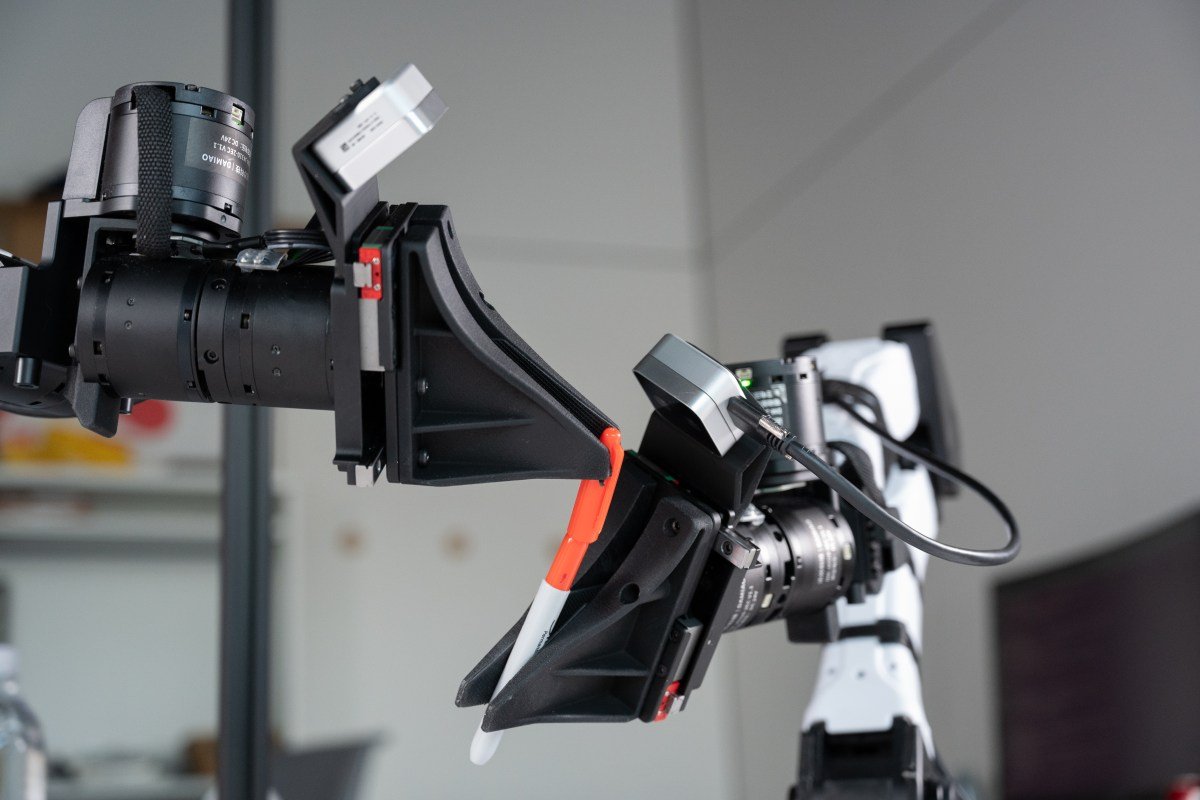
But the RB-Y1 offers a more realistic picture of what could arrive first. The robot has two arms and a human-like working range, yet it moves on wheels. It has reportedly undergone testing inside a Coupang warehouse, although Samsung hasn’t officially identified it as part of the RX division’s roadmap.

The design choice is pragmatic. Walking robots make impressive demonstrations. Wheels make more sense when the machine has a shift to finish. A robot that tips over on aisle three isn’t exactly a productivity win.

The case for wheeled robots in industrial settings

  • Wheels are more stable and energy-efficient than legs for repetitive tasks
  • Warehouse floors are flat and predictable, so legs add complexity without much benefit
  • Maintenance costs are lower, and uptime is higher

That’s not to say Samsung has abandoned walking robots entirely. The company’s ambition clearly extends beyond conventional robot arms. But the first machines out of the gate will likely be the ones that can do a job reliably today, not the ones that look cool in a demo reel.

When could Samsung robots reach homes?

Samsung’s ambitions could eventually extend into stores and homes, but the company hasn’t announced a consumer humanoid or provided a launch window. Don’t hold your breath.

Its history with Ballie gives us reason to stay skeptical. The rolling home robot missed its planned release before Samsung repositioned it as an internal innovation platform. That’s a polite way of saying it didn’t ship as a consumer product.

So while Samsung’s smart home ecosystem continues to grow, a humanoid that folds your laundry remains firmly in the PowerPoint phase. The company’s immediate focus is on industrial robots, and that’s where the RX division will earn its keep.

What this means for the humanoid robot race

Samsung is hardly alone in chasing humanoids. Companies like Tesla with Optimus and Figure are pushing bipedal designs. But Samsung’s strategy is different: build the industrial business first, and let humanoids come later.

That’s a sensible approach, but it also means Samsung is playing catch-up in the consumer space. The company’s real strength lies in manufacturing and supply chain integration, which gives it a natural edge in factory automation.

For now, the takeaway is clear: Samsung humanoid robots are a long-term ambition, not a near-term product. The RX division will start with machines that work on wheels, in controlled environments, doing structured tasks. If that sounds less exciting than a robot butler, well, it is. But it’s also a lot more likely to actually ship.

Continue Reading

Artificial Intelligence

Apple’s Camera-Equipped AirPods: Why They Might Not Be the ‘Pervert Pods’ Everyone Fears

Published

on

camera-equipped AirPods

The Rumor That Set the Internet on Edge

Picture this: you’re on a crowded train, and the person across from you is wearing AirPods. Now imagine those tiny earbuds have cameras. Creepy, right? That’s the fear that erupted when reports surfaced that Apple is working on camera-equipped AirPods. The internet, predictably, dubbed them “pervert pods.”

But here’s the thing — the reality might be far less sinister than the memes suggest.

What the Leaks Actually Reveal

The rumors gained traction after video footage surfaced in Apple’s macOS 26.7 RC (release candidate) — the final test version before public release. The clip shows a man holding a book while wearing AirPods, chatting with Siri about it. The audio track says: “With Visual Intelligence, your world becomes savable. See something you like? Just ask me to save it for later.”

Further evidence comes from code referencing a “Hair Detected” error. This would warn users when their hair blocks the AirPods’ camera. It’s a small detail, but it confirms the hardware is real — and that Apple is thinking about real-world usage.

Why These Aren’t Spy Cameras

Here’s where the narrative shifts. According to a report from Bloomberg’s Mark Gurman, these cameras won’t record photos or video. At all. As Gurman put it: “The cameras essentially act as eyes for the Siri digital assistant and aren’t designed to take photos or video. These components — located in both the right and left earbuds — allow the device to capture visual information in low resolution.”

So what’s the point? The goal is to feed visual data to Siri, which is getting a major AI upgrade in September with iOS 27. Instead of pulling out your iPhone to ask about something, you just look at it and speak. A book, a recipe’s ingredients, a street sign — Siri can see it and respond.

This isn’t surveillance. It’s a hands-free way to interact with your environment. Think of it as a smart assistant with eyes, not a hidden camera.

The LED Indicator: A Double-Edged Sword

Apple isn’t ignoring the privacy elephant in the room. Gurman reports the new AirPods will include an LED indicator that lights up whenever the device shares visual data to the cloud. That’s a transparency move — but it’s also a risk.

The LED could visually lump AirPods in with other AI wearables already facing public skepticism, like Meta‘s Ray-Bans, Snap’s Specs, or Google’s AI glasses. Apple can control what the cameras do, but it can’t control what people assume they do. A tiny light on an earbud might not be enough to reassure a nervous public.

The Visibility Problem

Gurman himself questioned the LED’s visibility given the AirPods’ small size. If the light is too small to see, it defeats its purpose. But if it’s too prominent, it could make wearers self-conscious. It’s a delicate balance.

A Strategic Bet on a Screen-Free Future

For Apple, this is about more than just a hardware refresh. It’s a bet that consumers want to interact with technology without staring at a screen. By baking AI access into a socially acceptable wearable, Apple is pushing toward a future where you don’t need to pull out your iPhone every five minutes.

That’s a compelling vision. Walking directions that whisper in your ear without checking your phone. Cooking help that sees your ingredients. A world where your devices work in the background, not in your face.

But it’s also a gamble. AirPods are currently a seamless accessory — people wear them all day without a second thought. Adding cameras, even benign ones, changes that perception. It forces people to wonder: is that person recording me?

The Privacy Tightrope Apple Must Walk

Apple has built its brand on privacy. That’s why this is riskier than a typical product launch. The company needs to convince consumers that the cameras are for Siri’s benefit, not for surveillance.

The LED indicator is a start, but it’s not enough. Apple will need a massive education campaign. It’ll need to explain, repeatedly, that these cameras can’t save photos or video. It’ll need to show, not just tell, how the data is processed and protected.

If Apple gets this right, it could redefine how we interact with AI. If it gets it wrong, the “pervert pods” label will stick — and that’s a PR nightmare no company wants.

For now, the leaked footage and code suggest Apple is thinking carefully. But in the court of public opinion, careful thinking isn’t always enough. The cameras are coming. The question is whether we’ll accept them.

Continue Reading

Trending