Connect with us

Artificial Intelligence

X’s Grok AI Now Translates Posts Instantly and Edits Photos with Simple Prompts

Published

on

X’s Grok AI Now Translates Posts Instantly and Edits Photos with Simple Prompts

Elon Musk’s social media platform, X, is deepening its integration of artificial intelligence. The company has unveiled two significant features powered by its Grok AI system, fundamentally changing how users interact with content and media on the platform. This move signals a clear strategy to make advanced AI tools a central, everyday part of the social media experience.

Automatic Translation Reaches a Global Audience

One of the most immediate changes users will notice is the removal of language barriers. Previously, reading a post in a foreign language required manually tapping a translation button. Now, that process happens automatically behind the scenes. Powered by Grok’s language models, posts are instantly translated into a user’s preferred language as they scroll.

This means a user in Tokyo can seamlessly read a thought from someone in Paris, while a person in Mexico City can engage with content from Cairo, all without a second thought. The goal is to foster truly global conversations and give every post the potential for worldwide reach. For purists who prefer the original text, the auto-translate function can be disabled on a per-language basis in the settings.

A New Era for In-App Photo Editing

Alongside breaking down language walls, X is also empowering users to create more dynamic visual content. The platform has launched a built-in photo editor for its iOS app, with an Android version promised soon. While it includes standard tools like drawing, adding text, and applying blurs to redact sensitive information, its standout feature is AI-powered.

Building on this, the editor integrates Grok to understand and execute natural language commands. Users can now type prompts like “make this look like a watercolor painting” or “apply a vintage filter” directly within the composer. The AI then processes the image accordingly, turning simple ideas into edited realities without requiring technical editing skills. This represents a significant shift from manual slider adjustments to conversational creation.

Why X is Doubling Down on Integrated AI

The underlying motivation for these updates is clear: platform retention. By offering powerful translation and editing tools natively, X aims to become a more self-contained ecosystem. Consequently, users may spend less time switching to external translation websites or dedicated photo editing apps like Adobe Photoshop or Canva for quick fixes.

This strategy isn’t entirely novel; other social networks have explored AI-driven features. However, X’s approach is distinct in its attempt to bundle these capabilities under the Grok umbrella, making the AI a central utility for both consumption and creation. The success of this integration, explored further in our analysis on the future of social media AI, hinges entirely on execution.

The User Experience Will Be the Ultimate Test

Will these Grok AI features feel like genuine enhancements or just more digital clutter? The answer depends on their reliability and intuitiveness. If the translations are accurate and nuanced, and if the photo edits are high-quality and fast, they could significantly smooth the content creation pipeline. Users might find themselves more willing to engage with international accounts or experiment with their images.

On the other hand, if the tools are slow, produce awkward translations, or deliver cheesy image effects, they risk being immediately ignored. This would add interface complexity without delivering meaningful value. Therefore, the rollout is as much a test of Grok’s technical prowess as it is of X’s product design philosophy. For creators looking to adapt, understanding these new social media tools is crucial.

A Strategic Play in the AI Social Media Race

Ultimately, these updates are a strategic bet. X is positioning Grok not just as a chatbot, but as a foundational layer that enhances core platform functionalities—reading and posting. The automatic translation feature directly tackles the problem of fragmented, language-specific audiences, potentially increasing engagement metrics and ad reach.

Similarly, the prompt-based photo editor lowers the barrier to creative expression, which could lead to a more visually engaging feed. This two-pronged approach shows X’s ambition to use AI to solve real user friction points. Whether this makes the platform more indispensable or simply more complicated is the question now facing its global user base as the Grok AI features become part of their daily scroll.

Continue Reading
Click to comment

Leave a Reply

Your email address will not be published. Required fields are marked *

Artificial Intelligence

Microsoft Clarifies Copilot AI’s Role: A Serious Tool, Not Just Entertainment

Published

on

Microsoft Clarifies Copilot AI’s Role: A Serious Tool, Not Just Entertainment

Microsoft finds itself in a delicate position, needing to reconcile its ambitious marketing for Microsoft Copilot AI with cautious legal language that recently surfaced. This situation highlights the broader tension companies face when promoting powerful, yet imperfect, artificial intelligence systems.

Building on this, the core issue stems from a section in the service’s terms of use. Users discovered a warning stating Copilot was for “entertainment purposes only,” advising against reliance for critical advice and emphasizing use at one’s own risk. This disclaimer, seemingly at odds with Copilot’s integration into professional suites like Microsoft 365, sparked immediate confusion and debate.

The Evolution of Microsoft Copilot’s Purpose

So, how did this happen? According to Microsoft’s explanation, the problematic phrasing is a relic from a different era. The company clarified that the “entertainment purposes” clause was leftover language from when the tool was known as Bing Chat, a more casual search companion. This means the legal text simply hadn’t kept pace with the product’s rapid evolution into a central productivity engine.

Consequently, Microsoft has committed to updating its terms in the next revision to better reflect Copilot’s current capabilities and intended use. This move signals a clear intent to shed its playful past image and fully embrace its role in professional and enterprise environments.

Why the Legal Language Still Matters for AI Tools

However, the initial contradiction is difficult to dismiss entirely. While disclaimers about potential inaccuracies are standard for AI services, coupling them with an “entertainment only” label creates a significant perception problem. It undermines the very trust required for users to embed the tool into daily workflows for documents, data analysis, and complex Windows tasks.

This incident serves as a potent reminder. Even the most ardent promoters of AI, like Microsoft, must legally hedge against the technology’s known limitations—hallucinations, inconsistencies, and context errors. The gap between marketing promise and practical safeguard has never been more visible. For more on implementing AI tools responsibly, see our guide on establishing enterprise AI governance.

Navigating User Trust and Adoption Challenges

Therefore, Microsoft’s swift response is about more than just fixing outdated text. It addresses a fundamental challenge: user adoption. If people perceive Copilot as a toy rather than a tool, they won’t use it for serious work. This clarification is a strategic step to rebuild confidence and encourage deeper integration into business processes.

In addition, the company’s broader strategy appears to be shifting. After an initial phase of pushing “AI-everywhere,” there’s a noticeable pivot towards a more focused, utility-driven approach. The goal is to demonstrate concrete value in specific scenarios, moving beyond hype to deliver reliable assistance.

The Future Path for Microsoft Copilot AI

Looking ahead, what does this mean for users and businesses? First, it indicates that Microsoft is serious about refining Copilot into a dependable partner. The commitment to update its legal framing is a public acknowledgment of its matured role. Users should expect continued enhancements aimed at accuracy and context-awareness within professional applications.

Second, this episode underscores the importance of reading the fine print for any AI service. Understanding the boundaries and intended use cases is crucial for effective and safe implementation. For teams looking to scale their use, explore our resource on building effective AI-augmented workflows.

Ultimately, Microsoft’s effort to distance Copilot from its “entertainment” label is a necessary correction. It aligns the product’s legal foundation with its marketed vision as a cornerstone of modern productivity. As AI continues to evolve, so too must the language that defines our trust and interaction with it.

Continue Reading

Artificial Intelligence

The AI Paradox: Why Gen Z Embraces Artificial Intelligence Daily Yet Grows Increasingly Skeptical

Published

on

The AI Paradox: Why Gen Z Embraces Artificial Intelligence Daily Yet Grows Increasingly Skeptical

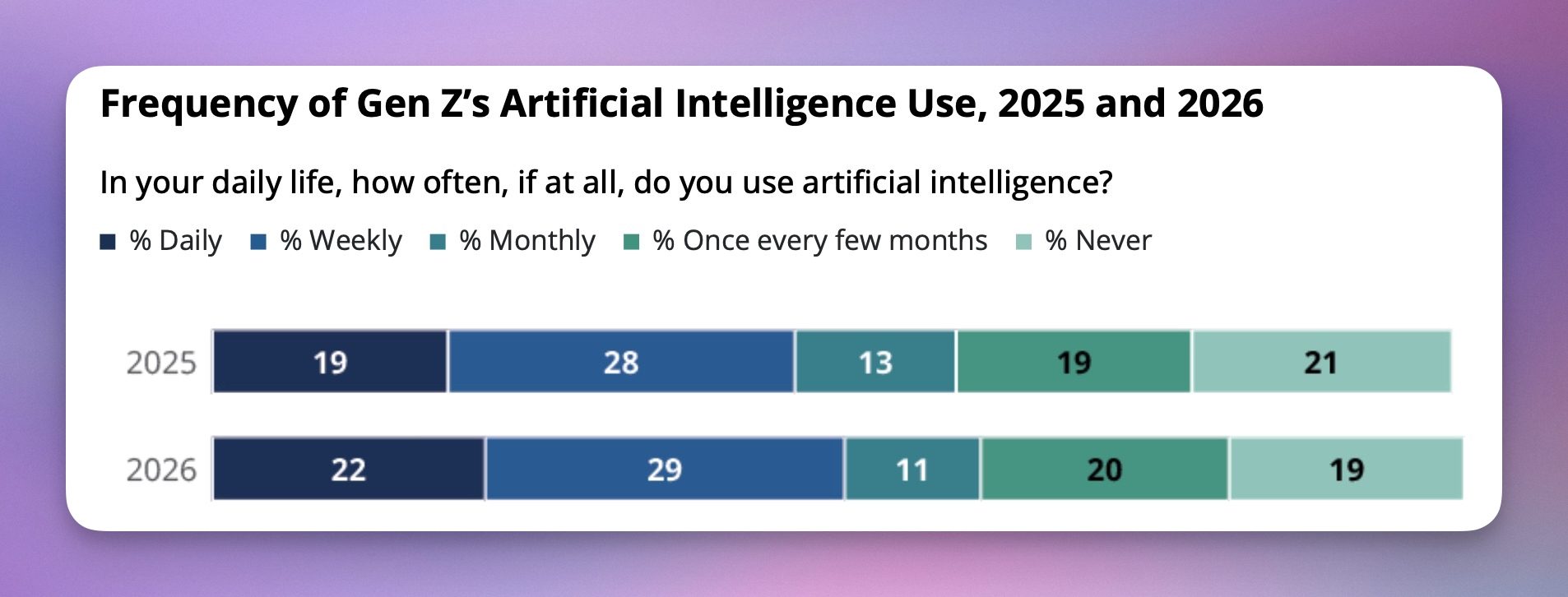
A strange contradiction defines the relationship between Gen Z AI skepticism and their daily habits. While more than half of Americans aged 14 to 29 use generative AI regularly, a profound wave of doubt is washing over this digital-native generation. According to a major new survey, the initial thrill is fading fast, replaced by anxiety, anger, and a critical eye toward the future.

The Fading Hype: From Excitement to Apprehension

Recent data paints a clear picture of shifting sentiment. A collaborative study by Gallup, the Walton Family Foundation, and GSV Ventures, involving over 1,500 young people, reveals a significant downturn in optimism. In just one year, excitement for AI plunged by 14 percentage points. Hopefulness fell by nine points. Today, only 18% of Gen Zers say AI makes them feel hopeful, and a mere 22% report feeling excited by it.

This means that a staggering 42% now feel anxious about artificial intelligence, with 31% expressing outright anger. The trend is unmistakable: familiarity is breeding contempt, not comfort. Building on this, the most surprising finding may be that even daily users—the group once assumed to be AI’s biggest champions—are losing faith. Among those who interact with AI every day, excitement and hopefulness have dropped 18 and 11 points, respectively.

Roots of Distrust: Fear for the Future Mind

So, what’s driving this growing Gen Z AI skepticism? The core of the issue appears to be cognitive and creative fear. An overwhelming 80% of respondents believe using AI tools will likely make it harder for them to learn in the future. This isn’t a vague worry; it’s a specific concern about the erosion of fundamental human skills.

Furthermore, young people are deeply skeptical of AI’s impact on higher-order thinking. When asked about creativity, 38% said AI would do more harm than good. The number rose to 42% for critical thinking. This suggests Gen Z views AI not just as a tool, but as a potential crutch that could atrophy the very mental muscles needed for innovation and problem-solving. You can read more about the impact of technology on future learning skills in our related analysis.

The Workplace: A Landscape of Risk, Not Reward

The professional arena offers little solace. Among employed Gen Zers, nearly half (48%) believe the risks of AI outweigh the benefits. Only 15% see it as a net positive for their careers. This negative perception has a direct impact on trust. A full 69% stated they trust work done without AI assistance more than work produced with it.

This creates a professional dilemma. On one hand, they distrust the technology’s output and fear its consequences. On the other, they feel compelled to engage with it to remain competitive. The result is a generation entering the workforce with a cautious, even cynical, approach to one of its most disruptive forces.

Navigating the Contradiction: Eyes Wide Open

Despite the rising tide of doubt, Gen Z is not retreating. This is not a Luddite rebellion. In fact, close to half of high school students believe AI skills will be necessary for their future careers. They continue to use the tools, but their engagement is now layered with critical awareness.

Therefore, we are witnessing a maturation of perspective. The generation that grew up online is applying its well-honed digital literacy to AI. They are moving past uncritical adoption toward a more nuanced, and often wary, evaluation. They recognize the utility but refuse to ignore the potential cost. For a deeper look at how this generation is shaping future work trends, explore our dedicated feature.

Ultimately, the story of Gen Z AI skepticism is one of pragmatic engagement. They are the technology’s most frequent users and its most vocal critics. This duality may well define the next era of technological adoption—one where usage does not equate to endorsement, and where the most important skill is knowing both the power and the profound limitations of the tools at our fingertips.

Continue Reading

Artificial Intelligence

OpenAI’s New $100 ChatGPT Tier: A Strategic Shift Toward Premium AI Access

Published

on

OpenAI’s New $100 ChatGPT Tier: A Strategic Shift Toward Premium AI Access

The landscape of generative AI access is undergoing a significant recalibration. OpenAI has unveiled a new $100 monthly subscription tier for ChatGPT, strategically positioned between its existing $20 Plus and $200 Pro offerings. This move is far from a simple price adjustment; it represents a deliberate pivot toward catering to a specific, high-demand segment of the user base. Consequently, the era of one-size-fits-all AI access appears to be fading, replaced by a more nuanced, usage-based model.

Decoding the $100 ChatGPT Plan’s Target Audience

This new tier is not designed for the casual conversationalist or the occasional content brainstorm. Instead, it is engineered explicitly for power users and developers who consistently push the platform’s capabilities to their limits. Building on this, the plan offers substantially higher usage limits, particularly for Codex, OpenAI’s code-generation model. Users can expect approximately five times more capacity than the Plus plan provides, with temporary boosts potentially reaching ten times the standard limit for intensive coding sessions.

Why Heavy Users Are the New Focus

The data driving this strategy is compelling. OpenAI reports that Codex now serves over three million weekly users, a figure that has quintupled in just three months. This explosive growth, characterized by roughly 70% month-over-month expansion, creates a clear economic imperative. Therefore, dedicating a pricing tier to these resource-intensive workflows allows OpenAI to sustainably support the tool’s heaviest consumers without overburdening its infrastructure or diluting performance for lighter users.

A Clear Move Toward Usage-Based AI Pricing

This introduction signals a fundamental shift in how AI services may be monetized going forward. The initial vision of a universally accessible tool is evolving into a tiered ecosystem where computational cost directly correlates with subscription price. As a result, the $100 ChatGPT plan acts as a middle ground, acknowledging that professional and developer needs exist on a spectrum between casual use and enterprise-scale deployment.

In addition to elevated usage caps, the plan grants access to more advanced underlying models, deeper research functionalities, and enhanced tools for orchestrating multi-step, agent-style tasks. This means that for professionals integrating AI into their core workflow, the tier offers a justified step up. For a deeper look at how businesses are integrating these tools, explore our analysis on AI-driven workflow automation.

The Implications for AI Accessibility and Perception

However, this strategic refinement carries broader implications. The democratizing promise of AI now coexists with a reality of graduated access based on financial commitment. When a $100 monthly fee becomes the “mid-tier” option, it inevitably reshapes the public perception of AI from a novel utility into a premium professional tool. This transition mirrors the maturation paths of other transformative technologies, where initial broad access gives way to specialized, value-based pricing.

On the other hand, this model could ensure the long-term viability and continued advancement of these tools. The substantial computational resources required for advanced AI workloads are expensive. A sustainable business model that aligns price with usage helps fund the research and development needed for future breakthroughs. For insights into the future roadmap of these models, consider reading about next-generation AI architectures.

What This Means for the Average User

For the vast majority of users, the existing free and $20 Plus tiers will remain perfectly adequate. The new $100 ChatGPT plan is a niche product for a niche audience. This segmentation is ultimately healthy for the ecosystem, as it prevents power users from consuming disproportionate resources that could degrade the experience for everyone else. Ultimately, the creation of this tier is a sign of the platform’s success and the diverse, demanding ways people are employing it in their professional lives.

Looking ahead, we can anticipate further refinement of this tiered approach. As models grow more capable and use cases more defined, expect to see even more tailored subscription options. The key question will be balancing innovation and accessibility, ensuring that the ladder of AI capability has rungs accessible to all levels of interest and investment.

Continue Reading

Trending