Connect with us

Artificial Intelligence

Apple Intelligence 2.0: The Real Story Behind Siri AI and What It Means for Your iPhone

Published

on

Apple Intelligence 2.0: The Real Story Behind Siri AI and What It Means for Your iPhone

Apple has never officially used the term Apple Intelligence 2.0, but it perfectly captures the company’s next ambitious leap. At its core, this update revolves around a dramatically revamped Siri AI—the most visible piece of a broader strategy to make your iPhone feel less like a collection of apps and more like a single, intelligent device.

But here’s the thing: Siri carries a lot of baggage. For years, it has been the assistant you use for timers, weather checks, and frustrating conversations where it somehow misses the most critical word. The promise of Apple Intelligence 2.0 is to finally change that narrative.

Why Siri AI Is the Star of the Show

Apple is betting big on Siri AI because it has been the company’s most public AI problem. The new version aims to understand context, see what’s on your screen, answer complex questions, and act across multiple apps. According to Apple, Siri AI can use personal context to search through messages, emails, photos, and more, while also responding to onscreen queries and taking systemwide actions.

This is a massive reset. It’s designed to make Siri appear as if it didn’t sleep through the entire chatbot revolution. Ironically, this update sounds impressive partly because the baseline has been so low. Apple is finally delivering the Siri many people thought they were getting years ago.

However, that doesn’t make the update trivial. The stakes are actually higher now. Apple must rebuild trust in a feature that many users have already trained themselves to ignore. A better Siri doesn’t need to become a charming digital friend; it needs to stop making simple tasks feel like a scavenger hunt.

What the New Apple Intelligence Features Actually Do

The new Apple Intelligence features might seem scattered at first glance. Some live in Siri, while others appear in the camera, text fields, calls, photos, and everyday apps. But together, they point to one clear goal: making the phone feel less fragmented.

Writing help will appear where you’re already typing. Visual search works through the camera. Call Context surfaces the right detail during a call, like a confirmation code or reservation number from your email. Photo tools make editing feel less like a separate errand. Messages and Mail get smarter without turning every reply into a corporate memo.

The best version of Apple Intelligence shouldn’t feel like “using AI.” It should feel like the phone understands the task better and removes the manual nonsense around it. Much of the AI race has trained people to think of AI as a separate destination, but Apple is trying to make it feel like something already under the glass.

How Apple Ended Up Here

Apple Intelligence started in 2024 with a smaller first wave of tools, including writing help, notification summaries, photo cleanup, and a nicer Siri shell. Those tools were useful, but they weren’t the full version of the idea Apple was selling. The larger promise was always a more personal Siri that could understand what users were doing and act across apps.

Because those ambitious Siri features weren’t part of the first wave, the initial version of Apple Intelligence felt oddly incomplete. This update is Apple’s attempt to close that gap. Apple can talk about privacy, polish, and ecosystem control, but useful AI also needs raw model strength. Apparently, that meant letting Google into the machinery.

Why the Boring Plumbing Decides Everything

The hidden machinery behind Apple Intelligence may decide whether it works at all. Siri AI can only become useful if apps expose enough information and actions for the system to understand. This is where things like App Intents and semantic indexing stop being developer jargon and start becoming the product.

Apple says App Intents lets developers connect app content and capabilities to Siri AI features like personal context understanding, app actions, and onscreen awareness. Most users will never think about any of this. Nobody buys an iPhone because the app plumbing looks healthy. But if Siri can’t find the right thing, act on the right screen, or understand what an app can do, the magic trick collapses back into voice-command theater.

This is the least glamorous part of Apple Intelligence, and probably the most important. A smarter model can answer better questions, but an assistant that can’t interact with the apps people actually use is still trapped behind glass.

Where the Promise Gets Messy

Apple’s careful approach creates its own problems. Siri needs enough personal context to help without making the phone feel like it’s reading over your shoulder. It also needs enough app access to act without becoming unpredictable. Then there’s the uneven rollout, which will depend on the device, region, language, and whether apps support the deeper hooks.

Apple says Siri AI will arrive as a beta later this year for supported devices set to English. It will not initially be available in the EU on iOS, iPadOS, and watchOS, and it will not be available in China while Apple works through regulatory requirements. Privacy is Apple’s advantage here, but it’s also a constraint. Too little access, and Siri remains a polite search box with a voice. Too much access, and the iPhone starts to feel like a personal assistant that has been rifling through the drawers.

What This Means for Normal iPhone Users

For everyday iPhone users, Apple Intelligence comes down to friction. You should be able to ask Siri to find a flight code from an email while you’re on a call, instead of playing clipboard gymnastics across three apps. That’s a small example, but small examples are where this kind of AI has to prove itself.

The real test is whether Siri can understand what’s happening in front of you, find the right personal detail, use the right app, and avoid turning the whole process into another chore. Apple Intelligence shouldn’t ask users to become prompt engineers. It should make the iPhone feel less like a pile of apps pretending to be one device.

That’s the real promise of Apple Intelligence 2.0, even if Apple would never call it that. Siri is getting a second chance, but the future of Apple AI may depend less on a shiny chatbot moment than on whether it can finally handle ordinary phone work without making a meal of it. After all these years, Siri may finally be getting the job it’s been pretending to have.

For more on how AI is reshaping your devices, check out our guide on top AI features for iPhone and Siri tips and tricks.

Continue Reading
Click to comment

Leave a Reply

Your email address will not be published. Required fields are marked *

Artificial Intelligence

Sam Altman’s space data center trash talk echoes what experts have been saying for years

Published

on

space data centers

The weekend spat that put a spotlight on orbital compute

Sam Altman and Elon Musk traded insults on social media over the weekend, and buried under the name-calling was a real disagreement about the future of computing in orbit.

Musk accused Altman of being a scammer. Altman fired back: “homeboy you’re the one sellling [sic] public market investors on short-term space datacenters.”

Set aside the schoolyard tone, and Altman’s jab lands close to what many industry insiders have concluded but public market investors seem to be ignoring: space data centers are not going to be a meaningful business anytime soon.

Why SpaceX’s orbital data center pitch is so seductive

SpaceX’s plan to launch a fleet of orbital data centers for AI inference work is a big reason the company is valued at $2 trillion. Bullish analysts see the potential for that processing power to fuel SpaceXAI’s models or serve as an orbital neocloud — something unprecedented in the AI boom.

The vision is compelling: put high-powered computing above the atmosphere, beam results down to Earth, and sidestep the terrestrial constraints of power and land. But experts who have actually studied the problem tell a different story.

What the experts say (when investors aren’t listening)

Talk to the entrepreneurs behind other space data center startups. Talk to the team at Google working on orbital compute. Talk to engineers who’ve run the numbers for fun. You get the same answer: this won’t make a big dent until we have much cheaper rockets and the ability to mass-produce high-powered satellites at low cost.

The economics simply don’t work yet. Launching a single satellite with meaningful compute power is expensive. Launching hundreds, or thousands, is currently inconceivable.

The Starship wildcard — and why it’s not enough

Musk’s answer to the skeptics is predictable: SpaceX‘s Starship, the massive new rocket, is expected to make its 13th test flight as soon as July 16. If Starship can fly again and again, the business case for space data centers could close.

But even a successful recovery of both stages on that test flight doesn’t mean operational reusable flight is right around the corner. It’s likely still years away. And even when Starship is flying regularly, space data center launches will take a back seat to SpaceX’s commitments to NASA and to building out its own Starlink network.

There’s another wrinkle. During its IPO road show, SpaceX conceded that Starship may not be fully reusable in the near term. Each launch might have to throw away its second stage. That would put a serious damper on the economics of orbital compute.

Musk’s “next year” promise falls flat

That’s why Musk’s rejoinder — “We start flying them next year” — doesn’t convince many people. Sure, SpaceX could launch a satellite equipped for high-speed data processing next year. That’s not the question.

The real question is when SpaceX can launch and manufacture these satellites at scale. And that’s likely a question for the 2030s.

For now, the gap between vision and reality in the space-compute business remains wide. Investors betting on near-term orbital data centers might be wise to listen to the engineers — and to Altman’s trash talk.

Continue Reading

Artificial Intelligence

China’s AI talent shortage is so bad that tech giants are recruiting teenagers

Published

on

AI talent shortage

The 13-year-old who’s already ahead of the curve

In Hangzhou, a 13-year-old boy has won national AI competitions and built an online following of more than 136,000 people. His dad, meanwhile, is trying to figure out how to guide a kid through a field that barely existed when he was growing up. That family’s story, first reported by Rest of World, captures where China’s tech industry is heading.

Companies used to wait for graduates to walk through the door. Now they’re reaching further back — first to undergrads, and increasingly to teenagers. The goal? Spot rare talent before anyone else gets to them.

Why the sudden rush to recruit teens?

The short answer is a serious talent gap. McKinsey estimates China could be short by 5 million AI workers by 2030. Right now, there are more open AI jobs than qualified people to fill them. That math has pushed companies to rethink who they even consider.

Tencent recently launched camps for students aged 13 to 18, covering everything from AI product management to quantum computing. ByteDance founder Zhang Yiming went even further, co-founding a research program that hand-picks just 30 students a year as full-time trainees.

Geely flips the hiring order entirely

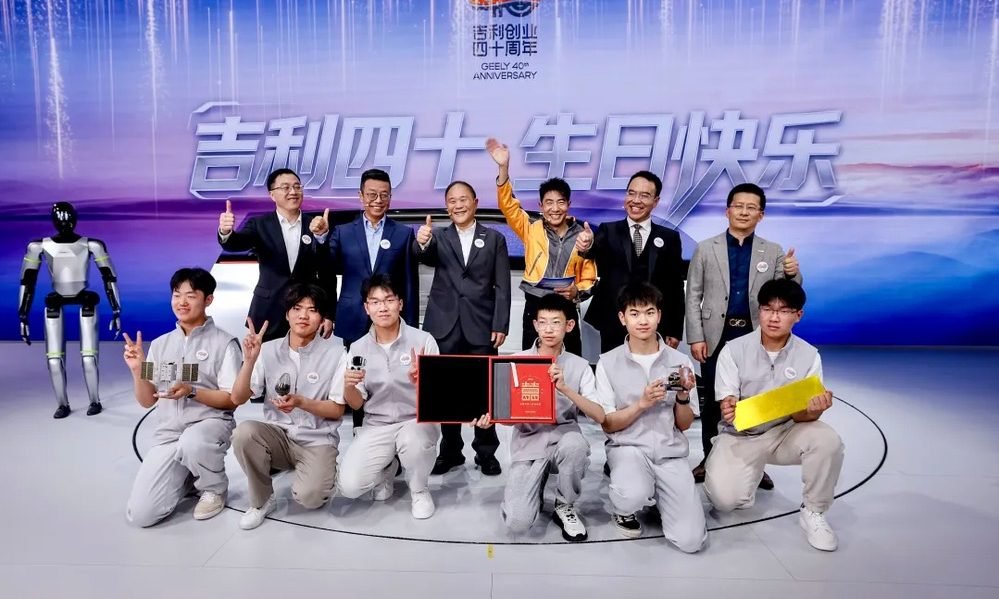
Then there’s Geely, which turned the usual hiring pipeline upside down. The automaker now recruits students straight out of high school, trains them in AI and EV tech alongside their studies, and guarantees them a job that pays the same as a fresh graduate once they’re done. No degree required. No waiting four years.

It’s a bold bet. But Geely isn’t alone in questioning the old rules.

Does a degree matter less now?

MiniMax, one of China’s leading AI startups, says it still isn’t hiring high schoolers — but it has stopped treating a degree as a hard requirement. The company cares more about curiosity and raw ability than a diploma. That shift isn’t unique to China either.

Google co-founder Sergey Brin has said the company is increasingly open to hiring people without a bachelor’s degree. At the end of the day, AI isn’t just changing what jobs look like. It’s rewriting who even gets considered for them.

What this means for the future of hiring

Degrees, age, and traditional resumes are all starting to matter a little less than raw skill and curiosity. That’s a big deal for young people who might have been overlooked before. It’s also a warning for anyone who assumed a diploma was a lifetime ticket.

For parents like that Hangzhou dad, the new landscape raises a tricky question: how do you raise a kid for a career that didn’t exist a decade ago? There’s no playbook. But if China’s tech giants are any indication, the answer might be to start earlier — and think less about credentials, more about capability.

If you’re curious about how AI is reshaping other parts of life, check out AI job market trends or how to build an AI career without a degree.

Continue Reading

Artificial Intelligence

VentureBeat taps Rob Strechay as its first Lead Analyst, doubling down on enterprise AI research

Published

on

Rob Strechay Lead Analyst

VentureBeat’s new research push has a name

Rob Strechay, formerly managing director and principal analyst at theCUBE Research, is now VentureBeat’s first Lead Analyst. He’s also a founding analyst of the company’s new research arm, VentureBeat Research.

The move signals something bigger than a single hire. VentureBeat is deliberately shifting toward specialization — analysis built for technical decision-makers like directors, VPs, CIOs, and CTOs who are actively evaluating, buying, and deploying enterprise AI.

“The enterprise AI stack is being rewritten in real time,” said VentureBeat’s leadership in announcing the appointment. “The decision-makers I talk with are starved for objective, defendable data.”

Why this hire matters now

The questions enterprise technology leaders are asking have changed. Organizations are moving past generative AI experimentation and into production deployment. They want to know how to orchestrate multi-vendor environments, where the security gaps in their agentic pipelines sit, and how to fix the utilization problems draining their infrastructure budgets.

News coverage alone can’t answer those questions. That’s the gap VentureBeat Research is built to fill.

An analyst who has sat on every side of the table

Strechay brings nearly three decades of experience as a practitioner, product executive, and industry analyst. Before becoming an analyst, he was an executive at startups including Zerto. He joined Amazon Web Services to help build a new analytics service. He later served as a senior analyst at Enterprise Strategy Group and, most recently, as managing director and principal analyst at theCUBE Research and SiliconANGLE.

His initial focus areas at VentureBeat: cloud infrastructure, advanced data infrastructure, platform engineering, DevOps orchestration and observability, and the intersection points where AI and enterprise security collide.

Already at work: GPU utilization and the VB Pulse surveys

Strechay hasn’t waited for an official start date. In May he published an analysis of enterprise GPU utilization, examining the compute waste sitting inside enterprise AI infrastructure. He also provided a substantive review of VentureBeat’s AI Infrastructure & Compute survey before it went into the field.

His infrastructure-level focus complements the research engine VentureBeat has built around its monthly VB Pulse surveys. These track five areas of enterprise AI adoption:

  • Agentic orchestration
  • Agent reliability and evals
  • Agentic security and identity
  • AI infrastructure and compute
  • Context layers, including retrieval-augmented generation (RAG)

The June report on agentic orchestration, drawn from a survey of 145 enterprises, found that two-thirds had hedged their AI model strategy rather than committing to a single provider. The June outage of Anthropic’s Claude models made that posture’s value painfully clear.

VB In Conversation: The first vehicle

A core vehicle for this expanded research footprint will be a deepening of VentureBeat’s existing VB In Conversation video interview series, which Strechay will host. The series will bring architectural blueprints, actual deployment barriers, and back-end infrastructure realities to light through in-depth technical interviews with the architects and product leaders behind leading enterprise AI systems.

“VentureBeat has built an audience of enterprise builders and technology buyers that any analyst would want to serve,” Strechay said. “My goal is to use deep empirical metrics and VentureBeat’s proprietary tracking data to help enterprise buyers and the people building for them make sound platform and infrastructure decisions during the most disruptive transition enterprise technology has seen.”

What to expect next

The expanded VB In Conversation series will appear on VentureBeat and on VentureBeat’s YouTube channel, alongside Strechay’s written analysis on the site. Enterprise practitioners who want to take part in the monthly VB Pulse surveys, or arrange an analyst briefing with Strechay, can reach the research team directly.

For those tracking enterprise AI adoption trends, this hire is a signal. VentureBeat is betting that technical depth — not just news — is what enterprise buyers need most right now.

Continue Reading

Trending