Connect with us

Artificial Intelligence

Googlebook AI Laptop: Why It May Not Be Google’s Next Big Thing

Published

on

Googlebook AI Laptop: Why It May Not Be Google’s Next Big Thing

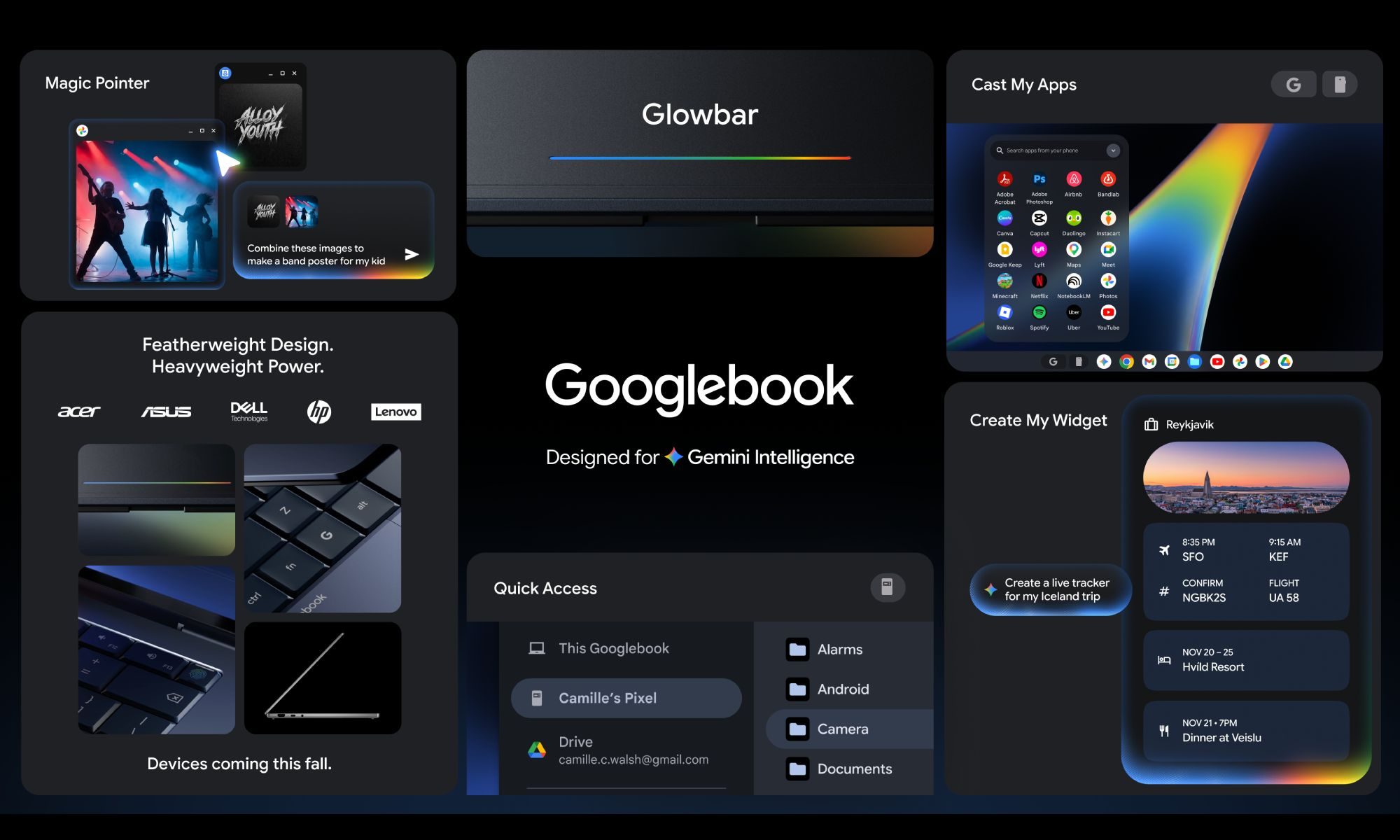
Fifteen years ago, Google bet big on the browser, shrinking the operating system down to ChromeOS and making laptops affordable for schools and offices. Today, the company is placing a far more expensive wager: an AI-driven laptop platform called Googlebook. Powered by Gemini Intelligence, this device promises seamless integration with Android phones, contextual AI suggestions, and on-device smart widgets. Yet, despite the ambitious pitch, serious doubts remain about whether the Googlebook AI laptop can truly become Google’s next big thing.

What Makes the Googlebook AI Laptop Different?

Unveiled at the Android Show in May 2026, Googlebook is built entirely around Gemini Intelligence. Move your cursor, and AI surfaces contextual suggestions. Type a sentence, and a widget appears around it. Access your Android phone’s apps and files without third-party software. The goal is a coherent, AI-first experience that rivals Apple’s ecosystem.

However, this vision relies heavily on deep Android integration. While compelling for Android users, Apple has already perfected cross-device handoffs with its unified ARM silicon. Googlebook, on the other hand, will ship with chips from Intel (x86), Qualcomm (ARM), and MediaTek (ARM). This multi-architecture approach introduces fragmentation risks that could undermine the promised AI experience.

The Multi-Chip Fragmentation Problem

Apple controls its silicon from design to deployment, ensuring seamless performance across iPhones and Macs. Google distributes that responsibility across multiple chip vendors and OEMs. Gemini Intelligence requires a flagship-grade chipset, at least 12GB of RAM, and support for AI Core and Gemini Nano v3. But not all chips are equal.

Intel’s Wildcat Lake chips deliver up to 40 TOPS of AI processing, while Qualcomm’s Snapdragon X Plus reaches 45 TOPS from its NPU alone. MediaTek’s budget ARM chips, however, lack equivalent NPU capabilities. This means on-device AI experiences could vary dramatically between models. As a result, the unified Googlebook experience Google showcased might be compromised on cheaper variants, forcing AI tasks to the cloud and introducing latency.

Pricing and Competitive Landscape

To succeed, Google must undercut established rivals. The MacBook Neo, priced at $599, already offers a seamless ecosystem with an A18 Pro chip and Apple Intelligence. The M5 MacBook Air starts at $1,099, while Microsoft Copilot+ PCs range from $800 to $1,000. Rumors suggest Googlebook could start around $1,000, placing it in direct competition with proven platforms.

For budget-conscious buyers, a price between $500 and $700 might be the sweet spot. But at $1,000, Google asks users to skip industry benchmarks for an unproven platform. Moreover, Windows on ARM has made progress, and Copilot+ PCs offer familiarity with a growing suite of AI features. Googlebook’s core advantage—Android app familiarity on a larger screen—may not be enough to sway buyers.

Key Competitors at a Glance

  • Apple MacBook Neo ($599): Sub-$600 disruption, unified A18 Pro silicon, and proven cross-device features.
  • Apple M5 MacBook Air ($1,099): Years of battery efficiency, mature ecosystem, and trusted longevity.
  • Microsoft Copilot+ PCs (~$1,000): Deep enterprise roots, established Windows ecosystem, and mature productivity.

Software Readiness and Buyer Confusion

Hours before the Android Show, a leaked build of Aluminium OS (Googlebook’s internal codename) surfaced online, showing a desktop environment comparable to Samsung DeX—but without the magical AI features. Google may argue that a pre-release build isn’t a fair depiction, but it also suggests the software isn’t ready yet.

Additionally, Google confirmed that new Chromebook and Chromebook Plus devices are still in development. Releasing premium Googlebook variants alongside mid-tier Chromebooks could confuse buyers about where ChromeOS ends and Android-on-desktop begins. This fragmentation in messaging could hurt adoption.

Will Googlebook Succeed or Stumble?

Googlebook is trying to be the MacBook for Android users, but the math has to work on multiple fronts. How well will Google educate buyers on the difference between a Googlebook and a Chromebook? Can it guarantee performance parity across different OEMs and chips? And most critically, will the pricing give buyers a reason to take the leap?

Right now, none of those questions have clean answers. While the vision is ambitious, the multi-chip fragmentation, competitive pricing pressure, and software readiness issues suggest that the Googlebook AI laptop may not be Google’s next big thing—at least not yet.

For more on Google’s evolving hardware strategy, check out our analysis of Chromebook vs Googlebook and the best AI laptops of 2026.

Continue Reading
Click to comment

Leave a Reply

Your email address will not be published. Required fields are marked *

Artificial Intelligence

AI is drowning Linux managers in a sea of duplicate bug reports

Published

on

AI is drowning Linux managers in a sea of duplicate bug reports

The promise of artificial intelligence in software development has hit a harsh reality check. As AI tools churn through code at machine speed, Linux maintainers are drowning under a flood of duplicate bug reports — many of them generated by similar tools finding identical flaws. AI bug reports Linux have become so numerous that they are now a significant drag on the kernel’s security process.

In the Linux 7.1-rc4 update, Linus Torvalds himself raised the alarm. He noted that the kernel’s security list has been swamped by AI-assisted submissions, with many being duplicates from people using comparable tools and uncovering the same issues. While the release itself looks routine — drivers make up about half the patch, with GPU fixes leading the way — the real story is the growing burden on human reviewers.

Why the inbox keeps overflowing

The problem isn’t that AI is finding bugs. It’s that AI is finding them faster than humans can sort them. Torvalds is drawing a clear line between useful AI-assisted work and submissions that arrive without verification, context, or patches. Those weak reports are turning bug sorting into extra work for the people maintaining Linux.

Linux isn’t telling developers to stop using AI. The project’s own guidance keeps responsibility on the contributor, which means AI-assisted work still has to follow the normal kernel process. But here’s the catch: a machine-generated finding doesn’t arrive ready for action. Reviewers still have to check whether it can be reproduced, whether someone already reported it, whether it was fixed earlier, and whether it belongs in a private security channel. One vague claim can start a chain of routing, follow-up, and cleanup.

As a result, the Linux kernel duplicate bugs problem is compounding. Maintainers spend hours cross-referencing similar reports, many of which stem from the same underlying vulnerability discovered by different AI tools. This inefficiency threatens to slow down the entire security patch pipeline.

Who pays when AI skips homework

The cost lands on maintainers first. Every weak submission still needs a human to read it, compare it with existing work, and decide where it belongs. That burden is starting to show up beyond Linux. In a separate open-source flare-up, Matplotlib maintainer Scott Shambaugh said an AI agent lashed out publicly after one of its code contributions was rejected, turning a routine project decision into reputational cleanup. Linux is dealing with a quieter version of the same pressure, with AI-generated work arriving faster than project volunteers can responsibly absorb it.

Torvalds’ warning lands harder than a normal release note because it describes a labor problem hiding inside an automation story. AI has lowered the cost of creating work for maintainers without lowering the cost of resolving it. This means that while AI can help identify potential flaws, it also generates noise that distracts from real issues.

For those managing open-source projects, the lesson is clear: AI-assisted bug reports need human oversight from the start. Without it, the volume of low-quality submissions can overwhelm even the most dedicated teams. Learn more about how to manage open-source contributions effectively in our guide to open-source governance.

What consumers should watch next

Consumers won’t feel this as an instant device-security crisis. The risk is slower, noisier patch work behind the scenes, especially because Linux helps power cloud services, routers, phones, smart TVs, and other connected hardware. The best AI-assisted findings can help real flaws get fixed faster. The bad ones can delay the path from discovery to patch by forcing kernel developers to clear duplicates and vague claims before useful work begins.

The next thing to watch is whether more open-source projects follow Linux’s lead and set firmer rules for AI-assisted contributions. AI can help secure software when humans bring proof, context, and patches with it. But as the flood of Linux security list overload shows, automation without accountability is a recipe for chaos.

In the end, the solution isn’t to ban AI — it’s to demand better. Maintainers need tools that filter duplicates, verify findings, and integrate with existing workflows. Until then, every AI-generated bug report is a test of human patience and project resilience. For more on how AI is reshaping software security, check out our analysis of AI in cybersecurity trends.

Continue Reading

Artificial Intelligence

Intel’s Project Firefly Aims to Make Budget Wildcat Lake Laptops a True Rival to MacBook Neo

Published

on

Intel’s Project Firefly Aims to Make Budget Wildcat Lake Laptops a True Rival to MacBook Neo

Intel is quietly rewriting the rulebook for affordable computing. With the launch of Project Firefly in China, the chipmaker is giving PC manufacturers a shared blueprint to build budget Windows laptops that no longer look or feel like compromise machines. The target? Apple’s MacBook Neo lineup, which has long dominated the premium-value segment.

At its core, Project Firefly is a supply-chain and design initiative. Intel is leveraging China’s mature phone supply chain to drive down costs while maintaining quality. The result, according to early reports from VideoCardz, is a wave of more than 70 laptop designs built around Intel’s new Wildcat Lake processors. Pricing starts at roughly $449, with some configurations hitting around $600. That puts them squarely in MacBook Neo territory, but with a Windows operating system.

How Project Firefly Redefines Budget Laptop Design

The heart of Project Firefly is a unified hardware playbook. Intel is pushing manufacturers to adopt a standardized 50-pin connector, shared components, and modular motherboard layouts. This approach reduces the number of unique parts and simplifies assembly, which cuts production costs and speeds up time to market.

But the benefits go beyond manufacturing. A tighter design philosophy means fewer internal cables, better thermal management, and a thinner chassis. Intel claims the reference motherboard is 5% smaller and uses 7% fewer components than previous generation designs. These incremental gains add up to a laptop that feels more premium—tighter build quality, cleaner lines, and easier repairability.

For buyers, this means fewer of the usual budget laptop compromises: flimsy hinges, noisy fans, or bulky frames. Instead, Project Firefly aims to deliver a consistent, polished experience across brands. As Intel refines its value laptop hardware strategy, the goal is to make affordable Windows machines feel like they belong in the same conversation as Apple’s offerings.

Can Intel Challenge Apple’s Vertical Integration?

Apple’s greatest strength in the laptop market is control. By designing its own chips, operating system, and hardware, Apple delivers a seamless user experience that competitors struggle to match. Project Firefly attacks this advantage head-on by creating a unified design ecosystem for Windows laptops.

Intel’s plan encourages upstream and downstream partners—from component suppliers to final assemblers—to collaborate on system-level design, component selection, and cost structure. This coordinated approach mirrors Apple’s vertical integration, but within an open ecosystem. PC makers can pick from a shared parts library, reuse designs across models, and focus on differentiating features like screen quality, battery life, or keyboard feel.

However, there is a technical ceiling. Wildcat Lake’s neural processing unit (NPU) tops out at 17 TOPS, well below the 40 TOPS Microsoft requires for Copilot+ PC certification. This means Intel’s budget laptops may not deliver the same AI capabilities as pricier alternatives. For buyers who prioritize AI features, Intel’s value story might feel incomplete, even if the hardware feels more polished.

What to Expect from Early Wildcat Lake Laptops

Intel has confirmed that the first wave of Project Firefly designs will roll out through 2026. Early benchmarks suggest battery life up to 18.5 hours for video playback, which is competitive with the MacBook Neo. But real-world performance will depend on each manufacturer’s choices for screen, battery capacity, memory, storage, and cooling.

For now, the promise is compelling. A $449 laptop that looks and feels like a $700 machine, with a standardized design that makes repairs easier and software updates more consistent. Intel’s budget Windows laptops have long been dismissed as bargain-bin options. Project Firefly could change that perception.

Still, buyers should watch for the final product. Reference designs are one thing; retail execution is another. If manufacturers follow Intel’s blueprint closely, the market could see a new class of affordable laptops that genuinely rival Apple’s MacBook Neo. If they cut corners, the initiative may fade into another footnote in Intel’s long history of platform plays.

In the meantime, the race is on. Intel is betting that a unified approach to Project Firefly will give Windows laptops the consistency and polish they need to compete. Whether that bet pays off depends on how well PC makers embrace the shared vision—and how quickly they can bring these designs to store shelves.

Continue Reading

Artificial Intelligence

Google I/O 2026: What to Expect from Gemini, Android 17, and the AI Revolution

Published

on

Google I/O 2026: What to Expect from Gemini, Android 17, and the AI Revolution

Google is gearing up for its annual developer conference, Google I/O 2026, and this year’s event promises to be a defining moment for the company. Scheduled to kick off on May 19 at the Shoreline Amphitheatre in Mountain View, California, the conference will feature a keynote led by CEO Sundar Pichai. As always, the event will be livestreamed globally via Google’s official I/O website and YouTube channels.

While past editions have catered primarily to developers, Google I/O 2026 is expected to deliver announcements that directly impact everyday users. From Android phones to Search, Chrome, Workspace, and smart devices, the spotlight will be on artificial intelligence and its growing role across Google’s ecosystem.

Gemini AI Takes Center Stage

The biggest theme at Google I/O 2026 is undoubtedly Gemini AI. Over the past year, Google has steadily integrated Gemini into products like Gmail, Search, Android, and Workspace. However, this year’s event may reveal just how deeply the company plans to embed AI into its entire suite of services.

One of the most anticipated updates is the next evolution of Gemini Intelligence within Android 17. According to reports, Android is shifting from a traditional operating system to a context-aware AI platform. This new system could automate tasks, generate widgets, handle voice interactions, and proactively assist users across multiple apps.

In addition, Google is rumored to unveil “Gemini Omni,” an advanced AI model focused on video generation and editing. If confirmed, this would position Google as a direct competitor to OpenAI’s Sora and Adobe’s generative AI tools.

Beyond smartphones, AI may also reshape Google’s laptop ambitions. Multiple reports suggest that Google could formally introduce “Googlebook,” an AI-first laptop platform designed to eventually replace Chromebooks. These devices are expected to blend elements of Android and ChromeOS while integrating Gemini AI deeply into the user experience.

Android 17 and XR: New Frontiers

Android 17 is poised to receive a host of upgrades focusing on personalization, multitasking, and AI-powered features. Leaks and previews hint at redesigned widgets, enhanced voice input, new digital wellbeing tools, and updates to Android Auto. This release could mark a significant leap forward for the world’s most popular mobile operating system.

Google may also showcase progress on Android XR, its augmented and mixed reality platform. With Meta, Apple, and Samsung all investing heavily in smart glasses and wearable AI devices, Google’s strategy in this space is under intense scrutiny. The company previously teased Android XR hardware, and Google I/O 2026 could provide a clearer picture of its long-term vision.

Why This Year’s Event Matters

Google I/O 2026 arrives at a critical juncture for the tech giant. The AI race has accelerated dramatically over the past two years, with OpenAI, Microsoft, Apple, and Meta all vying to shape how consumers interact with AI systems.

For Google, this event is about more than just announcing new software features. It is an opportunity to demonstrate that Gemini can serve as the foundation of Google’s future products, rather than simply an optional assistant layered onto existing services.

At the same time, the company faces growing scrutiny over AI-generated search summaries, misinformation risks, and the broader impact AI may have on publishers and the web ecosystem. Addressing these concerns will be crucial for maintaining user trust.

What’s Next for Google

Google I/O 2026 begins on May 19, with announcements expected across Android, Gemini AI, XR devices, Search, Workspace, and possibly new hardware categories. If leaks and reports are accurate, this year’s conference could mark Google’s biggest shift yet toward an AI-first ecosystem.

To stay updated on the latest developments, check out our live blog for real-time coverage. For more on Android’s evolution, read our Android 17 preview. And if you’re curious about Google’s AI strategy, explore our deep dive into Gemini.

Continue Reading

Trending