Connect with us

Infosecurity

Poorly Designed IoT Devices Pose a Real Threat to Enterprise Security: What IT Pros Must Do Now

Published

on

Poorly Designed IoT Devices Pose a Real Threat to Enterprise Security: What IT Pros Must Do Now

The Internet of Things (IoT) has long been a source of excitement, from smart fridges to connected thermostats. But beneath the buzz lies a serious concern: poorly conceived and executed IoT device security is creating a growing threat to enterprise networks. As vendors rush products to market, security often becomes an afterthought, leaving organizations vulnerable to attacks that can originate from the most unexpected devices.

At a recent industry event, security researchers demonstrated how easily a Bluetooth-enabled personal massager could be hacked. The hack itself drew laughs—until the researchers explained that the same technique could be used to infiltrate the manufacturer’s backend systems. Suddenly, the amusement vanished. This is not an isolated case. From smart toys to connected cars, every IoT device is a potential entry point for cybercriminals.

So, what can IT professionals do? The answer lies in a two-pronged approach: a solid IoT security strategy and tactical tools that can be deployed immediately.

Building a Strategic Foundation for IoT Security

Strategy is the bedrock of any effective security program. Without it, even the best tools are useless. As the old saying goes, failing to prepare is preparing to fail. If your organization might ever adopt IoT technology, start planning now—long before the first device connects to your network.

Creating a comprehensive policy is time-consuming and involves navigating office politics, securing management buy-in, and answering countless questions from across the organization. However, the effort is worth it. A well-crafted strategy often determines whether you remain secure or suffer a breach.

What Should Your IoT Policy Include?

Your corporate policy for IoT devices must define a clear framework that goes beyond smartphones and laptops. It should cover all network-connected devices, from sensors to smart appliances. Key requirements for vendors should include:

  • Certifying the security of their device before deployment
  • Publishing changes in advance for each new OS version
  • Informing customers about hardware component changes in future production runs

Additionally, your organization must allocate budget and staff for ongoing testing of vendor updates, including regular security reviews. This might seem overly cautious, and it could lead to higher ownership costs or friction with management. But skipping this level of strategic thinking invites serious trouble. In IT security, it’s always better to be safe than sorry.

Tactical Steps to Secure IoT Devices Right Now

While strategy addresses the long term, tactical actions can be taken immediately to manage devices already on your network. Here are three tools every IT pro should use to strengthen enterprise IoT security.

1. Use a NetFlow Analyzer

NetFlow analyzers are commonly used to monitor bandwidth usage, but they can do much more. By tracking data transfers between two endpoints using the same port and protocol, you can identify IoT behavior and monitor which external sites your devices are connecting to. This tool is likely already in your arsenal—put it to work for IoT device management.

2. Deploy an IP Address Management (IPAM) Tool

IPAM tools identify and manage IP addresses across your network. This is especially useful for IoT devices, which consume a large number of IPs and often share MAC addresses grouped under a single vendor. An IPAM tool can automatically locate and report on IoT devices as part of its routine tasks, giving you visibility into your connected device security posture.

3. Implement Deep Packet Inspection (DPI)

DPI sits in the middle of IoT traffic, capturing and analyzing packets to identify source and destination IPs, ports, and protocols. This helps categorize traffic as malicious, business-related, or something else entirely. For keeping tabs on IoT traffic, DPI is an extremely useful tool.

What Now? The Future of IoT Security

The proliferation of IoT devices was always going to impact organizational security. From cars to children’s toys, every connected object is a potential Trojan horse for hackers. The key is to treat IoT vulnerability as a serious risk, not a punchline.

Before you roll your eyes at yet another mention of smart fridges, consider the consequences of failing to prepare. With a solid strategy and the right tactical tools, IT pros can avoid being swept away by this wave of innovation. Instead, they can harness its opportunities—safely and securely.

For more insights, check out our guide on network security best practices and learn about IoT risk assessment frameworks.

Continue Reading
Click to comment

Leave a Reply

Your email address will not be published. Required fields are marked *

Infosecurity

Squatted Open VSX Extensions Slip Past the Registry and Drain CI Data

Published

on

fake Open VSX extensions

Malicious Packages Hit the Open VSX Registry

Counterfeit extensions that copied the names of legitimate developer tools were discovered on the Open VSX registry. Roughly a quarter of them were quietly harvesting the git and continuous integration identity of anyone who ran them.

Security firm Manifold Security published its findings on August 4. The team flagged 77 packages that appeared between July 26 and August 1. Each one republished the name and namespace of a real extension from an account that had zero ownership rights to it.

Every single package beaconed to one domain. That domain was registered just 11 days before the first malicious package surfaced.

What the Payload Actually Collected

Most of the packages were light on data. They sent little more than a hostname. But the squatted namespaces tell a story of their own. The list included AMD, LEGO Education, Hyperledger, Azure, Artsy, Salesforce OSS, a US federal agency, and marketplace.visualstudio — a name that impersonated the marketplace itself.

The other 19 packages carried a much heavier payload. Seconds after activation, they sent the hostname, the operating system username, editor details, and the machine ID. Then things got more serious.

The malicious code read the repository currently open in the editor. It pulled the git remote host and organization, the commit email domain, the branch, and the HEAD commit. It also grabbed continuous integration values, including the GitHub repository name, GitLab project path, and Codespace name.

“On a build runner or a cloud development environment, that is the full private repository name, not just the organization,” Manifold explained.

The Disclosure Was the Disguise

Here’s the twist. The listings actually disclosed what they were doing.

Each one carried a “Telemetry” section that enumerated most of those fields accurately. The disclosure also included assurances that no source code, credentials, or tokens were taken. Manifold checked those claims against the code and found they held up.

Almost all of them, anyway.

One listing stated that continuous integration data covered marker names only and never values. The code, however, sent both. The single most sensitive field in the payload was the one the disclosure explicitly said was not being sent.

These extensions had no other real function. A status bar item rendered a checkmark. One command displayed a message box. Then the beacon fired.

Built to Outlive the Takedown

The collector domain was registered through a registrar that redacts registrant details. The registration term was three years. The code treated any HTTP response as success — including an error — and retried across seven days, resuming on every editor restart.

If every endpoint failed, the beacon queried a DNS TXT record for a replacement collector address. That let the operator relocate infrastructure without shipping new packages.

The payload also reported whether the workspace’s own devcontainer or extensions configuration had pulled the extension in. That distinction matters: it separates installs a repository caused from installs a human chose.

Manifold argued this is critical because name resolution is increasingly automated. Agents and provisioning scripts install by name across two registries whose separate ownership rules make a squatted name indistinguishable from the real one.

How to Protect Yourself

Open VSX removed the packages on August 3, though the infrastructure remained live at the time of writing. If you’re worried about similar attacks, Manifold offered some practical advice:

  • Pin by publisher and version where registries are mirrored internally
  • Treat the unverified-publisher banner as a blocking condition in automated installs
  • Alert on editor processes contacting recently registered domains shortly after startup

This isn’t the first time extension name abuse has caused problems. Earlier research highlighted how malicious VS Code extensions exploit a name reuse loophole. The pattern keeps repeating because the registries haven’t closed the gap.

The takeaway is simple. If you’re running automated installs across a team, don’t trust names alone. Verify the publisher. Check the version. And treat any telemetry disclosure in a random extension as a red flag, not a comfort.

Continue Reading

Infosecurity

Canadian man pleads guilty to Snowflake hacks that led to 165 breaches

Published

on

Snowflake hacks

Canadian man pleads guilty to Snowflake hacks that led to 165 breaches

A Canadian national is facing decades in prison for his role in the hacking of data storage platform Snowflake. Connor Riley Moucka, 26, pleaded guilty to computer fraud, wire fraud, aggravated identity theft and a related conspiracy on Wednesday in a Washington state federal court. He will be sentenced on October 27 and faces up to 32 years behind bars.

Moucka and his co-conspirators used stolen login credentials to breach Snowflake and steal troves of information from at least 165 companies. The hackers walked away with billions of files from major corporations, including AT&T, Ticketmaster, Advance Auto Parts, one of the largest school districts in the U.S., Neiman Marcus, Santander, LendingTree and more.

The AT&T breach exposed logs of calls and texts belonging to more than 100 million customers. The Ticketmaster breach affected roughly 560 million users. Those numbers alone show the scale of what Moucka and his crew pulled off.

How the Snowflake hacks unfolded

Moucka, from Kitchener, Ontario, was arrested in November 2024 and extradited to the U.S. in July 2025. Prosecutors said the breaches happened between February and October 2024. During that window, the hackers stole banking records, financial information, Drug Enforcement Administration (DEA) registration numbers, driver’s license numbers, passport numbers, Social Security numbers and more.

The stolen data wasn’t just for show. The hackers tried to extort victim companies by threatening to publish the information online. The crew collected about $2.5 million in ransom payments. Court documents show Moucka even extorted at least one victim a second time.

“Moucka used the stolen data of a government officer and members of a then-former government officer’s immediate family in this re-extortion attempt,” prosecutors said.

That’s a chilling detail. It shows Moucka wasn’t just casting a wide net — he was targeting specific people with sensitive information.

Profit from stolen data

Beyond the ransom payments, Moucka earned another $495,000 by advertising some of the stolen data on cybercriminal forums like BreachForums and XSS.is. Court documents said victim companies suffered about $9.5 million in losses related to the breaches.

FBI Special Agent in Charge W. Mike Herrington didn’t hold back in his assessment of Moucka’s actions.

“Connor Moucka’s threats and re-extortion tactics were calculated and predatory, and his actions did real harm to his victims, be they companies targeted for theft and extortion or the millions of everyday people who are their customers,” Herrington said.

Snowflake’s response and the Mandiant investigation

After the breaches came to light, Snowflake hired Google’s Mandiant unit to investigate. Mandiant confirmed that Snowflake’s platform itself wasn’t compromised. The hackers, according to Mandiant, stole still-valid credentials dating back to 2020 and used those login details to access company accounts.

That’s a key point for anyone worried about cloud security. The breach wasn’t a flaw in Snowflake’s infrastructure — it was a credential problem. The hackers got their hands on old passwords that were still active, and that was enough.

The Turkey connection

Mandiant said at the time that the hackers behind the campaign are “based in North America, and collaborates with an additional member in Turkey.” At least one of the alleged Turkey-based hackers, John Erin Binns, was detained by Turkish authorities in 2024 after being indicted for his role in a previous hack of telecom T-Mobile.

Before his arrest, Moucka allegedly spoke to news outlet 404Media, telling them he expected to be arrested and had been destroying evidence in advance of his detainment. That detail paints a picture of someone who knew the net was closing in.

What this means for cybersecurity

The Snowflake hacks are a reminder that credential theft remains one of the most effective attack vectors. Companies can have the best security infrastructure in the world, but if old passwords are still floating around, they’re a liability.

For businesses, the takeaway is clear: regularly rotate credentials, enforce multi-factor authentication, and audit who has access to what. For individuals, the lesson is equally simple — if you’re reusing passwords across accounts, stop. The fallout from these breaches affects real people, not just corporations.

Moucka’s guilty plea is a significant step in holding cybercriminals accountable. But with 165 breaches and millions of victims, the damage is already done. Sentencing in October will determine how long he pays for it.

Continue Reading

Infosecurity

Ransomware Attacks Surge 19% in July After a Quieter Spring

Published

on

ransomware attacks surge

Ransomware Attacks Surge After a Spring Slowdown

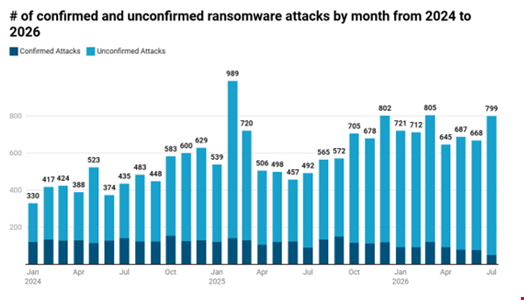
Ransomware activity snapped back with a vengeance in July. New data from Comparitech shows a 19% jump in claimed attacks compared to June, making last month the second-busiest of 2026 so far.

The numbers are stark. Researchers tracked 799 claimed ransomware attacks in July — the third-highest monthly total in the past 17 months. That spike follows an unusually quiet stretch from April through June, when activity dipped noticeably.

Finance took the hardest hit, with attacks soaring 71% month-over-month. Technology wasn’t far behind at 62%, while healthcare (46%) and education (44%) also saw sharp increases. US-based organizations felt the pressure too, with attacks up 31% from June.

Major Incidents Show the Damage Ransomware Can Do

Two confirmed attacks stood out for their real-world consequences. US healthcare provider AnMad was forced to close facilities after a breach. In Romania, the government’s land registry agency suffered an attack that wiped an entire database, throwing the country’s real estate market into chaos.

Rebecca Moody, head of data research at Comparitech, put it bluntly: “These attacks highlight how ransomware groups hit organizations in various different ways – taking down key systems, stealing troves of data, and even deleting massive datasets.”

Her advice? Regular backups — and backups of those backups. “Never has it been more important for organisations to ensure they’re carrying out regular backups… so they can reset systems and restore data as quickly as possible if the worst does happen,” she said.

The Gentlemen and Qilin Continue Their Battle for Supremacy

Two ransomware strains continue to dominate the threat landscape. The Gentlemen and Qilin together accounted for 33% of all attacks in July — 135 and 125 claims, respectively.

That’s a continuation of a power struggle that’s been brewing for months. ReliaQuest analysis from earlier this year found The Gentlemen had overtaken Qilin as the most prolific threat actor between March and May 2026.

The gap between these two and everyone else is significant. DragonForce came in third with 41 attacks, followed by INC (36), CRPx0 (33), and SafePay (30).

What This Means for Security Teams

The July numbers are a reminder that ransomware isn’t going anywhere. The lull in spring was temporary — these groups adapt, regroup, and strike when defenses drop.

For organizations in finance, healthcare, and tech, the message is clear: ransomware protection strategies need constant updating. That means patching vulnerabilities, segmenting networks, and testing recovery plans before an incident, not after.

It also means paying attention to who’s actually attacking. The dominance of The Gentlemen and Qilin suggests a consolidation in the ransomware ecosystem — fewer, bigger players with more resources and better tactics.

How to Prepare for the Next Wave

Comparitech’s data points to a few practical steps every organization should take:

  • Maintain offline backups and test restoration procedures regularly
  • Monitor threat intelligence feeds for emerging ransomware groups
  • Implement strict access controls and multi-factor authentication
  • Develop and rehearse an incident response plan specific to ransomware
  • Consider cyber insurance that covers extortion payments and business interruption

The July surge is a warning shot. The spring lull lulled some into complacency — but the attackers never stopped. They were just waiting.

Continue Reading

Trending